


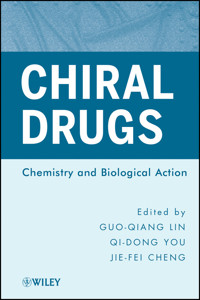
Chiral Drugs E-Book
150,99 €
Mehr erfahren.
- Herausgeber: John Wiley & Sons
- Kategorie: Wissenschaft und neue Technologien
- Sprache: Englisch
An integrated view of chiral drugsfrom concept and synthesisto pharmaceutical properties
Chirality greatly influences a drug's biological and pharmacological properties. In an effort to achieve more predictable results from chiral drugs, the Food and Drug Administration now requires that these medicines be as pure as possible, which places great demands on drug synthesis, purification, analysis, and testing. To assist researchers in acquiring the essential knowledge to meet these rigid guidelines, Chiral Drugs focuses on three vital chiral technologiesasymmetric synthesis, biocatalytic process, and chiral resolutionto offer details on the basic concepts, key developments, and recent trends in chiral drug discovery, along with:
-
The history of chiral drugs development and industrial applications of chiral technologies
-
A section listing twenty-five approved or advanced-trial chiral drugs that lists each drug name, chemical name and properties, a representative synthetic pathway, pharmacological characterizations, and references
-
An interdisciplinary approach combining synthetic organic chemistry, medicinal chemistry, and pharmacology
Nearly two-thirds of the drugs on today's market are chiral drugs. Reducing and eliminating their negative characteristics is an ongoing and serious challenge for the pharmaceutical industry. With its well-balanced approach to covering each important aspect of chirality, Chiral Drugs champions important strategies for tipping the medical scale in a positive direction for the production of more effectiveand saferdrugs.
Sie lesen das E-Book in den Legimi-Apps auf:
Seitenzahl: 681
Veröffentlichungsjahr: 2011
Ähnliche




















Table of Contents
Title Page
Copyright
About the Editors
Contributors
Introduction
Chapter 1: Overview of Chirality and Chiral Drugs
1.1 Introduction
1.2 Overview of Chirality
1.3 General Strategies for Synthesis of Chiral Drugs
1.4 Trends in the Development of Chiral Drugs
References
Chapter 2: Chiral Drugs Through Asymmetric Synthesis
2.1 Catalytic Asymmetric Synthesis and its Application
2.2 Asymmetric Hydrogenation Reaction and Reduction Reaction
2.3 Asymmetric Oxidation Reaction
2.4 Asymmetric C–C Bond Formation
2.5 Asymmetric Reactions Via Organocatalysis
References
Chapter 3: Chiral Drugs Via Biocatalytical Approaches
3.1 Introduction
3.2 Chiral Drugs Via Biocatalytical Approaches
3.3 Biosynthesis
References
Chapter 4: Resolution of Chiral Drugs
4.1 The Characteristics of Racemates
4.2 Chemical Resolution by Crystallization
4.3 Composite Resolution and Inclusion Resolution
4.4 Kinetic Resolution
4.5 Dynamic Resolution
References
Chapter 5: Fluorine-Containing Chiral Drugs
5.1 Introduction
5.2 Effects of Fluorine Atom (Or Fluorine-Containing Groups)
5.3 Chiral Fluorine-Containing Drugs
5.4 Synthetic Methods of Organofluorine Compounds: Asymmetric Electrophilic Fluorination
References
Chapter 6: Industrial Application of Chiral Technologies
6.1 Introduction
6.2 Chiral Resolution
6.3 Chiral Pool Synthesis
6.4 Asymmetric Desymmetrization
6.5 Stereoselective Isomerization
6.6 Asymmetric Reduction
6.7 Asymmetric Oxidation
6.8 Cited By Url
6.9 Patents
References
Chapter 7: Structural Basis and Computational Modeling of Chiral Drugs
7.1 Introduction
7.2 Structural Basis of Chiral Drugs
7.3 Molecular Modeling in Chiral Drug Design
7.4 Perspectives
References
Chapter 8: Pharmacology of Chiral Drugs
8.1 Introduction
8.2 Basic Principles of Pharmacodynamics
8.3 Effect of Chiral Property on Drugs
8.4 Summary
References
Chapter 9: Pharmacokinetics of Chiral Drugs
9.1 Basic Concepts in Pharmacokinetics
9.2 Stereoselectivity in ADME Properties of Chiral Drugs
9.3 Stereoselective Drug-Drug Interactions of Chiral Drugs
9.4 Concluding Remarks
References
Chapter 10: Toxicology of Chiral Drugs
10.1 Stereochemistry and Stereopharmacology
10.2 Toxicology of Chiral Drugs
10.3 Toxicity of Distomers
10.4 Toxicity of Eutomers and Racemates
10.5 Significance of Chiral Inversion
10.6 Discussion
References
Chapter 11: Representative Chiral Drugs
11.1 Introduction
11.2 Representative Chiral Drugs
11.2.5 Rivastigmine Tartrate
11.2.21 Ezetimibe
References
Index
Copyright © 2010 by John Wiley & Sons, Inc. All rights reserved.
Published by John Wiley & Sons, Inc., Hoboken, New Jersey.
Published simultaneously in Canada.
No part of this publication may be reproduced, stored in a retrieval system, or transmitted in any form or by any means, electronic, mechanical, photocopying, recording, scanning, or otherwise, except as permitted under Section 107 or 108 of the 1976 United States Copyright Act, without either the prior written permission of the Publisher, or authorization through payment of the appropriate per-copy fee to the Copyright Clearance Center, Inc., 222 Rosewood Drive, Danvers, MA 01923, (978) 750-8400, fax (978) 750-4744. Requests to the Publisher for permission should be addressed to the Permissions Department, John Wiley & Sons, Inc., 111 River Street, Hoboken, NJ 07030, (201) 748-6011, fax (201) 748-6008, or online at http://www.wiley.com/go/permission.
Limit of Liability/Disclaimer of Warranty: While the publisher and author have used their best efforts in preparing this book, they make no representations or warranties with respect to the accuracy or completeness of the contents of this book and specifically disclaim any implied warranties of merchantability or fitness for a particular purpose. No warranty may be created or extended by sales representatives or written sales materials. The advice and strategies contained herein may not be suitable for your situation. You should consult with a professional where appropriate. Neither the publisher nor author shall be liable for any loss of profit or any other commercial damages, including but not limited to special, incidental, consequential, or other damages.
For general information on our other products and services or for technical support, please contact our Customer Care Department within the United States at (800) 762-2974, outside the United States at (317) 572-3993 or fax (317) 572-4002.
Wiley also publishes its books in a variety of electronic formats. Some content that appears in print may not be available in electronic formats. For more information about Wiley products, visit our web site at www.wiley.com.
Library of Congress Cataloging-in-Publication Data:
Chiral drugs : chemistry and biological action / edited by Guo-Qiang Lin, Qi-Dong You, Jie-Fei Cheng.
p. ; cm.
Includes bibliographical references and index.
ISBN 978-0-470-58720-1 (hardback)
1. Chiral drugs. 2. Drug development. 3. Structure-activity relationships (Biochemistry).
I. Lin, Guo-Qiang, 1943- II. You, Qi-Dong. III. Cheng, Jie-Fei.
[DNLM: 1. Drug Discovery-methods. 2. Pharmaceutical Preparations-chemistry.
3. Structure-Activity Relationship. QV 744]
RS429.C483 2011
615.19–dc22
2011002203
About the Editors
Professor Guo-Qiang Lin received his BS degree in chemistry from Shanghai University of Science and Technology in 1964. After completion of his graduate study at the Shanghai Institute of Organic Chemistry in 1968, he remained in the same institute and worked on natural products chemistry. He was promoted to full professorship in 1991. In 2001, he was elected as an Academician of the Chinese Academy of Sciences. His research interests include the synthesis of natural products and biologically active compounds, asymmetric catalysis, and biotransformation. He is an Executive Board Member of Editors for Tetrahedron Publications, Vice Editor-In-Chief of Acta Chimica Sinica, and Scientia Sinica Chimica. He has served as Director of the Division of Chemical Science, National Natural Science Foundation of China since 2006.
Dr. Qi-Dong You is the Dean and a Professor of the School of Pharmacy, at China Pharmaceutical University. He received his BS degree in pharmacy from the China Pharmaceutical University and completed his PhD degree in medicinal chemistry at the Shanghai Institute of Pharmaceutical Industry in 1989. He then returned to CPU as a lecturer and associate director of the Department of Medicinal Chemistry. He spent one year and a half as a senior visiting scholar in the Department of Pharmaceutical Sciences, University of Strathclyde, Glasgow, UK, before he was promoted to a full professorship in 1995. He is a council member of the China Pharmaceutical Association (CPA) and the Vice-Director of the Division of Medicinal Chemistry of CPA. His research interests include the design, synthesis, and biological evaluation of new therapeutic agents for cancer and cardiovascular and infectious diseases. He is an Associate Editor of Progress in Pharmaceutical Sciences and serves on the Editorial Board of the International Journal of Medicinal Chemistry and Acta Pharmaceutica Sinica.
Dr. Jie-Fei (Jay) Cheng was born in 1964 in Jiangxi, China. He obtained his BS degree in chemistry from the Jiangxi Normal University in 1983 and continued his graduate studies at the Shanghai Institute of Organic Chemistry, Chinese Academy of Sciences, under the guidance of Professors Wei-Shan Zhou and Guo-Qiang Lin. After receiving his Master's degree in chemistry in 1986, he joined the research group of Professor Yoshimasa Hirata and Dr. Junichi Kobayashi (now a Professor at Hokkaido University) at the Mistubishi-Kasei Institute of Life Sciences, Tokyo, Japan. He then moved to Keio University to pursue his Ph.D in Professor Shosuke Yamamura's lab. Since 1993, he has been working at various pharmaceutical companies/biotechs in the United States, focusing on small-molecule drug discovery. He is currently the Director of Otsuka Shanghai Research Institute, a fully owned subsidiary of Otsuka Pharmaceutical Co. Ltd, Japan and an adjunct professor at Fudan Univeristy, China.
Contributors
CARL BEHRENS, Wilmington PharmaTech Company LLC, Newark, DE, USA, and University of Delaware, Newark, DE, USA
HAI-ZHI BU, 3D BioOptima Co. Ltd, Suzhou, Jiangsu, China
JIE-FEI (JAY) CHENG (EDITOR), Otsuka Maryland Medicinal Laboratories, Inc., Rockville, MD, USA, and, Otsuka Shanghai Research Institute, Shanghai, China
HANQING DONG, OSI Pharmaceuticals, A Wholly Owned Subsidiary of Astellas US, Farmingdale, NY, USA
XIAO-HUI GU, Otsuka Maryland Medicinal Laboratories, Inc., Rockville, MD, USA
XIAOCHUAN GUO, Drumetix Laboratories, LLC, Greensboro, NC, USA
ERIC HU, Gilead Sciences Inc., Foster City, CA, USA
HUI-YIN (HARRY) LI, Wilmington PharmaTech Company LLC, Newark, DE, USA, and University of Delaware, Newark, DE, USA
ZENGBIAO LI, Drumetix Laboratories, LLC, Greensboro, NC, USA
GUO-QIANG LIN (EDITOR), Key Laboratory of Synthetic Chemistry of Natural Substances, Shanghai Institute of Organic Chemistry, Chinese Academy of Sciences, Shanghai, China
DINGGUO LIU, Pfizer, San Diego, CA, USA
YONGGE LIU, Otsuka Maryland Medicinal Laboratories, Inc., Rockville, MD, USA
RUI LIU, Wilmington PharmaTech Company LLC, Newark, DE, and University of Delaware, Newark, DE, USA
WENYA LU, Department of Chemistry, Iowa State University, Ames, Iowa, USA
CHAO-YING NI, Wilmington PharmaTech Company LLC, Newark, DE, USA, and University of Delaware, Newark, DE, USA
FENG-LING QING, Key Laboratory of Organofluorine Chemistry, Shanghai Institute of Organic Chemistry, Chinese Academy of Sciences, Shanghai, China, and College of Chemistry and Chemistry Engineering, Donghua University, Shanghai, China
XIAO-LONG QIU, Key Laboratory of Organofluorine Chemistry, Shanghai Institute of Organic Chemistry, Chinese Academy of Sciences, Shanghai, China
JIANGQIN SUN, Otsuka Shanghai Research Institute, Shanghai, China
XING-WEN SUN, Department of Chemistry, Fudan University, Shanghai, China
DEPING WANG, Biogen IDEC Inc., Cambridge, MA, USA
JIANQIANG WANG, ArQule Inc., Woburn, MA, USA
ZHIMIN WANG, Sundia MedTech Company Ltd., Shanghai, China
GUANG YANG, GLAXOSMITHKLINE, R&D China, Shanghai, China
QI-DONG YOU (EDITOR), China Pharmaceutical University, Nanjing, Jiangsu, China
XUYI YUE, Key Laboratory of Organofluorine Chemistry, Shanghai Institute of Organic Chemistry, Chinese Academy of Sciences, Shanghai, China
JIAN-GE ZHANG, School of Pharmaceutical Science, Zhengzhou University, Zhengzhou, Henan, China
Introduction
The book consists of 11 chapters. The first part of the book introduces the general concept of chirality and its impact on drug discovery and development. The history and the trends of chiral drug development, the technologies for the preparation of chiral drugs, and the industrial applications of chiral technologies are discussed. This part covers three important chiral technologies, namely, asymmetric synthesis, biocatalytic process, and chiral resolution, and discusses their impact on chiral drug development. Without question, fluorine atoms play an important role in chiral drug discovery and development. The significance and the preparation of fluorine-containing chiral drugs are the topic of a separate chapter.
The second part of the book mainly deals with some unique aspects of chiral drugs in terms of pharmaceutical, pharmacological, and toxicological properties. For instance, pharmacology, pharmacokinetic properties, and toxicology of chiral drugs are discussed in comparison with racemic drugs. Additionally, computational modeling as applied to chiral drug discovery and development is discussed. This part of the book provides a general knowledge of design, synthesis, screening, and pharmacology from the preclinical point of view, hoping to raise interest from a broad range of readers.
Finally, Chapter 11 covers 25 representative chiral drugs that have been approved or are in advanced clinical trials. Some natural products are not included. The most important criteria for their selection are the involvement of chiral processes during their preparation and the significance of chirality in their development. Every entry contains the trade name, chemical name and properties, a representative synthetic pathway, pharmacological characterizations, and references.
This book is intended to introduce chemists to pharmacological aspects of drug development and to form a fruitful cooperation among academic synthetic chemists, medicinal chemists, pharmaceutical scientists, and pharmacologists from the pharmaceutical and biotechnology industries. The references after each chapter will give readers an opportunity for further reading on the topics discussed. This is the first book of its kind to combine synthetic organic chemistry, medicinal chemistry, process chemistry, and pharmacology in the context of chiral drug discovery and development.
Chapter 1
Overview of Chirality and Chiral Drugs
Guo-Qiang Lin
Key Laboratory of Synthetic Chemistry of Natural Substances, Shanghai Institute of Organic Chemistry, Chinese Academy of Sciences, Shanghai, China
Jian-Ge Zhang
School of Pharmaceutical Science, Zhengzhou University, Zhengzhou,China
Jie-Fei Cheng
Otsuka Shanghai Research Institute, Pudong New District, Shanghai, China
1.1 Introduction
The pharmacological activity of a drug depends mainly on its interaction with biological matrices or drug targets such as proteins, nucleic acids, and biomembranes (e.g., phospholipids and glycolipids). These biological matrices display complex three-dimensional structures that are capable of recognizing specifically a drug molecule in only one of the many possible arrangements in the three-dimensional space, thus determining the binding mode and the affinity of a drug molecule. As the drug target is made of small fragments with chirality, it is understandable that a chiral drug molecule may display biological and pharmacological activities different from its enantiomer or its racemate counterpart when interacting with a drug target. In vivo pharmacokinetic processes (ADME) may also contribute to the observed difference in in vivo pharmacological activities or toxicology profiles. One of the earliest observations on the taste differences associated with two enantiomers of asparagines was made in 1886 by Piutti (1). Colorless crystalline asparagine is the amide form of aspartic or aminosuccinic acid and is found in the cell sap of plants in two isomeric forms, levo- and dextro-asparagin. The l-form exists in asparagus, beet-root, wheat, and many seeds and is tasteless, while the d-form is sweet. Thalidomide is another classical example. It was first synthesized as a racemate in 1953 and was widely prescribed for morning sickness from 1957 to 1962 in the European countries and Canada. This led to an estimated over 10,000 babies born with defects (2). It was argued that if one of the enantiomers had been used instead of the racemate, the birth defects could have been avoided as the S isomer caused teratogenesis and induced fatal malformations or deaths in rodents while the R isomer exhibited the desired analgetic properties without side effects (3). Subsequent tests with rabbits proved that both enantiomers have desirable and undesirable activities and the chiral center is easily racemized in vivo (4). Recent identification of thalidomide's target solved the long-standing controversies (5). The chirality story about thalidomide, although not true, has indeed had great impact on modern chiral drug discovery and development (Fig. 1.1).
Figure 1.1 Asparagine (1) and thalidomide (2).
1.2 Overview of Chirality
1.2.1 Superimposability
Chirality is a fundamental property of three-dimensional objects. The word “chiral” is derived from the Greek word cheir, meaning hand, or “handedness” in a general sense. The left and right hands are mirror images of each other no matter how the two are arranged. A chiral molecule is the one that is not superimposable with its mirror image. Accordingly, an achiral compound has a superimposable mirror image. Two possible mirror image forms are called enantiomers and are exemplified by the right-handed and left-handed forms of lactic acids in Figure 1.2. Formally, a chiral molecule possesses either an asymmetric center (usually carbon) referred to as a chiral center or an asymmetric plane (planar chirality).
Figure 1.2 Mirror images of lactic acid.
In an achiral environment, enantiomers of a chiral compound exhibit identical physical and chemical properties, but they rotate the plane of polarized light in opposite directions and react at different rates with a chiral compound or with an achiral compound in a chiral environment. A chiral drug is a chiral molecule with defined pharmaceutical/pharmacological activities and utilities. The description “chiral drug” does not indicate specifically whether a drug is racemic, single-enantiomeric, or a mixture of stereoisomers. Instead, it simply implies that the drug contains chiral centers or has other forms of chirality, and the enantiomeric composition is not specified by this terminology.
1.2.2 Stereoisomerism
In chemistry, there are two major forms of isomerism: constitutional (structural) isomerism and stereoisomerism. Isomers are chemical species (or molecular entities) that have the same stoichiometric molecular formula but different constitutional formulas or different stereochemical formulas. In structural isomers, the atoms and functional groups are joined together in different ways. On the other hand, stereoisomers are compounds that have the same atoms connected in the same order but differ from each other in the way that the atoms are oriented in space. They include enantiomers and diastereomers, the latter indicating compounds that contain two or more chiral centers and are not superimposable with their mirror image. Diastereomers also include the nonoptical isomers such as cis-trans isomers.
Many molecules, particularly many naturally derived compounds, contain more than one chiral center. In general, a compound with n chiral centers will have 2n possible stereoisomers. Thus 2-methylamino-1-phenylpropanol with two chiral centers could have a total of four possible stereoisomers. Among these, there are two pairs of enantiomers and two pairs of diastereomers. This relationship is exemplified by ephedrines (4a, 4b) and pseudoephedrines (4c, 4d) shown in Figure 1.3. In certain cases, one of the stereoisomeric forms of a molecule containing two or more chiral centers could display a superimposable mirror image, which is referred to as a meso isomer.
Figure 1.3 Enantiomers and diastereomers.
1.2.3 Absolute Configuration
It is important to define the absolute configuration of a chiral molecule in order to understand its function in a biological system. Many biological activities are exclusive to one specific absolute configuration. Without a good understanding of absolute configuration of a molecule, it often is hard to understand its chemical and biological behavior. As mentioned above, two enantiomers of a chiral compound will have identical chemical and physical properties such as the same boiling/melting points and solubility in a normal achiral environment.
Lesen Sie weiter in der vollständigen Ausgabe!
Lesen Sie weiter in der vollständigen Ausgabe!
Lesen Sie weiter in der vollständigen Ausgabe!
Lesen Sie weiter in der vollständigen Ausgabe!
Lesen Sie weiter in der vollständigen Ausgabe!
Lesen Sie weiter in der vollständigen Ausgabe!
Lesen Sie weiter in der vollständigen Ausgabe!
Lesen Sie weiter in der vollständigen Ausgabe!
Lesen Sie weiter in der vollständigen Ausgabe!
Lesen Sie weiter in der vollständigen Ausgabe!
Lesen Sie weiter in der vollständigen Ausgabe!




