


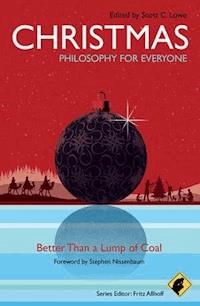
Christmas - Philosophy for Everyone E-Book
14,99 €
Mehr erfahren.
- Herausgeber: John Wiley & Sons
- Kategorie: Geisteswissenschaft
- Serie: Philosophy for Everyone
- Sprache: Englisch
From Santa, elves and Ebenezer Scrooge, to the culture wars and virgin birth, Christmas - Philosophy for Everyone explores a host of philosophical issues raised by the practices and beliefs surrounding Christmas. * Offers thoughtful and humorous philosophical insights into the most widely celebrated holiday in the Western world * Contributions come from a wide range of disciplines, including philosophy, theology, religious studies, English literature, cognitive science and moral psychology * The essays cover a wide range of Christmas themes, from a defence of the miracle of the virgin birth to the relevance of Christmas to atheists and pagans
Sie lesen das E-Book in den Legimi-Apps auf:
Seitenzahl: 469
Veröffentlichungsjahr: 2010
Ähnliche




















CONTENTS
Foreword: Joining the Manger to the Sleigh?Stephen Nissenbaum
Introduction Scott C. Lowe
PART I CHRISTMAS: In the Beginning
1 Jesus, Mary, and Hume: On the Possibility of the Virgin Birth Zachary Jurgensen and Jason Southworth
2 The Virgin Birth: Authentic Christmas Magic Victor Lyons
3 Putting the “Yule” Back in “Yuletide” Todd Preston
PART II IS CELEBRATING CHRISTMAS REALLY A GOOD IDEA?
4 Armed for the War on Christmas Scott F. Aiken
5 Christmas Mythologies: Sacred and Secular Guy Bennett-Hunter
6 The Significance of Christmas for Liberal Multiculturalism Mark Mercer
7 Crummy Commercials and BB Guns: Son-of-a-Bitch Consumerism in a Christmas Classic Erin Haire and Dustin Nelson
PART III SANTA: A Deeper Look
8 The Mind of Santa Claus and the Metaphors He Lives By William E. Deal and S. Waller
9 Making a List, Checking It Twice: The Santa Claus Surveillance System Richard Hancuff and Noreen O’Connor
10 You’d Better Watch Out … Will Williams
11 Santa’s Sweatshop: Elf Exploitation for Christmas Matthew Brophy
PART IV THE MORALITY OF CHRISTMAS
12 Against the Santa Claus Lie: The Truth We Should Tell Our Children David Kyle Johnson
13 Lying to Children about Santa: Why It’s Just Not Wrong Era Gavrielides
14 Putting Claus Back into Christmas Steven D. Hales
15 Scrooge Learns it All in One Night: Happiness and the Virtues of Christmas Dane Scott
PART V CHRISTMAS THROUGH OTHERS' EYES
16 Holly Jolly Atheists: A Naturalistic Justification for Christmas Ruth Tallman
17 Heaven, Hecate, and Hallmark: Christmas in Hindsight Marion G. Mason
18 Festivus and the Need for Seasonal Absurdity Caleb Holt
19 Common Claus: Santa as Cross-Cultural Connection Cindy Scheopner
Afterword Santa Claus
Notes on Contributors: Santa’s Elves
VOLUME EDITOR
SCOTT C. LOWE is Professor of Philosophy and Chair of the Department of Philosophy at Bloomsburg University of Pennsylvania.His current interest is in the political philosophy of Richard Rorty.He is the editor, along with Steven Hales, of Delight in Thinking:An Introduction to Philosophy Reader (2006).
SERIES EDITOR
FRITZ ALLHOFF is an Assistant Professor in the PhilosophyDepartment at Western Michigan University, as well as a SeniorResearch Fellow at the Australian National University’s Centre forApplied Philosophy and Public Ethics. In addition to editing the Philosophy for Everyone series, Allhoff is the volume editor or co-editorfor several titles, including Wine & Philosophy (Wiley-Blackwell, 2007),Whiskey & Philosophy (with Marcus P. Adams, Wiley, 2009), andFood & Philosophy (with Dave Monroe, Wiley-Blackwell, 2007).
PHILOSOPHY FOR EVERYONE
Series editor: Fritz Allhoff
Not so much a subject matter, philosophy is a way of thinking. Thinking not just about the Big Questions, but about little ones too. This series invites everyone to ponder things they care about, big or small, significant, serious … or just curious.
Running & Philosophy: A Marathon for the MindEdited by Michael W. Austin
Wine & Philosophy: A Symposium on Thinking and DrinkingEdited by Fritz Allhoff
Food & Philosophy: Eat, Think and Be MerryEdited by Fritz Allhoff and Dave Monroe
Beer & Philosophy: The Unexamined Beer Isn’t Worth DrinkingEdited by Steven D. Hales
Whiskey & Philosophy: A Small Batch of Spirited IdeasEdited by Fritz Allhoff and Marcus P. Adams
College Sex – Philosophy for Everyone:Philosophers With BenefitsEdited by Michael Bruceand Robert M. Stewart
Cycling – Philosophy for Everyone: A Philosophical Tour de ForceEdited by Jesús Ilundáin-Agurruza and Michael W. Austin
Climbing – Philosophy for Everyone: Because It’s ThereEdited by Stephen E. Schmid
Hunting – Philosophy for Everyone: In Search of the Wild LifeEdited by Nathan Kowalsky
Christmas – Philosophy for Everyone:Better Than a Lump of CoalEdited by Scott C. Lowe
Cannabis – Philosophy for Everyone: What Were We Just Talking About?Edited by Dale Jacquette
Porn – Philosophy for Everyone: How to Think With KinkEdited by Dave Monroe
Serial Killers – Philosophy for Everyone: Being and KillingEdited by S. Waller
Dating – Philosophy for Everyone: Flirting With Big IdeasEdited by Kristie Miller and Marlene Clark
Gardening – Philosophy for Everyone: Cultivating WisdomEdited by Dan O’Brien
Motherhood – Philosophy for Everyone: The Birth of WisdomEdited by Sheila Lintott
Fatherhood – Philosophy for Everyone: The Dao of DaddyEdited by Lon S. Nease and Michael W. Austin
Forthcoming books in the series:
Fashion – Philosophy for EveryoneEdited by Jessica Wolfendale and Jeanette Kennett
Coffee – Philosophy for EveryoneEdited by Scott Parker and Michael W. Austin
Blues – Philosophy for EveryoneEdited by Abrol Fairweather and Jesse Steinberg
This edition first published 2010
© 2010 Blackwell Publishing Ltd except for editorial material and organization © 2010 Scott C. Lowe
Blackwell Publishing was acquired by John Wiley & Sons in February 2007. Blackwell’s publishing program has been merged with Wiley’s global Scientific, Technical, and Medical business to form Wiley-Blackwell.
Registered OfficeJohn Wiley & Sons Ltd, The Atrium, Southern Gate, Chichester, West Sussex, PO19 8SQ, United Kingdom
Editorial Offices350 Main Street, Malden, MA 02148–5020, USA9600 Garsington Road, Oxford, OX4 2DQ, UKThe Atrium, Southern Gate, Chichester, West Sussex, PO19 8SQ, UK
For details of our global editorial offices, for customer services, and for information about how to apply for permission to reuse the copyright material in this book please see our website at www.wiley.com/wiley-blackwell.
The right of Scott C. Lowe to be identified as the author of the editorial material in this work has been asserted in accordance with the UK Copyright, Designs and Patents Act 1988.
All rights reserved. No part of this publication may be reproduced, stored in a retrieval system, or transmitted, in any form or by any means, electronic, mechanical, photocopying, recording or otherwise, except as permitted by the UK Copyright, Designs and Patents Act 1988, without the prior permission of the publisher.
Wiley also publishes its books in a variety of electronic formats. Some content that appears in print may not be available in electronic books.
Designations used by companies to distinguish their products are often claimed as trademarks. All brand names and product names used in this book are trade names, service marks, trademarks or registered trademarks of their respective owners. The publisher is not associated with any product or vendor mentioned in this book. This publication is designed to provide accurate and authoritative information in regard to the subject matter covered. It is sold on the understanding that the publisher is not engaged in rendering professional services. If professional advice or other expert assistance is required, the services of a competent professional should be sought.
Library of Congress Cataloging-in-Publication Data
Christmas – philosophy for everyone: better than a lump of coal / edited by Scott C. Lowe.
p. cm.—(Philosophy for everyone)
Includes bibliographical references.
ISBN 978-1-4443-3090-8 (pbk.: alk. paper) 1. Christmas. I. Lowe, Scott C. II. Title: Christmas – philosophy for everyone.
BV45.C548 2010
263′.915—dc22
2010006824
A catalogue record for this book is available from the British Library.
To John Hirschi
“… it was always said of him, that he knew how to keep Christmas well …”
STEPHEN NISSENBAUM
FOREWORD
Joining the Manger to the Sleigh?
Here’s a philosophical exercise of sorts. Imagine, first, the manger scene, set in Bethlehem. You will of course visualize the newborn infant Jesus, the Virgin Mary and her husband Joseph, and perhaps several shepherds, angels and animals; possibly also the three wise men. All right, now place into that same scene, just in front of the holy infant, the kneeling figure of … Santa Claus.
Something wrong with this picture? Does Santa not quite belong in this scene? And why not? If you find this exercise puzzling, then you have entered into a Christmas problem that may be deemed philosophical. The nineteenth-century American poet Emily Dickinson once recalled that as a child in the 1830s she secretly “loved Santa Claus” more than “the Lord Jesus Christ.” And in that preference (though perhaps not in the acknowledgment of it) Emily Dickinson was – and remains – far from alone. In their hearts, many people today probably love Santa Claus more than Jesus Christ. As certain Christians point out, the mere reversal of two letters turns Santa into Satan.
The contest between Santa and Jesus is not the only philosophical dispute that Christmas has ignited over the years. In the seventeenth century the Puritans actually banned the celebration of Christmas (it was illegal for a time both in Oliver Cromwell’s England and in the colony of Massachusetts). In Puritan eyes, Christmas was a pagan holiday, not a Christian one. They argued, quite accurately, that there is no scriptural basis for celebrating the birth of Jesus; indeed, there is no evidence at all that he was born in December. (The nativity scene so vividly described in the Gospel of Luke – the shepherds abiding in their fields, keeping watch over their flocks by night, when an angel appeared to announce the birth “this day, in the city of David” of Christ the Lord – offers no clue about when “this day” happened to fall.) The Puritans were fond of saying that that if God had intended for the birthday of his only begotten son to be observed, he would surely have provided some indication of when it occurred.
Actually, that dispute leads back to an earlier one, the very dispute that provoked the Church Fathers to decree the celebration of Christmas in the first place. This decree was levied as late as the year 395 CE, fully 400 years after Jesus’ birth. Why only then, and not before? The answer has to do with a certain philosophical idea that was winning many adherents in the fourth century; this was the idea that Jesus had never been a physical being at all, that he was instead a pure spirit who had only appeared to take on human form. (At the risk of committing sacrilege, you might imagine a parallel question about the identity of Santa Claus.) In the fourth century, when the nature of Christian “orthodoxy” was still being hotly debated, such an idea posed a real philosophical threat: it challenged the reality of Christ’s incarnation, even of his crucifixion. In order to suppress that dangerous idea (it was called Docetism, after the Greek word meaning “to seem”), the Church Fathers realized that nothing would make Jesus more physically human than having a birthday.
Of course, by that time nobody had any memory of when Jesus was born, so a date had to be devised. And it had to be a date that Christians would be likely to celebrate. It was for this reason that the Church Fathers settled on late December, for this was a time of general celebration that long preceded Christianity. Late December was the winter solstice (thus the ritual of seasonal lights, practiced by Jews at Chanukah). Late December was also a season of extended leisure time and culinary bounty (the harvest work was finally completed, and there was plenty of fresh food and alcohol to be consumed). In Rome itself, at the center of Christianity, these very days of late December had traditionally been celebrated as the boisterous Saturnalia. So the Church Fathers in the year 395 CE chose to place the nativity of Jesus on December 25. But doing so involved a serious trade-off: on the one hand, the Church Fathers could be confident that the new holiday would be widely celebrated (and that Christians would come to accept the idea that Jesus was a real human being). On the other hand, it would be difficult to insure that the new holiday would be celebrated in a spirit of pious Christian devotion. There were simply too many powerful associations of this particular date, associations that had more to do with eating, drinking and being merry than with praying.
And so Christmas began with a kind of philosophical dilemma. I would argue that this dilemma has never been resolved (its modern form involving the battle between piety and presents, between Jesus and Santa Claus). I might even say, perhaps a bit provocatively, that Christmas has always proven extremely difficult to Christianize. That, at any rate, was precisely what the Puritans came to conclude, and so they decided to simply suppress it. And when Christmas finally did enter mainstream American culture, beginning in the 1820s, it was courtesy of the ever-bulging pack that Santa carried on his back. As one of the essays in this book points out, “The Night before Christmas” (first published in 1823) is a wholly secular poem. By the 1830s Santa Claus had already become established as a commercial icon, appropriated by shopkeepers in urban America. By the end of that decade it was already possible for a New England girl like Emily Dickinson to love Santa – and the presents he left – more than Jesus. It’s all too easy to conclude that Santa has won the battle for Christmas.
And yet. And yet if we moderns find it so difficult to imagine Santa kneeling down before the infant Jesus – so tough to join the manger to the sleigh – perhaps our very difficulty suggests that the sleigh has not completely won the battle after all. Early in the twentieth century some American merchants actually did insert the figure of Santa Claus into the elaborate manger scenes they installed to drum up business. It didn’t work and their efforts were ridiculed. Today, too, as I write this I have located an Internet website advertising 231 different products that show Santa kneeling before Jesus; these include figurines and Christmas tree ornaments. You wouldn’t buy any of these … would you?
Keep reading.
SCOTT C. LOWE
INTRODUCTION
Behold! The virgin will be with child and shall bear a son,
And they will name him Immanuel.
(Matthew 1:23)
The stockings were hung by the chimney with care,
In hopes that St. Nicholas soon would be there.
(Clement Clarke Moore, “ ’Twas the Night Before Christmas”)
The new fallen snow blankets the moonlit hills as sleigh bells jingle in the distance. Inside, the lights shine, the tinsel sparkles, all the ornaments are hung with care and presents are piled high under the tree. It’s Christmas and there’s magic in the air. Cousins and aunts and uncles and grandparents gather together from far and near for feast and fellowship, and maybe a little football, too. There will be delicious food, sweet treats, and a few spirits (of the alcoholic variety) as well. And presents, yes, lots of presents. It’s the stuff of fond memories. It’s Christmas just like Norman Rockwell or Charles Dickens pictured it.
That’s what the holiday’s all about, isn’t it? Family, togetherness and, well, presents. Maybe, maybe not. For what’s supposed to be a holly, jolly holiday, Christmas sure stirs up a lot of controversy. There’s not much agreement about the origins, history, practices, point or purpose of this holiday. Wait a minute, you say, everybody knows that Christmas is about the virgin birth of baby Jesus, right? Everybody? Guess again. Well, at least it’s about the birth of some baby on a cold December night in a drafty manger. Hardly, that one’s pretty clearly not true. Well, then, it’s about that time honored Christian practice of decorating pine trees. Oh, come on now, what have you been smoking? It’s about Santa? Please, don’t get the fundamentalists started! Nativities on the courthouse lawn? Don’t get Bill O’Reilly started! You see what I mean?
What does seem clear is that Christ’s mass has been part of the church calendar since about the fourth century, that the early Christian church moved the celebration to December to coincide with existing pagan (or maybe Roman) solstice celebrations, that we picked up decorating pine trees from existing pagan practices, and that it wasn’t until fairly recently that Christmas was accepted as the day of festive celebration that we recognize. (Did you ever notice that Bob Cratchit had to Mr. Scrooge for Christmas day off?) An interesting aspect of the history of Christmas is the degree to which this celebration of Christ’s birth was associated with existing non-Christian holidays as a way of winning and keeping converts. Presumably, early Christians weren’t willing to throw out everything old in adopting their new religion, so adapted existing holidays to new, Christian, purposes. The modern Christmas celebration has ancient connections with a number of winter solstice feasts, including the Roman festival dedicated to Sol Invictus (the unconquered sun) and Germanic and Scandinavian Yule festivals. Similarly, later Christmas celebrations picked up elements from non-Christian sources, such as the decorating of Christmas trees and the burning of Yule logs which also come from Germany and Scandinavia. In fact, the practice of decorating a Christmas tree is only about a century and a half old in the English speaking world. It was not until the 1840s that the practice became widespread in England, in part due to Queen Victoria’s adopting a custom from Prince Albert’s native Germany, and not until the latter half of the nineteenth century that Christmas trees caught on in the United States.
Lesen Sie weiter in der vollständigen Ausgabe!
Lesen Sie weiter in der vollständigen Ausgabe!
Lesen Sie weiter in der vollständigen Ausgabe!
Lesen Sie weiter in der vollständigen Ausgabe!
Lesen Sie weiter in der vollständigen Ausgabe!
Lesen Sie weiter in der vollständigen Ausgabe!
Lesen Sie weiter in der vollständigen Ausgabe!
Lesen Sie weiter in der vollständigen Ausgabe!
Lesen Sie weiter in der vollständigen Ausgabe!
Lesen Sie weiter in der vollständigen Ausgabe!
Lesen Sie weiter in der vollständigen Ausgabe!
Lesen Sie weiter in der vollständigen Ausgabe!
Lesen Sie weiter in der vollständigen Ausgabe!
Lesen Sie weiter in der vollständigen Ausgabe!
Lesen Sie weiter in der vollständigen Ausgabe!
Lesen Sie weiter in der vollständigen Ausgabe!
Lesen Sie weiter in der vollständigen Ausgabe!
Lesen Sie weiter in der vollständigen Ausgabe!
Lesen Sie weiter in der vollständigen Ausgabe!
Lesen Sie weiter in der vollständigen Ausgabe!
Lesen Sie weiter in der vollständigen Ausgabe!
Lesen Sie weiter in der vollständigen Ausgabe!
Lesen Sie weiter in der vollständigen Ausgabe!
Lesen Sie weiter in der vollständigen Ausgabe!
Lesen Sie weiter in der vollständigen Ausgabe!
Lesen Sie weiter in der vollständigen Ausgabe!




