


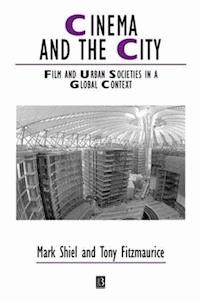
Cinema and the City E-Book
26,99 €
Mehr erfahren.
- Herausgeber: John Wiley & Sons
- Kategorie: Wissenschaft und neue Technologien
- Serie: Studies in Urban and Social Change
- Sprache: Englisch
This book brings together the literature of urban sociology and film studies to explore new analytical and theoretical approaches to the relationship between cinema and the city, and to show how these impact on the realities of life in urban societies.
Sie lesen das E-Book in den Legimi-Apps auf:
Seitenzahl: 608
Veröffentlichungsjahr: 2011
Ähnliche




















Contents
List of Illustrations
Illustrations Acknowledgments
List of Contributors
Series Editors’ Preface
Preface
1 Cinema and the City in History and Theory
Cinema and the City
Film Studies and Sociology
Culture and Society
Space and Spatiality
Geographical Description and Uneven Development
Describing History
Globalization
Sameness and Difference
Notes
2 Film and Urban Societies in a Global Context
Notes
Part 1: Postmodern Mediations of the City: Los Angeles
3 Bunker Hill: Hollywood’s Dark Shadow
Five Points
Angel’s Flight
Notes
4 Film Mystery as Urban History: The Case of Chinatown
Introduction
The Story
Symbols and Politics
Film and History
Notes
5 Return to Oz: The Hollywood Redevelopment Project, or Film History as Urban Renewal
Notes
Part 2: Urban Identities, Production, and Exhibition
6 Shamrock: Houston’s Green Promise
Notes
7 From Workshop to Backlot: The Greater Philadelphia Film Office
The Museum
The Entertainment Center
The Shoot
The Value of Production
The Hawaii Five-O Effect
Contested Public Space
Reality Check
Notes
8 Cities: Real and Imagined
Notes
9 Emigrating to New York in 3-D: Stereoscopic Vision in IMAX’s Cinematic City
Mobility and Memory in the City of Progress
Belonging to the City Through Vision
The 3-D City
Notes
10 Finding a Place at the Downtown Picture Palace: The Tampa Theater, Florida
Introduction
Members of Distinction
The Downtown Experience
Conclusion
Notes
11 Global Cities and the International Film Festival Economy
Mapping the Circuit
Festival Image
Planning the Festival Spectacle
Notes
Part 3: Cinema and the Postcolonial Metropolis
12 Streetwalking in the Cinema of the City: Capital Flows Through Saigon
Notes
13 Cityscape: The Capital Infrastructuring and Technologization of Manila
Introduction
Capital Infrastructuring and the Flatness of Manila
Manila in the Claws of Neon and the Three Historical Phases of the City
Spanish Colonialism
US Neocolonialism
The Modern Period
The Dying City
Squatter Colonies and Cities
Conclusion
Notes
14 The Politics of Dislocation: Airport Tales, The Castle
Looking Over the Back Fence
We’ve Got to Stop Taking Other People’s Land Away...
Notes
15 Representing the Apartheid City: South African Cinema in the 1950s and Jamie Uys’s The Urgent Queue
Notes
16 The Visual Rhetoric of the Ambivalent City in Nigerian Video Films
Introduction
The Milieu
Between the “Jungle” and the Jingle of Excellence
Conclusion
Notes
17 Montréal Between Strangeness, Home, and Flow
Notes
18 (Mis-)Representing the Irish Urban Landscape
Notes
Part 4: Urban Reactions on Screen
Idealism and Defeat
19 Postwar Urban Redevelopment, the British Film Industry, and The Way We Live
Introduction
Documentary Film and Town Planning
The Way We Live, the Planning Debate, and the British Film Industry
Conclusion
Notes
20 Naked: Social Realism and the Urban Wasteland
Notes
Escape and Invasion
21 Jacques Tati’s Play Time as New Babylon
Notes
22 Poaching on Public Space: Urban Autonomous Zones in French Banlieue Films
Urban Space and the “Writing Machine of the Law”: Visibility and Marginality in the Banlieue
Poaching on the Hors-Carton: The Search for Urban Autonomous Zones
Notes
Index
Studies in Urban and Social Change
Published by Blackwell in association with the International Journal of Urban and Regional Research. Series editors: Chris Pickvance, Margit Meyer and John Walton.
Published
Fragmented Societies
Enzo Mingione
Free Markets and Food Riots
John Walton and David Seddon
Post-Fordism
Ash Amin (ed.)
The People’s Home?
Social Rented Housing in Europe and America
Michael Harloe
Cities After Socialism
Urban and Regional Change and Conflict in Post-Socialist Societies
Gregory Andrusz, Michael Harloe and Ivan Szelenyi (eds)
Urban Poverty and the Underclass: A Reader
Enzo Mingione
Capital Culture
Gender at Work in the City
Linda McDowell
Contemporary Urban Japan
A Sociology of Consumption
John Clammer
Globalizing Cities
A New Spatial Order?
Peter Marcuse and Ronald van Kempen (eds)
The Social Control of Cities?
A Comparative Perspective
Sophie Body-Gendrot
Cinema and the City
Film and Urban Societies in a Global Context
Mark Shiel and Tony Fitzmaurice (eds)
Forthcoming
European Cities in a Global Age
A Comparative Perspective
Alan Harding (ed.)
Urban South Africa
Alan Mabin and Susan Parnell
Urban Social Movements and the State
Margit Mayer
Urban Studies
Contemporary Perspectives
John Eade and Chris Mele (eds)
Copyright © Blackwell Publishers Ltd 2001
Editorial matter and arrangement copyright © Mark Shiel and Tony Fitzmaurice 2001
First published 2001
2 4 6 8 10 9 7 5 3 1
Blackwell Publishers Ltd
108 Cowley Road
Oxford OX4 1JF
UK
Blackwell Publishers Inc.
350 Main Street
Malden, Massachusetts 02148
USA
All rights reserved. Except for the quotation of short passages for the purposes of criticism and review, no part of this publication may be reproduced, stored in a retrieval system, or transmitted, in any form or by any means, electronic, mechanical, photocopying, recording or otherwise, without the prior permission of the publisher.
Except in the United States of America, this book is sold subject to the condition that it shall not, by way of hardback and trade or otherwise, be lent, resold, hired out, or otherwise circulated without the publisher’s prior consent in paperback any form of binding or cover other than that in which it is published and without a similar condition including editions this condition being imposed on the subsequent purchaser.
British Library Cataloguing in Publication Data
A CIP catalogue record for this book is available from the British Library.
Library of Congress Cataloging-in-Publication Data
Cinema and the city : film and urban societies in a global context / edited by Mark Shiel and Tony Fitzmaurice.
p. cm. — (Studies in urban and social change)
Includes bibliographical references and index.
ISBN 0–631–22243–X (acid-free paper) — ISBN 0–631–22244–8 (pbk. : acid-free paper)
1. Cities and towns in motion pictures. 2. Motion pictures—Social aspects. 3. City and town life. I. Shiel, Mark. II. Fitzmaurice, Tony, 1953– III. Series.
PN1995.9.C513 C45 2001
791.43¢621732—dc21
00–010767
Typeset in 10½ on 12 pt Baskerville
by Ace Filmsetting Ltd, Frome, Somerset
From Mark, to Alyce
From Tony, to Mary and Fionn
Illustrations
3.1 Millard Sheets’s Angel’s Flight, 1931
3.2 Mike Hammer (Ralph Meeker) and Velda (Maxine Cooper) in Kiss Me Deadly
4.1 A production still from the film Chinatown in which local farmers protest Los Angeles’s water policy by herding sheep into the City Council Chamber, ca.1937
4.2 Owens Valley citizens take possession of the Los Angeles Aqueduct, November 16, 1924
5.1 Area map of the Hollywood Redevelopment Project
5.2 Artist’s impression of an aerial view of the Hollywood & Highland site, looking north
5.3 Artist’s impression of the Babylon Court in the Hollywood & Highland development
6.1 Glenn McCarthy and Gene Autry – riding the free-range city
7.1 Philadelphia remade as nineteenth-century Cincinnati during the production of Beloved
8.1 Michelangelo Antonioni filming La notte on the streets of Milan, 1960
9.1 Exterior of the Sony IMAX Theater, Lincoln Square, 68th St. and Broadway, New York City
10.1 Interior of the Tampa Theater, Tampa, Florida
12.1 Sectors of the population outside the circuits of money, influence, and power (Cyclo)
14.1 Flyer for The Castle, 1997
14.2 “On a clear day he can see planes forever,” The Australian, June 27, 1998, front page
18.1 “. . . some of the first moving pictures of Ireland . . .” Sackville Street (now O’Connell Street), Dublin, as filmed by the Lumière brothers, 1897
19.1 The closing sequence of The Way We Live
20.1 Johnny’s lone odyssey in the capital . . . (Naked)
21.1 Spectacularization and reification in Jacques Tati’s Play Time
22.1 The banlieusards articulate another line of escape (La haine)
22.2 Hubert allegorizes the Icarian fall they all must take (La haine)
Illustrations Acknowledgments
We would like to express our thanks to the following for illustrations and permissions: British Film Institute Stills Library, London; Film Institute of Ireland, Dublin; Eastern California Museum, Independence, CA; Ehrenkrantz Eckstut & Kuhn Architects, Los Angeles, CA; George Cott/Chroma Inc.; Greater Philadelphia Film Office; Houston Metropolitan Research Center, Houston Public Library; Les Films Lazennec, Paris; Loews Cineplex (US), New York; Los Angeles County Museum of Art; News Limited, Sydney; Roadshow Film Distributors, Melbourne; Specta Films CEPEC, Paris; Thin Man Films Ltd, London; Working Dog Pty. Ltd, Melbourne.
While every effort has been made to identify and contact copyright holders, it has not been possible to do so in every case. Any rights not acknowledged here will be acknowledged in subsequent editions if notice is given to the publisher.
Contributors
Gary Baines is Senior Lecturer in History at Rhodes University. He completed his Ph.D. at Cape Town University and has published primarily on Port Elizabeth’s African population and South African urban history and culture. He is currently working on a study of jazz in postwar South Africa.
Mike Davis teaches urban and social history and theory in the Department of History at the State University of New York, Stony Brook. He is the author of numerous books including Ecology of Fear: Los Angeles and the Imagination of Disaster (1998), City of Quartz: Excavating the Future in Los Angeles (1992), and Prisoners of the American Dream (1986). His most recent book is entitled Magical Urbanism: Latinos Reinvent the US Big City (2000).
Leo Enticknap recently completed his Ph.D. thesis at the University of Exeter on the non-fiction film in postwar Britain. He has articles forthcoming on the newsreel series This Modern Age and the implications for film scholars of archival restoration projects, with reference to the recent re-release of Vertigo.
Adrian Fielder is currently completing his doctorate at Northwestern University on trends of globalization and urban cultures in postcolonial France and North Africa. His most recent publications include “The Tactical Poetics of Urban Nomadism,” in Les Enfants de l’immigration, ed. Ernstpeter Ruhe (1999), and “Articulating the Hip-Hop Nation in the US and France” (in disClosure, vol. 8, Summer 1999).
Tony Fitzmaurice is College Lecturer at the Centre for Film Studies, University College Dublin, where he specializes in postwar American cinema and European – particularly Italian – modernist cinema. A graduate of UCD in English and in Film Studies, he previously taught at the National College of Art and Design, Dublin. He has published articles on Hollywood in the 1970s and on Irish and international contemporary art.
James Hay is an Associate Professor in Speech Communication, the Graduate Program in Cultural Studies, the Unit for Criticism and Interpretive Theory, and the Unit for Cinema Studies at the University of Illinois, Champaign-Urbana. His books include Popular Film Culture in Fascist Italy, TheAudience and its Landscape, and numerous essays about screen media and social space. He is currently completing a book (related to his essay in this volume) on cultural technology, advanced liberalism, and the production of social space.
Janna Jones is Assistant Professor of Interdisciplinary Studies at the University of South Florida. She received her Ph.D. in Communication at the University of South Florida. Her research and publications focus on how people understand and negotiate public and private space. She is currently writing a book entitled Let’s Go Downtown: The Return to the Southern PicturePalace.
Justine Lloyd is Postdoctoral Research Fellow in the Faculty of Humanities and Social Sciences, University of Technology, Sydney. She is the author of numerous articles on popular culture and identity, most recently “A Sublime Indifference,” in Impossible Selves: Cultural Readings of Identity (ed. J. Lo et al., 1999). She is coeditor of Planet Diana: Cultural Studies and Global Mourning (with Ien Ang et al., 1997, and recently completed her doctoral thesis at the University of West Sydney Nepean on technology, travel, and the imagination of modernity in twentieth-century Sydney.
Laurent Marie lectures in French at University College Dublin and completed his Ph.D., on the relationship between the French Communist Party and French cinema, at the University of Warwick. His recent published articles include “La nostalgie est toujours ce qu’elle était: Germinale de Claude Berri et le Parti Communiste Français,” in Excavatio, Spring 1998, and “La réception critique de L’amour d’une femme,” in 1895, special issue on Jean Grémillon, October 1997. His essay “Le Chêne et le roseau: French Communist critics and the New Wave,” will be published shortly in Visual Culture andFrench National Identity.
Bill Marshall is Professor of Modern French Studies at the University of Glasgow, Scotland. He has written a book on Québec National Cinema (2000), as well as studies of Victor Serge and Guy Hocquenghem, and coedited Musicals: Hollywood and Beyond (2000).
Mike Mason is Senior Lecturer in Media Theory at the University of Lincolnshire and Humberside. After a varied career in theater, fashion, and graphic design in Holland he returned to England in the late 1980s to study Media and Film at Sheffield Hallam University, completing his dissertation on masculinity in social realist film. His current research focuses on media education and European film-funding.
J. Paul Narkunas is a doctoral candidate in the Department of English at the University of Pittsburgh completing a dissertation entitled “Surfing the Long Waves of Global Capitalism: Inhuman Flights Through Time.” His areas of research include Gilles Deleuze, the English language as commodity, US influence in East Asia, the World Bank and UNESCO, and East Asian Film. He is the author of the article “The Metabolic State: Market English and the World Bank.”
Mark Neumann is an associate professor in the Department of Communication at the University of South Florida in Tampa, Florida. His research and teaching interests focus on the study of visual society, popular culture, tourism, consumption, and urban life. He is the author of On the Rim: Looking for the Grand Canyon (1999), and has written articles and book chapters on documentary, photography, casino gambling, travel, and bootleg music recording.
Geoffrey Nowell-Smith is Professor of Cinema Cultures at the University of Luton. He is the author of L’avventura (1998), and has edited or coedited numerous publications including The Oxford History of World Cinema (1996), Hollywood and Europe: Economics, Culture, National Identity, 1945–95 (1998), and The Companion to Italian Cinema (1996). He is currently writing a book on art cinema for publication in 2001.
Obododimma Oha is a lecturer in the Department of English, Gaston Berger University, Saint-Louis, Senegal. His research interests are in semiotics and Nigerian visual culture and politics, subjects on which he has published widely. He is currently working on a study of the impact of military dictatorship on the arts in Nigeria.
Kevin Rockett is Lecturer in Film Studies at Trinity College Dublin, and was previously Postdoctoral Fellow at the Centre for Film Studies, University College Dublin. One of the foremost scholars on Irish cinema, he is the author of The Irish Filmography: Fiction Films, 1896–1996 (1996), and Still Irish:A Century of the Irish in Film (1995). Additionally, he has coauthored The Companion to British and Irish Cinema, with John Caughie (1996) and Cinema andIreland, with Luke Gibbons and John Hill (1987).
Mark Shiel is Lecturer in Film Studies at Sheffield Hallam University, where he specializes in American cinema, politics, and social history, and was previously Faculty of Arts Fellow at the Centre for Film Studies, University College Dublin. He is a graduate of Trinity College Dublin (in English Literature and Drama Studies) and completed his Ph.D., “Radical Agendas and the Politics of Space in American Cinema, 1968–1974,” at the British Film Institute in London in 1999.
Josh Stenger is a Ph.D. candidate in the English Department at Syracuse University in Syracuse, New York. He is completing his dissertation, which focuses on the relationship between Hollywood film, consumerism, and the urban landscape of Los Angeles. His previous published work includes essays on Planet Hollywood and Universal CityWalk.
Julian Stringer is Lecturer in Film Studies at the University of Nottingham. He received his Ph.D. from Indiana University, Bloomington. His articles have appeared in numerous film journals, including Screen. He has contributed essays to the anthologies The Road Movie Book (1997), The Encyclopedia ofChinese Film (1998), Asian-American Screen Cultures (1999), Mythologies of Violence inPostmodern Media (1999), and Titanic: Anatomy of a Blockbuster (1999). He is currently working on a study of the cultural politics of international film festivals.
Paul Swann is Associate Professor and Director of the MFA Program in the Department of Film and Media Arts at Temple University. He is the author of The British Documentary Film Movement, 1926–1946 (1989) and of The Hollywood Feature Film in Postwar Britain (1987). He has also published extensively on documentary and on Hollywood’s relationship to European cinema markets after World War Two. He is currently working on a study of the reception of American popular television in Asia and British films in the United States.
Rolando B. Tolentino is Assistant Professor of Filipino and Philippine Literature at the University of the Philippines. He completed his Ph.D. at the School of Cinema-Television, University of Southern California, and has published widely on Philippine and Southeast Asian cultural identity and global politics.
John Walton is Professor of Sociology at the University of California, Davis. His recent books include Free Markets and Food Riots (Blackwell, 1994), Western Times and Water Wars: State, Culture, and Rebellion in California (1992), and ThePower and the Story: Collective Memory in Monterey from Colonial Rule to Cannery Row (forthcoming).
Series Editors’ Preface
In the past three decades there have been dramatic changes in the fortunes of cities and regions, in beliefs about the role of markets and states in society, and in the theories used by social scientists to account for these changes. Many of the cities experiencing crisis in the 1970s have undergone revitalization while others have continued to decline. In Europe and North America new policies have introduced privatization on a broad scale at the expense of collective consumption, and the viability of the welfare state has been challenged. Eastern Europe has witnessed the collapse of state socialism and the uneven implementation of a globally driven market economy. Meanwhile, the less developed nations have suffered punishing austerity programmes that divide a few newly industrializing countries from a great many cases of arrested and negative growth.
Social science theories have struggled to encompass these changes. The earlier social organizational and ecological paradigms were criticized by Marxian and Weberian theories, and these in turn have been disputed as allembracing narratives. The certainties of the past, such as class theory, are gone and the future of urban and regional studies appears relatively open.
The aim of the series Studies in Urban and Social Change is to take forward this agenda of issues and theoretical debates. The series is committed to a number of aims but will not prejudge the development of the field. It encourages theoretical works and research monographs on cities and regions. It explores the spatial dimension of society, including the role of agency and of institutional contexts in shaping urban form. It addresses economic and political change from the household to the state. Cities and regions are understood within an international system, the features of which are revealed in comparative and historical analyses.
The series also serves the interests of university classroom and professional readers. It publishes topical accounts of important policy issues (e.g. global adjustment), reviews of debates (e.g. post-Fordism) and collections that explore various facets of major changes (e.g. cities after socialism or the new urban underclass). The series urges a synthesis of research and theory, teaching and practice. Engaging research monographs (e.g. on women and poverty in Mexico or urban culture in Japan) provide vivid teaching materials, just as policy-oriented studies (e.g. of social housing or urban planning) test and redirect theory. The city is analysed from the top down (e.g. through the gendered culture of investment banks) and the bottom up (e.g. in challenging social movements). Taken together, the volumes in the series reflect the latest developments in urban and regional studies.
Subjects which fall within the scope of the series include: explanations for the rise and fall of cities and regions; economic restructuring and its spatial, class, and gender impact; race and identity; convergence and divergence of the “east” and “west” in social and institutional patterns; new divisions of labour and forms of social exclusion; urban and environmental movements; international migration and capital flows; politics of the urban poor in developing countries; cross-national comparisons or housing, planning and development; debates on post-Fordism, the consumption sector and the “new” urban poverty.
Studies in Urban and Social Change addresses an international and interdisciplinary audience of researchers, practitioners, students, and urban enthusiasts. Above all, it endeavours to reach the public with compelling accounts of contemporary society.
Editorial Committee
John Walton, Chair
Margit Mayer
Chris Pickvance
Preface
This book is entitled Cinema and the City: Film and Urban Societies in a GlobalContext because it is primarily interested not in the cinema per se or in the city per se but in the relationship or conjunction between the two as it has been played out in a wide range of geographical and historical contexts and, particularly, as it may help us to apprehend and respond to large social and cultural processes such as globalization today.
The book is divided into four parts: three mapping a geographical relationship between key global regions and their respective city types and film cultures (Los Angeles, the cities of a number of former European colonies, and the capital cities of two former European colonial powers); and one mapping the political-economic relationship between film production and consumption, on the one hand, and key urban centers, on the other. Each part has its own brief introduction, relating the various chapters to each other and each part to the others. The book as a whole is introduced by two critical chapters: the first, “Cinema and the City in History and Theory,” provides a macro-geographical and broad historical contextualization of the relationship between cinema and urban society and its importance in social and cultural theory; the second, “Film and Urban Societies in a Global Context,” introduces in detail the various particular essays and parts of the book through a consideration of their binding interest in power, globalization, and resistance as these are revealed in or practiced through cinema and films in the urban environment.
This book has its practical origins in the Cinema and the City conference, organized by us, which was hosted by the Centre for Film Studies at University College Dublin (UCD) in March 1999. The conference brought together a wide range of both eminent and emerging scholars in a number of related fields such as Film Studies, Sociology, Urban Studies, Geography, and Architecture to explore the rich relationship between film and the urban environment through a variety of methodologies. The success of the event, the creativity of the many opinions and ideas expressed, and the interest generated internationally by the conference, testified to the importance and fruitfulness of interdisciplinary collaboration, particularly as a means to the understanding of the crucial interconnectedness of cinema/culture and city/ society over the past 100 years.
For their support in the development and hosting of the Cinema and the City conference in the first place, we would like to take this opportunity to thank the Faculty of Arts and the Board of Studies of the Centre for Film Studies, UCD. Thanks too to our colleagues and students at UCD for their encouragement and practical assistance. A special thank-you to Susanne Bach.
We are very grateful to the Series Editors of Studies in Urban and SocialChange – John Walton, Chris Pickvance, and Margit Mayer – for their guidance and support throughout the development of the book. A particular note of thanks should go to John Walton for the warmth of his interest and encouragement from the very outset – both from a distance, in California, and on occasional visits to Dublin.
The editorial staff at Blackwell in Oxford have been of invaluable assistance in the course of our work on the book. In particular, we would like to thank Sarah Falkus, Katherine Warren, Joanna Pyke, Jill Landeryou (formerly of Blackwell), and Juanita Bullough for their attentiveness and patience throughout.
We are also indebted to a number of other people for their practical help in securing illustrations and permissions for the book. We would particularly like to mention: Vanessa Marshall and Ann Haydon at the British Film Institute Stills Library; Shaula Coyl at the Los Angeles County Museum of Art; Sunniva O’Flynn at the Film Institute of Ireland; Mary Jane Dodge, VP IMAX Theaters, Loews-Cineplex, New York City; Deborah Reade at Thin Man Films, London; Noura Aberkane at Lazennec Productions, Paris; and Tara Schroeder at the Tampa Theater, Tampa, Florida.
Finally, we would like to thank our respective families and friends for their love, support, and inspiration.
Mark Shiel
Tony Fitzmaurice
1
Cinema and the City in History and Theory
Mark Shiel
A whole history remains to be written of spaces – which would at the same time be the history of powers – from the great strategies of geopolitics to the little tactics of the habitat.
Michel Foucault, “The Eye of Power”1
Cinema and the City
This book is concerned with the relationship between the most important cultural form – cinema – and the most important form of social organization – the city – in the twentieth century (and, for the time being at least, the twenty-first century), as this relationship operates and is experienced in society as a lived social reality.
Since the end of the nineteenth century, the fortunes of cinema and the city have been inextricably linked on a number of levels. Thematically, the cinema has, since its inception, been constantly fascinated with the representation of the distinctive spaces, lifestyles, and human conditions of the city from the Lumière brothers’ Paris of 1895 to John Woo’s Hong Kong of 1995. Formally, the cinema has long had a striking and distinctive ability to capture and express the spatial complexity, diversity, and social dynamism of the city through mise-en-scène, location filming, lighting, cinematography, and editing, while thinkers from Walter Benjamin – confronted by the shocking novelties of modernity, mass society, manufacture, and mechanical reproduction – to Jean Baudrillard – mesmerized by the ominous glamour of postmodernity, individualism, consumption, and electronic reproduction have recognized and observed the curious and telling correlation between the mobility and visual and aural sensations of the city and the mobility and visual and aural sensations of the cinema. Industrially, cinema has long played an important role in the cultural economies of cities all over the world in the production, distribution, and exhibition of motion pictures, and in the cultural geographies of certain cities particularly marked by cinema (from Los Angeles to Paris to Bombay) whose built environment and civic identity are both significantly constituted by film industry and films.2
The nexus cinema–city, then, provides a rich avenue for investigation and discussion of key issues which ought to be of common interest in the study of society (in this case, the city) and in the study of culture (in this case, the cinema) and in the study of their thematic, formal, and industrial relationship historically and today. Indeed, interest in their relationship has been growing significantly of late – particularly with regard to the thematic and formal representation of the city – in the fields of Film Studies, Cultural Studies, and Architecture. The central innovative aim of this book is to contribute to the study of the cinema and to the study of society by focusing on the relationship between cinema and the city as in a range of urban societies of the present and recent past.
Lesen Sie weiter in der vollständigen Ausgabe!
Lesen Sie weiter in der vollständigen Ausgabe!
Lesen Sie weiter in der vollständigen Ausgabe!
Lesen Sie weiter in der vollständigen Ausgabe!
Lesen Sie weiter in der vollständigen Ausgabe!
Lesen Sie weiter in der vollständigen Ausgabe!
Lesen Sie weiter in der vollständigen Ausgabe!
Lesen Sie weiter in der vollständigen Ausgabe!
Lesen Sie weiter in der vollständigen Ausgabe!
Lesen Sie weiter in der vollständigen Ausgabe!
Lesen Sie weiter in der vollständigen Ausgabe!
Lesen Sie weiter in der vollständigen Ausgabe!
Lesen Sie weiter in der vollständigen Ausgabe!
Lesen Sie weiter in der vollständigen Ausgabe!
Lesen Sie weiter in der vollständigen Ausgabe!
Lesen Sie weiter in der vollständigen Ausgabe!
Lesen Sie weiter in der vollständigen Ausgabe!
Lesen Sie weiter in der vollständigen Ausgabe!
Lesen Sie weiter in der vollständigen Ausgabe!
Lesen Sie weiter in der vollständigen Ausgabe!
Lesen Sie weiter in der vollständigen Ausgabe!
Lesen Sie weiter in der vollständigen Ausgabe!
Lesen Sie weiter in der vollständigen Ausgabe!
Lesen Sie weiter in der vollständigen Ausgabe!
Lesen Sie weiter in der vollständigen Ausgabe!
Lesen Sie weiter in der vollständigen Ausgabe!
Lesen Sie weiter in der vollständigen Ausgabe!
Lesen Sie weiter in der vollständigen Ausgabe!




