


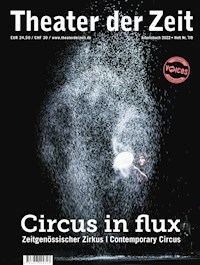
Circus in flux E-Book
Erhalten Sie Zugang zu diesem und mehr als 300000 Büchern ab EUR 5,99 monatlich.
- Herausgeber: Verlag Theater der Zeit
- Kategorie: Geisteswissenschaft
- Sprache: Deutsch
In den letzten fünfzig Jahren hat der Zirkus einen bemerkenswerten Wandel erlebt. Progressive Zirkusformen haben sich international als "Zeitgenössischer Zirkus" eine neue Position innerhalb der Gesellschaft erobert. Das Arbeitsbuch widmet sich dieser noch jungen Zirkusform und präsentiert Analysen, Interviews, Kommentare, umfangreiches Fotomaterial und künstlerische Positionen internationaler und deutscher Zirkuskünstlerinnen und -künstler. Mit der zusätzlichen Sondereinlage des VOICES Magazins "Re-thinking objects" taucht das Buch tief in den aktuellen zirkusästhetischen Diskurs über neue Materialismen ein und nimmt außerdem die Verbindungen zum zeitgenössischen Tanz auf.
Sie lesen das E-Book in den Legimi-Apps auf:
Seitenzahl: 274
Veröffentlichungsjahr: 2022
Das E-Book (TTS) können Sie hören im Abo „Legimi Premium” in Legimi-Apps auf:
Ähnliche




















Circus in flux
Zeitgenössischer ZirkusContemporary Circus
Herausgeber: CircusDanceFestival, Tim Behren, Jenny Patschovsky
INHALTCONTENTS
EditorialSeite/page 11
Spielorte und Festivals in Deutschland und Europa/Venues and festivals in Germany and EuropeSeite/page 26
Träumen mit Plan/Dream with a planSeite/page 122
Autor:innen/AuthorsSeite/page 126
Impressum/ImprintSeite/page 136
ALEXANDER KLUGE geboren 1932 in Halberstadt, ist Schriftsteller, Hörspielautor, Fernsehproduzent und Filmemacher. In seinem vielfältigen Werk spielt die Faszination für den Zirkus eine wichtige Rolle, so zum Beispiel in dem frühen Film „Die Artisten in der Zirkuskuppel: ratlos“ (1968) und zuletzt in dem Buch „Zirkus Kommentar“ (Suhrkamp Verlag 2022). Für sein literarisches Schaffen erhielt Alexander Kluge zahlreiche Preise, u. a. den Bayerischen Staatspreis für Literatur, den Theodor-W.-Adorno-Preis sowie den Georg-Büchner-Preis. Alexander Kluge, born in Halberstadt in 1932, is a writer, radio playwright, television producer and filmmaker. His fascination with the circus plays an important role in his multifaceted work, for example in the early film “Artists Under the Big Top: Perplexed” (1968) and most recently in the book “Circus Commentary” (Suhrkamp Verlag 2022). Alexander Kluge has received numerous prizes for his literary work, including the Bavarian State Prize for Literature, the Theodor W. Adorno Prize and the Georg Büchner Prize.Mit dem Unbekannten umgehen – Gedanken zum Zirkus. Dealing with the unknown – Thoughts on the circusSeite/page 13
Foto Markus Kirchgessner
DR. FRANZISKA TRAPP, Post-Doc-Wissenschaftlerin an der Freien Universität Berlin (DE) und der Université Libre de Bruxelles (BE), widmet sich in ihrem aktuellen Forschungsprojekt den Objekten und Apparaturen im Zirkus. Sie ist die Gründerin des Forschungsprojekts Zirkus | Wissenschaft, Organisatorin internationaler Konferenzen wie u. a. Semiotics of the Circus (2015), UpSideDown – Circus and Space (2017), Semaine du Cirque (2020), Écrire l‘histoire du cirque (2022), Initiatorin des Young Researchers Network in Circus Studies (YOUR | Circus) und Co-Herausgeberin des wissenschaftlichen Journals Circus Arts, Life and Science. Darüber hinaus arbeitet Trapp als freiberufliche Dramaturgin (u. a. Tall Tales Company (NL), Sysmo (BE), Sing Out Bruxelles (NL) Julia Berger (DE), Cie Equinoctis (FR)). Sie wurde vom Deutschen Hochschulverband mit dem dritten Platz als Nachwuchswissenschaftlerin des Jahres 2019 ausgezeichnet und erhielt 2020 den Nachwuchspreis der Deutschen Gesellschaft für Semiotik für ihre Dissertation mit dem Titel „Lektüren des Zeitgenössischen Zirkus“ (De Gruyter 2020 (DE), Routledge 2023 (EN)). Dr Franziska Trapp, post-doctoral researcher at the Freie Universität Berlin (DE) and Université Libre de Bruxelles (BE), addresses objects and apparatus in the circus in her current research project. She is the founder of the research project Zirkus | Wissenschaft (Circus | Science), organiser of international conferences such as Semiotics of the Circus (2015), UpSide-Down – Circus and Space (2017), Semaine du Cirque (2020), Ecrire l’histoire du cirque (2022), initiator of the Young Researchers Network in Circus Studies (YOUR | Circus) and co-editor of the scientific journal Circus Arts, Life and Science. Trapp also works as a freelance dramaturge for Tall Tales Company (NL), Sysmo (BE), Sing Out Bruxelles (NL) Julia Berger (DE), Cie Equinoctis (FR), among others. She was awarded third place as Young Academic of the Year 2019 by the German University Association and received the Young Academic Award of the German Society for Semiotics in 2020 for her dissertation entitled “Reading Contemporary Circus” (De Gruyter 2020 (DE), Routledge 2023 (EN)). Not my Circus, not my Monkeys? – Eine Einführung in den Zeitgenössischen Zirkus. An introduction to the contemporary circusSeite/page 16
Foto Franziska Trapp
MIRJAM HILDBRAND, Dr. des., arbeitet als Dramaturgin, Kuratorin, Kulturveranstalterin, Theaterwissenschaftlerin und Dozentin. Sie promovierte am Institut für Theaterwissenschaft der Universität Bern zum Konkurrenzverhältnis von Zirkus und Theater um 1900 in Berlin. Zwischen 2015 und 2021 baute sie in Basel das Projekt Station Circus, ein Gastspiel-, Residenz- und Trainingsort für zeitgenössisches Zirkusschaffen, mit auf. Als Dramaturgin und Kuratorin unter anderem mit dem Festival cirqu’ in Aarau oder der Kompanie Overhead Project sowie dem CircusDanceFestival in Köln verbunden. Als Jurymitglied darf sie immer wieder Verantwortung bei der Vergabe von Stipendien und Produktionsfördergeldern übernehmen. Mirjam Hildbrand, Dr. des., is a dramaturge, curator, cultural organiser, theatre scholar and lecturer. She completed her doctorate addressing the competitive relationship between circus and theatre in Berlin around 1900 at the Institute for Theater Studies at the University of Bern. Between 2015 and 2021 she helped establish the Station Circus project in Basel, a guest performance, residency and training venue for contemporary circus work. As a dramaturge and curator, she is associated with the festival cirqu’ in Aarau, the company Overhead Project and the CircusDanceFestival in Cologne, among others. As a jury member, she frequently assumes responsibility for awarding grants and production subsidies. Zirkus, Theater und Spartendenken. Circus, theatre and the question of categoriesSeite/page 23
Foto Valeria Miropolska
COMPAGNIE XY Seit fünfzehn Jahren erforscht die Compagnie XY, ein Kollektiv aus fast vierzig Akrobat:innen, die akrobatische Sprache durch ihre Praxis der portés, also das Heben, Werfen, Fangen und Tragen. Ausgehend von den technischen Grundlagen dieser zirzensischen Disziplin spielen die Artist:innen mit den Codes, den Rhythmen und Formen der Akrobatik, um sie in den Fokus ihrer künstlerischen Arbeit zu rücken. Die Compagnie XY hat mehrere Produktionen parallel auf Tournee und arbeitet eng mit der Phénixscène nationale de Valencienne, mit dem Cirque-théâtre d’Elbeuf–Pole National Cirque en Normandie und mit dem Théâtre Chaillot in Paris zusammen. Airelle Caen ist Akrobatin, Fliegerin und Mitbegründerin der Compagnie und ist an all ihren Projekten beteiligt. Der Choreograf Rachid Ouramdane arbeitete mit der Compagnie XY 2019 für die Kreation „Möbius“ zusammen. Bevor er zum Direktor des Chaillot – Théâtre national de la Danse in Paris ernannt wurde, war er Co-Leiter des CCN2–Centre choréographique national de Grenoble. Compagnie XY, a collective of almost forty acrobats, has been exploring acrobatic language for 15 years through their practice of portés – lifting, throwing, catching and carrying. Building on the technical foundations of this circus discipline, the artists play with the codes, rhythms and forms of acrobatics to place them at the centre of their artistic work. Compagnie XY has several productions on tour in parallel and works closely with the Phénixscène national de Valencienne, the Cirque-théâtre d’Elbeuf–Pole National Cirque en Normandie and with the Théâtre Chaillot in Paris. Airelle Caen is an acrobat, trapeze artist and co-founder of the company, and is involved in all of their projects. Choreographer Rachid Ouramdane collaborated with Compagnie XY in 2019 for the creation “Möbius”. Before he was appointed director of the Chaillot – Théâtre national de la Danse in Paris, Ouramdane was co-director of the CCN2–Centre choreographique national de Grenoble. Der Ruf der Luft. Die Compagnie XY und ihre sensiblen Architekturen. The Call of the Air. Compagnie XY and their sensitive architecturesSeite/page 28
Foto Samuel Buton
MARTIN ZIMMERMANN, geboren 1970 in Wildberg (Schweiz), ist Choreograf, Theaterregisseur, Bühnenbildner und Zirkuskünstler. Nach einer Ausbildung als Dekorationsgestalter in Zürich diplomierte er 1995 an der Hochschule Centre National des Arts du Cirque (CNAC) in Paris. Seit mehr als 20 Jahren erfindet, choreografiert und inszeniert er visuelles und physisches Theater ohne Worte, aus einer Mischung von Zirkus, Tanz, Theater und spektakulären Bühneninstallationen. Seine Stücke werden weltweit aufgeführt. Wenn er nicht selbst mitspielt, lässt er seine Tänzer:innen, Schauspieler:innen und virtuosen Artist:innen zu Komplizen seines tragikomischen Universums werden. Aktuell ist er mit mehreren Produktionen international gleichzeitig auf Tournee. Sein jüngstes Werk „Danse Macabre“ feierte 2021 Premiere am Zürcher Theater Spektakel. Im gleichen Jahr wurde er mit dem Schweizer Grand Prix Darstellende Künste/Hans-Reinhart-Ring ausgezeichnet. www.martinzimmermann.chMartin Zimmermann, born in Wildberg (Switzerland) in 1970, is a choreographer, theatre director, set designer and circus performer. After training as a set designer in Zurich, he graduated from the Centre National des Arts du Cirque (CNAC) in Paris in 1995. For more than 20 years he has been devising, choreographing and directing visual and physical theatre without words, blending circus, dance, theatre and spectacular stage installations. His pieces are performed worldwide. When he is not acting himself, his dancers, actors and virtuoso performers become accomplices in his tragicomic universe. He is currently touring internationally with multiple productions simultaneously. His most recent work, “Danse Macabre”, premièred at the Zürcher Theater Spektakel festival in 2021. That same year he was awarded the Swiss Grand Prix for the Performing Arts/Hans-Reinhart-Ring. Das Beobachten von Menschen im Alltag ist mein Kerngeschäft. Observing people in everyday life is my core occupation. Seite/page 43
Foto Augustin Rebetez
OVERHEAD PROJECTDie Kompanie Overhead Project steht seit 2008 für Performances zwischen Zeitgenössischem Zirkus und Tanz – zwei Sprachen, die unterschiedliche Perspektiven auf den menschlichen Körper sowie multidimensionale Bezüge zu Raum und Objekten ermöglichen. Die Kompanie entwickelte sich aus einer intensiven Zusammenarbeit des Akrobatenduos Tim Behren und Florian Patschovsky. Heute wird Overhead Project künstlerisch vom Choreografen und Kurator Tim Behren geleitet, in Zusammenarbeit mit einem künstlerischen Kernteam, dem Komponisten Simon Bauer, der bildenden Künstlerin Charlotte Ducousso, der Performerin Mijin Kim sowie langjährigen Begleiter:innen aus Philosophie und Dramaturgie. Über zehn Produktionen und mehrere Gastchoreografien für Stadttheater mit großen Ensembles sind seit der Gründung entstanden. Die Kompanie erhielt für ihre Werke eine Reihe von internationalen Choreografiepreisen, zuletzt eine Auszeichnung des bundesweit bedeutenden George-Tabori-Preises vom Fonds Darstellende Künste. Since 2008, the company Overhead Project has stood for performances between contemporary circus and dance – two languages that enable different perspectives on the human body as well as multidimensional references to space and objects. The company developed from an intensive collaboration between the acrobatic duo Tim Behren and Florian Patschovsky. Today, Overhead Project is artistically directed by choreographer and curator Tim Behren, in collaboration with a artistic core team, composer Simon Bauer, visual artist Charlotte Ducousso, performer Mijin Kim and longstanding companions from philosophy and dramaturgy. More than ten productions and several guest choreographies for municipal theatres with large ensembles have been created since the company was founded. The company has received a number of international choreography prizes for its works, most recently an award from the nationally important George Tabori Prize from the Fonds Darstellende Künste. Haut-an-Haut. Zu Geschichte, Konzept und Werken von Overhead Project. Skin to skin. On the history, concept and works of Overhead ProjectSeite/page 48
Foto Ingo Solms
JEAN-MICHEL GUY, geboren 1956, ist Soziologe, Autor, Regisseur und Dramaturg. Von 1980 bis 2021 arbeitete er als Forschungsingenieur im französischen Kulturministerium (Abteilung für Studien, Prognosen und Statistiken). Dort führte er soziologische Studien zu verschiedenen Themen durch (Publikum im Kultursektor, kulturelle Werte etc.). Er unterrichtet kritische Analyse an verschiedenen Zirkushochschulen (CNAC, ENACR, Flic) und ist seit 2016 im Rahmen des vom CNAC eingerichteten Studiumszertifikats in Zirkusdramaturgie involviert. Er ist Autor zahlreicher Artikel und Werke über den Zirkus, darunter „Les arts du cirque en France en l’an 2000“ und die mit Julien Rosemberg gestaltete DVD „Le nuancier du cirque“ (2010). Von 2012 bis 2017 widmete er sich dem Schreiben seiner Circonférences-Reihe, performative Konferenzen zu verschiedenen Zirkuskünsten. Er ist Mitbegründer des Ensembles La Scabreuse, Mitautor und Regisseur mehrerer Stücke und arbeitet als Dramaturg mit zahlreichen Kompanien zusammen. Seit 2001 ist er Jury-Mitglied des Förderprogramms Circus Next und seit 2014 jedes Jahr Gastgeber der Rencontres artistiques im Rahmen des Festivals Circa im französischen Auch. Jean-Michel Guy, born in 1956, is a sociologist, writer, director and dramaturge. From 1980 to 2021 he worked as a research engineer at the French Ministry of Culture (department of studies, forecasts and statistics). There he conducted sociological studies on various topics including audiences in the cultural sector and cultural values. He teaches critical analysis at various circus schools (CNAC, ENACR, Flic) and has been involved in circus dramaturgy since 2016 as part of the certificate of study established by the CNAC. He is the author of numerous articles and works on the circus, including “Les arts du cirque en France en l’an 2000” and the DVD “Le nuancier du cirque” (2010), devised with Julien Rosemberg. From 2012 to 2017 he devoted himself to his “Circonférences” series – performative conferences on various circus arts. He is co-founder of the ensemble La Scabreuse, co-author and director of several plays, and works as a dramaturge with numerous companies. He has been a member of the jury for the Circus Next funding program since 2001 and has hosted the Rencontres artistiques every year since 2014 as part of the Circa festival in Auch, France. Zwischen Tanz und Zirkus. Überlegungen zur Ästhetik hybrider Kunstformen. Between dance and circus. Reflections on the aesthetics of hybrid art formsSeite/page 53
Foto Milan Szypura
JOHANN LE GUILLERM entstammt demersten Jahrgang des CNAC (Centre National des Arts du Cirque). Er hat mit Archaos gearbeitet, am Bau der Volière Dromesko mitgewirkt und den Cirque O mit begründet. 1994 entstanden seine eigene Kompanie Cirque ici und gleichzeitig seine erste Solo-Performance „Où ça?“. Für seine Arbeit wurde Johann Le Guillerm 1996 mit dem Grand Prix National du Cirque ausgezeichnet, 2005 mit dem Prix des Arts du Cirque SACD und 2017 mit dem Grand Prix SACD für sein Gesamtwerk. 2001 stürzt er sich ganz und gar in das Projekt „Attraction“, eine breit angelegte Recherche über Gleichgewicht, Formen, Blickwinkel, Bewegung usw. Mit seiner Selbstdefinition als Praktiker des Blickwinkelraums sprengt er die traditionellen Zirkusdisziplinen. „Attraction“ ist eine Suche, die in verschiedenen Formen Gestalt annimmt: ein Labor zur Erforschung des Punkts, bewegliche Skulpturen, Beobachtungsinstrumente, selbsttragende Skulpturen, eine kulinarische Erfahrung, ein Observatorium für schwebende Gegenstände, ein Spektakel unter einer Zirkuskuppel, eine Showkonferenz usw. – so viele Formen, wie es Baustellen und Blickwinkel auf die Welt gibt. Johann Le Guillerm attended the first year of the CNAC (Centre National des Arts du Cirque). He worked with the Archaos troupe on the construction of the Volière Dromesko and co-founded Cirque O. In 1994 he formed his own company, Cirque ici, and staged his first solo performance “Où ça?”. Johann Le Guillerm has received the Grand Prix National du Cirque in 1996, the Prix des Arts du Cirque SACD in 2005 and the Grand Prix SACD in 2017 for his complete works. In 2001 he dedicated himself entirely to “Attraction”, a wide-ranging project in which he researched elements such as balance, forms, perspectives and movement. Defining himself as a practitioner of perspective space, he transcends traditional circus disciplines. “Attraction” is a quest that takes different forms: a laboratory for exploring the point, mobile sculptures, observational instruments, self-supporting sculptures, a culinary experience, an observatory for floating objects, a spectacle under the big top, a show lecture – as many forms as there are sites and perspectives in the world. Zirkus als Linse zur Betrachtung des Minimalen. Circus as a lens for observing the minimalSeite/page 59
Foto David Dubost
ANGELA LAURIER, geboren 1962 in Terrace in der kanadischen Provinz Britisch-Kolumbien und aufgewachsen in Québec, ist Regisseurin, Zirkuskünstlerin und bekannte Kontorsionistin. Bereits als Kind und Jugendliche trainierte sie Gymnastik und erhielt Unterricht in Akrobatik, Tanz, Schauspiel und Gesang. Zu Beginn der 1980er Jahre entdeckte sie die Kontorsion für sich. Sie begann ihre Bühnenkarriere 1983 mit dem belgischen Cirque du Trottoir und war 1984 Teil des ersten Programms von Cirque du Soleil, mit dem sie mehrere Jahre auf Tournee war. In den 1990er Jahren wurde Laurier für Inszenierungen von den Theaterregisseuren Robert Lepage und Jean-Frédéric Messier engagiert, war aber auch Mitglied des Circus Gosh. 2006 gründete sie in Frankreich die Compagnie Angela Laurier, mit der sie zwischen 2007 und 2012 vier Stücke kreierte, die sie international tourte. 2013 wurde sie für ihr Schaffen von der französischen Autorengesellschaft SACD mit dem Preis im Bereich der Zirkuskünste ausgezeichnet. 2017 war Laurier Teil der Produktionen „Talk Show“ (Gaël Santisteva) und „La fille du collectionneur“ (Théo Mercier). Angela Laurier, born in 1962 in Terrace in the Canadian province of British Columbia and raised in Quebec, is a director, circus performer and well-known contortionist. She trained in gymnastics as a child and teenager and received tuition in acrobatics, dance, acting and singing. In the early 1980s she discovered contortion. She began her stage career in 1983 with the Belgian troupe Cirque du Trottoir and in 1984 became part of the first iteration of Cirque du Soleil, with whom she toured for several years. In the 1990s, Laurier was hired for productions by theatre directors Robert Lepage and Jean-Frédéric Messier, while also serving as a member of Circus Gosh. In 2006 she founded the Compagnie Angela Laurier in France, with which she created four pieces between 2007 and 2012 which she toured internationally. In 2013, she was awarded the Prix des Arts du Cirque by the French authors’ society SACD. In 2017, Laurier performed in the productions “Talk Show” (Gaël Santisteva) and “La fille du collectionneur” (Théo Mercier). Ich hatte das Bedürfnis zu erzählen – von Dingen, Menschen und Geschichten, die ich seit Langem in mir trage. I felt the need to tell stories – of things and people that I have carried inside me for a long time. Seite/page 83
Foto Manuel Pasdelou
ANGÉLIQUE WILLKIE studierte Wirtschaftswissenschaften an der McGill University Montréal, bevor sie ihre Tanzausbildung begann. Sie arbeitet international als Performerin, Sängerin, Dramaturgin und Pädagogin, neben ihrer künstlerischen Laufbahn ist sie aktuell auch Assoziierte Professorin für zeitgenössischen Tanz an der Concordia University in Montréal, Kanada. Sie ist Absolventin des School of Toronto Dance Theatre und verfolgte im Anschluss eine Karriere in Europa mit verschiedenen Kompanien und Independent-Projekten, darunter Alain Platel/Les Ballets C. de la B., Jan Lauwers/Needcompany, Sidi Larbi Cherkaoui und Helena Waldmann. Angélique Willkie studied economics at McGill University Montréal before beginning her dance education. She works internationally as a performer, singer, dramaturge and teacher, and in addition to her artistic career, she is currently Associate Professor of Contemporary Dance at Concordia University in Montréal, Canada. She is a graduate of the School of Toronto Dance Theatre and subsequently pursued a career in Europe with various companies and independent projects, including Alain Platel/Les Ballets C. de la B., Jan Lauwers/Needcompany, Sidi Larbi Cherkaoui and Helena Waldmann. Von der Gefahr einseitiger Erzählung (im Zirkus). The danger of a single story (in circus)Seite/page 87
Foto Concordia University
STILL HUNGRY ist ein Kollektiv für zeitgenössischen Zirkus aus Berlin. Die drei Artistinnen und Mütter Romy Seibt (Abschluss bei DIE ETAGE mit Schwerpunkt Partnertrapez und Vertikalseil), Anke van Engelshoven (Abschluss bei DIE ETAGE mit Schwerpunkt Tanzakrobatik und Luftartistik) und Lena Ries (Abschluss an der École nationale de Cirque de Montréal mit den Schwerpunkten Kontorsion, Tanz und Luftartistik) kamen nach langen Jahren der Freundschaft und internationalen Karrieren zusammen, um ein Stück innovativen Zirkus zu schaffen. Starke Bilder und eine gute Portion Humor machen ihre Arbeit zu einem berührenden und hoch amüsanten Erlebnis. Ihre Arbeiten sind frisch, feministisch, stark und schrecken nicht davor zurück, persönliche Themen zu erkunden, die im Zirkus nicht so leicht zu finden sind – einem Genre, das immer noch stark mit Unterhaltung gleichgesetzt wird.
Für ihre Performance „Raven“ arbeitete still hungry unter anderen mit Bryony Kimmings zusammen, einer Regisseurin und Performancekünstlerin, die für ihren emotional intelligenten, provokativen und erfrischenden Stil bekannt ist. still hungry is a collective for contemporary circus from Berlin. The three performers Romy Seibt (graduate of DIE ETAGE majoring in partner trapeze and vertical rope), Anke van Engelshoven (graduate of DIE ETAGE majoring in dance acrobatics and aerial acrobatics) and Lena Ries (graduate of the École national de Cirque de Montréal majoring in contortion, dance and aerial artistry) came together after many years of friendship and their own international careers to create a piece of innovative circus. Their work is characterised by strong images and a healthy portion of humour which make for an experience both moving and amusing. Their work is fresh, feminist and strong, fearlessly exploring personal themes rarely found in the circus – a genre still largely equated with entertainment. Collaborators for the still hungry performance “Raven” include Bryony Kimmings, a director and performance artist known for her emotionally intelligent, provocative and refreshing style Immer hungrige Rabenmütter. Die Artistinnen von still hungry im Porträt. The motherhood of hungry ravens The artists of still hungrySeite/page 91
Foto Gianluca Quaranta
ANDREA SALUSTRI stammt aus Rom, wo er Kontaktjonglage und Feuermanipulation lernte und als Straßenkünstler arbeitete. Im Jahr 2013 schloss er sein Studium der Philosophie an der Universität La Sapienza in Rom mit Auszeichnung ab und absolvierte eine Ausbildung in Berlin in Zeitgenössischem Tanz. Er ist Preisträger für circusnext 2018–2019. Zu seinen jüngsten Arbeiten gehören „As long as it burns“, ein poetischer Akt über die Natur des Feuers; „MATERIA“, eine Choreografie für einen Menschen und mehrere Formen aus Styropor; „Toxic Landscapes“, eine Serie von Plastikkunstwerken, die aus der Show „MATERIA“ hervorgegangen sind; „In the maze of your perception, I resonate“, eine Ausstellung von Mixed-Media-Installationen, die mit der Flüchtigkeit des Zirkus spielen und in Zusammenarbeit mit Elena Lydia Kreusch entstanden sind; „Circus of Discarded Objects“, eine Performance, die in Zusammenarbeit mit der koreanischen Kompanie The Chorokso einen Dialog mit weggeworfenen Objekten aus Seoul aufnimmt; „[Outside the Bo]x – a sensory circus laboratory“, eine interaktive sensorische Erfahrung, die Materialität und Performativität erforscht und derzeit in Zusammenarbeit mit Kolja Huneck entwickelt wird. Andrea Salustri comes from Rome, where he learned contact juggling, fire manipulation, and has worked as a street artist. In 2013 he graduated cum laude in philosophy at La Sapienza University in Rome, and pursued an education in contemporary dance. He is laureate artist for circusnext 2018–2019. His recent works include “As long as it burns”, a poetic act about the nature of fire; “MATERIA” a choreography for one human and several shapes of polystyrene; “Toxic Landscapes”, a series of plastic artworks derived from the show “MATERIA”, “In the maze of your perception, I resonate”, an exhibition of mixed-media installations that play with the elusiveness of circus, created in collaboration with Elena Lydia Kreusch; “Circus of Discarded Objects”, a performance engaging in a dialogue with thrown-away objects collected in Seoul, in collaboration with the Korean company The Chorokso; “[Outside the Bo]x – a sensory circus laboratory”, an interactive sensorial experience that explores materiality and performativity, a collaboration with Kolja Huneck currently in development. Kontrollierter Kontrollverlust. Controlled loss of controlSeite/page 95
Foto Eike Walkenhorst
NATALIE RECKERT ist Autorin des Neuen Zirkus und Handstandkünstlerin. Sie hat 2007 am National Centre for Circus Arts in London abgeschlossen und 2009 ein Studienjahr bei visions in motion, der Schule für zeitgenössischen Tanz in Kassel, belegt. Ihre Solo Performance „Selbstporträt mit Eiern“ hat vier Sterne beim Edinburgh Fringe Festival 2016 bekommen. Seit 2018 arbeitet sie mit dem Digitalkünstler Mark Morreau, mit dem „Natalie Inside Out“ in Co-Produktion mit dem Lowry Theatre entstanden ist. Auf ihrem YouTube-Kanal vermittelt sie einem großen Publikum tägliches Handstandtraining. Natalie Reckert is a New Circus author and handstand artist. She graduated from the National Centre for Circus Arts in London in 2007 and took a year of study at visions in motion, the school for contemporary dance in Kassel, Germany in 2009. Her solo performance “Selbstportrait mit Eiern” won four stars at the Edinburgh Fringe Festival 2016. Since 2018 she has been working with digital artist Mark Morreau, with whom “Natalie Inside Out” was co-produced with the “Lowry Theatre. She teaches daily handstand training to a large audience on her YouTube channel. Stark und zerbrechlich. Strong and fragileSeite/page 101
Foto Kalena Leo
THOMAS OBERENDER, geboren in Jena, war Schauspieldirektor der Salzburger Festspiele und Intendant der Berliner Festspiele/Gropius Bau. 2016 startete er das von ihm konzipierte Programm Immersion. Er veröffentlichte Stücke, Kritiken und Essays über zeitgenössische Künstler sowie politische und ästhetische Transformationsprozesse. Thomas Oberender, born in Jena, was Head of Theatre at the Salzburg Festival and Artistic Director of the Berliner Festspiele/Gropius Bau. In 2016 he created and launched the programme Immersion. He has published articles, reviews, and essays on contemporary artists and processes of political and aesthetic transformation. Eros und Tod. Die Alienhaftigkeit des Zirkus. Eros and Death. The alien in the circusSeite/page 105
Foto Elias Krohn
HOLGER BERGMANN ist Kurator, Mentor und leitet als Geschäftsführer den Fonds Darstellende Künste, er lebt in Berlin. Geboren wurde er 1965 im Ruhrgebiet. Studium der Theaterwissenschaft 1990 bis 1995 an der Ruhr-Universität Bochum. Gründungsmitglied und von 2002 bis 2014 Künstlerischer Leiter des Theaterproduktionshauses Ringlokschuppen Ruhr. Eigene Inszenierungen an freien Theatern und zahlreiche Projekte mit Künstler:innen und Künstler:innenkollektiven des frei produzierenden Theaters, häufig in Zusammenarbeit mit Stadttheatern oder internationalen Festivals. Veröffentlichungen u. a. an der Zürcher Hochschule der Künste und HafenCity Universität Hamburg. Mitglied in Kuratorien und Jurys u. a. für den Theaterpreis des Bundes in den Jahren 2015 und 2017 im Rahmen der European Capital of Culture Aarhus (DK). Im Januar 2016 übernahm Holger Bergmann die Geschäftsführung des Fonds Darstellende Künste in Berlin. 2016 und 2017 kuratierte er COOP3000 in Dortmund, Duisburg und Bochum. Mitte 2017 gründete er den kulturpolitisch engagierten Verein DIE VIELEN mit, dessen Vorsitzender er seitdem ist. Im November 2018 wurde er in den Vorstand der Kulturpolitischen Gesellschaft gewählt und ist seit 2021 Mitglied im Rat für Darstellende Künste und Tanz des Deutschen Kulturrats. Holger Bergmann is a curator, mentor and Managing Director of the Fonds Darstellende Künste based in Berlin. He was born in 1965 in the Ruhr and studied theatre studies from 1990 to 1995 at the Ruhr University in Bochum. He was a founding member of the theatre production house Ringlokschuppen Ruhr, and from 2002 to 2014 Artistic Director. He has staged his own productions at independent theatres and numerous projects with artists and artist collectives, often in cooperation with municipal theatres and international festivals. Publications at the Zurich University of the Arts and HafenCity University Hamburg, among others. Member of boards of trustees and juries including for the Federal Theatre Prize in 2015 and 2017 as part of the European Capital of Culture Aarhus (DK). In January 2016, Holger Bergmann took over the management of the Fonds Darstellende Künste in Berlin. In 2016 and 2017 he curated COOP3000 in Dortmund, Duisburg and Bochum. In mid-2017 he co-founded the cultural and political association DIE VIELEN, and has served as chairman since then. In November 2018 he was elected to the board of the Cultural Policy Society (Kulturpolitische Gesellschaft) and has been a member of the Council for Performing Arts and Dance of the German Cultural Council since 2021. Förderung hilft nicht, eine künstlerische Entwicklung hervorzubringen. Funding doesn’t help foster artistic developmentSeite/page 112
Foto Fond Darstellende Künste / Benjamin Krieg
ALISAN FUNK ist Assistenzprofessorin für Zirkus und Leiterin des Bachelor-Programms für Zirkus an der Universität der Künste Stockholm. Basierend auf ihrem Hintergrund in Zirkusperformance, Ausbildung und künstlerischem Schaffen forscht sie an den Schnittstellen von Zirkus und Hochschulbildung in den Bereichen Lehrplanstudien, Kreativitätsforschung und Genderstudien. Ihre Solo- und Gemeinschaftspublikationen umfassen wissenschaftliche Untersuchungen zu Zirkuspädagogik, Jugendzirkus, körperlicher Bildung und Gender. Sie beschäftigt sich intensiv mit der Übertragung von Wissen zwischen Zirkuskontexten und akademischen Kontexten und setzt sich für die fortlaufende Entwicklung der internationalen Zirkusausbildung und -forschung im Rahmen der European Federation of Professional Circus Schools (FEDEC) und der Circus Arts Research Platform ein. Alisan Funk is an Assistant Professor of Circus and Head of the Bachelor Programme in Circus at the Stockholm University of the Arts. Drawing on her background in circus performance, education and creation, she researches the intersections of circus and higher education using the fields of curriculum studies, creativity research and gender studies. Her solo and collaborative publications include scholarly investigations into circus education, youth circus, physical literacy and gender. Strongly invested in translating knowledge between circus and academic contexts, she also works towards the ongoing development of international circus education and research with the European Federation of Professional Circus Schools (FEDEC) and the Circus Arts Research Platform. Zirkushochschulen – ein Umfeld für praktizierende und forschende Artist:innen. Circus schools – an environment for practising and researching performersSeite/page 117
Foto Alisan Funk
„Cirque Inextremiste“. Inszenierung von Yann Ecauvre Im Rahmen des Solstice Festivals – Parc de Sceaux 2017. Foto Christophe Raynaud de Lage
Editorial
Zirkus hat heute viele Gesichter. Das jüngste ist der Zeitgenössische Zirkus, der sich seit vielen Jahren international einen Namen macht. Kraft seiner Unmittelbarkeit und einem sehr spezifischen Umgang mit dem menschlichen Körper, dem (öffentlichen) Raum und mit Objekten ist er zu einer der aufregendsten Bühnenkünste avanciert.
Auch in Deutschland wird der Zeitgenössische Zirkus immer sichtbarer: Die Zahl der Zirkus programmierenden Spielstätten und Festivals steigt mit wachsender Publikumsbeteiligung, die Menge der Ensembles mit großen Produktionen wächst. Zirkus ist Gegenstand wissenschaftlicher Forschung und wird zunehmend als eigene Sparte mit öffentlichen Mitteln gefördert. Höchste Zeit, diese Entwicklungen in einem Überblickswerk einzufangen.
Das Arbeitsbuch „Circus in flux“ ist Momentaufnahme und Vision, ein Querschnitt durch unterschiedliche künstlerische Positionen, Arbeitsweisen und Perspektiven. Zeitgenössischer Zirkus ist enorm facettenreich – im Zentrum dieser Zusammenstellung stehen Positionen aus Mitteleuropa. Die Porträts und Interviews geben Einblick in kreative Prozesse, in ästhetische Fragestellungen und Kreationsstrukturen innerhalb der Kunstform. Die Artikel und Kommentare führen in das Spezifikum des Genres ein, regen an, die eigenen Vorstellungen von Zirkus zu revidieren, reflektieren historische Entwicklungen, verweisen auf interdisziplinäre Aspekte und decken politische Verflechtungen auf.
Es geht um (Zeitgenössischen) Zirkus als kulturhistorisches, soziales und ästhetisches Phänomen – und als gesellschaftliche Projektionsfläche. Mit der Beiheftung des Magazins VOICES erweitert sich der Blick um den sogenannten Non-human turn, einem zirkusästhetischen Diskurs, der die starke Präsenz von Objekten und Zirkusapparaten untersucht.
„Circus in flux“ offenbart die grenzenlose Vielfalt von Zeitgenössischem Zirkus. Wo diverse Publikumsgruppen, Kunstformen, Kulturen und Darstellungsformen zusammenkommen, eröffnen sich neue ästhetische und soziale Möglichkeitsräume. Treten Sie ein!
Circus today has many faces. The most recent face is contemporary circus, which has been making an international name for itself for many years now. With its immediacy, with its highly specific way of dealing with the human body, (public) space and objects, it has evolved into one of the most exciting performing arts.
In Germany, too, contemporary circus is becoming increasingly visible; the number of venues and festivals programming circus is increasing along with audience numbers, and the number of ensembles with large productions is growing. Circus is a subject for academic research and increasingly funded from the public purse as a distinct category. High time, then, that we had an overview of these developments.
The workbook “Circus in flux” is both snapshot and vision, offering a cross-section of different artistic positions, working methods and perspectives. Contemporary circus is extremely multifaceted; here it is positions from Central Europe which form the heart of the survey. Portraits and interviews provide insight into creative processes, aesthetic issues and structures within the art form. Articles and comments introduce the specifics of the genre and encourage us to review our own preconceptions of the circus, reflect on historical developments, reference interdisciplinary aspects and discover political interdependencies. This is about (contemporary) circus as a phenomenon of cultural history, of social relations, of aesthetics – and what society projects onto it. With the inclusion of the magazine VOICES, this view expands to include the “non-human turn”, a discourse of circus aesthetics that examines the significant presence of objects and circus apparatus.
In “Circus in flux” we discover the infinite variety of the contemporary circus world. A world where diverse audiences, art forms, cultures and forms of representation come together, where new spaces of aesthetic and social opportunity open up. Step inside!
Tim Behren and Jenny Patschovsky
„Croc“ von und mit Mélissa von Vépy, Kompanie Happé. 2009. Foto Christophe Raynaud de Lage
Mit dem Unbekannten umgehen
Gedanken zum Zirkus
von Alexander Kluge
Allmachtsphantasien gehören zum Zirkus. Aber sie finden sich auch in jeder Revolution und in jeder REBELLION DER GEFÜHLE. Wir sahen das an den studentischen Protesten. Es ergab sich die Frage: Wie reagiert eine politische Intelligenz, die in akademischer Artistik geschult ist, auf die Robustheit der Gesellschaft, deren Basis auf Arbeit, technischer Geschicklichkeit und Überlebenswillen beruht. Verkürzt hieß das: Wie verhalten sich Künste hoch in der Zirkuskuppel zum Boden der Manege? Zur Bodenhaftung überhaupt?“1
Jenny Patschovsky: Herr Kluge, in Ihrem Buch „Zirkus Kommentar“ stellen Sie akademische Abgehobenheit und praktische Bodenständigkeit gegenüber, indem Sie den Zirkus als Metapher benutzen. Könnte Zirkus auch als Brücke zwischen diesen beiden Seiten fungieren?
Alexander Kluge:




