


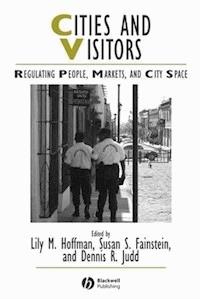
Cities and Visitors E-Book
20,99 €
Mehr erfahren.
- Herausgeber: John Wiley & Sons
- Kategorie: Wissenschaft und neue Technologien
- Serie: Studies in Urban and Social Change
- Sprache: Englisch
The authors of this book use regulation theory to bring theoretical focus and analytic clarity to the study of urban tourism. * Provides a unifying analytic framework for the study of urban tourism. * Brings urban tourism into focus as an important political, economic and cultural phenomenon. * Presents original essays written by established scholars, including studies of Venice, Mexico, Montreal, New York, Los Angeles, London, Barcelona, Berlin, Amsterdam, Paris, and Australia's Gold Coast.
Sie lesen das E-Book in den Legimi-Apps auf:
Seitenzahl: 471
Veröffentlichungsjahr: 2011
Ähnliche




















Contents
List of Illustrations
List of Tables
List of Contributors
Series Editors’ Preface
Preface
Introduction
Theoretical Framework
Types of Regulation
Scale, Disaggregation, Difference
Organization of the Book
Part I
1 Visitors and the Spatial Ecology of the City
The Construction of Tourist Enclaves
Tourist Enclaves as “Total Regulation” Regimes
The Complex Spatiality of Urban Tourism
Modes of Resistance
NOTES
REFERENCES
2 Cities, Security, and Visitors: Managing Mega-Events in France
The World Soccer Cup of 1998
The Millennium Celebrations5
The Risks and the Benefits of Mega-Events
NOTES
REFERENCES
3 Sociological Theories of Tourism and Regulation Theory
Critical Theory
Relational Theory
Sustainable Tourism
City Users and Hypertourists
Hypertourism and Venice
Collaboration Theory as a Regulation Theory of Tourism
Conclusion
NOTES
REFERENCES
Part II
4 Amsterdam: It’s All in the Mix
Creating the Assets of Amsterdam’s Tourism
Crisis-Generated Restructuring of the City Center
Amsterdam’s Contested Image
Conclusion
REFERENCES
5 Revalorizing the Inner City: Tourism and Regulation in Harlem
Social/Spatial Inequality in the Post-Fordist City
Global Forces/Local Conditions: Tourism and Development in Harlem
Emerging Issues: The View from Harlem
Tourism and Changing Social/Political Realities
Looking Forward, Looking Back
NOTES
REFERENCES
6 Barcelona: Governing Coalitions, Visitors, and the Changing City Center
Stage One: The Planning Freeze under Franco
Stage Two: Modernization under Strong Local Leadership
Stage Three: Consolidating the City of Visitors
Tourism and the Flexible Labor Market: An Example of National Regulation
Conclusion
REFERENCES
7 The Evolution of Australian Tourism Urbanization
Introduction
Tourism Urbanization
Australian Tourism Urbanization
The Land Economy and Australian Tourism Urbanization
The Gold Coast
Conclusion
REFERENCES
Part III
8 Regulating Hospitality: Tourism Workers in New York and Los Angeles
The New York and Los Angeles Tourism Industries
Employment and Labor Market Characteristics
Tourism and Local Regulation
Theoretical Significance
NOTES
REFERENCES
9 Shaping the Tourism Labor Market in Montreal
Tourism Development in Montreal since the 1960s
The Tourism Labor Market in Montreal
Conclusion
NOTES
Part IV
10 Mexico: Tensions in the Fordist Model of Tourism Development
Introduction
Mexico: From Individual Experience to Mass Tourism
From Mass Tourism to Flexible Organization, 1985–2002
Conclusion
11 The New Berlin: Marketing the City of Dreams
Introduction
Staging “The New Berlin”: Urban Marketing and Construction Site Tourism
Potsdamer Platz, the Creation of a Tourist Attraction Ex Nihilo
Marketed Spaces, Living Spaces: Cultural and Material Conflicts over the Marketing of “The New Berlin”
Conclusion
12 Museums as Flagships of Urban Development
Introduction: The Growing Importance of the Cultural Economy of Cities
The Emergence and Transformation of the Modern Museum
Urban Cultural Tourism and Museums
The Changing Nature of the Museum
Creation of Spectacle: Museums and Signature Architecture
Flagship Museums as Anchors of Regeneration
Regime, Scale, and Museum Development
Conclusion
REFERENCES
Part V
13 Making Theoretical Sense of Tourism
Why Regulation Theory?
Changing Social Structure and its Impact on the Uses of the City
Promoting Cities – Cultural Capital and Place
The Politics of Regulation
Who Benefits?
Prospects and Limits of Tourism
The Future of Tourism?
Index
Studies in Urban and Social Change
Published by Blackwell in association with the International Journal of Urban and Regional Research. Series editors: Harvey Molotch, Linda McDowell, Margit Mayer, and Chris Pickvance.
Published
Fragmented Societies
Enzo Mingione
Free Markets and Food Riots
John Walton and David Seddon
Post-Fordism
Ash Amin (ed.)
The People’s Home? Social Rented Housing in Europe and America
Michael Harloe
Cities After Socialism: Urban and Regional Change and Conflict in Post-Socialist Societies
Gregory Andrusz, Michael Harloe and Ivan Szelenyi (eds)
Urban Poverty and the Underclass: A Reader
Enzo Mingione
Capital Culture: Gender at Work in the City
Linda McDowell
Contemporary Urban Japan: A Sociology of Consumption
John Clammer
Globalizing Cities: A New Spatial Order?
Peter Marcuse and Ronald van Kempen (eds)
The Social Control of Cities? A Comparative Perspective
Sophie Body-Gendrot
Cinema and the City: Film and Urban Societies in a Global Context
Mark Shiel and Tony Fitzmaurice (eds)
The New Chinese City: Globalization and Market Reform
John R. Logan (ed.)
Understanding the City: Contemporary and Future Perspectives
John Eade and Christopher Mele (eds)
Cities and Visitors: Regulating People, Markets, and City Space
Lily M. Hoffman, Susan S. Fainstein, and Dennis R. Judd (eds)
Forthcoming
European Cities in a Global Age: A Comparative Perspective
Alan Harding (ed.)
Urban South Africa
Alan Mabin and Susan Parnell
Urban Social Movements and the State
Margit Mayer
© 2003 by Blackwell Publishing Ltd
350 Main Street, Malden, MA 02148-5018, USA
108 Cowley Road, Oxford OX4 1JF, UK
550 Swanston Street, Carlton, Victoria 3053, Australia
The right of Lily M. Hoffman, Susan S. Fainstein, and Dennis R. Judd to be identified as the Authors of the Editorial Material in this Work has been asserted in accordance with the UK Copyright, Designs, and Patents Act 1988.
All rights reserved. No part of this publication may be reproduced, stored in a retrieval system, or transmitted, in any form or by any means, electronic, mechanical, photocopying, recording or otherwise, except as permitted by the UK Copyright, Designs, and Patents Act 1988, without the prior permission of the publisher.
First published 2003 by Blackwell Publishing Ltd
Library of Congress Cataloging-in-Publication Data
Cities and visitors: regulating people, markets, and city space / edited by Lily M. Hoffman, Susan S. Fainstein, Dennis R. Judd.
p. cm. — (Studies in urban and social change)
Papers generated by a research collective, the International Tourism Research Group (ITRG), funded by the Council for European Studies, whose member scholars first met in Amsterdam in April 1998 and subsequently in Montreal and in Barcelona.
Includes bibliographical references and index.
ISBN 1-4051-0058-3 (alk. paper) — ISBN 1-4051-0059-1 (pbk.: alk. paper)
1. Tourism. 2. Cities and towns. 3. Tourism—management. I. Hoffman, Lily M.
II. Fainstein, Susan S. III. Judd, Dennis R. IV. Series.
G155.A1C487 2003
338.4'791'091732—dc21
2003044370
List of Illustrations
Plates1.1Times Square, New York, entertainment complex2.1Paris sports fan3.1The Grand Canal, Venice4.1Legalized prostitution in Amsterdam5.1The Apollo Theater, Harlem’s cultural icon6.1Doing business in Barcelona’s medieval center7.1Beachfront property on Australia’s Gold Coast8.1Waiter dressed as action hero at restaurant in Universal City Walk, Los Angeles9.1Tourists in Old Montreal10.1Mexican beach scene11.1“The largest building site in Europe”12.1Inside the Musée D’Orsay, Paris13.1Resistance to plans for a stadium to house Olympic competition on Manhattan’s West SideFigures7.1Location of Australia’s 14 largest urban areas, including the three major tourist centers, and other selected tourist centers12.1Museum building and commercialization process: a conceptual frameworkList of Tables
5.1Repositioning of the US inner-city minority community6.1Number of hotels by category, Barcelona, 1999–20017.1Australia’s 14 largest urban areas at the 2001 Census (ranked) and population change, 1991–20017.2Australia’s top ten tourism destinations for international and domestic tourists (percentage of overnight visitors)7.3Employment in tourism industries: Gold Coast, Sunshine Coast, and Cairns compared (1996) (percentages)8.1New York City visitor arrivals and expenditures, 1991–20028.2Los Angeles visitor arrivals and expenditures, 1991–20008.3New York City tourism-related employment, 1977–19978.4Los Angeles County tourism-related employment, 1977–19979.1Average annual employment income in key tourism occupations in metropolitan Montreal, 1990–19959.2Work, status, and gender composition of key tourism occupations in metropolitan Montreal, 19959.3Income in tourism occupations as proportion of average employment income, Canada’s three largest metropolitan areas, 19959.4Average wages in tourism occupations as proportion of average annual pay, selected US metropolitan areas, 1997 1739.5Unionization rates in selected North American metropolitan areas12.1The ten most visited attractions (millions of visitors) in London, Paris, and New York, 1997 224Contributors
Sophie Body-Gendrot, a political scientist, is Professor of American Studies at the Sorbonne, Paris, and a researcher at CNRS. She is the Director of the Center of Urban Studies in the Anglophone World at the Sorbonne and of a European network of researchers focusing on the dynamics of violence in Europe. She has written and co-edited a dozen books and numerous articles published in Europe and in the US. The author of The Social Control of Cities? A Comparative Perspective (Blackwell, 2000), she has just completed a book (in French) on American society after 9/11.
Núria Claver holds a degree in sociology from the Universitat de Barcelona. Her MA dissertation was on Barcelona’s old city regeneration. She is currently involved in two European research projects: “The socioeconomic performance of social enterprises in the field of integration by work” and “Transformations des structures familiales et évolution des politiques sociales.”
Claire Colomb will complete a PhD in Town Planning at the Bartlett School of Architecture and Planning, University College London (UCL) in 2003. Her dissertation is entitled “City marketing and urban planning in the new Berlin: urban policy-making between the global and the local.” She is currently working as Project Developer in the European Union Programme on Transnational Co-operation in Spatial Planning, while teaching part-time at the Bartlett School of Planning, UCL.
Nicolò Costa is Associate Professor of the Sociology of Tourism at Milano Bicocca University and Director of the Observatory on Religious and Cultural Tourism in Italy. He has published a number of papers on tourism and tourism education.
Leon Deben is Associate Professor and Chair of the Department of Sociology and Anthropology at the University of Amsterdam. He has written about the culture of the working class in the Netherlands, urban renewal, homelessness, and changes in the use of urban public space.
Susan S. Fainstein is Professor of Urban Planning in the School of Architecture, Planning and Preservation at Columbia University, New York. With Dennis Judd she is co-editor of The Tourist City. Among her other books is The City Builders, now in a second edition. In her various published works she has written about urban redevelopment, planning theory, comparative public policy, and urban social movements.
Marisol García lectures at the University of Barcelona. She is a member of the editorial board of the International Journal of Urban and Regional Research, and has been a Visiting Fellow at St Antony’s College (Oxford), a Research Fellow at the Royal Institute of International Affairs (London), and a Visiting Fellow at the European University Institute (Florence) and the University of Amsterdam. Among her recent publications is Does a Southern European Model Exist? (2001) (with various authors).
David L. Gladstone is an Assistant Professor at the College of Urban and Public Affairs, University of New Orleans. He has written on urban tourism and economic development and is currently writing a book on the nature and impact of tourism in developing countries.
Chris Hamnett is Professor of Geography at King’s College London. He was previously Professor of Urban Geography at the Open University. Among his publications are Winners and Losers: The Housing Market in Modern Britain, Unequal City: London in the Global Arena, and Shrinking the State: Privatization in Comparative Perspective. He has held numerous visiting appointments including Nuffield College Oxford and the Netherlands Institute of Advanced Studies. He currently holds an advisory professorship at East China Normal University, Shanghai.
Hartmut Häussermann was Professor for Urban Sociology and Local Administration at the Universities of Kassel and Bremen. Since 1993, he has been teaching at Humboldt-University of Berlin. President of Research Committee 21 of the ISA, his research interests include changes and restructuring of the united Berlin, new forms of social and spatial segregation and exclusion in European cities, and urban governance.
Daniel Hiernaux-Nicolas is the Director of the Human Geography Program at the Metropolitan Autonomous University of Mexico City, Campus Iztapalapa. He is a specialist in tourism studies and urban and regional questions in Mexico and the author of numerous books about these topics. His latest work is Metropolis and Ethnicity (in Spanish), published by El Colegio Mexiquense, 2000. His most recent research is a study of social tourism in Mexico, financed by the Federal Ministry of Tourism.
Lily M. Hoffman is Associate Professor of Sociology and Director of the Rosenberg/Humphrey Program in Public Policy at City College/CUNY, and a member of the sociology faculty at the CUNY Graduate Center. She has written (with Jiri Musil) about urban tourism in post-Communist Prague. She is interested in how restructuring economies affect formerly marginalized inner-city communities with a focus on issues of social and spatial inclusion/exclusion. She is the author of The Politics of Knowledge: Activist Movements in Medicine and Planning (SUNY Press).
Dennis R. Judd is a Professor in the Department of Political Science, University of Illinois at Chicago. He is editor of the “Globalization and Community” book series for the University of Minnesota Press. He has published extensively on urban politics, urban development, urban tourism, and related subjects. Most recently he co-edited with Susan S. Fainstein The Tourist City and edited The Infrastructure of Play: Building the Tourist City (M. E. Sharpe, 2003).
Marc V. Levine is Director of the Center for Economic Development and Director of the Center for Canadian-American Policy Studies at the University of Wisconsin-Milwaukee, where he is Professor of History and Urban Studies. He also holds a visiting professorship at l’Institut National de la Recherche Scientifique-Urbanisation at l’Université du Québec in Montreal. He is the author or co-author of four books, including, most recently, La Reconquête de Montréal, and he has written numerous articles on urban development, economic policy, and social inequality. He is currently working on a book comparing the impact of tourism-based urban redevelopment in Baltimore and Montreal since the 1960s.
Guido Martinotti holds the Chair of Urban Sociology at the Università degli studi di Milano-Bicocca, in which he is also currently Pro-rector. Since 1985 he has been annually Visiting Professor at the Department of Sociology of the University of California at Santa Barbara. He has been Chairman of the Standing Committee for the Social Sciences of the European Science Foundation, member of the board of the European Science and Technology Assembly and is currently Chairman of the Social Science Committee of Academia Europaea. He has written extensively on urban social change and the sociology of knowledge.
Patrick Mullins is Reader in Sociology at the University of Queensland. He has had a long-standing interest in the way tourism effects new urban forms, with his research focusing empirically on Australia’s two major tourist centers, the Gold Coast and the Sunshine Coast. Currently he is involved in an international study of urban quality of life, as a member of the Australian research team that is examining quality of life in South East Queensland, a rapidly growing urban region that includes the Gold Coast and the Sunshine Coast.
Noam Shoval is a lecturer in the Department of Geography of the Hebrew University of Jerusalem. He conducted his post-doctoral research at the Department of Geography, King’s College, University of London (2000–1). He was the recipient of the Lord Goodman Chevening Postdoctoral fellowship (2000) and a Fulbright post-doctoral award (2000). His main research interests are tourism and culture as tools for urban regeneration, models of hotel location, spatial activity of tourists and tourism management in heritage cities.
Pieter Terhorst is Associate Professor of Urban and Economic Geography at the University of Amsterdam, Department of Geography and Planning. His published works concern housing, the informal economy, and regimes and urban trajectories.
Jacques van de Ven is Associate Professor of Economic Geography at the University of Amsterdam and Professor of Urban Affairs at the College of Professional Education at The Hague.
Series Editors’ Preface
The Blackwell Studies in Urban and Social Change series aims to advance theoretical debates and empirical analyses stimulated by changes in the fortunes of cities and regions across the world. Among topics taken up in past volumes and welcomed for future submissions are:
Connections between economic restructuring and urban changeUrban divisions, difference, and diversityConvergence and divergence among regions of east and west, north, and southUrban and environmental movementsInternational migration and capital flowsTrends in urban political economyPatterns of urban-based consumption and symbolic systemsThe series is explicitly interdisciplinary; the editors judge books by their contribution to intellectual solutions rather than according to disciplinary origin.
Proposals may be submitted to members of the series Editorial Committee:
Harvey Molotch
Linda McDowell
Margit Mayer
Chris Pickvance
Preface
This book had its genesis in a research collective, the International Tourism Research Group (ITRG), funded by the Council for European Studies. Although tourism had become an increasingly important sector of the global economy and shaper of cities, scholarship had yet to treat it with the seriousness accorded to other urban topics. Our aim was to place tourism within a theoretical perspective so as to enable comparative research. Our group, made up of eminent urban scholars from a number of countries, met three times. Our first meeting was held in Amsterdam in April 1998; we subsequently met in Montreal and in Barcelona. The meetings were considerably enhanced by the tourism opportunities presented by the three cities in which we conferred and the stimulating company of our conferees.
At our last meeting we decided to place tourism and travel within the framework of regulation theory. We struggled together to fit empirical data within a theoretical framework that would allow the complexities of scale and the multidimensionality of factors with which we were engaged to remain intact. The individual chapters of this book, which originated as papers presented at this conference, reflect our ongoing effort toward analytic clarity.
We wish to thank the Council for European Studies for its initial grant, and City College of the City University of New York, the University of Missouri at Saint Louis, the University of Amsterdam, and the University of Illinois at Chicago for their ongoing support. Many individuals also contributed to this book. We appreciate the able assistance of Núria Claver, Gina Neff, Grace Han, Roosmarijn Gerritsma, Aitor Gómez and Daniel Bliss.
Lily M. Hoffman
Susan S. Fainstein
Dennis R. Judd
Introduction
Susan S. Fainstein, Lily M. Hoffman, and Dennis R. Judd
In recent decades cities have fought hard to insert themselves into the “space of flows” of global tourism (Castells 2000). The scale of investment has been significant: In only two or three decades, the infrastructure of travel has transformed cityscapes, prompted the construction of airports, mass transportation systems, and urban amenities, and even forced governments to address long-standing environmental problems (Judd et al. 2002). Urban regimes have especially focused on the competition for tourists because, unlike other economic sectors where central cities lose out to peripheral areas, in the case of tourism, the urban core dominates the metropolitan area. Their history, architectural heritage, inimitable cultural assets and qualities, and clusters of amenities give older central cities built-in advantages as tourist destinations. Even within resort areas where travelers may be seeking beauty and solitude, major agglomerations boasting multiple sites for shopping and dining typically spring up. Though some aspects of urban tourism may be suburbanizing, the advantages that favor cities are not likely to disappear.
Cities have attempted to attract tourists by persuading national governments to finance large tourism-related infrastructure projects and by promoting such projects on their own. Many of the bitterest political issues in recent decades have revolved around the question of whether disproportionate resources should be devoted to the promotion of middle-class leisure when poverty and its attendant social problems are neglected (Harvey 2001: 345–68; Eisinger 2000). Despite criticisms about its effects, however, the high priority afforded to tourist development by city leaders will undoubtedly continue, in light of its character as an export industry that offers opportunities for unskilled workers.
Lesen Sie weiter in der vollständigen Ausgabe!
Lesen Sie weiter in der vollständigen Ausgabe!
Lesen Sie weiter in der vollständigen Ausgabe!
Lesen Sie weiter in der vollständigen Ausgabe!
Lesen Sie weiter in der vollständigen Ausgabe!
Lesen Sie weiter in der vollständigen Ausgabe!
Lesen Sie weiter in der vollständigen Ausgabe!
Lesen Sie weiter in der vollständigen Ausgabe!
Lesen Sie weiter in der vollständigen Ausgabe!
Lesen Sie weiter in der vollständigen Ausgabe!
Lesen Sie weiter in der vollständigen Ausgabe!
Lesen Sie weiter in der vollständigen Ausgabe!
Lesen Sie weiter in der vollständigen Ausgabe!
Lesen Sie weiter in der vollständigen Ausgabe!
Lesen Sie weiter in der vollständigen Ausgabe!
Lesen Sie weiter in der vollständigen Ausgabe!
Lesen Sie weiter in der vollständigen Ausgabe!
Lesen Sie weiter in der vollständigen Ausgabe!
Lesen Sie weiter in der vollständigen Ausgabe!




