


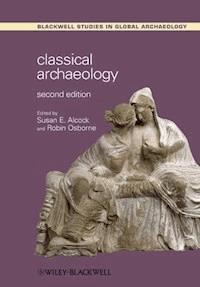
Classical Archaeology E-Book
34,99 €
Mehr erfahren.
- Herausgeber: John Wiley & Sons
- Kategorie: Geisteswissenschaft
- Serie: Blackwell Studies in Global Archaeology
- Sprache: Englisch
The fully revised second edition of this successful volume includes updates on the latest archaeological research in all chapters, and two new essays on Greek and Roman art. It retains its unique, paired essay format, as well as key contributions from leading archaeologists and historians of the classical world.
- Second edition is updated and revised throughout, showcasing the latest research and fresh theoretical approaches in classical archaeology
- Includes brand new essays on ancient Greek and Roman art in a modern context
- Designed to encourage critical thinking about the interpretation of ancient material culture and the role of modern perceptions in shaping the study of art and archaeology
- Features paired essays – one covering the Greek world, the other, the Roman – to stimulate a dialogue not only between the two ancient cultures, but between scholars from different historiographic and methodological traditions
- Includes maps, chronologies, diagrams, photographs, and short editorial introductions to each chapter
Sie lesen das E-Book in den Legimi-Apps auf:
Seitenzahl: 1057
Veröffentlichungsjahr: 2012
Ähnliche




















Table of Contents
Cover
BLACKWELL STUDIES IN GLOBAL ARCHAEOLOGY
Title page
Copyright page
List of Figures
Notes on Contributors
Introduction
Why Classical Archaeology?
What Sort of Classical Archaeology?
The Archaeology of an Alien World
How This Guide to Classical Archaeology is Organized
1 What is Classical Archaeology?
1 (a) What is Classical Archaeology?
Connoisseurship
Greek Architecture
Topography and Regional Survey
Chronology
Conclusion
1 (b) What Is Classical Archaeology?
Definitions and Perceptions
Historical Perspectives: Origins
Historical Perspectives: Development
Contrasting Social Contexts: Britain and the United States of America
A New Classical Archaeology
Classical Archaeology Today
Prospects
ACKNOWLEDGMENTS
2 Doing Archaeology in the Classical Lands
2 (a) Doing Archaeology in the Classical Lands
Learning to Do Classical Archaeology: An American Perspective
Doing Mediterranean Archaeology At Last
The Institutions of Archaeology in the Eastern Mediterranean
Directing Fieldwork in the Mediterranean for the First Time
Fin de Siècle Classical Archaeology in Greece
Doing Classical Archaeology in Albania
Doing Archaeology in the New Millennium
ACKNOWLEDGMENTS
2 (b) Doing Archaeology in the Classical Lands
How Is Research Generated?
Organizing a Project: Thoughts Between the Lines
Doing Specifically Classical Archaeology: Three Case Histories
Conclusion
3 Human Ecology and the Classical Landscape
3 Human Ecology and the Classical Landscape
The Mediterranean Context of Greek Society
Adaptations to the Mediterranean in the Classical Greek World
Managing Soils: Terracing and Drainage
Cultivation Technologies and Techniques: Plows and Plowing
Arboriculture
Gardens
Pastoralism, Transhumance, and Seasonality
Contrasting Ecological Strategies of the Greek and Roman Worlds
Northern Expansion
Southern Expansion
Meadows, Gardens, and Moldboard Plows
Contrasts in the Ecology of the Classical World
4 The Essential Countryside
4 (a) The Essential Countryside
The Greek Polis
Exploring the Chora
What Is Found in the Countryside?
The Countryside Through Time: The Archaic to Late Roman Periods
Outside Greece: The Hellenistic World
4 (b) The Essential Countryside
Chronological Development
Some Thematic Elements
Conclusion
5 Urban Spaces and Central Places
5 (a) Urban Spaces and Central Places
Urban Spaces: Conditions and Mirrors of Social Life
The Origin of the Polis in the Eighth and Seventh Century B.C.: Structuring Social Spaces
Civic Density and Monumentalization of Public Spaces in Archaic Times
The Political Activation of Public Centers in Classical Times
Visualizing Public Order and Political Identity in Late Classical and Hellenistic Times
5 (b) Urban Spaces and Central Places
Introduction
Centrality—Without Really Trying
Centrality—Thinking Very Hard About It
Effects of the Center on Its Periphery: Territoriality and Space
Centrality and the Ideology of the Roman Town
On Roman Imperial Space
Rome in Context: The City to Which All Roads Lead
6 Housing and Households
6 (a) Housing and Households in Ancient Greece
Domestic Space in the Early Iron Age: Defining a “House”
Eighth-century Housing: Social Revolution?
The Fifth and Fourth Centuries: Spatial Organization and Social Control
From the Later Classical into the Hellenistic Period: Housing as Status Symbol
The Second and First Centuries B.C.: Housing and Cultural Identity
Conclusion
6 (b) Housing and Households
The Atrium House
The Peristyle House
Insulae and Multiple Dwellings
Villas
Interior Décor
Conclusion
7 Cult and Ritual
7 (a) Cult and Ritual
Introduction
Cult Acts
Placing Cult
The Margins of Religion
7 (b) Cult and Ritual
Introduction: Evidence and Theory
What Was Roman about Roman Religion?
What Was Material about Roman Religious Culture?
The Diffusion of Roman Religion
The Adaptability of Roman Religions
The Ends of Roman Religion
Conclusion
8 The Personal and the Political
8 (a) The Personal and the Political
The Problem of the Individual in Archaeology
A Little History
Sources, Written and Material
The Image of Alexander
City Foundations and the Spread of Hellenism
Epilogue: Alexander “the Great”?
8 (b) The Personal and the Political
General Patterns
Where Personalities Emerge
Conclusion
9 The Creation and Expression of Identity
9 (a) The Creation and Expression of Identity
The Archaeology of Identity
The Elusive Dorians: Archaeology and Ethnicity
Taming the Elite: The Material Expression of Athenian Democracy
Colonialism and Hybridity
Conclusion
9 (b) The Creation and Expression of Identity
Clothes and Language: What Is “Hellenization”?
Romanizing Italy
Romanizing the Barbarian: Baths and Seduction
10 Linking with a Wider World
10 (a) Linking with a Wider World
Prehistoric Prelude: Contacts East and West
Famished Colonists and Thirsty Barbarians: Greeks and Others Overseas
The Classical Moment: Greeks and “Barbarians”
Hellenism Abroad: Macedon and After
10 (b) Linking with a Wider World
The Roman Republic and the Wider World
Exchanging Things within the Roman Empire
Exchange and Identity on the Frontiers
11 A Place for Art?
11 (a) Putting the Art into Artifact
The Roman-ness of Greek Art and the Greek-ness of Roman Art
But Is It Art?
Studying and Sensing
Embracing Incongruity
Conclusion
11 (b) Classical Archaeology and the Contexts of Art History
I
II
III
Prospective
Index
BLACKWELL STUDIES IN GLOBAL ARCHAEOLOGY
Series Editors: Lynn Meskell and Rosemary A. Joyce
Blackwell Studies in Global Archaeology is a series of contemporary texts, each carefully designed to meet the needs of archaeology instructors and students seeking volumes that treat key regional and thematic areas of archaeological study. Each volume in the series, compiled by its own editor, includes 12-15 newly commissioned articles by top scholars within the volume’s thematic, regional, or temporal area of focus.
What sets the Blackwell Studies in Global Archaeology apart from other available texts is that their approach is accessible, yet does not sacrifice theoretical sophistication. The series editors are committed to the idea that useable teaching texts need not lack ambition. To the contrary, the Blackwell Studies in Global Archaeology aim to immerse readers in fundamental archaeological ideas and concepts, but also to illuminate more advanced concepts, thereby exposing readers to some of the most exciting contemporary developments in the field. Inasmuch, these volumes are designed not only as classic texts, but as guides to the vital and exciting nature of archaeology as a discipline.
1 Mesoamerican Archaeology: Theory and Practice
Edited by Julia A. Hendon and Rosemary A. Joyce
2 Andean Archaeology
Edited by Helaine Silverman
3 African Archaeology: A Critical Introduction
Edited by Ann Brower Stahl
4 Archaeologies of the Middle East: Critical Perspectives
Edited by Susan Pollock and Reinhard Bernbeck
5 North American Archaeology
Edited by Timothy R. Pauketat and Diana DiPaolo Loren
6 The Archaeology of Mediterranean Prehistory
Edited by Emma Blake and A. Bernard Knapp
7 Archaeology of Asia
Edited by Miriam T. Stark
8 Archaeology of Oceania: Australia and the Pacific Islands
Edited by Ian Lilley
9 Historical Archaeology
Edited by Martin Hall and Stephen W. Silliman
10 Classical Archaeology, Second Edition
Edited by Susan E. Alcock and Robin G. Osborne
11 Prehistoric Europe
Edited by Andrew Jones
12 Prehistoric Britain
Edited by Joshua Pollard
13 Egyptian Archaeology
Edited by Willeke Wendrich
14 Social Bioarchaeology
Edited by Sabrina C. Agarwal and Bonnie A. Glencross
This second edition first published 2012
© 2012 Blackwell Publishing Ltd
Edition History: Blackwell Publishing Ltd (1e, 2007)
Blackwell Publishing was acquired by John Wiley & Sons in February 2007. Blackwell’s publishing program has been merged with Wiley’s global Scientific, Technical, and Medical business to form Wiley-Blackwell.
Registered Office
John Wiley & Sons Ltd, The Atrium, Southern Gate, Chichester, West Sussex, PO19 8SQ, UK
Editorial Offices
350 Main Street, Malden, MA 02148-5020, USA
9600 Garsington Road, Oxford, OX4 2DQ, UK
The Atrium, Southern Gate, Chichester, West Sussex, PO19 8SQ, UK
For details of our global editorial offices, for customer services, and for information about how to apply for permission to reuse the copyright material in this book please see our website at www.wiley.com/wiley-blackwell.
The right of Susan E. Alcock and Robin Osborne to be identified as the authors of the editorial material in this work has been asserted in accordance with the UK Copyright, Designs and Patents Act 1988.
All rights reserved. No part of this publication may be reproduced, stored in a retrieval system, or transmitted, in any form or by any means, electronic, mechanical, photocopying, recording or otherwise, except as permitted by the UK Copyright, Designs and Patents Act 1988, without the prior permission of the publisher.
Wiley also publishes its books in a variety of electronic formats. Some content that appears in print may not be available in electronic books.
Designations used by companies to distinguish their products are often claimed as trademarks. All brand names and product names used in this book are trade names, service marks, trademarks or registered trademarks of their respective owners. The publisher is not associated with any product or vendor mentioned in this book. This publication is designed to provide accurate and authoritative information in regard to the subject matter covered. It is sold on the understanding that the publisher is not engaged in rendering professional services. If professional advice or other expert assistance is required, the services of a competent professional should be sought.
Library of Congress Cataloging-in-Publication Data applied for
Paperback ISBN: 978-1-4443-3691-7
ISBN: 978-1-1182-5515-5 (epdf)
ISBN: 978-1-1182-5516-2 (epub)
ISBN: 978-1-1182-5514-8 (mobi)
A catalogue record for this book is available from the British Library.
List of Figures
Notes on Contributors
Susan E. Alcock is Director of the Joukowsky Institute for Archaeology and the Ancient World, Joukowsky Family Professor of Archaeology and Professor of Classics and Anthropology at Brown University. Her research interests include the Hellenistic and Roman Eastern Mediterranean, landscape archaeology, and archaeologies of memory and imperialism. She has been involved with several regional archaeological projects in Greece and Armenia, and is currently co-directing fieldwork in and near the major site of Petra, southern Jordan.
Bettina Bergmann is Helene Philips Herzig ’49 Professor of Art at Mount Holyoke College. Her research concerns the Roman art of landscape, domestic space, and the reception and reconstruction of ancient houses and villas.
John F. Cherry is Joukowsky Family Professor of Archaeology in the Joukowsky Institute for Archaeology and the Ancient World at Brown University, where he is also Professor of Classics and Anthropology. He is an Aegean prehistorian, whose current research interests include the archaeology of islands, landscape archaeology, lithic analysis, and reception studies of Alexander the Great. His fieldwork has mainly involved archaeological surveys in Greece, Italy, and Armenia, and he is currently co-directing a project on Montserrat in the West Indies.
Penelope J. E. Davies is Associate Professor in the Department of Art and Art History, College of Fine Arts, University of Texas at Austin. Her research focuses on the roles of state art and architecture in the political life of Rome during the Republic and the Empire.
Jack L. Davis is Carl W. Blegen Professor of Greek Archaeology at the University of Cincinnati and Director of the American School of Classical Studies at Athens. His research interests include landscape archaeology, Greek prehistory, and the rural history of Ottoman and Venetian Greece. He has directed or co-directed several regional archaeological projects in Greece and Albania, has excavated a Greek temple at Apollonia and is currently studying unpublished finds from the Palace of Nestor at Pylos in Greece.
Hamish Forbes is Senior Lecturer in Archaeology at Nottingham University. His main research interests lie in the study of recent and modern Mediterranean landscapes and their communities and how they impact on our understanding of the archaeological and historical records.
Lin Foxhall, Professor of Greek Archaeology and History in the School of Archaeology and Ancient History, University of Leicester, was educated at Bryn Mawr College, University of Pennsylvania and the University of Liverpool. She has also held posts at Oxford University and University College London. She has published extensively on gender in classical antiquity, as well as on agriculture and the ancient economy.
Jonathan M. Hall is the Phyllis Fay Horton Distinguished Service Professor in the Humanities and Professor of History and Classics at the University of Chicago. His research interests include ethnic and cultural identities in Greek antiquity, issues of historical method in Greek protohistory, and the relationship between history and archaeology.
Tonio Hölscher is Professor emeritus of Classical Archaeology at the University of Heidelberg, Germany. His main research field is Greek and Roman figurative art in political, social and religious contexts; this embraces studies of urbanism as well as aesthetic theory. His current research projects include political monuments in the ancient world and the use of images in social practice.
Henry Hurst is Reader in Classical Archaeology at the University of Cambridge. His main research interest is urban archaeology and he is currently involved with publishing work on the Santa Maria Antiqua complex in Rome. He also continues to be involved in the archaeology of Carthage and Roman Britain, where he worked previously.
Martin Jones is George Pitt-Rivers Professor of Archaeological Science at the University of Cambridge. His field of interest is bio-archaeology and the spread and development of agricultural practices and crops.
Martin Millett is Laurence Professor of Classical Archaeology at Cambridge University and a Fellow of Fitzwilliam College. His principal interests are in the social and economic archaeology of the Roman empire. He has run field surveys and excavations in Britain, Spain, Portugal and Italy.
Sarah P. Morris is a classicist and archaeologist in the Department of Classics and the Cotsen Institute of Archaeology at UCLA, where she was named the Steinmetz Professor of Classical Archaeology and Material Culture in 2001. Her teaching and research interests include early Greek literature (Homer, Hesiod, and Herodotus), Greek religion, prehistoric and early Greek archaeology, especially, ceramics, architecture and landscape studies, and Near Eastern influence on Greek art and culture. She has excavated in Israel, Turkey, Greece, and Albania.
Lisa Nevett is Professor of Classical Archaeology at the University of Michigan, Ann Arbor. Her research involves using interdisciplinary approaches to the built environment as a way of addressing large-scale questions about Greek and Roman society.
Robin Osborne is Professor of Ancient History at the University of Cambridge. He has published widely on topics in Greek archaeology, art, and history, including Classical Landscape with Figures (London, 1987), Greece in the Making, c. 1200–479 B.C. (London, 1996) and Archaic and Classical Greek Art (Oxford, 1998), Athens and Athenian Democracy (Cambridge, 2010) and The History Written on the Classical Greek Body (Cambridge 2011).
Nicholas Purcell is Camden Professor of Ancient History at the University of Oxford. He works on ancient social, economic and cultural history and is also interested in the history of the Mediterranean over the longer term.
Christopher Smith is Professor of Ancient History at the University of St Andrews and is currently Director of the British School at Rome. His research interests include early Rome, ancient religion and ancient rhetoric and historiography. He has recently completed a book on the Roman gens.
Anthony Snodgrass was Laurence Professor of Classical Archaeology at the University of Cambridge from 1976 to 2001. He has worked for many years primarily on the archaeology and history of pre-Classical Greece, more recently also on the intellectual and disciplinary background of Classical Archaeology. He has a long-standing involvement in intensive field survey in Greece.
Michael Squire is Lecturer in Classical Greek Art at King’s College, London. His research deals with all aspects of Graeco-Roman visual culture, as well as its abiding western influence: this is reflected in his two most recent books, concerned with Graeco-Roman representations of the body on the one hand, and the so-called “Iliac tablets” on the other.
Nicola Terrenato is Professor of Classical Archaeology at the University of Michigan at Ann Arbor. He directs the Gabii project and has conducted extensive fieldwork in and around Rome and in Northern Etruria. His research interests include Roman imperialism and colonialism, field survey methods and early Roman landscapes.
Caroline Vout is Senior Lecturer in Classics at the University of Cambridge and a Fellow of Christ’s College. She has published widely on topics in Roman history and Latin literature, Greek and Roman art and its reception and, in 2006, curated the international exhibition of ancient sculpture, Antinous: the Face of the Antique, at the Henry Moore Institute in Leeds. In 2009, she was awarded a Philip Leverhulme Prize for her work on ancient visual culture.
Andrew Wallace-Hadrill is Director of the British School at Rome and Professor of Classics at the University of Reading. His work lies in the area of Roman social and cultural history, from imperial ideology to domestic space. He is involved in various projects in Italy, and directs a project of conservation and research at Herculaneum.
Jane Webster is Lecturer in Historical Archaeology at the University of Newcastle-upon-Tyne (UK), where she teaches and researches on colonial archaeology in both the Roman and early modern periods. A former Caird Senior Research Fellow at the National Maritime Museum, Greenwich, she is currently working on a study of the material culture of slave shipping.
Introduction
Robin Osborne and Susan E. Alcock
Why Classical Archaeology?
Unlike “Mesoamerican Archaeology,” “North American Archaeology” or “The Archaeology of Mediterranean Prehistory,” “Classical Archaeology” is a title with strong, and not entirely positive, connotations. The title “classical” carries with it a claimed value judgment that is quite absent from the geographical or period titles of other volumes in this series. In fact, the “classical” of “classical archaeology” does not directly apply to the archaeology—“classical archaeology” is not the archaeology of material that has acquired “classic” status. It applies rather to the “Classical World,” that is, the world that has left us the literature that has acquired “classic” status in western civilization. This is the world inhabited by Greeks and Romans between the eighth century B.C. and the fourth century A.D. “classical archaeology” is the archaeology of that world.
It is not difficult to envisage an archaeological guide that treated Greece with its Near Eastern neighbors or one that subsumed imperial Rome into the early Christian world. Our decision to treat Greek and Roman civilization as a single “classical” whole is traditional but it is neither innocent nor inconsequential. It is a decision that both reflects and perpetuates the claims that have been made by Europeans and their descendants repeatedly since the Renaissance for the unique status of the ancient Greek and Roman worlds. The intellectual understanding of the world and how to live in the world, and the literary expression of that understanding achieved in Greece and Rome, have been hailed as the necessary basis for civilized life. It has been the spreading of this “classical” understanding of the world which, along with the spreading of Christianity, has underpinned, and served to justify western imperialism. The imperialism of our own day, with its stress on democracy, continues to draw a significant amount of its power from the claim that democracy was invented by the ancient Greeks.
Lesen Sie weiter in der vollständigen Ausgabe!
Lesen Sie weiter in der vollständigen Ausgabe!
Lesen Sie weiter in der vollständigen Ausgabe!
Lesen Sie weiter in der vollständigen Ausgabe!
Lesen Sie weiter in der vollständigen Ausgabe!
Lesen Sie weiter in der vollständigen Ausgabe!
Lesen Sie weiter in der vollständigen Ausgabe!
Lesen Sie weiter in der vollständigen Ausgabe!
Lesen Sie weiter in der vollständigen Ausgabe!
Lesen Sie weiter in der vollständigen Ausgabe!
Lesen Sie weiter in der vollständigen Ausgabe!
Lesen Sie weiter in der vollständigen Ausgabe!
Lesen Sie weiter in der vollständigen Ausgabe!




