


SONDERANGEBOT
SONDERANGEBOT
74,89 €
Niedrigster Preis in 30 Tagen: 64,19 €
74,89 €
Niedrigster Preis in 30 Tagen: 64,19 €
Niedrigster Preis in 30 Tagen: 64,19 €
-100%
Sammeln Sie Punkte in unserem Gutscheinprogramm und kaufen Sie E-Books und Hörbücher mit bis zu 100% Rabatt.
Mehr erfahren.
Mehr erfahren.
- Herausgeber: Springer Singapore
- Kategorie: Wissenschaft und neue Technologien
- Sprache: Englisch
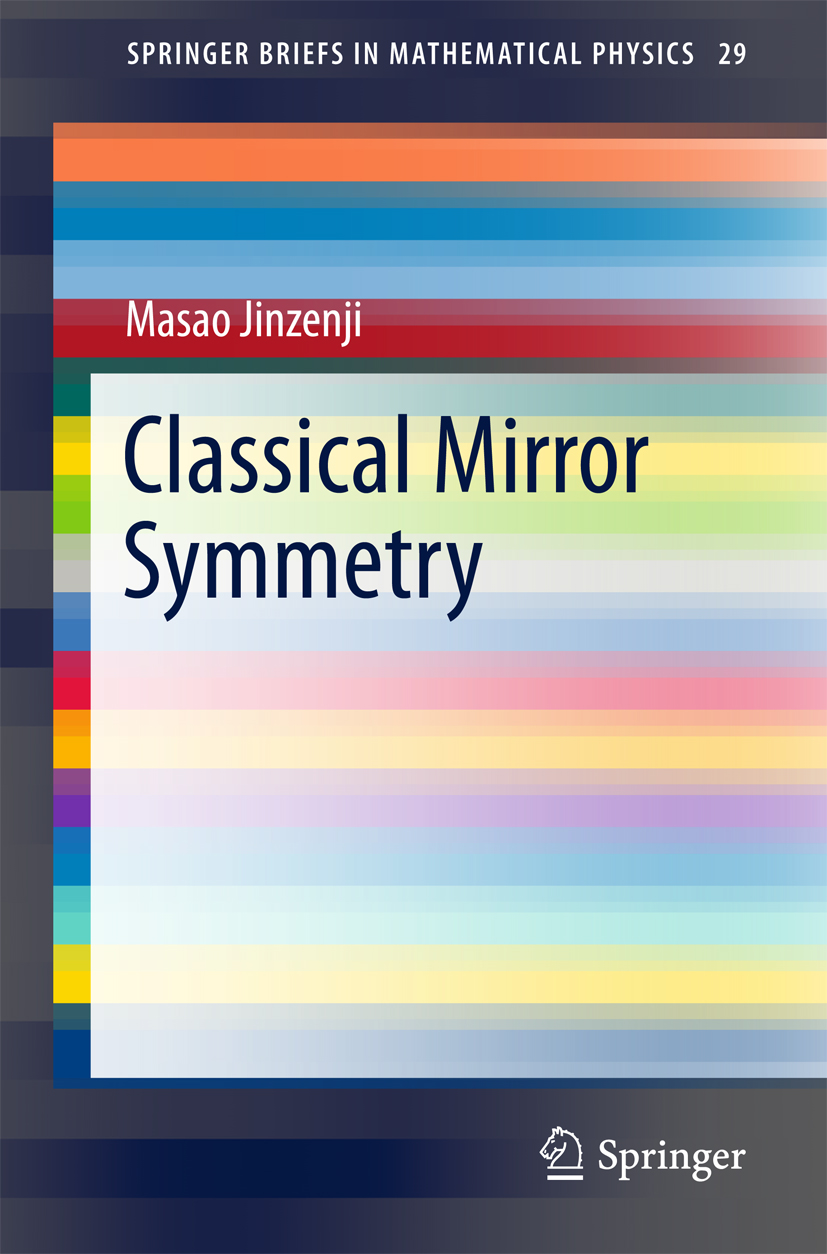
This book furnishes a brief introduction to classical mirror symmetry, a term that denotes the process of computing Gromov–Witten invariants of a Calabi–Yau threefold by using the Picard–Fuchs differential equation of period integrals of its mirror Calabi–Yau threefold. The book concentrates on the best-known example, the quintic hypersurface in 4-dimensional projective space, and its mirror manifold.
First, there is a brief review of the process of discovery of mirror symmetry and the striking result proposed in the celebrated paper by Candelas and his collaborators. Next, some elementary results of complex manifolds and Chern classes needed for study of mirror symmetry are explained. Then the topological sigma models, the A-model and the B-model, are introduced. The classical mirror symmetry hypothesis is explained as the equivalence between the correlation function of the A-model of a quintic hyper-surface and that of the B-model of its mirror manifold.
On the B-model side, the process of construction of a pair of mirror Calabi–Yau threefold using toric geometry is briefly explained. Also given are detailed explanations of the derivation of the Picard–Fuchs differential equation of the period integrals and on the process of deriving the instanton expansion of the A-model Yukawa coupling based on the mirror symmetry hypothesis.
On the A-model side, the moduli space of degree d quasimaps from CP^1 with two marked points to CP^4 is introduced, with reconstruction of the period integrals used in the B-model side as generating functions of the intersection numbers of the moduli space. Lastly, a mathematical justification for the process of the B-model computation from the point of view of the geometry of the moduli space of quasimaps is given.
The style of description is between that of mathematics and physics, with the assumption that readers have standard graduate student backgrounds in both disciplines.
Das E-Book können Sie in einer beliebigen App lesen, die das folgende Format unterstützt:
Veröffentlichungsjahr: 2018
0,0
Bewertungen werden von Nutzern von Legimi sowie anderen Partner-Webseiten vergeben.
Legimi prüft nicht, ob Rezensionen von Nutzern stammen, die den betreffenden Titel tatsächlich gekauft oder gelesen/gehört haben. Wir entfernen aber gefälschte Rezensionen.























