


45,99 €
Mehr erfahren.
- Herausgeber: John Wiley & Sons
- Kategorie: Wissenschaft und neue Technologien
- Sprache: Englisch
This book is designed for first- and second-year university students (and their instructors) in earth science, environmental science, and physical geography degree programmes worldwide. The summaries at the end of each section constitute essential reading for policy makers and planners. It provides a simple but masterly account, with a minimum of equations, of how the Earth’s climate system works, of the physical processes that have given rise to the long sequence of glacial and interglacial periods of the Quaternary, and that will continue to cause the climate to evolve. Its straightforward and elegant description, with an abundance of well chosen illustrations, focuses on different time scales, and includes the most recent research in climate science by the United Nations Intergovernmental Panel on Climate Change (IPCC). It shows how it is human behaviour that will determine whether or not the present century is a turning point to a new climate, unprecedented on Earth in the last several million years.
Sie lesen das E-Book in den Legimi-Apps auf:
Seitenzahl: 820
Veröffentlichungsjahr: 2015
Ähnliche



















CLIMATE CHANGE: PAST, PRESENT AND FUTURE
Marie-Antoinette Mélières
Université Grenoble Alpes, France
and
Chloé Maréchal
Université Claude Bernard Lyon 1, France
Translated by
Erik Geissler
Université Grenoble Alpes, France
and Catherine Cox
This edition first published 2015 © by John Wiley & Sons Ltd
© CRDP Académie de Grenoble, first published 2010 as Climat et société. Climats passés, passage de l'homme, climats futurs: repères essentiels by Marie-Antoinette Mélières and Chloé Maréchal.
Registered office: John Wiley & Sons, Ltd, The Atrium, Southern Gate, Chichester, West Sussex, PO19 8SQ, UK
Editorial offices: 9600 Garsington Road, Oxford, OX4 2DQ, UK The Atrium, Southern Gate, Chichester, West Sussex, PO19 8SQ, UK 111 River Street, Hoboken, NJ 07030-5774, USA
For details of our global editorial offices, for customer services and for information about how to apply for permission to reuse the copyright material in this book please see our website at www.wiley.com/wiley-blackwell.
The right of the author to be identified as the author of this work has been asserted in accordance with the UK Copyright, Designs and Patents Act 1988.
All rights reserved. No part of this publication may be reproduced, stored in a retrieval system, or transmitted, in any form or by any means, electronic, mechanical, photocopying, recording or otherwise, except as permitted by the UK Copyright, Designs and Patents Act 1988, without the prior permission of the publisher.
Designations used by companies to distinguish their products are often claimed as trademarks. All brand names and product names used in this book are trade names, service marks, trademarks or registered trademarks of their respective owners. The publisher is not associated with any product or vendor mentioned in this book.
Limit of Liability/Disclaimer of Warranty: While the publisher and author(s) have used their best efforts in preparing this book, they make no representations or warranties with respect to the accuracy or completeness of the contents of this book and specifically disclaim any implied warranties of merchantability or fitness for a particular purpose. It is sold on the understanding that the publisher is not engaged in rendering professional services and neither the publisher nor the author shall be liable for damages arising herefrom. If professional advice or other expert assistance is required, the services of a competent professional should be sought.
Library of Congress Cataloging-in-Publication DataMélières, Marie-Antoinette. [Climat et société. English] Climate change : past, present, and future / Marie-Antoinette Mélières and Chloé Maréchal ; translated by Erik Geissler and Catherine Cox. pages cm Originally published: Grenoble : CRDP de l' Académie de Grenoble, 2010. Includes index. ISBN 978-1-118-70852-1 (cloth) – ISBN 978-1-118-70851-4 (pbk.) 1. Climatic changes. 2. Biodiversity. 3. Greenhouse effect, Atmospheric. 4. Global warming. 5. Climate change mitigation. I. Maréchal, Chloé. II. Title. QC902.9.M4513 2015 551.6–dc23
2014039734
A catalogue record for this book is available from the British Library.
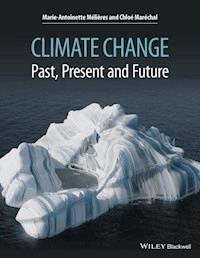
About the cover: Banded iceberg drifting a couple of miles off the French station, Dumont d'Urville (Terre Adélie), Antarctica. White stripes are normal glacier ice resulting from snow compaction including air bubbles. The coloured stripes are the result of the melting and refreezing processes within the layered structure of the iceberg. Due to enhanced melting at the contact with the ocean, the immersed part rapidly reduces leading to a tipping over as revealed by the now tilted stripes. © Emmanuel Le Meur, 2008/9.
Contents
Foreword
Discovering complexity: a springboard for action
Acknowledgements
About the companion website
Introduction
Aims
The situation in brief . . .
. . . and the questions that arise
The different parts of this book
PART I: THE CLIMATE ENGINE OF THE EARTH: ENERGY
1. Why are there many different climates on Earth?
2. Different climates . . . such diversity of life
2.1 The different climates on Earth
2.2 Climates, biomes and biodiversity
2.3 Climate and society
3. From a patchwork of climates to an average climate
3.1 Temperature and thermal equilibrium
3.2 The average temperature of the Earth’s surface
3.3 Precipitation
3.4 Wind
3.5 Three major items in energy consumption
4. The global mean climate
4.1 The Sun, source of energy
4.2 The energy equilibrium at the Earth’s surface
5. Atmosphere and ocean: key factors in climate equilibrium
5.1 Driving forces
5.2 The atmosphere
5.3 The oceans
5.4 Heat transport from the Equator to the poles
Part I Summary
Part I Notes
Part I Further Reading
PART II: MORE ON THE ENERGY BALANCE OF THE PLANET
6. Thermal radiation, solar and terrestrial radiation
6.1 Thermal radiation from a
black body
6.2 The laws of black-body radiation
6.3 Solar and terrestrial radiation
7. The impact of the atmosphere on radiation
7.1 Scattering and reflection
7.2 Absorption by a gas – the
cut-off approximation
7.3 Absorption of solar and terrestrial radiation by atmospheric gases
7.4 Direct transfer by the atmosphere
7.5 Major atmospheric constituents involved in radiative transfer
8. Radiative transfer through the atmosphere
8.1 Three radiative mechanisms that heat or cool the Earth’s surface
8.2 The greenhouse effect
8.3 Radiative transfer: the roles of the different constituents
8.4 The radiation balance of the Earth
9. The energy balance
9.1 The energy balance at the surface of the Earth in the
single-layer model
9.2 The Earth’s energy balance at equilibrium
9.3 The impact of human activity
9.4 The present unbalanced global energy budget
10. Climate forcing and feedback
10.1 Climate forcing
10.2 Feedbacks
10.3 Climate sensitivity
11. Climate modelling
11.1 The Energy Balance and Radiative–Convective Models
11.2 Three-dimensional Atmosphere Global Circulation Models
11.3 Three-dimensional models: ever-increasing refinements
11.4 Climate models – what for?
Part II Summary
Part II Notes
Part II Further Reading
PART III: THE DIFFERENT CAUSES OF CLIMATE CHANGE
12. The choice of approach
13. The Sun’s emission
13.1 The impact on the climate
13.2 How emission varies
13.3 What are the consequences?
14. The position of the Earth with respect to the Sun
14.1 An overview
14.2 Irradiance, determined by orbital parameters
14.3 Changes in obliquity: the impact on the seasons
14.5 Precession of the axis of rotation: the impact on the Earth–Sun distance at different seasons
14.6 Changes in irradiance
15. The composition of the atmosphere
15.1 The effect on the climate: the mechanism
15.2 How the composition has changed, and why
15.3 What are the consequences?
16. Heat transfer from the Equator to the poles
16.1 The impact on the climate: the mechanism
16.2 How and why can the transfer vary?
16.3 What are the consequences?
17. Oscillations due to ocean–atmosphere interactions
17.1 The impact on the climate: the mechanism
17.2 The El Niño Southern Oscillation and trade wind fluctuations
17.3 The North Atlantic and Arctic Oscillations
Part III Summary
Part III Notes
Part III Further Reading
PART IV: LEARNING FROM THE PAST …
18. Memory of the distant past
18.1 Over billions of years …
18.2 The past tens of millions of years: slow cooling
18.3 The entry of Northern Hemisphere glaciations
19. Since 2.6 million years ago: the dance of glaciations
19.1 The archives of the dance
19.2 The glacial–interglacial cycles
19.3 Glacials and interglacials: very different climate stages
19.4 Glacials and interglacials: similar but never identical
19.5 Abrupt climate changes in the last climate cycle
20. Glacial–interglacial cycles and the Milankovitch theory
20.1 The leading role of the Northern Hemisphere
20.2 Seasonal irradiance, the key parameter in Quaternary glaciations
20.3 Two types of configuration
20.4 The climate in the past 250,000 years
20.5 Glacials and interglacials: similar situations, never identical
20.6 The energy budget: radiative forcing and feedback
21. The glaciation dance: consequences and lessons
21.1 The impact on life of glacial–interglacial cycles
21.2 Lessons to be drawn
21.3 When will the next glaciation come?
22. The past 12,000 years: the warm Holocene
22.1 The Holocene
22.2 Deciphering climate changes during the Holocene
22.3 Slow changes in irradiance (Timescale 1: millennia)
22.4 Slow cooling at middle and high latitudes in the Northern Hemisphere
22.5 Strong monsoon in the Early Holocene: the ‘Green Sahara’ episode
22.6 Solar fluctuations (Timescale 2: centuries)
22.7 The Holocene and the birth of agriculture and animal husbandry
23. Global and regional fluctuations (Timescale 3: decades)
23.1 From global …
23.2 … to regional: the North Atlantic Oscillation
23.3 The Sun, the other source of change
24. Future warming and past climates
24.1 The global ‘hot flush’ of 55 million years ago
24.2 Three million years ago
24.3 Warmer periods in the past 2 million years?
Part IV Summary
Part IV Notes
Part IV Further Reading
PART V: CLIMATE CHANGE IN RECENT YEARS
25. Recent climate change
25.1 Changes in temperature
25.2 Changes in precipitation, water vapour and extreme events
25.3 An overview of the past few decades
25.4 The impact of global warming: the key issue
26. The impact of global warming on the cryosphere
26.1 Sea ice, the ‘canary’ of our planet
26.2 Changes in glaciers
26.3 Ice-sheet changes
26.4 Changes in frozen soils
26.5 Freeze-up and snow cover
27. The impact of warming on the ocean
27.1 Change in sea level
27.2 Regional changes in ocean salinity
27.3 Is deep ocean circulation slowing?
27.4 Changes in dissolved carbon dioxide and ocean acidification
27.5 In summary: consistency over the globe
28. The impact of warming on the biosphere
28.1 Ongoing changes
28.2 Oceans
28.3 Land
28.4 Portents of dysfunction
29. Warming in the 20th century: natural or human-induced?
29.1 The carbon cycle prior to the industrial era
29.2 The impact of human activity on the carbon cycle
29.3 Changes related to human activity
29.4 Natural causes: solar and volcanic activity
29.5 An overview of all the causes: the major role of human activity
Part V Summary
Part V Notes
Part V Further Reading
PART VI: CLIMATE IN THE 21ST CENTURY: DIFFERENT SCENARIOS
30. Two key factors
30.1 Greenhouse gas emissions
30.2 Population growth
31. Projections: economic scenarios and climate models
31.1 Successive steps in a projection
31.2 Climate models
32. Simulations: a survey
32.1 Long-term scenarios
32.2 IPCC 2007 scenarios for the 21st century
32.3 IPCC 2013 scenarios for the 21st century
33. Future warming and its consequences
33.1 Global warming
33.2 The water cycle and precipitation
33.3 Extreme events
33.4 Snow and ice
33.5 The sea level
33.6 Ocean acidification
33.7 Climate predictions: what degree of confidence?
33.8 In summary, the future is already with us
34. The choice
34.1 Can future warming be counteracted naturally?
34.2 Which choice of scenario?
34.3 Global warming: no more than 2°C
34.4 The ‘Triple Zero’ challenge
35. Climate change in the present state of the planet
35.1 Environmental degradation
35.2 Depletion of energy resources
35.3 Inexorable world population growth?
35.4 A new type of development?
Part VI Summary
Part VI Notes
Part VI Further Reading
Conclusion
References
Index
End User License Agreement
List of Tables
Chapter 1
Table 1.1
Chapter 7
Table 7.1
Lesen Sie weiter in der vollständigen Ausgabe!
Lesen Sie weiter in der vollständigen Ausgabe!
Lesen Sie weiter in der vollständigen Ausgabe!
Lesen Sie weiter in der vollständigen Ausgabe!
Lesen Sie weiter in der vollständigen Ausgabe!
Lesen Sie weiter in der vollständigen Ausgabe!
Lesen Sie weiter in der vollständigen Ausgabe!
Lesen Sie weiter in der vollständigen Ausgabe!
Lesen Sie weiter in der vollständigen Ausgabe!
Lesen Sie weiter in der vollständigen Ausgabe!
Lesen Sie weiter in der vollständigen Ausgabe!
Lesen Sie weiter in der vollständigen Ausgabe!
Lesen Sie weiter in der vollständigen Ausgabe!
Lesen Sie weiter in der vollständigen Ausgabe!
Lesen Sie weiter in der vollständigen Ausgabe!
Lesen Sie weiter in der vollständigen Ausgabe!
Lesen Sie weiter in der vollständigen Ausgabe!
Lesen Sie weiter in der vollständigen Ausgabe!
Lesen Sie weiter in der vollständigen Ausgabe!
Lesen Sie weiter in der vollständigen Ausgabe!
Lesen Sie weiter in der vollständigen Ausgabe!
Lesen Sie weiter in der vollständigen Ausgabe!
Lesen Sie weiter in der vollständigen Ausgabe!
Lesen Sie weiter in der vollständigen Ausgabe!
Lesen Sie weiter in der vollständigen Ausgabe!
Lesen Sie weiter in der vollständigen Ausgabe!
Lesen Sie weiter in der vollständigen Ausgabe!
Lesen Sie weiter in der vollständigen Ausgabe!
Lesen Sie weiter in der vollständigen Ausgabe!
Lesen Sie weiter in der vollständigen Ausgabe!
Lesen Sie weiter in der vollständigen Ausgabe!
Lesen Sie weiter in der vollständigen Ausgabe!
Lesen Sie weiter in der vollständigen Ausgabe!
Lesen Sie weiter in der vollständigen Ausgabe!
Lesen Sie weiter in der vollständigen Ausgabe!
Lesen Sie weiter in der vollständigen Ausgabe!
Lesen Sie weiter in der vollständigen Ausgabe!
Lesen Sie weiter in der vollständigen Ausgabe!
Lesen Sie weiter in der vollständigen Ausgabe!
Lesen Sie weiter in der vollständigen Ausgabe!
Lesen Sie weiter in der vollständigen Ausgabe!
Lesen Sie weiter in der vollständigen Ausgabe!
Lesen Sie weiter in der vollständigen Ausgabe!
Lesen Sie weiter in der vollständigen Ausgabe!
Lesen Sie weiter in der vollständigen Ausgabe!
Lesen Sie weiter in der vollständigen Ausgabe!
Lesen Sie weiter in der vollständigen Ausgabe!
Lesen Sie weiter in der vollständigen Ausgabe!
Lesen Sie weiter in der vollständigen Ausgabe!




