


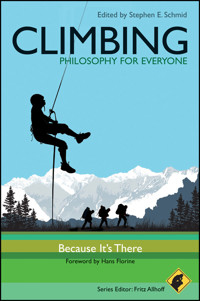
Climbing - Philosophy for Everyone E-Book
14,99 €
Mehr erfahren.
- Herausgeber: John Wiley & Sons
- Kategorie: Geisteswissenschaft
- Serie: Philosophy for Everyone
- Sprache: Englisch
Climbing - Philosophy for Everyone presents a collection of intellectually stimulating new essays that address the philosophical issues relating to risk, ethics, and other aspects of climbing that are of interest to everyone from novice climbers to seasoned mountaineers.
- Represents the first collection of essays to exclusively address the many philosophical aspects of climbing
- Includes essays that challenge commonly accepted views of climbing and climbing ethics
- Written accessibly, this book will appeal to everyone from novice climbers to seasoned mountaineers
- Includes a foreword written by Hans Florine
- Shortlisted for the Boardman Tasker Prize for Mountain Literature, 2010
Sie lesen das E-Book in den Legimi-Apps auf:
Seitenzahl: 469
Veröffentlichungsjahr: 2011
Ähnliche




















CONTENTS
Foreword
Hans Florine
Acknowledgments
Stephen E. Schmid
Philosophizing Into the Void: An Introduction to Climbing – Philosophy for Everyone
Stephen E. Schmid
PART I TYING IN: Why Risk Climbing
1 Climbing and the Stoic Conception of Freedom
Kevin Krein
2 Risk and Reward: Is Climbing Worth It?
Paul Charlton
3 Why Climb?
Joe Fitschen
4 Jokers on the Mountain: In Defense of Gratuitous Risk
Heidi Howkins Lockwood
PART II QUEST FOR THE SUMMIT: Cultivating the Climber
5 High Aspirations: Climbing and Self-Cultivation
Brian Treanor
6 More than Meets the “I”: Values of Dangerous Sport
Pam R. Sailors
7 Mountaineering and the Value of Self-Sufficiency
Philip A. Ebert and Simon Robertson
8 It Ain’t Fast Food: An Authentic Climbing Experience
Ben Levey
9 Zen and the Art of Climbing
Eric Swan
PART III CUTTING THE ROPE: Climbing Ethics
10 Freedom and Individualism on the Rocks
Dane Scott
11 Hold Manufacturing: Why You May Be Wrong About What’s Right
William Ramsey
12 The Ethics of Free Soloing
Marcus Agnafors
13 Making Mountains Out of Heaps: Environmental Protection One Stone at a Time
Dale Murray
PART IV MIXED CLIMBING: Philosophy on Varied Terrain
14 From Route Finding to Redpointing: Climbing Culture as a Gift Economy
Debora Halbert
15 Are You Experienced? What You Don’t Know About Your Climbing Experience
Stephen M. Downes
16 What Is a Climbing Grade Anyway?
Richard G. Graziano
17 The Beauty of a Climb
Gunnar Karlsen
Climbing Glossary
Notes on Contributors
VOLUME EDITOR
STEPHEN E. SCHMID is Assistant Professor of Philosophy atthe University of Wisconsin-Rock County. His doctoral work was inphilosophy of mind and his current research focuses on motivationin sport and education. Schmid has been playing in the mountainsand on rock for more than 20 years.
SERIES EDITOR
FRITZ ALLHOFF is an Assistant Professor in the Philosophy Department at Western Michigan University, as well as a Senior Research Fellow at the Australian National University’s Centre for Applied Philosophy and Public Ethics. In addition to editing thePhilosophy for Everyone series, Allhoff is the volume editor or co-editorfor several titles, including Wine & Philosophy (Wiley-Blackwell, 2007),Whiskey & Philosophy (with Marcus P. Adams, Wiley, 2009), and Food & Philosophy (with Dave Monroe, Wiley-Blackwell, 2007).
PHILOSOPHY FOR EVERYONE
Series editor: Fritz Allhoff
Not so much a subject matter, philosophy is a way of thinking. Thinking not just about the Big Questions, but about little ones too. This series invites everyone to ponder things they care about, big or small, significant, serious … or just curious.
Running & Philosophy: A Marathon for the MindEdited by Michael W. Austin
Wine & Philosophy: A Symposium on Thinking and DrinkingEdited by Fritz Allhoff
Food & Philosophy: Eat, Think and Be MerryEdited by Fritz Allhoff and Dave Monroe
Beer & Philosophy: The Unexamined Beer Isn’t Worth DrinkingEdited by Steven D. Hales
Whiskey & Philosophy: A Small Batch of Spirited IdeasEdited by Fritz Allhoff and Marcus P. Adams
College Sex – Philosophy for Everyone:Philosophers With BenefitsEdited by Michael Bruceand Robert M. Stewart
Cycling – Philosophy for Everyone:A Philosophical Tour de ForceEdited by Jesús Ilundáin-Agurruza and Michael W. Austin
Climbing – Philosophy for Everyone:Because It’s ThereEdited by Stephen E. Schmid
Hunting – Philosophy for Everyone:In Search of the Wild LifeEdited by Nathan Kowalsky
Christmas – Philosophy for Everyone:Better Than a Lump of CoalEdited by Scott C. Lowe
Cannabis – Philosophy for Everyone:What Were We Just Talking About?Edited by Dale Jacquette
Porn – Philosophy for Everyone:How to Think With KinkEdited by Dave Monroe
Serial Killers – Philosophy for Everyone:Being and KillingEdited by S. Waller
Dating – Philosophy for Everyone:Flirting With Big IdeasEdited by Kristie Miller and Marlene Clark
Gardening – Philosophy for Everyone:Cultivating WisdomEdited by Dan O’Brien
Motherhood – Philosophy for Everyone:The Birth of WisdomEdited by Sheila Lintott
Fatherhood – Philosophy for Everyone:The Dao of DaddyEdited by Lon S. Nease and Michael W. Austin
Forthcoming books in the series:
Fashion – Philosophy for EveryoneEdited by Jessica Wolfendale and Jeanette Kennett
Coffee – Philosophy for EveryoneEdited by Scott Parker and Michael W. Austin
Blues – Philosophy for EveryoneEdited by Abrol Fairweather and Jesse Steinberg
This edition first published 2010© 2010 Blackwell Publishing Ltd except for editorial material and organization© 2010 Stephen E. Schmid
Blackwell Publishing was acquired by John Wiley & Sons in February 2007. Blackwell’s publishing program has been merged with Wiley’s global Scientific, Technical, and Medical business to form Wiley-Blackwell.
Registered OfficeJohn Wiley & Sons Ltd, The Atrium, Southern Gate, Chichester, West Sussex, PO19 8SQ, United Kingdom
Editorial Offices350 Main Street, Malden, MA 02148–5020, USA9600 Garsington Road, Oxford, OX4 2DQ, UKThe Atrium, Southern Gate, Chichester, West Sussex, PO19 8SQ, UK
For details of our global editorial offices, for customer services, and for information about how to apply for permission to reuse the copyright material in this book please see our website at www.wiley.com/wiley-blackwell.
The right of Stephen E. Schmid to be identified as the author of the editorial material in this work has been asserted in accordance with the UK Copyright, Designs and Patents Act 1988.
All rights reserved. No part of this publication may be reproduced, stored in a retrieval system, or transmitted, in any form or by any means, electronic, mechanical, photocopying, recording or otherwise, except as permitted by the UK Copyright, Designs and Patents Act 1988, without the prior permission of the publisher.
Wiley also publishes its books in a variety of electronic formats. Some content that appears in print may not be available in electronic books.
Designations used by companies to distinguish their products are often claimed as trademarks. All brand names and product names used in this book are trade names, service marks, trademarks or registered trademarks of their respective owners. The publisher is not associated with any product or vendor mentioned in this book. This publication is designed to provide accurate and authoritative information in regard to the subject matter covered. It is sold on the understanding that the publisher is not engaged in rendering professional services. If professional advice or other expert assistance is required, the services of a competent professional should be sought.
Library of Congress Cataloging-in-Publication Data
Climbing – philosophy for Everyone:because it’s there / edited by Stephen E. Schmid.
p. cm. — (Philosophy for everyone)
Includes bibliographical references and index.
ISBN 978-1-4443-3486-9 (pbk.: alk. paper) 1. Free will and determinism. 2. Liberty. 3. Risk-taking (Psychology) 4. Mountaineering—Miscellanea. I. Schmid, Stephen E. II. Title: Climbing – philosophy for everyone.
B105.L45C47 2010
796.52201—dc22
2010006826
A catalogue record for this book is available from the British Library.
To Beth
HANS FLORINE
FOREWORD
Climbers often claim, and it is often true, that it is about the journey, not the summit. Similarly, I suggest that the joy in philosophy is about pursuing the answers, not necessarily finding them.
As a professional climber and speaker, I have had the pleasure of interacting with a wide variety of strangers on the topic of climbing. I have fielded philosophical questions from the most ignorant city dwellers to the most experienced climbers: Why climb? Is solo climbing crazy or morally wrong? Is chipping a hold a bad thing to do? Are you scared of heights? How does one rate a climb or what does it mean to rate a climb? In answering these and many other questions, I am offering my considered opinion and, perhaps, am influencing the questioner’s thinking on possible “answers.” I am rarely providing a definitive answer. If I or anyone had the answers, then this book likely would not have been written. It is the posing of intriguing questions that makes philosophy interesting and exceptionally so when applied to the activity of climbing.
What a joy it is to sit back and let these champion philosophers influence our thinking on some of the most interesting philosophical questions in and about climbing. Some of the above mentioned questions and more are discussed with insight from experienced climbers and brilliant thinkers.
For example, here are two challenging issues. I am often asked whether I think people who solo are crazy. I have often responded with the question: “Do you think your father is crazy to climb a ladder in order to clean the rain gutters, or hang Xmas lights?” My follow up is that as a physical event, there is the same comfort level for many soloists as there would be for your father. This is usually not the end of my answer nor, I believe, is Mr. Agnafors’ essay on the topic herein all that he has to say on the subject. Note that Agnafors addresses the morality of soloing while I was questioned on the sanity of a soloist. Another question I have been asked is whether chipping a ¼ inch hand hold is bad. In my opinion, more information about the specific case is needed to answer the question. I have glued holds on smooth cement walls. I have not glued holds on the smooth granite of El Capitan. Do I think manufacturing holds is okay? You’ll need to track me down for tea to find out. In the meantime, Mr. Ramsey’s essay on this very subject is a delight to read. Like these two, all the philosopher-climbers in this anthology have deepened my thinking on all the questions I think about and discuss with others.
By reading these essays, I have been further reminded that it is the careful pondering of the questions that is wise and prudent, not vesting in a single answer. It’s a joy to be flexible and explore the tangents one follows when remaining open to other ideas. It is no surprise that the same flexibility is immensely useful when facing the challenges one encounters in the very act of climbing.
I have met high-level academics at the climbing gym and at the cliff. I have met accountants, lawyers, advertising agents, supermodels,1 construction workers, and librarians, all of whom have that obsession with climbing that I have. There is something in climbing that feeds and satisfies a need in many of us. The physical aspect of climbing involves every part of your body, from the tip of your toe to the tip of your finger. You must truly mentally engage with the rock or mountain. You must inventory your strengths and apply what you have to the challenge in front of you. Often times, it is a matter of great consequence if you do not have your complete focus on the task immediately before you. Simply put, you are 100 percent focused on climbing. I call it physical meditation. You simply can’t be thinking about the bills due or the office you must be at Monday morning at 8 a.m. and climb at the same time. Climbing is a great mental break from the “other world.” You do not need to study any Western or Eastern meditation techniques to enjoy the benefits of climbing.
What is climbing to me? Before climbing came into my life, I was an athlete and a competitor (and I still am). I saw climbing initially as a sport. Quickly, I found one could adventure, explore, and play on wild terrain. It was just darn fantastic Huck Finn and Tom Sawyer-like adventure! I was smitten by climbing. Even in my twenties when my hormones were raging, I would choose a rock climbing outing over a date with a woman.
I loved the athletic movement involved and I loved the incredible places climbing took me. I would never have traveled to the places I’ve been if I were obsessed with swimming, basketball, or soccer. I went to Europe my first time and lived there some three months without going to a single tourist destination. I was climbing! It was not until my fourth year of visiting France that I made it to the Louvre. I’m known for my speed climbing – heck, I wrote the book on it! Make no mistake, I do not climb more to go fast. Rather, I go fast because I get in more climbing.
In the philosophical world, I will often take the stance of an Ayn Rand Objectivist (though I often take on world troubles personally as a Buddhist). Logical reasoning I often think of, as did Rand, as an unwavering tool one can count on to judge the merits of a philosophical argument and to guide one’s actions and beliefs. Yet, some may think that to use logic to argue a position, either ethical or otherwise, in something as ridiculous as climbing may seem more ridiculous than the act of climbing itself. In most people’s minds, I’m already guilty of illogical behavior. However, I can’t think of a more rewarding and interesting “illogical” activity to ponder philosophically than climbing.
I have had immensely entertaining conversations about a single gear placement on a 1,000-foot rock route in Patagonia. I have had lengthy discussions about the ethics of rap bolting, chopping, drilling, and chipping the rock. People will try to pin you down on where you stand. They are either looking for a fight or knowledge. I’ve managed to avoid fights for nearly thirty years. Is climbing a worthy pursuit? Is applying philosophical discussion about climbing a worthy endeavor? At risk of a fight, I’ll tell you where I stand on these two questions: Yes and Yes. As you will discover when reading these essays, all the contributors are on “my side.” But if you have any doubts about climbing being a worthy activity, I encourage you to read chapters 2 (Charlton), 5 (Treanor), 6 (Sailors), and 7 (Ebert and Robertson).
By reading the following essays, if you are not a climber you might well give it a try. If you are a climber, you will likely find yourself reading statements you have made or at least thoughts you’ve had about climbing. You might well find you are rethinking how and why you climb. You may find you are a little more flexible on and off the rock. In the end, you may just enjoy climbing a little more.
Speed be with you.2
NOTES
1 Hans is married to retired supermodel Jacki Adams, who is an accomplished climber herself (see www.jacquelineflorine.com).
2 “Speed” derives from the old English word spede, which means success and prosperity.
ACKNOWLEDGMENTS
Thank you to each of the contributors for your excellent essays, commitment to the journey, and willingness to endure my ceaseless edits. While most of you I know only through email, it has been a pleasure to work with you on this collection. I look forward to talking story over beers after a day of climbing together.
Thank you to Hans Florine for contributing the foreword.
Thank you to Fritz Allhoff, Jeff Dean, and Tiffany Mok at Wiley-Blackwell for your guidance and support.
Thank you to Daniel at rockclimbing.com for permission to use your climbing terms as a reference for the contributors and as the source for this volume’s glossary.
A special thanks to climbing partners and friends: Katie Devine, Chris Durand, and Doug Hemken. Your advice and comments at various stages of this project were invaluable and greatly appreciated. An additional thanks to Doug for sharing your keen insights on the essays.
Finally, thank you to all those readers who share our passion for climbing and philosophy.
Stephen E. Schmid
STEPHEN E. SCHMID
PHILOSOPHIZING INTO THE VOID
An Introduction to Climbing – Philosophy for Everyone
“Because it’s there,” George Mallory is said to have responded to a reporter’s question about why he wanted to climb Mt. Everest.1 Arguably, these are the most famous words in climbing. The reporter, in asking his question, was undoubtedly expressing a common sentiment – why would you participate in this seemingly meaningless, useless, life-threatening pursuit? Surely, there is more you can do with your life than that! Perhaps the enduring allure of Mallory’s answer can be attributed to what it implies more than what it says. In light of attempting Everest, one can discover in Mallory’s answer a call to expand the limits of human possibility and greatness – the answer inspires us to act on our dreams and ascend to great heights; it challenges us to face the unknown void; and it reminds us that there may be no other reason for our quest than the challenge, adventure, and fun of climbing.
Like climbing, those who venture into the philosophical void will discover similar sentiments and revelations. Contemplating the value of philosophy, Bertrand Russell writes:
Philosophy is to be studied, not for the sake of any definite answers to its questions . . . but rather for the sake of the questions themselves; because these questions enlarge our conception of what is possible, enrich our intellectual imagination and diminish the dogmatic assurance which closes the mind against speculation; but above all because, through the greatness of the universe which philosophy contemplates, the mind also is rendered great, and becomes capable of that union with the universe which constitutes its highest good.2
So the philosopher, when asked “Why philosophy?” might find him or herself answering like Mallory: “Because it’s there.”
In the last several decades the connection between philosophy and climbing has become pronounced. This is especially so in the area of ethics, a branch of philosophy that is concerned with defining the principles that should govern our behavior. The seminal essay on climbing ethics is Tejada-Flores’ 1967 “Games Climbers Play,” which originally appeared in the American journal and was later anthologized in a collection of climbing essays. This essay revealed a new way of thinking about climbing. Tejada-Flores showed how the sport of climbing is a collection of different games, each with its own set of rules and playing fields. From the bouldering game to the expedition game, the seven climbing games Tejada-Flores identified provided a means of talking about climbing ethics. Climbing ethically, he writes, “means respecting the set of rules of the climbing-game that one is playing.” With a means of determining ethical climbing, Tejeda-Flores equates climbing with style to ethical climbing. A climber with good style deliberately climbs according to the rules of a climbing game. Better style arises when the climber follows a more restrictive, more difficult set of rules to accomplish his climbing game (for example, using trad rules to climb a big wall). Today, this way of framing climbing style and ethics is part of the fabric of climbing discourse and is expressed in everything from climbing magazines to fireside debates. In mapping the terrain for climbing games, Tejada-Flores’ essay did what all good philosophy does – force us to rethink and understand our world anew. Ten years after its initial publication, Ken Wilson wrote that Tejada-Flores’ essay still provided a useful mechanism for understanding climbing. If the philosophical essays in this volume are any indication, Tejada-Flores’ essay is as influential now as it was more than forty years ago.
Lesen Sie weiter in der vollständigen Ausgabe!
Lesen Sie weiter in der vollständigen Ausgabe!
Lesen Sie weiter in der vollständigen Ausgabe!
Lesen Sie weiter in der vollständigen Ausgabe!
Lesen Sie weiter in der vollständigen Ausgabe!
Lesen Sie weiter in der vollständigen Ausgabe!
Lesen Sie weiter in der vollständigen Ausgabe!
Lesen Sie weiter in der vollständigen Ausgabe!
Lesen Sie weiter in der vollständigen Ausgabe!
Lesen Sie weiter in der vollständigen Ausgabe!
Lesen Sie weiter in der vollständigen Ausgabe!
Lesen Sie weiter in der vollständigen Ausgabe!
Lesen Sie weiter in der vollständigen Ausgabe!
Lesen Sie weiter in der vollständigen Ausgabe!
Lesen Sie weiter in der vollständigen Ausgabe!
Lesen Sie weiter in der vollständigen Ausgabe!
Lesen Sie weiter in der vollständigen Ausgabe!
Lesen Sie weiter in der vollständigen Ausgabe!
Lesen Sie weiter in der vollständigen Ausgabe!
Lesen Sie weiter in der vollständigen Ausgabe!
Lesen Sie weiter in der vollständigen Ausgabe!
Lesen Sie weiter in der vollständigen Ausgabe!
Lesen Sie weiter in der vollständigen Ausgabe!




