


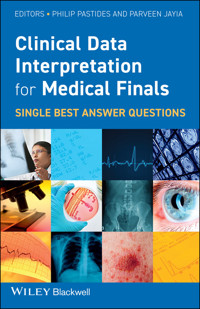
Clinical Data Interpretation for Medical Finals E-Book
33,99 €
Mehr erfahren.
- Herausgeber: John Wiley & Sons
- Kategorie: Fachliteratur
- Sprache: Englisch
Written by senior clinicians across a range of specialties, Data Interpretation for Medical Finals: Single Best Answer Questions is the perfect way to prepare for data interpretation assessments and clinical practice.
Featuring over 200 questions on key topics in medicine, each question is set around an image or investigation, such as an X-ray, CT scan, or blood film, and tests identification and interpretation of the data provided. Thorough explanation of the correct and incorrect answers helps you learn from mistakes. The questions reflect current exam question style and incorporate high quality images, many of which are annotated, and are presented in full colour throughout.
Data Interpretation for Medical Finals will help build the confidence of all medical students, and Foundation Doctors, as it encourages application of investigation results to clinical decision making.
Sie lesen das E-Book in den Legimi-Apps auf:
Seitenzahl: 260
Veröffentlichungsjahr: 2012
Ähnliche




















Contents
Cover
Title Page
Copyright
Contributors
Foreword
Preface
Acknowledgements
Reference Values
Chapter 1q: Cardiac Medicine
Question 1
Question 2
Question 3
Question 4
Question 5
Question 6
Question 7
Question 8
Question 9
Question 10
Question 11
Question 12
Question 13
Question 14
Question 15
Question 16
Question 17
Question 18
Question 19
Question 20
Question 21
Chapter 1a: Cardiac Medicine
Question 1
Question 2
Question 3
Question 4
Question 5
Question 6
Question 7
Question 8
Question 9
Question 10
Question 11
Question 12
Question 13
Question 14
Question 15
Question 16
Question 17
Question 18
Question 19
Question 20 20a: 2, 20b: 2
Question 21
Chapter 2q: Respiratory Medicine
Question 1
Question 2
Question 3
Question 4
Question 5
Question 6
Question 7
Question 8
Question 9
Question 10
Question 11
Question 12
Question 13
Question 14
Question 15
Chapter 2a: Respiratory Medicine
Question 1
Question 2
Question 3
Question 4
Question 5
Question 6
Question 7
Question 8
Question 9
Question 10
Question 11
Question 12
Question 13
Question 14
Question 15
Chapter 3q: Haematology
Question 1
Question 2
Question 3
Question 4
Question 5
Question 6
Question 7
Question 8
Question 9
Question 10
Question 11
Question 12
Question 13
Question 14
Question 15
Question 16
Question 17
Question 18
Question 19
Question 20
Chapter 3a: Haematology
Question 1
Question 2
Question 3
Question 4
Question 5
Question 6
Question 7
Question 8
Question 9
Question 10
Question 11
Question 12
Question 13
Question 14
Question 15
Question 16
Question 17
Question 18
Question 19
Question 20
Chapter 4q: Microbiology
Question 1
Question 2
Question 3
Question 4
Question 5
Question 6
Question 7
Question 8
Question 9
Question 10
Question 11
Question 12
Question 13
Question 14
Question 15
Question 16
Question 17
Question 18
Question 19
Question 20
Chapter 4a: Microbiology
Question 1
Question 2
Question 3
Question 4
Question 5
Question 6
Question 7
Question 8
Question 9
Question 10
Question 11
Question 12
Question 13
Question 14
Question 15
Question 16
Question 17
Question 18
Question 19
Question 20
Chapter 5q: Radiology
Question 1
Question 2
Question 3
Question 4
Question 5
Question 6
Question 7
Question 8
Question 9
Question 10
Question 11
Question 12
Question 13
Question 14
Question 15
Question 16
Question 17
Question 18
Question 19
Question 20
Question 21
Question 22
Question 23
Question 24
Question 25
Question 26
Chapter 5a: Radiology
Question 1
Question 2
Question 3
Question 4
Question 5
Question 6
Question 7
Question 8
Question 9
Question 10
Question 11
Question 12
Question 13
Question 14
Question 15
Question 16
Question 17
Question 18
Question 19
Question 20
Question 21
Question 22
Question 23
Question 24
Question 25
Question 26
Chapter 6q: General Surgery and Gastroenterology
Question 1
Question 2
Question 3
Question 4
Question 5
Question 6
Question 7
Question 8
Question 9
Question 10
Question 11
Question 12
Question 13
Question 14
Question 15
Question 16
Chapter 6a: General Surgery and Gastroenterology
Question 1
Question 2
Question 3
Question 4
Question 5
Question 6
Question 7
Question 8
Question 9
Question 10
Question 11
Question 12
Question 13
Question 14
Question 15
Question 16
Chapter 7q: Musculoskeletal Medicine and Trauma
Question 1
Question 2
Question 3
Question 4
Question 5
Question 6
Question 7
Question 8
Question 9
Question 10
Question 11
Question 12
Question 13
Question 14
Question 15
Question 16
Question 17
Question 18
Question 19
Question 20
Chapter 7a: Musculoskeletal Medicine and Trauma
Question 1
Question 2
Question 3
Question 4
Question 5
Question 6
Question 7
Question 8
Question 9
Question 10
Question 11
Question 12
Question 13
Question 14
Question 15
Question 16
Question 17
Question 18
Question 19
Question 20
Chapter 8q: Dermatology
Question 1
Question 2
Question 3
Question 4
Question 5
Question 6
Question 7
Question 8
Question 9
Question 10
Question 11
Question 12
Question 13
Question 14
Question 15
Question 16
Question 17
Question 18
Chapter 8a: Dermatology
Question 1
Question 2
Question 3
Question 4
Question 5
Question 6
Question 7
Question 8
Question 9
Question 10
Question 11
Question 12
Question 13
Question 14
Question 15
Question 16
Question 17
Question 18
Chapter 9q: Ophthalmology
Question 1
Question 2
Question 3
Question 4
Question 5
Question 6
Question 7
Question 8
Question 9
Question 10
Question 11
Question 12
Question 13
Question 14
Question 15
Question 16
Question 17
Question 18
Chapter 9a: Ophthalmology
Question 1
Question 2
Question 3
Question 4
Question 5
Question 6
Question 7
Question 8
Question 9
Question 10
Question 11
Question 12
Question 13
Question 14
Question 15
Question 16
Question 17
Question 18
Chapter 10q: Evidence-based Medicine
Question 1
Question 2
Question 3
Question 4
Question 5
Question 6
Question 7
Question 8
Question 9
Question 10
Question 11
Question 12
Question 13
Question 14
Question 15
Chapter 10a: Evidence-based Medicine
Question 1
Question 2
Question 3
Question 4
Question 5
Question 6
Question 7
Question 8
Question 9
Question 10
Question 11
Question 12
Question 13
Question 14
Question 15
Appendix A: How to Interpret an ECG
1. Rate, rhythm and axis deviation
2. Individual waves and complexes
Appendix B: How to Interpret a Chest Radiograph
Appendix C: How to Interpret an Arterial Blood Gas
Appendix D: How to Interpret an Abdominal Radiograph
System for reviewing film
Abnormalities
Appendix E: How to Interpret a CT Head
Pathologies
This edition first published 2012 © 2012 by Philip Socrates Pastides and Parveen Jayia
Wiley-Blackwell is an imprint of John Wiley & Sons, formed by the merger of Wiley's global Scientific, Technical and Medical business with Blackwell Publishing.
Registered office: John Wiley & Sons, Ltd, The Atrium, Southern Gate, Chichester, West Sussex, PO19 8SQ, UK
Editorial offices: 9600 Garsington Road, Oxford, OX4 2DQ, UK
The Atrium, Southern Gate, Chichester, West Sussex, PO19 8SQ, UK
111 River Street, Hoboken, NJ 07030-5774, USA
For details of our global editorial offices, for customer services and for information about how to apply for permission to reuse the copyright material in this book please see our website at www.wiley.com/wiley-blackwell.
The right of the author to be identified as the author of this work has been asserted in accordance with the UK Copyright, Designs and Patents Act 1988.
All rights reserved. No part of this publication may be reproduced, stored in a retrieval system, or transmitted, in any form or by any means, electronic, mechanical, photocopying, recording or otherwise, except as permitted by the UK Copyright, Designs and Patents Act 1988, without the prior permission of the publisher.
Designations used by companies to distinguish their products are often claimed as trademarks. All brand names and product names used in this book are trade names, service marks, trademarks or registered trademarks of their respective owners. The publisher is not associated with any product or vendor mentioned in this book. This publication is designed to provide accurate and authoritative information in regard to the subject matter covered. It is sold on the understanding that the publisher is not engaged in rendering professional services. If professional advice or other expert assistance is required, the services of a competent professional should be sought.
Library of Congress Cataloging-in-Publication Data
Clinical data interpretation for medical finals: single best answer questions / edited by Philip Socrates Pastides, Parveen Jayia.
p. ; cm.
ISBN 978-0-470-65988-5 (pbk.)
I. Pastides, Philip Socrates. II. Jayia, Parveen.
[DNLM: 1. Clinical Medicine–Examination Questions. WB 18.2]
616.0076–dc23
2011037227
A catalogue record for this book is available from the British Library.
Wiley also publishes its books in a variety of electronic formats. Some content that appears in print may not be available in electronic books.
Contributors
Sandeep Basavarajaiah, MBBS MRCP MD, Specialist Registrar in Cardiology, Papworth Hospital, Cambridge, UK
Santino Jacob Capocci, BMedSCI(Hons) BMBS MRCP(Resp) DTM&H, Specialist Registrar in Respiratory Medicine, Royal Free Hospital, London, UK
Claudia Carmaciu, MBBS BSc(Hons), Foundation Year Two, Queens Hospital Romford, London, UK
Neil Chauhan, MBBS MRCP, Specialist Registrar in Haematology, Royal London Hospital, London, UK
Hugo Donaldson, MB BCh MRCP FRCPath, Consultant Microbiologist, Charing Cross Hospital, London, UK
Petrut Gogalniceanu, MBBS BSc MRCS, Specialist Registrar General Surgery, London Postgraduate School of Surgery, London, UK
Parminder Johal, MBBS MD FRCS Ed(Tr&Orth), Consultant Trauma & Orthopaedic Surgeon, North Middlesex Hospital, London, UK
Saleem Khoyratty, MA (Cantab) MBBS, Anaesthetic Senior House Officer, Kent, Surrey, Sussex Deanery
Rohaj Mehta, MBBS MRCP, Consultant Dermatologist, Basildon University Hospital, Essex, UK
Michel Michaelides, BSc MBBS MD FRCOphth, Clinical Senior Lecturer & Consultant Ophthalmologist, UCL Institute of Ophthalmology & Moorfields Eye Hospital, London, UK
Nick Manickam Muthiah, MBBS MEd MRCOphth, Vitreo-Retinal Surgery Clinical Research Fellow, Moorfields Eye Hospital & Institute of Ophthalmology, UCL, London, UK
Paraskevas A Paraskeva, PhD FCRS, Reader in Surgery and Consultant Surgeon, Imperial College London, & Imperial College Healthcare NHS Trust, London, UK
Prasanna Lionel Perera, MBBS MRCP FRCR, Consultant Radiologist, Worthing Hospital, West Sussex, UK
Vimal Raj, MBBS FRCR PGDMLS EDM, Consultant Radiologist, Glenfield Hospital, Leicester, UK
Foreword
It has become almost universal that multi-option questioning forms the mainstay of many of the written components of medical exams. As these have evolved we have seen a change from traditional multiple choice questions with negative marking and black-and-white answers to more scenario-based questions. One of the most popular modern formats is the single-best-answer style, which this book adopts. When written carefully, single best answers can challenge the students' range of abilities and can use more realistic clinical examples.
This book provides advice on exam questions and allows students to test their knowledge with a more modern style of single-best-answer questions, which are based more around clinical situations that would be faced by students, foundation year doctors and junior trainees. All of the questions have full explanatory answers which allow students to learn as they test themselves. There are many question books available, but this one is written to be informative and challenging while ensuring that the foundations of medical and surgical practice are covered and that it is enjoyable to use.
Mr P Paraskeva PhD FRCSReader in Surgery Imperial College London
Lesen Sie weiter in der vollständigen Ausgabe!
Lesen Sie weiter in der vollständigen Ausgabe!
Lesen Sie weiter in der vollständigen Ausgabe!
Lesen Sie weiter in der vollständigen Ausgabe!
Lesen Sie weiter in der vollständigen Ausgabe!
Lesen Sie weiter in der vollständigen Ausgabe!
Lesen Sie weiter in der vollständigen Ausgabe!
Lesen Sie weiter in der vollständigen Ausgabe!
Lesen Sie weiter in der vollständigen Ausgabe!
Lesen Sie weiter in der vollständigen Ausgabe!
Lesen Sie weiter in der vollständigen Ausgabe!
Lesen Sie weiter in der vollständigen Ausgabe!
Lesen Sie weiter in der vollständigen Ausgabe!
Lesen Sie weiter in der vollständigen Ausgabe!
Lesen Sie weiter in der vollständigen Ausgabe!
Lesen Sie weiter in der vollständigen Ausgabe!
Lesen Sie weiter in der vollständigen Ausgabe!
Lesen Sie weiter in der vollständigen Ausgabe!
Lesen Sie weiter in der vollständigen Ausgabe!
Lesen Sie weiter in der vollständigen Ausgabe!
Lesen Sie weiter in der vollständigen Ausgabe!
Lesen Sie weiter in der vollständigen Ausgabe!
Lesen Sie weiter in der vollständigen Ausgabe!
Lesen Sie weiter in der vollständigen Ausgabe!
Lesen Sie weiter in der vollständigen Ausgabe!
Lesen Sie weiter in der vollständigen Ausgabe!
Lesen Sie weiter in der vollständigen Ausgabe!
Lesen Sie weiter in der vollständigen Ausgabe!




