


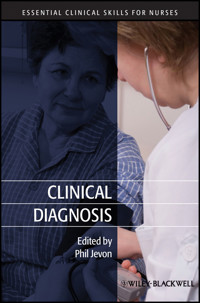
Clinical Diagnosis E-Book
31,99 €
Mehr erfahren.
- Herausgeber: John Wiley & Sons
- Kategorie: Fachliteratur
- Serie: Essential Clinical Skills for Nurses
- Sprache: Englisch
The role and function of the nurse is rapidly changing. Some nurses are now required to undertake clinical diagnosis of the patient, a responsibility traditionally undertaken by a doctor. Clinical Diagnosis helps prepare nurses to fulfill this role, providing them with the skills and underpinning knowledge to make clinical diagnoses of patients effectively. Each chapter follows the same layout for each symptom or sign, exploring the definition, causes, history, precipitating factors, associated signs and symptoms, important considerations, relevant clinical examination, and investigations and tests. * The first UK text to explore clinical diagnosis from a nursing perspective * In the Essential Clinical Skills for Nurses series * Written by an authority in the field * Concise, accessible, and evidence-based
Sie lesen das E-Book in den Legimi-Apps auf:
Seitenzahl: 248
Veröffentlichungsjahr: 2011
Ähnliche




















Contents
Cover
Title Page
Copyright
Contributors List
Foreword
1: An Overview to Clinical Diagnosis
LEARNING OUTCOMES
INTRODUCTION
OBJECTIVES OF HISTORY TAKING
ESTABLISHING A RAPPORT WITH THE PATIENT
IMPORTANCE OF EFFECTIVE LISTENING SKILLS
SEQUENCE OF HISTORY TAKING
AN OVERVIEW OF CLINICAL EXAMINATION
SYMPTOMS OF DISEASE
TESTS AND INVESTIGATIONS
CONCLUSION
2: Clinical Diagnosis of Symptoms Associated with the Respiratory System
LEARNING OUTCOMES
ACUTE BREATHLESSNESS
COUGH
HAEMOPTYSIS
INSPIRATORY STRIDOR
3: Clinical Diagnosis of Symptoms Associated with the Cardiovascular System
LEARNING OUTCOMES
CHEST PAIN
PALPITATIONS
HYPERTENSION
CALF SWELLING
LEG ULCER
BRUISING
ANAEMIA
HYPOTENSION
4: Clinical Diagnosis of Symptoms Associated with the Gastrointestinal System
LEARNING OUTCOMES
NAUSEA AND VOMITING
ABDOMINAL PAIN
ABDOMINAL SWELLING
HAEMATEMESIS
ASCITES
CONSTIPATION
DIARRHOEA
DYSPHAGIA
INTESTINAL OBSTRUCTION
MELAENA
RECTAL BLEEDING
JAUNDICE
WEIGHT LOSS
WEIGHT GAIN
HICCUP
STEATORRHOEA
5: Clinical Diagnosis of Symptoms Associated with the Neurological System
LEARNING OUTCOMES
HEADACHE
SYNCOPE
DIZZINESS
SEIZURE
TREMOR
HEMIPLEGIA
ACUTE CONFUSION
REDUCED CONSCIOUS LEVEL AND COMA
6: Clinical Diagnosis of Symptoms Associated with the Musculoskeletal System
LEARNING OUTCOMES
MUSCLE WASTING AND WEAKNESS
PAINFUL JOINTS
DEFORMITY
LOSS OF FUNCTION
7: Clinical Diagnosis of Symptoms Associated with the Genitourinary System
LEARNING OUTCOMES
ANURIA AND OLIGURIA
POLYURIA
URETHRAL DISCHARGE
DYSURIA
INCONTINENCE
SCROTAL SWELLING
RETENTION OF URINE
GYNAECOMASTIA
8: Clinical Diagnosis of Symptoms Associated with the Ears, Nose and Throat
LEARNING OUTCOMES
DYSPHAGIA
DEAFNESS
SORE THROAT
MOUTH ULCERS
Index
This edition first published 2011. © 2011 by Blackwell Publishing Ltd
Blackwell Publishing was acquired by John Wiley & Sons in February 2007. Blackwell's publishing program has been merged with Wiley's global Scientific, Technical and Medical business to form Wiley-Blackwell.
Registered office: John Wiley & Sons Ltd, The Atrium, Southern Gate, Chichester, West Sussex, PO19 8SQ, UK
Editorial offices: 9600 Garsington Road, Oxford, OX4 2DQ, UK The Atrium, Southern Gate, Chichester, West Sussex, PO19 8SQ, UK 2121 State Avenue, Ames, Iowa 50014-8300, USA
For details of our global editorial offices, for customer services and for information about how to apply for permission to reuse the copyright material in this book please see our website at www.wiley.com/wiley-blackwell.
The right of the author to be identified as the author of this work has been asserted in accordance with the UK Copyright, Designs and Patents Act 1988.
All rights reserved. No part of this publication may be reproduced, stored in a retrieval system, or transmitted, in any form or by any means, electronic, mechanical, photocopying, recording or otherwise, except as permitted by the UK Copyright, Designs and Patents Act 1988, without the prior permission of the publisher.
Designations used by companies to distinguish their products are often claimed as trademarks. All brand names and product names used in this book are trade names, service marks, trademarks or registered trademarks of their respective owners. The publisher is not associated with any product or vendor mentioned in this book. This publication is designed to provide accurate and authoritative information in regard to the subject matter covered. It is sold on the understanding that the publisher is not engaged in rendering professional services. If professional advice or other expert assistance is required, the services of a competent professional should be sought.
Library of Congress Cataloging-in-Publication Data
Clinical diagnosis / edited by Phil Jevon. p. ; cm. Includes bibliographical references and index. ISBN 978-1-4443-3516-3 (pbk. : alk. paper) 1. Diagnosis, Differential. 2. Clinical medicine–Decision making. 3. Medical history taking. I. Jevon, Philip. [DNLM: 1. Diagnostic Techniques and Procedures. WB 141] RC71.5C38 2010 616.07′5–dc22 2010040964
A catalogue record for this book is available from the British Library.
This book is published in the following electronic formats: ePDF 9781444340037; Wiley Online Library 9781444340051; ePub 9781444340044
Contributors List
Kathryn Blakey, MBBS nMRCGP General Practice vocational training scheme Birmingham West Midlands
Yonas Mhando, MD GPST Trainee, Northern Deanery; Formerly Clinical Teaching Fellow & Honorary Clinical Lecturer University of Birmingham & Manor Hospital, Walsall, West Midlands
Dev Mohan Gulur, MBBS, MRCS SpR in Urology, Mersey Rotation
Phil Jevon, RN, BSc (Hons), PGCE Resuscitation Officer/Clinical Skills Lead Manor Hospital, Walsall
Dev Mittapalli, MBBS, MRCS, PGCME SpR in General Surgery, East of Scotland (Dundee) Surgical Rotation, and Honorary Clinical Lecturer at the University of Birmingham
Michael Parry, BSc (Hons), MBChB, MRCS Specialist Registrar, Severn Deanery and Clinical Research Fellow, University of Bristol
Gareth Walters, BSc (Hons), MBChB MRCP (UK), MRCP (London), FHEA, MinstLM, LCGI Specialist Registrar in Respiratory and General Medicine, West Midlands Rotation, and Honorary Clinical Lecturer, University of Birmingham
Yi-Yang Ng, MBChB, MRCS, AHEA, PGCME GP Registrar, Dartford, Kent Sussex and Surrey Deanery previously Clinical Teaching Fellow, Manor Hospital Walsall, West Midlands and Honorary Clinical Lecturer
Foreword
As nursing progresses in terms of skill set and competencies focusing on patient pathways, there is a requirement to support professionals with up to date and relevant tools to support them. Clinical diagnosis can be complex and we know that timely and effective clinical diagnosis delivers optimum outcomes for patients.
This book is designed as a practical guide to support nurses in their decision making. It is well written and has had relevant clinical experts contributing chapters. It is comprehensively written and follows a systems approach providing a logical structure.
The editor must be commended for his foresight in developing this book and I am confident that many nurses will use this excellent guide in supporting their decision making and improving outcomes for patients. I am delighted to recommend this book and wish that this had been available to me many years ago!
Sue Hartley Director of Nursing and Governance Walsall Hospitals NHS Trust
1
An Overview to Clinical Diagnosis
Phil Jevon
LEARNING OUTCOMES
At the end of this chapter, the reader will be able to:
list the objectives of history taking,discuss establishing a rapport with the patient,describe the importance of effective listening skills,discuss the sequence of history taking,provide an overview to clinical examination,discuss the symptoms of disease andoutline the role of tests and investigations.INTRODUCTION
The term ‘clinical’ originates from the Greek word klinike meaning bedside (Soanes & Stevenson 2006). Diagnosis, which originates from the Greek word diagignoskein meaning distinguish or discern, can be defined as the identification of the nature of an illness or other problem by examination of the symptoms (Soanes & Stevenson 2006).
History taking (discussing the patients’ complaints with them) and clinical examination, together with performing or ordering relevant investigations, are essential for clinical diagnosis (Cox & Roper 2006). Despite the advances in modern diagnostic tests, history taking and clinical examination remain fundamental in determining the most appropriate treatment (if any) for the patient. History taking is considered one of the most important aspects of patient assessment and is being increasingly undertaken by nurses (Crumbie 2006).
History taking and clinical examination require a structured, logical approach to ensure that all the relevant information is obtained and that nothing important is overlooked. History taking and clinical examination skills are difficult to acquire and, above all, require practice (Gleadle 2004).
The aim of this chapter is to provide an overview to clinical diagnosis.
OBJECTIVES OF HISTORY TAKING
Lesen Sie weiter in der vollständigen Ausgabe!
Lesen Sie weiter in der vollständigen Ausgabe!
Lesen Sie weiter in der vollständigen Ausgabe!
Lesen Sie weiter in der vollständigen Ausgabe!
Lesen Sie weiter in der vollständigen Ausgabe!
Lesen Sie weiter in der vollständigen Ausgabe!
Lesen Sie weiter in der vollständigen Ausgabe!
Lesen Sie weiter in der vollständigen Ausgabe!




