


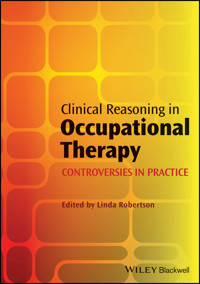
Clinical Reasoning in Occupational Therapy E-Book
38,99 €
Mehr erfahren.
- Herausgeber: John Wiley & Sons
- Kategorie: Fachliteratur
- Sprache: Englisch
Clinical Reasoning in Occupational Therapy is a key text for occupational therapy students and practitioners.
Written by an internationally renowned group of clinicians, educators and academics and with a central case study running throughout, the book covers the theory and practice of the following key topics: Working and Thinking in Different Contexts; Teaching as Reasoning; Ethical Reasoning; Diversity in Reasoning; Working and Thinking within 'Evidence Frameworks'; Experience as a Framework; The Client.
FEATURES
- includes case studies
- problem-solving framework
- questions at the end of each chapter
- commentaries on key topics
- relates theory to practice
Sie lesen das E-Book in den Legimi-Apps auf:
Seitenzahl: 308
Veröffentlichungsjahr: 2012
Ähnliche




















Contents
List of Contributors
Foreword
Preface
Acknowledgements
1 Problem Solving in Occupational Therapy
Introduction
Strand One: the theoretical underpinning of problem solving
Strand Two: the relationship of problem solving to other models of reasoning
Strand Three: using problem solving to define outcomes in reasoning
Conclusion
2 Abductive Reasoning and Case Formulation in Complex Cases
Introduction
What is a problem?
What clinician factors influence the process of clinical reasoning?
Ways clinicians reduce the complexity
Assumptions are invisible
What is abductive reasoning?
What is clinical reasoning and case formulation?
What is case formulation?
Why should we use a case formulation approach?
Case formulation using abductive reasoning
3 Ethical Reasoning: Internal and External Morality for Occupational Therapists
Introduction
Context
External morality: professional autonomy and truth telling
Internal morality: informed consent
Conclusion
4 Occupational Therapists, Care and Managerialism
Introduction
Background to the rise of managerialism
The ‘new’ health professional
Learning to recognise the ‘drift’ in snowflakes
Becoming bilingual
Guides for trekking through the managerialist blizzard
5 Context and How It Influences Our Professional Thinking
Introduction
Putting Mary’s practice in context
Reasoning and time both differ in different contexts
Changing contexts
Personal context enhancing contextual reasoning
6 The Novice Therapist
Introduction
The clown model
Tangible elements of practice
Dilemmas in practice
Learning to be an Occupational Therapist
Conclusion
7 Artistry and Expertise
Introduction
Clinical reasoning terminology – what are we talking about?
Clinical reasoning and practice – fitting expertise and judgment into practice and evidence-based practice
Clinical reasoning in practice – valuing and developing judgment artistry
Conclusion
Acknowledgments
8 Kai Whakaora Ngangahau – Māori Occupational Therapists’ Collective Reasoning
Introduction
Māori in Aotearoa/New Zealand
Treaty of Waitangi and colonisation
Knowledge in te ao Māori – the world of Māori
Māori working with Māori
Occupation as a connector of wairua and tangata
Working with whānau/extended family
The process of collective reasoning in clinical versus tikanga/customary practices
Whānau/extended family intergenerational knowledge
Secure cultural identity
Conclusion
Glossary
9 Reasoning That Is Difficult to Articulate
Introduction
Contextual influences
Personal context
Intuitive responses
Professional values and credibility
Index
This edition first published 2012© 2012 by Blackwell Publishing Ltd
Wiley-Blackwell is an imprint of John Wiley & Sons, formed by the merger of Wiley’s global Scientific, Technical and Medical business with Blackwell Publishing.
Registered OfficeJohn Wiley & Sons, Ltd, The Atrium, Southern Gate, Chichester, West Sussex, PO19 8SQ, UK
Editorial Offices9600 Garsington Road, Oxford, OX4 2DQ, UKThe Atrium, Southern Gate, Chichester, West Sussex, PO19 8SQ, UK2121 State Avenue, Ames, Iowa 50014-8300, USA
For details of our global editorial offices, for customer services and for information about how to apply for permission to reuse the copyright material in this book please see our website at www.wiley.com/wiley-blackwell.
The right of the author to be identified as the author of this work has been asserted in accordance with the UK Copyright, Designs and Patents Act 1988.
All rights reserved. No part of this publication may be reproduced, stored in a retrieval system, or transmitted, in any form or by any means, electronic, mechanical, photocopying, recording or otherwise, except as permitted by the UK Copyright, Designs and Patents Act 1988, without the prior permission of the publisher.
Designations used by companies to distinguish their products are often claimed as trademarks. All brand names and product names used in this book are trade names, service marks, trademarks or registered trademarks of their respective owners. The publisher is not associated with any product or vendor mentioned in this book. This publication is designed to provide accurate and authoritative information in regard to the subject matter covered. It is sold on the understanding that the publisher is not engaged in rendering professional services. If professional advice or other expert assistance is required, the services of a competent professional should be sought.
Library of Congress Cataloging-in-Publication Data
Clinical reasoning in occupational therapy / edited by Linda Robertson. p. ; cm. Includes bibliographical references and index. ISBN 978-1-4051-9944-5 (pbk. : alk. paper) I. Robertson, Linda, 1947– [DNLM: 1. Occupational Therapy. 2. Clinical Competence. 3. Problem Solving. WB 555] 615.8′515–dc23
2011048895A catalogue record for this book is available from the British Library.
Wiley also publishes its books in a variety of electronic formats. Some content that appears in print may not be available in electronic books.
List of Contributors
Dr Mary Butler
Injury Prevention Research Unit
Dunedin School of Medicine
New ZealandProfessor Catherine Donnelly
Occupational Therapy Program
School of Rehabilitation Therapy
Queen’s University
Kingston
Ontario
CanadaIsla Emery-Whittington
Occupational Therapist
Auckland
New ZealandDr Ruth Fitzgerald
Senior Lecturer
Social Anthropology Programme
University of Otago
Dunedin
New ZealandJo-Anne Gilsenan
Occupational Therapist/NASC
Carelink
West Coast DHB
Greymouth
New ZealandSiân Griffiths
Senior Lecturer
Occupational Therapy Department
Otago Polytechnic
Dunedin
New ZealandProfessor Joy Higgs AM
Strategic Research Professor in Professional Practice
The Research Institute for Professional Practice, Learning & Education (RIPPLE)
Director, The Education for Practice Institute (EFPI)
Charles Sturt University
North Parramatta
AustraliaCarol Hills
Occupational Therapy
School of Health Sciences
Faculty of Health
University of Newcastle
NSW
AustraliaJane Hopkirk
Occupational Therapist
Independent Practitioner
Lower Hutt
New ZealandDr Margo Paterson
Professor and Chair
Occupational Therapy Program
School of Rehabilitation Therapy
Queen’s University
Kingston
Ontario
CanadaDr Linda Robertson
Principal Lecturer
Occupational Therapy Department
Otago Polytechnic
Dunedin
New ZealandProfessor Susan Ryan
Occupational Therapy
School of Health Sciences
Faculty of Health
University of Newcastle
NSW
AustraliaBronwyn Thompson
Clinical Senior Lecturer
Department of Orthopaedic Surgery and Musculoskeletal Medicine
University of Otago
Christchurch
New Zealand
Foreword
While the literature on clinical reasoning is not prolific, writers from a background of health and social care have been consistent contributors since the early 1990s. Dr Linda Robertson was one of the first occupational therapists in the United Kingdom to research in this area and this book is a timely and valuable addition to the existing corpus of knowledge. As editor for the text, she has sought mainly contributors from New Zealand but also other key writers in this area who all explore, debate and challenge basic tenets of clinical reasoning. She has synthesised existing knowledge, highlighted unreported aspects of clinical reasoning and offered new insights. Linda’s signature is attention to the cognitive element of reasoning and, in particular, problem solving, which provides the conceptual structure for the book.
The book has a grounded quality to it where emerging ideas have been shared and rehearsed with learners at both undergraduate and postgraduate level. Each chapter has provided valuable vignettes for the reader to develop their understanding of the issues being considered. Important questions for future study are also raised in each chapter and in this way readers are engaged to reflect upon their own thinking processes.
C. Wright Mills (1959, p. 223), the eminent sociologist, asserted that ‘thinking was a struggle for order and at the same time for comprehensiveness’. He stressed the necessity to appreciate the dynamics of thinking but also the influences of context in pursuit of sound decision making. In this text, context is well considered in terms of contemporary influences upon health and social care but also the underpinning cultural issues. As such, there is constant appreciation and negotiation of the dynamics which scaffold clinical reasoning. Of particular note is the unique inclusion of why collective reasoning is pivotal for Māori people.
Other key themes which reverberate throughout the text include ways of assisting occupational therapists to constantly question and be able to articulate their professional ideas and understandings. This applies to the essence of problem posing and interrogating the ethics of practice prior to decision making. In turn it leads into another prevailing theme concerning professional integrity to which almost all writers refer either implicitly or explicitly. At the heart of this theme are confidence in the contribution of occupation to health and well being and the shift in thinking from a biomedical imperative.
Constant self-evaluation and reflexivity is another theme in all chapters where the authors have personally revealed through the vignettes the importance of self-scrutiny to understanding how personal frameworks impact upon reasoning. It could be argued that when members of a profession devote time to the specific study of their own thinking in an attempt to truly understand inherent issues, this metacognitive process enhances practice.
Particular attention has been paid to new therapists and how they can be helped to develop their reasoning skills and ‘juggle’ more than one form of reasoning. As observed in the chapter about the novice therapist, the transition from ‘knowing about practice to knowing how to practise is a journey that takes time’. Equally, as we change roles within the profession, for example from practitioner to educator, we need to revisit elements of our own reasoning to appreciate unique dynamics that occur. We each experience being a novice countless times over our professional careers.
I have had the pleasure of being involved with this book from the initial stimulus of the idea, through reading some of the emerging chapters, to the final product. As such, I consider that this book has achieved its aims and makes a significant contribution to the profession and the literature on clinical reasoning. It will be of immense assistance to educators, students, practitioners, managers and researchers. I congratulate Linda as the editor and all the writers of the nine chapters for their unique insights into clinical reasoning, enthusiasm for analysing decision making and their contribution to both learning and professional practice.
Dr Sheena E. E. BlairEd D, M Ed, Dip COT, FHEA, FCOT
Reference
Wright Mills, C. (1959). The Sociological Imagination. London: Oxford University Press.
Preface
Introduction
Occupational therapists have been challenged by health care imperatives such as evidence-based practice, accountability and client-centred practice. Autonomous practice has become more evident and has deprived therapists of the support of departments where daily contact with colleagues was taken for granted. Consultancy has also become more prevalent. These are some of the changes that have resulted in therapists modifying the ways they think about practice and then explaining what they do. For instance, passing on knowledge to others (e.g. technicians, carers, teacher aids) rather than a hands-on approach influences therapist thinking as to what problems might be addressed and which interventions are thought to be appropriate. Similarly, client-centred or family-centred practice has challenged notions of who has control. Knowledge sharing and negotiation have become expected, rather than the therapists’ ideas of ‘best’ practice being accepted as the only way. Practice that limits professional input (e.g. restricts funding, discharges patients early) challenges therapist thinking and presents ethical dilemmas that were not apparent in more traditional practice. Community-based practice has moved therapists away from the biomedical influences and encouraged them to frame their practice in language that can be readily understood within community teams and by their clients. This area of practice has become increasingly orientated to working from the premise of people having deficiencies related to ‘occupation’ rather than a biomedical problem. Clinical reasoning is dynamic and responds to current practice demands. The aims of this book are to inform clinicians and undergraduate students about the current literature on clinical reasoning and to stimulate critical thinking about issues related to reasoning in practice.
Organisation
This book begins with an overview of problem solving. Robertson and Griffiths explain that diagnostic reasoning is a fundamental method of clinical reasoning that describes a cognitive process common in all problem solving. In Chapter 1 they point out the value of using this approach and challenge the tendency to replace ‘problems’ with ‘strengths’ to clarify the focus of occupational therapy practice. This chapter also draws on commonly used models of clinical reasoning (such as three-track mind) to suggest that problem solving is a framework that can complement these models and be used successfully in student learning as an anchoring device.
While diagnostic reasoning induces both inductive and deductive reasoning, Thompson (Chapter 2) provides another way for occupational therapists to think about problem solving: abductive reasoning. She recommends the use of case formulation to provide a depth of analysis. This approach argues for the value of taking time during complex cases to sort out the ‘real’ problem, thus reducing the complexity before intervention. It teases out levels of problems and warns against the human reaction of jumping to conclusions without thoroughly testing the hypotheses. The case analysis challenges the extent to which we use evidence to substantiate our intervention.
Using the context of the Accident Compensations Corporation in New Zealand (a private provider), Butler (Chapter 3) argues that problems in practice may usefully be explored using the framework of internal and external ethics. External morality refers to influential organisational requirements which may threaten the integrity of practitioners. Internal morality is explained as the way in which occupational therapists work to maintain the integrity of their patients. Tensions may arise between these two types of morality and questions are raised about how well our profession recognises that therapists may be implicated in the processes that contribute to the oppression of disabled people.
Similarly, Fitzgerald (Chapter 4) focuses on influences in the work context that impact on practice. Managerialism leads to restrictions on service provision, and she suggests that the moral and ethical basis of professions will reduce as health professionals limit their practice to meet the demands of efficiency. Interestingly, this is in contrast to Butler (Chapter 3), who equates complexity with greater demands on moral questions. In her discussion of the sociopolitical context, Fitzgerald argues that external ideologies shape our reasoning as much as the procedural knowledge that we acquire in our training. She points to the confusions around the notion of care and how this can be misconstrued because of differences between managers and health professionals. Emotional labour is suggested as a core constituent of professional care because it has the potential to assist therapists in understanding their emotional responses to patients and to the context. Critical reflection is viewed as the means whereby the meaning of practice can be examined in order to explore the impact of power dynamics and the nature of professional ambiguities.
Chapter 5 also addresses the impact of the work context as well as a myriad of other factors such as personal experiences, educational experiences and supervision that impact on how well the unwary student copes with the demands of practice. Ryan and Hills provide a contextual guideline for thinking about practice in order to assist the new therapist in situating reasoning within the realities of the particular work environment. It challenges ways of orientating new practitioners and suggests that a focus on individual practice misses essential reasoning which grounds practice within a context, as does Chapter 4. The authors propose that learning about the contextual aspects should be a systematic process as it is fundamental to reasoning. For the therapist in a new situation, it is recommended that reflective practice should be directed towards how to practice effectively in the particular work environment rather than focusing primarily on specific interventions.
The realities of the contextual elements in reasoning are also addressed in Chapter 6 by Robertson, who compares the novice therapist to a juggling clown. Elements such as the role of the occupational therapist (and who defines this) and team-related challenges to practice are raised. Even following protocols is fraught with difficulty as the new graduate struggles to make sense of practice. Like Ryan and Hills, Robertson argues for time to allow for practice realities to be better understood and to have space to think through the application of theory to practice. Suggestions are made to ensure that accurate procedural reasoning is developed and empathic qualities are nurtured. Acculturation into a profession is considered to be a key issue, as is learning how to function within a team.
Chapter 7 addresses the topic of artistry and expertise in occupational therapy. Paterson, Higgs and Donnelly helpfully differentiate between the four concepts of experience, expertise, professional artistry and judgement artistry. They point out that not all practitioners become ‘expert’ despite being experienced and that little is known about the progress from novice to expert in occupational therapy. One concern presented is that the human aspects of reasoning and professional autonomy are often devalued in environments where accuracy and certainty have high value. Their argument is that professional judgement builds on, rather than disregards, the more procedural aspects of reasoning.
Chapter 8 also challenges ideas about procedural reasoning being overemphasised and asks us to consider the importance of the cultural context. Gilsenan, Hopkirk and Emery-Whittington describe collective Māori ways of decision making in New Zealand practice. So often reasoning is addressed from the point of view of the dominant cultural group, so this is a refreshing overview of a different perspective. The orientation towards answering questions such as ‘Where do I come from?’ and ‘What are my connections to this person?’ as a starting point in decision making reminds us to be cognisant of human relations in reasoning. In a Māori world, everything has a place and holds significance in that it is imbued with spiritual meaning – including occupation. This chapter is a reminder of the potency of the personal life experiences that we bring to our practice and the importance of enhancing cultural identity in client interactions.
In the final chapter, Robertson comments on topics that have been raised in this book and relates these to the persistent theme in occupational therapy literature that we need to be more articulate about our practice. Reference is made to aspects such as the influences on our reasoning, intuitive responses and the need for credibility in environments that do not necessarily embrace the values of our profession. She asks several questions related to understanding how occupational therapists reason and poses ideas for further research – in particular, the need to better understand cognitive processes as well as what we reason about; that is, the content of our reasoning.
Linda Robertson
Acknowledgements
I am indebted to both undergraduate and postgraduate students who have challenged my thinking over the years that I have taught clinical reasoning. The stories of practice that have been told and thoughtfully analysed in assignments have provided inspiration and insights. One particular ‘mantra’ was that of experienced therapists no longer thinking about the problems clients had and instead focusing on their strengths. This got me thinking – especially as clinicians were very willing to concede that problem identification was central to their practice once they had completed the course. As described in this book, the challenge is to claim the problems that fit within our scope of practice and clearly articulate our rationale for assessment processes and interventions. Hopefully this book will assist both students and clinicians to demystify reasoning and provide direction for further research.
I have been keen to write a book that contributed to the discussion on clinical reasoning for some time now. I am indebted to Dr Sheena Blair, who had confidence in my ability to undertake this task and actively encouraged me. Writing critically is a demanding task and I am grateful to several people for feedback on my work, but in particular Dr Ruth Fitzgerald, a colleague and mentor, who through supportive critique made it possible for me to write more coherently about the issues that I felt had become under-reported in the occupational therapy literature. Ongoing debate and discussion with colleagues has also provided insights and I attribute much of this to the corridor conversations with Siân Griffiths. I would also like to acknowledge those who have taken up the task of writing for this book. Their perspectives have added richness to understandings of clinical reasoning.
Finally, editing a book has been a time-consuming task which my husband has commented on frequently, but he has remained supportive throughout. Thank you, Roy!
Linda Robertson
Lesen Sie weiter in der vollständigen Ausgabe!
Lesen Sie weiter in der vollständigen Ausgabe!
Lesen Sie weiter in der vollständigen Ausgabe!
Lesen Sie weiter in der vollständigen Ausgabe!
Lesen Sie weiter in der vollständigen Ausgabe!
Lesen Sie weiter in der vollständigen Ausgabe!
Lesen Sie weiter in der vollständigen Ausgabe!
Lesen Sie weiter in der vollständigen Ausgabe!
Lesen Sie weiter in der vollständigen Ausgabe!
Lesen Sie weiter in der vollständigen Ausgabe!




