


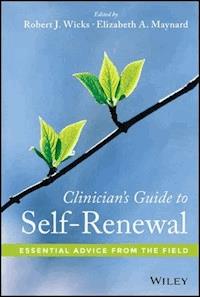
Clinician's Guide to Self-Renewal E-Book
62,99 €
Mehr erfahren.
- Herausgeber: John Wiley & Sons
- Kategorie: Fachliteratur
- Sprache: Englisch
Providing clinicians with advice consistent with the current emphasis on working from strengths to promote renewal, this guide presents a holistic approach to psychological wellness. Time-tested advice is featured from experts such as Craig Cashwell, Jeffrey Barnett, and Kenneth Pargament. With strategies to renew the mind, body, spirit, and community, this book equips clinicians with guidance and inspiration for the renewal of body, mind, community, and spirit in their clients and themselves.
Sie lesen das E-Book in den Legimi-Apps auf:
Seitenzahl: 1049
Veröffentlichungsjahr: 2014
Ähnliche




















Contents
About the Book
About the Editors
About the Authors
Self-Renewal Themes in Psychotherapy: An Introduction
Part I: Self-Renewal and the Clinician
Chapter 1: Growth, Love, and Work in Psychotherapy
I. Personal Growth, Love, and the Development of Therapeutic Talent
II. What It Takes to Be a Therapist
Conclusion
References
Chapter 2: Renewing One’s Self-Care Sensibilities
The Challenges of Being a Helping Professional
Distress
Vicarious Traumatization
Problems With Professional Competence
The Ethical Mandate to Monitor and Promote Our Wellness
Self-Care and Well Functioning
Maladaptive Coping Strategies
Self-Awareness, Risk Factors, and Warning Signs
Self-Care as Self-Renewal
Continuing Your Self-Care (Self-Renewal) Journey
References
Chapter 3: Self-Care for Clinicians in the Disaster Context
Clinician Stress in Disaster—An Example From Haiti
Acute Stress
Burnout
Vicarious Traumatization
Cautions for Care Professionals With Significant Ties to Impacted Communities
References
Chapter 4: Clinical Supervision and Self-Renewal
What Is Clinical Supervision?
First Continuum: Illness to Wellness
Clinical Supervision and Self-Renewal
Mandatory Development
Aspirational Self-Renewal
Conclusion
References
Part II: Alonetime, Mindfulness, the Sabbath, Natural Empathy: Loving Kindness, Zen Therapy, and Self-Renewal
Chapter 5: Valuing and Accessing Alonetime
Alonetime
Recognizing, Honoring, and Appreciating More Fully the Spaces in Daily Life
Appreciating the Crumbs of Alonetime
What Are Some of the Crumbs of Alonetime?
References
Chapter 6: Keeping the Sabbath
An Ancient Religious Practice
A Contemporary Practice for Self-Renewal
Models for Sabbath-Keeping
References
Chapter 7: Self-Renewal Through Natural Empathy
Leaning In
Bearing Witness
Relaxing
Accepting
Communing
Compassion
Conclusion
References
Chapter 8: Mind and Heart
Overview
Buddhist Understandings of Mindfulness and Loving-Kindness
Buddhist and Western Understandings and Practice of Mindfulness
Buddhist Understandings of Loving-Kindness
Western Understandings and Practice of Loving-Kindness
Loving-Kindness Practice
Evidence-Base for Mindfulness Meditation and Loving-Kindness Practice
Enhancing Psychotherapist Well-Being by Combining Mindfulness and Loving-Kindness Practice
Summary
References
Chapter 9: Zen Therapy
The Origin of the Ideas of Zen Therapy
A Distinctive Paradigm
It Is Already Happening
Encountering Something Terrible and Yet Sublime
Getting Outside of One’s Old Identity
The Importance of Failure
A Dash of Zen
Taking It All Upon Oneself
Dukkha Happens
The Transformation
References
Part III: Trauma, Growth, Healing, Patience, Forgiveness, Courage, and the Process of Renewal
Chapter 10: Blooming in the Night
What Is Posttraumatic Growth?
Reasons to Understand Posttraumatic Growth Literature
Conclusion
References
Chapter 11: Tell the Story
References
Chapter 12: Patience and Self-Renewal
Patience and the Process of Self-Renewal
Increasing Patience to Facilitate Self-Renewal
Conclusion
References
Chapter 13: Forgiveness and Self-Renewal
Forgiveness Therapy: The Enright Process Model
Measuring Self-Renewal Through Forgiveness
New Applications: Forgiveness and Peace
Conclusion
References
Chapter 14: Psychological and Spiritual Aspects of Courage for Self-Renewal
Psychology and Courage
Spirituality and Courage
Conclusion
References
Part IV: Theoretical Approaches to Self-Renewal: Group, Marital, and Family System, Dialectical, Behavioral, and the Ways Paradigm
Chapter 15: The Group as a Medium for Personal and Professional Renewal
Renewal in Late Adolescence/Early Adulthood
Professional Case
Three Vignettes
Principles of Group Psychotherapy Fostering Renewal
Conclusions
References
Chapter 16: Renewal in Marital and Family Systems
Introduction
Strategies for Renewal
Conclusion
References
Chapter 17: A Dialectical Behavior Therapy Approach to Self-Renewal
Mindfulness
Distress Tolerance
Emotion Regulation
Interpersonal Effectiveness
References
Chapter 18: Self-Renewal and the Ways Paradigm
Introduction
The Ways Paradigm
The Ways Paradigm and Self-Renewal
Way of Being
Way of Understanding
Way of Intervening
Professional Obligation
References
Part V: Spirituality and Self-Renewal
Chapter 19: Spiritual Coping Resources for the Self-Renewal of Clients and Therapists
Introduction
What Is Coping?
Spiritual/Religious Coping and Spiritual Self-Care
The Importance of Spiritual Coping and Spiritual Self-Care
Spiritual Self-Care Strategies
Summary of Self-Renewal
References
Chapter 20: Religion and Spirituality: A Source of Renewal for Families
Defining Renewal
Defining Religion and Spirituality
Family Therapy Theories
Family Structure
Family Functioning
Religion and Spirituality as Sources of Family Renewal
Applications to Helping Professionals
Conclusion
References
Part VI: Topics in Self-Renewal
Chapter 21: Self-Renewal With African Americans in Psychotherapy
Introduction: Self-Renewal and African Americans
Self-Renewal: Definitions and Wellness Components
Summary
References
Chapter 22: Clergy Self-Renewal Themes in Clinical Practice
The Congregational Context
The Ambivalence Toward Self
Beyond Self-Care to Self-Renewal
Conclusion
References
Chapter 23: Self-Renewal Among Gay and Lesbian Adults
Coming Out Across the Life span
Self-Renewal and Wellness
Self-Renewal Themes for LGBTQ Adults: Strengths Born of Challenge
References
Chapter 24: Renewing One’s Ethical Sensibilities
Underlying Values of the Mental Health Professions
A Commitment to Ethical Practice
A Commitment to Excellence
Ethical Dilemmas and Problems
Ethical Decision Making
Ethical Challenges and Pitfalls
The Competent Community and Communitarian Ethics
Revitalizing Your Ethical Focus
References
Chapter 25: Sexual Attraction and Self-Renewal in Psychotherapy
Three Unavoidable Aspects of the Therapeutic Relationship
The Process of Attraction in the Therapeutic Relationship
Sexual Attraction and Self-Renewal
References
Going Forward: A Brief Epilogue
Author Index
Subject Index
List of Tables
Table 1.1 Phases of Personal Growth
Table 13.1 The Enright Process Model
Table 13.2 Forgiveness Therapy Intervention Studies
Table 17.1 Distress Tolerance Examples (adapted from Linehan, 1993a, 1993b)
Table 19.1 Insight Dialogue Basic Guidelines
List of Illustrations
Figure 4.1 Self-Renewal Model
Pages
iii
iv
v
vi
xi
xii
xiii
xiv
xv
xvi
xvii
xviii
xix
xx
xxi
xxii
xxiii
xxiv
xxv
xxvi
1
2
3
4
5
6
7
8
9
10
11
12
13
14
15
16
17
18
19
20
21
22
23
24
25
26
27
28
29
30
31
32
33
34
35
36
37
38
39
40
41
42
43
44
45
46
47
48
49
50
51
52
53
54
55
56
57
58
59
60
61
62
63
64
65
66
67
68
69
70
71
72
73
74
75
76
77
78
79
80
81
82
83
84
85
86
87
88
89
90
91
92
93
94
95
96
97
98
99
100
101
102
103
104
105
106
107
108
109
110
111
112
113
114
115
116
117
118
119
120
121
122
123
124
125
126
127
128
129
130
131
132
133
134
135
136
137
138
139
140
141
142
143
144
145
146
147
148
149
150
151
152
153
154
155
156
157
158
159
160
161
162
163
164
165
166
167
168
169
170
171
172
173
174
175
176
177
178
179
180
181
182
183
184
185
186
187
188
189
190
191
192
193
194
195
196
197
198
199
200
201
202
203
204
205
206
207
208
209
210
211
212
213
214
215
216
217
218
219
220
221
222
223
224
225
226
227
228
229
230
231
232
233
234
235
236
237
238
239
240
241
242
243
244
245
246
247
248
249
250
251
252
253
254
255
256
257
258
259
260
261
262
263
264
265
266
267
268
269
270
271
272
273
274
275
276
277
278
279
280
281
282
283
284
285
286
287
288
289
290
291
292
293
294
295
296
297
298
299
300
301
302
303
304
305
306
307
308
309
310
311
312
313
314
315
316
317
318
319
320
321
322
323
324
325
326
327
328
329
330
331
332
333
334
335
336
337
338
339
340
341
342
343
344
345
346
347
348
349
350
351
352
353
354
355
356
357
358
359
360
361
362
363
364
365
366
367
368
369
370
371
372
373
374
375
376
377
378
379
380
381
382
383
384
385
386
387
388
389
390
391
392
393
394
395
396
397
398
399
400
401
402
403
404
405
406
407
408
409
410
411
412
413
414
415
416
417
418
419
420
421
422
423
424
425
426
427
428
429
430
431
432
433
434
435
436
437
438
439
440
441
442
443
444
445
446
447
448
449
450
451
452
453
454
455
456
457
458
459
460
461
462
463
464
465
466
467
468
469
470
471
472
473
474
475
476
477
478
479
480
481
482
483
484
485
486
487
488
489
490
491
492
493
494
495
496
497
498
499
500
501
502
Guide
Cover
Table of Contents
Begin Reading
Clinician’s Guide to Self-Renewal
Essential Advice From the Field
Robert J. Wicks
Elizabeth A. Maynard
Cover image: @istockphoto.com/ooyoo
Cover design: Wiley
Copyright © 2014 by John Wiley & Sons, Inc. All rights reserved.
Published by John Wiley & Sons, Inc., Hoboken, New Jersey
Published simultaneously in Canada
No part of this publication may be reproduced, stored in a retrieval system, or transmitted in any form or by any means, electronic, mechanical, photocopying, recording, scanning, or otherwise, except as permitted under Section 107 or 108 of the 1976 United States Copyright Act, without either the prior written permission of the Publisher, or authorization through payment of the appropriate per-copy fee to the Copyright Clearance Center, 222 Rosewood Drive, Danvers, MA 01923, (978) 750-8400, fax (978) 646-8600, or on the web at www.copyright.com. Requests to the Publisher for permission should be addressed to the Permissions Department, John Wiley & Sons, Inc., 111 River Street, Hoboken, NJ 07030, (201) 748-6011, fax (201) 748-6008, or online at www.wiley.com/go/permissions.
Limit of Liability/Disclaimer of Warranty: While the publisher and author have used their best efforts in preparing this book, they make no representations or warranties with the respect to the accuracy or completeness of the contents of this book and specifically disclaim any implied warranties of merchantability or fitness for a particular purpose. No warranty may be created or extended by sales representatives or written sales materials. The advice and strategies contained herein may not be suitable for your situation. You should consult with a professional where appropriate. Neither the publisher nor the author shall be liable for damages arising herefrom.
For general information about our other products and services, please contact our Customer Care Department within the United States at (800) 762-2974, outside the United States at (317) 572-3993 or fax (317) 572-4002.
Wiley publishes in a variety of print and electronic formats and by print-on-demand. Some material included with standard print versions of this book may not be included in e-books or in print-on-demand. If this book refers to media such as a CD or DVD that is not included in the version you purchased, you may download this material at http://booksupport.wiley.com. For more information about Wiley products, visit www.wiley.com.
ISBN: 978-1-118-44381-1 (pbk)
ISBN: 978-1-118-84103-7 (ebk)
ISBN: 978-1-118-84106-8 (ebk)
For the Students and Faculty of Loyola University Maryland: In gratitude for being the recipient of your graciousness, wisdom, good humor, and friendship for over 25 years.
Robert J. Wicks
To all who offer comfort and sustenance to those in need: May you be renewed each day.
Elizabeth A. Maynard
About the Book
The goal of this book is to begin a more in-depth and broader discussion as to how using the lens of self-renewal can enrich the psychotherapy process as well as the clinician’s personal and professional life.
The emphasis on the clinician’s own self-renewal in the early chapters of the book is an outgrowth of the belief that while technique and the therapeutic relationship are of paramount importance in the treatment encounter, there is a third element that is of profound import as well: the modeling by the therapist of a respect for, and involvement in, seeking a healthier lifestyle. In this light, a clinician’s self-care is not viewed solely as benefiting the therapist alone, although the direct benefit to the helper is certainly a goal. It is also seen as having a subtle but powerful impact on the therapy process itself.
With clinician self-care and mindfulness as a bedrock of self-renewal, the remainder of the subsequent sections of the book are designed to provide new insights and perspective on self-renewal in terms of client growth and healing, therapeutic techniques, spirituality, different populations, ethics, and other challenges.
Specific key features in Self-Renewal Themes in Psychotherapy include:
Self-care for clinicians in the disaster context.
Clinical supervision and self-renewal.
Mindfulness, silence, solitude, and reflection in the life of the clinician.
Zen therapy and renewal.
Self-renewal among gay and lesbian adults.
Posttraumatic growth.
Intergenerational trauma and healing.
Patience, forgiveness, and courage in the process of self-renewal.
Renewal in marital, family, and group settings.
Spirituality, religion, and renewal.
Self-renewal with African Americans in psychotherapy.
Growth, love, and work in psychotherapy.
The positive impact of this information is not simply limited to a present specific benefit (i.e., how can I put this knowledge in play with my caseload?) alone. In a broader sense, the topics covered are designed as well to draw on the experience and wisdom of the clinicians reading this material by prompting them to also ask such questions as:
How can I more productively use the frame of “self-renewal” with different populations and presenting problems?
What topics were
not
covered in this initial effort at discussing self-renewal and clinical practice that you might develop more clearly going forward?
What are the most pressing issues that intrigue, challenge, and reward you in your own personal and professional journey that would significantly enhance your self-renewal process?
How can your own self-renewal plan be developed further—not as a duty in being healthier but as part of a pilgrimage in enjoying life—including one’s clinical practice in a much fuller way
now
?
These are but a few questions that, if truly, honestly, nonjudgmentally, and comprehensively faced, may well lead to alter and enrich how clinicians can involve themselves in the process of therapy. The impact, and living out, of insights achieved from grappling with such questions and the different approaches in this book can change the clinician and how therapy is undertaken. The lyrics (theory and technique) of the treatment may remain fairly unaltered. However, the music (modeling, relational aspects, and sense of mindfulness in play) of the clinical work may be profoundly changed, ending in surprisingly gratifying results. Once again, self-renewal is a gift therapists can give themselves. But, in the end, it is a gift that can open up those they treat to open up so much more in their lives as well and, in its essence, isn’t this what therapy is truly about?
About the Editors
Robert J. Wicks, PsyD
Dr. Wicks, who received his doctorate in psychology from Hahnemann Medical College and Hospital, is a professor emeritus of Loyola University Maryland. He has published more than 50 books for professionals and the general public. They include: Bounce: Living the Resilient Life; Riding the Dragon; The Inner Life of the Counselor; and Streams of Contentment. Dr. Wicks has lectured on the importance of resilience and possessing a healthy perspective in Hanoi, Bejing, Budapest, Belfast, and Johannesburg as well as at the Mayo Clinic, Harvard’s Children’s Hospital and Harvard Divinity School, at the Johns Hopkins School of Medicine, and on Capitol Hill to Members of Congress and their Chiefs of Staff. He received the Humanitarian of the Year Award from the American Counseling Association’s Division on Spirituality, Ethics, and Values and in 2006 was recipient of the first annual Alumni Award for Excellence in Professional Psychology from Widener University.
Related Books by Dr. Wicks . . .
Bounce: Living the Resilient Life
(OUP)
Streams of Contentment
(Sorin Books)
Riding the Dragon
(Sorin Books)
The Inner Life of the Counselor
(Wiley)
Primer on Posttraumatic Growth
—Written with Mary Beth Werdel (Wiley)
Elizabeth A. Maynard, PhD
Dr. Maynard is associate professor of psychology and director of clinical mental health counseling programs at the University of St. Thomas in Houston, Texas. Trained as a clinical psychologist at Fuller Theological Seminary, she is a licensed clinical psychologist who serves professional helpers, including both clergy and mental health professionals and those in training for helping careers. Her research focuses on the themes of sexuality, religious coping, and prejudice.
About the Authors
Jeffrey E. Barnett, PsyD, ABPP
Dr. Barnett is a professor and associate chair of the Department of Psychology at Loyola University Maryland. He is a licensed psychologist in Maryland, board certified in clinical psychology and clinical child and adolescent psychology by the American Board of Professional Psychology, and is a distinguished practitioner in the National Academies of Practice. He specializes in ethics and professional practice issues for mental health professionals to include self-care, psychological wellness, and burnout prevention.
Jodi L. Bartley
Jodi is a doctoral student in the Department of Counseling and Educational Development at the University of North Carolina at Greensboro. She holds master’s degrees in both Mental Health Counseling and Educational Psychology. Her current research interests include relational depth and spirituality.
Amber E. Blews
Amber is a doctoral student in the clinical psychology program at Fuller Graduate School of Psychology in Pasadena, California. She holds an MA in Educational Counseling from the University of Redlands and an MA in Psychology from Fuller Theological Seminary. Blews studies the effects of religion and spirituality, goals, and virtue/character development in adolescent and young adult populations.
Virginia Brabender, PhD, ABPP
Dr. Brabender is a professor at Widener University’s Institute for Graduate Clinical Psychology. She has authored or coauthored five books, four on group psychotherapy. Her most recent contribution is a volume coedited with April Fallon titled .
Lesen Sie weiter in der vollständigen Ausgabe!
Lesen Sie weiter in der vollständigen Ausgabe!
Lesen Sie weiter in der vollständigen Ausgabe!
Lesen Sie weiter in der vollständigen Ausgabe!
Lesen Sie weiter in der vollständigen Ausgabe!
Lesen Sie weiter in der vollständigen Ausgabe!
Lesen Sie weiter in der vollständigen Ausgabe!
Lesen Sie weiter in der vollständigen Ausgabe!
Lesen Sie weiter in der vollständigen Ausgabe!
Lesen Sie weiter in der vollständigen Ausgabe!
Lesen Sie weiter in der vollständigen Ausgabe!
Lesen Sie weiter in der vollständigen Ausgabe!
Lesen Sie weiter in der vollständigen Ausgabe!
Lesen Sie weiter in der vollständigen Ausgabe!
Lesen Sie weiter in der vollständigen Ausgabe!
Lesen Sie weiter in der vollständigen Ausgabe!
Lesen Sie weiter in der vollständigen Ausgabe!
Lesen Sie weiter in der vollständigen Ausgabe!
Lesen Sie weiter in der vollständigen Ausgabe!
Lesen Sie weiter in der vollständigen Ausgabe!
Lesen Sie weiter in der vollständigen Ausgabe!
Lesen Sie weiter in der vollständigen Ausgabe!
Lesen Sie weiter in der vollständigen Ausgabe!
Lesen Sie weiter in der vollständigen Ausgabe!
Lesen Sie weiter in der vollständigen Ausgabe!
Lesen Sie weiter in der vollständigen Ausgabe!
Lesen Sie weiter in der vollständigen Ausgabe!
Lesen Sie weiter in der vollständigen Ausgabe!
Lesen Sie weiter in der vollständigen Ausgabe!
Lesen Sie weiter in der vollständigen Ausgabe!
Lesen Sie weiter in der vollständigen Ausgabe!
Lesen Sie weiter in der vollständigen Ausgabe!
Lesen Sie weiter in der vollständigen Ausgabe!
Lesen Sie weiter in der vollständigen Ausgabe!
Lesen Sie weiter in der vollständigen Ausgabe!
Lesen Sie weiter in der vollständigen Ausgabe!




