


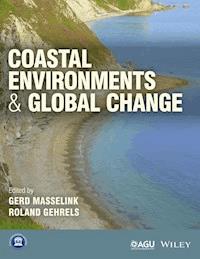
Coastal Environments and Global Change E-Book
50,99 €
Mehr erfahren.
- Herausgeber: John Wiley & Sons
- Kategorie: Wissenschaft und neue Technologien
- Serie: Wiley Works
- Sprache: Englisch
The coastal zone is one of the most dynamic environments on our planet and is much affected by global change, especially sea-level rise. Coastal environments harbour valuable ecosystems, but they are also hugely important from a societal point of view. This book, which draws on the expertise of 21 leading international coastal scientists, represents an up-to-date account of coastal environments and past, present and future impacts of global change. The first chapter of the book outlines key principles that underpin coastal systems and their behaviour. This is followed by a discussion of key processes, including sea level change, sedimentation, storms, waves and tides, that drive coastal change. The main part of the book consists of a discussion of the main coastal environments (beaches, dunes, barriers, salt marshes, tidal flats, estuaries, coral reefs, deltas, rocky and glaciated coasts and coastal groundwater), and how these are affected by global change. The final chapter highlights strategies for coping with coastal change.
Readership: final year undergraduate and postgraduate-level students on coastal courses in a wide range subjects, including geography, environmental management, geology, oceanography and coastal/civil engineering. The book will also be a valuable resource for researchers and applied scientists dealing with coastal environments.
Additional resources for this book can be found at: www.wiley.com/go/masselink/coastal
Sie lesen das E-Book in den Legimi-Apps auf:
Seitenzahl: 1315
Veröffentlichungsjahr: 2014
Ähnliche




















CONTENTS
Cover
Title page
Copyright page
Contributors
1 Introduction to Coastal Environments and Global Change
1.1 Setting the scene
1.1.1 What is the coastal zone?
1.1.2 Coastal zone and society
1.1.3 Scope of this book and chapter outline
1.2 Coastal morphodynamics
1.2.1 Research paradigm
1.2.2 Coastal morphodynamic systems
1.2.3 Morphodynamic feedback
1.2.4 Coastal evolution and stratigraphy
1.3 Climate change
1.3.1 Quaternary climate change
1.3.2 Present and future climate change
1.4 Modelling coastal change
1.4.1 Need for adequate models
1.4.2 Conceptual models
1.4.3 Empirical models
1.4.4 Behaviour-oriented models
1.4.5 Process-based morphodynamic models
1.4.6 Physical models
1.5 Summary
Key publications
References
2 Sea Level
2.1 Introduction
2.1.1 What is sea level?
2.1.2 Processes affecting sea level
2.1.3 Observing sea level
2.1.4 Chapter outline
2.2 Quaternary sea-level change
2.2.1 Introduction
2.2.2 Sea-level observations
2.2.3 Interpretation of the observations
2.3 Recent and future sea-level change
2.3.1 Introduction
2.3.2 Sea-level observations
2.3.3 Interpretation of the observations
2.3.4 Estimating future sea levels
2.4 Summary
Key publications
Acknowledgements
References
3 Environmental Control
3.1 Geology and sediments: setting boundary conditions for coasts
3.1.1 Coastal diversity: a heritage of geology and sediments
3.1.2 Spatial and temporal scales: from global tectonics to local geological controls
3.2 Geology and coasts
3.2.1 The pervasive role of plate tectonics
3.2.2 The role of Quaternary ice sheets and isostatic rebound on high-latitude coasts
3.2.3 Water loading of continental shelves
3.2.4 Lithology, sediment texture and coasts
3.2.5 Other regional to local boundary conditions: coastal orientation and gradient
3.3 Sediments and coasts
3.3.1 Coastal sediment stacking over time: sequence stratigraphy and sea-level change
3.3.2 Sediment accommodation space
3.3.3 Terrigenous sediment supply
3.3.4 Sediment redistribution from river-mouth to coast
3.3.5 Carbonate sediments
3.3.6 Sediment supply from soft cliffs
3.3.7 Longshore sediment transport
3.3.8 Sediment supply from the inner continental shelf
3.3.9 Boulders on the shore: an enigmatic issue
3.4 Human impacts on sediment supply to coasts
3.5 Climate change, geology and sediments
3.6 Summary
Key publications
References
4 Drivers
4.1 Physical drivers of the coastal environment
4.2 Waves
4.2.1 Importance and definitions
4.2.2 Wave theories
4.2.3 Wave generation
4.2.4 Wave propagation and shoaling
4.2.5 Wave measurement
4.2.6 Long waves
4.2.7 Wave climate and response to global climate change
4.3 Tides
4.3.1 Tidal characteristics
4.3.2 Equilibrium tides
4.3.3 Dynamical considerations
4.3.4 Tidal analysis and prediction
4.3.5 Tidal currents
4.3.6 Global change effects on tides
4.4 Summary
Key publications
References
5 Coastal Hazards
5.1 Coastal hazards
5.1.1 Coastal vulnerability to storm and tsunami hazards
5.1.2 Assessing risk
5.2 Extratropical storms and tropical cyclones
5.2.1 The anatomy of storms and cyclones
5.2.2 Vulnerable coasts and the storm cycle
5.2.3 Disequilibrium in the storm cycle
5.3 Tsunamis
5.3.1 Tsunamis in the ocean
5.3.2 Tsunamis at the coast
5.3.3 Tsunami drawdown
5.3.4 Tsunami warning systems
5.4 Overwash
5.4.1 Overwash impacts
5.4.2 Washover deposits
5.5 Palaeostudies of coastal hazards
5.5.1 Reviewing historical documents
5.5.2 Using the geological record
5.5.3 Overwash studies: successes and limitations
5.6 Integrating hazard studies with coastal planning
5.7 Cyclones in a warmer world
5.8 Summary
Key publications
References
6 Coastal Groundwater
6.1 Introduction
6.2 The subterranean estuary
6.3 Submarine groundwater discharge (SGD)
6.3.1 Measurement of SGD
6.3.2 SGD in the global hydrological cycle
6.4 Controls on SGD variability
6.4.1 Spatial variations
6.4.2 Temporal variations
6.5 Human influences
6.6 Influence of global climate change
6.7 Summary
Key publications
References
7 Beaches
7.1 Introduction
7.1.1 Setting
7.1.2 Scales of nearshore morphology
7.1.3 Scope of this chapter
7.2 Nearshore hydrodynamics
7.2.1 Wave breaking
7.2.2 Wave-generated nearshore currents
7.3 Surf-zone morphology
7.3.1 Intertidal sandbars
7.3.2 Subtidal sandbars: cross-shore migration
7.3.3 Subtidal sandbars: alongshore non-uniform dynamics
7.4 Anthropogenic activities
7.5 Climate change
7.5.1 Potential future impacts
7.5.2 Quantification of climate change impacts: future directions
7.6 Summary
Key publications
References
8 Coastal Dunes
8.1 Conditions for dune formation
8.1.1 Aeolian transport
8.1.2 Potential for dune building
8.1.3 Processes of dune formation
8.1.4 Dune fields
8.2 Dunes as habitat
8.3 Dunes in developed areas
8.3.1 Degradational activities
8.3.2 Value of dunes
8.4 Dune restoration and management
8.4.1 Favouring dune building by natural aeolian processes
8.4.2 Depositing fill directly
8.4.3 Using sand fences
8.4.4 Using vegetation
8.4.5 Restricting negative human actions
8.4.6 Maintaining dune environments
8.5 Effects of future climate change
8.6 Summary
Key publications
References
9 Barrier Systems
9.1 Definition and description of barriers and barrier systems
9.2 Classification
9.2.1 Barriers
9.2.2 Barrier systems
9.3 Barrier sub-environments
9.4 Theories on barrier formation
9.5 Modes of barrier behaviour
9.6 Drivers in barrier development and behaviour
9.6.1 Introduction
9.6.2 Antecedent topography and substrate lithology
9.6.3 Relative sea-level change
9.6.4 Sediment sources, sinks and fluxes
9.6.5 Wind, waves, longshore and cross-shore currents, and tides
9.6.6 Storm surges
9.6.7 River discharge
9.6.8 Climate
9.6.9 Flora and fauna
9.6.10 Processes and impacts of anthropogenic activities
9.7 Barrier sequences as archives of barrier behaviour
9.8 Lessons from numerical and conceptual models
9.8.1 Data and concepts
9.8.2 Model output relevant to barrier-system behaviour
9.9 Coastal-zone management and global change
9.10 Future perspectives
9.11 Summary
Key publications
References
10 Tidal Flats and Salt Marshes
10.1 Introduction
10.2 Tidal flats
10.2.1 Tidal-flat setting
10.2.2 Geomorphological and ecosystem functioning
10.2.3 Sediments and sedimentology of tidal flats
10.2.4 Mud dynamics
10.2.5 Post-depositional change
10.2.6 Erosion and re-suspension
10.3 Salt marshes
10.3.1 Salt-marsh ecology
10.3.2 Salt-marsh vegetation and biogeography
10.3.3 Salt-marsh zonation and succession
10.3.4 Geomorphological and ecosystem functioning
10.3.5 The role of sedimentation and tides in salt-marsh maintenance
10.3.6 Response to sea-level changes
10.3.7 Impact of future climate and sea-level change
10.4 Human influences
10.5 Summary
Key publications
References
11 Mangrove Shorelines
11.1 Introduction
11.2 Mangrove adaptation in relation to climate zones
11.3 Mangrove biogeography
11.4 Zonation and succession
11.5 Geomorphological setting and ecosystem functioning
11.6 Sedimentation and morphodynamic feedback
11.7 Mangrove response to sea-level change
11.8 Human influences
11.9 Impact of future climate and sea-level change
11.10 Summary
Key publications
References
12 Estuaries and Tidal Inlets
12.1 Introduction
12.2 Estuaries
12.2.1 Introduction
12.2.2 Geomorphic settings
12.2.3 Salinity stratification
12.2.4 Circulation and sedimentation
12.2.5 Sedimentary regimes
12.2.6 Wave-dominated estuaries
12.2.7 Tide-dominated estuaries
12.2.8 Effects of floods: New England estuaries
12.2.9 Future of estuaries
12.3 Tidal inlets
12.3.1 Morphodynamics
12.3.2 Tidal-inlet formation and evolution
12.3.3 Tidal-inlet relationships
12.3.4 Sand transport patterns
12.3.5 Tidal-inlet effects on adjacent shorelines
12.3.6 Human influences
12.3.7 Tidal-inlet stratigraphy
12.3.8 Tidal-inlet response to sea-level rise
12.4 Summary
References
13 Deltas
13.1 Deltas: definition, context and environment
13.1.1 A definition of deltas
13.1.2 The tectonic context of deltas
13.1.3 Why do some rivers form deltas?
13.2 Delta sub-environments
13.2.1 The delta plain
13.2.2 The subaqueous delta
13.2.3 Deltas and deep-sea fans
13.3 The morphodynamic classification of river deltas
13.3.1 River-dominated deltas
13.3.2 Wave-dominated deltas
13.3.3 Tide-dominated deltas
13.3.4 Quantifying river, wave and tide controls
13.3.5 Spatial and temporal morphodynamic variability
13.4 Sediment trapping processes in deltas and coastal sediment redistribution
13.4.1 Delta-plain deposition
13.4.2 Estuarine processes in deltas
Lesen Sie weiter in der vollständigen Ausgabe!
Lesen Sie weiter in der vollständigen Ausgabe!
Lesen Sie weiter in der vollständigen Ausgabe!
Lesen Sie weiter in der vollständigen Ausgabe!
Lesen Sie weiter in der vollständigen Ausgabe!
Lesen Sie weiter in der vollständigen Ausgabe!
Lesen Sie weiter in der vollständigen Ausgabe!
Lesen Sie weiter in der vollständigen Ausgabe!
Lesen Sie weiter in der vollständigen Ausgabe!
Lesen Sie weiter in der vollständigen Ausgabe!
Lesen Sie weiter in der vollständigen Ausgabe!
Lesen Sie weiter in der vollständigen Ausgabe!
Lesen Sie weiter in der vollständigen Ausgabe!
Lesen Sie weiter in der vollständigen Ausgabe!
Lesen Sie weiter in der vollständigen Ausgabe!
Lesen Sie weiter in der vollständigen Ausgabe!
Lesen Sie weiter in der vollständigen Ausgabe!
Lesen Sie weiter in der vollständigen Ausgabe!
Lesen Sie weiter in der vollständigen Ausgabe!
Lesen Sie weiter in der vollständigen Ausgabe!
Lesen Sie weiter in der vollständigen Ausgabe!
Lesen Sie weiter in der vollständigen Ausgabe!
Lesen Sie weiter in der vollständigen Ausgabe!
Lesen Sie weiter in der vollständigen Ausgabe!
Lesen Sie weiter in der vollständigen Ausgabe!




