


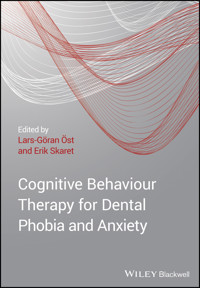
Cognitive Behavioral Therapy for Dental Phobia and Anxiety E-Book
49,99 €
Mehr erfahren.
- Herausgeber: John Wiley & Sons
- Kategorie: Fachliteratur
- Sprache: Englisch
The first book to describe evidence-based treatment of dental phobia using brief CBT, based on the pioneering single-session treatment for specific phobias developed by Lars-Göran Öst.
- Brings together research, experience and techniques from clinical psychology and dentistry to describe evidence-based treatment of dental phobia in clinical and dental contexts
- Chapters describe epidemiology, diagnosis and differential diagnosis, symptoms, clinical characteristics and consequences, and aetiology of dental phobia
- Also covers related issues including intra-oral injection phobia, dental treatment of fearful children, and the use of medication to supplement psychological treatment of fear
Sie lesen das E-Book in den Legimi-Apps auf:
Seitenzahl: 532
Veröffentlichungsjahr: 2013
Ähnliche




















Contents
Contributors
Preface
Organization of the Book
Acknowledgements
Part I Background, Assessment and Aetiology
1 Symptoms, Clinical Characteristics and Consequences
Introduction
Symptoms, Characteristics and Consequences of Dental Anxiety and Dental Phobia
Conclusion
2 Background Description and Epidemiology
Background
Dental Fear, Dental Anxiety and Dental Phobia
Consequences
Measurement of Dental Fear and Anxiety
Prevalence
Conclusion
3 Assessment of Dental Phobia and Anxiety
Differential Diagnoses
Assessment Tools
Future Developments
4 Aetiology of Dental Phobia
Introduction
Psychological and Interpersonal Aspects of Dental Treatment
Elements of the Fear Reaction
Aetiological Theories of Dental Fear and Anxiety
The Multi-factorial Aetiology of Dental Phobia
From Dental Fear to Dental Phobia – Three Vicious Circles
General Conclusions
5 Intra-Oral Injection Phobia
Blood-Injury-Injection Phobia
Prevalence, Subtypes and Gender Differences
Catastrophic Beliefs in BII Phobics
Aetiology
Overlap between BII Phobia and High Dental Anxiety
Dental Health in Intra-Oral Injection Phobics
Quality of Life in Persons with BII Phobia
Assessment of BII Anxiety
Clinical Challenges
Case Presentation
6 Dental Anxiety in Children and Adolescents
Definitions of Dental Fear and Anxiety and Dental Behaviour Management Problems
Relationship between Dental Fear and Anxiety and Behaviour Management Problems
Prevalence
Psychological Factors Associated with the Development of DFA and DBMP
Part II Treatments
7 Cognitive Behaviour Therapy
The Birth and Early Development of Behavior Therapy
The Birth and Early Development of Cognitive Therapy
CBT: The Combination of Two Therapies
Characteristic Features of Cognitive Behaviour Therapy
Myths and Misconceptions about CBT
Important CBT Principles
Treatment Principles in CBT for Emotional Disorders
The Evidence Base of CBT
Which CBT Treatments are effective for which Disorders?
8 Multimodal Cognitive Behavioural Treatment
Historical Background
The First Treatment Method
The Revised Treatment
The Current Treatment
9 One-Session Treatment of Dental Phobia
Background
General Description of the One-Session Treatment
One-Session Treatment of Dental Phobia
Training Dentists to do the One-Session Treatment
Evaluation of Dentists Carrying Out OST
10 The Combined Treatment
Background
Characteristics of the Dental Treatment Situation
The Dentist as Therapist
CBT in the Dental Chair
Intra-Oral Injection Phobia
Patients with Blood-Injury-Injection (BII) Phobia
Patients Afraid of Drilling
Patients Afraid of Extractions
Patients Afraid of Endodontic Treatment
Patients with Gagging Problems
Coping with Future Dental Treatment
When Does the Psychologist Need to be There?
Conclusions
11 Dental Treatment under Sedation
Introduction
Pain and Pain Control
Indications for Sedation and General Anaesthesia
Preoperative Assessment
Sedatives and Techniques
Side Effects and Safety
Documentation and Records
Sedation and CBT
12 Effects of Cognitive Behavioural Treatments
Description of Treatments Evaluated in Randomized Controlled Trials
Systematic Review
Meta-Analysis
Summary and Conclusions
Part III Cultural Aspects, Prevention and Future Research
13 Different Treatment Approaches in Different Cultures and Health-Care Systems
Introduction
Dental Fear and Phobia in Non-Western Countries
Considerations for CBT in Non-Western Cultures
Providing CBT in Different Health-Care Systems
Alternatives to Face-to-Face CBT for Dental Phobia
Pharmacological Strategies
Summary
14 Prevention of Dental Phobia
Aetiology as the Background for Prevention
Dentist Behaviour
Meeting the Child and the Parent in the Waiting Room
Child and Parent in the Dental Clinic
Behaviour Shaping
Cognitive Behavioural Therapy in Fearful Children and Adolescents
Exploring the child’s’ negative thoughts
Explaining the fear and the principles of gradual exposure
The Complexity of Pain
Pain Control
Local Anaesthesia in Children with Blood-Injury-Injection (BII) Phobia Activation
Patient Control
Pharmacological Methods
Aspects of Prevention in the Dental Health Service
The Role of the Dental Hygienist (DH) in Prevention and Treatment of DA and BMP
Counselling and Health Behaviour Change
Conclusions
15 Future Research and Applications
Symptoms, Clinical Characteristics and Consequences
Epidemiology
Assessment
Aetiology
Intra-Oral Injection Phobia
Dental Anxiety in Children and Adolescents
Multi-Modal Cognitive-Behavioural Treatment
One-Session Treatment
The Combined Treatment
The Meta-analysis
Prevention of Dental Phobia
Conclusions
Index
This edition first published 2013© 2013 John Wiley & Sons, Ltd
Wiley-Blackwell is an imprint of John Wiley & Sons, formed by the merger of Wiley’s global Scientific, Technical and Medical business with Blackwell Publishing.
Registered OfficeJohn Wiley & Sons, Ltd, The Atrium, Southern Gate, Chichester, West Sussex, PO19 8SQ, UK
Editorial Offices350 Main Street, Malden, MA 02148-5020, USA9600 Garsington Road, Oxford, OX4 2DQ, UKThe Atrium, Southern Gate, Chichester, West Sussex, PO19 8SQ, UK
For details of our global editorial offices, for customer services, and for information about how to apply for permission to reuse the copyright material in this book please see our website at www.wiley.com/wiley-blackwell.
The right of Lars-Göran Öst and Erik Skaret to be identified as the authors of the editorial material in this work has been asserted in accordance with the UK Copyright, Designs and Patents Act 1988.
All rights reserved. No part of this publication may be reproduced, stored in a retrieval system, or transmitted, in any form or by any means, electronic, mechanical, photocopying, recording or otherwise, except as permitted by the UK Copyright, Designs and Patents Act 1988, without the prior permission of the publisher.
Wiley also publishes its books in a variety of electronic formats. Some content that appears in print may not be available in electronic books.
Designations used by companies to distinguish their products are often claimed as trademarks. All brand names and product names used in this book are trade names, service marks, trademarks or registered trademarks of their respective owners. The publisher is not associated with any product or vendor mentioned in this book. This publication is designed to provide accurate and authoritative information in regard to the subject matter covered. It is sold on the understanding that the publisher is not engaged in rendering professional services. If professional advice or other expert assistance is required, the services of a competent professional should be sought.
Library of Congress Cataloging-in-Publication Data
Cognitive behavioral therapy for dental phobia and anxiety / edited by Lars-Göran Öst, Erik Skaret. pages cmIncludes bibliographical references and index.
ISBN 978-1-119-96072-0 (hardback) – ISBN 978-1-119-96071-3 (paper) 1. Fear of dentists. 2. Cognitive therapy. 3. Evidence-based dentistry. 4. Dentist and patient. I. Öst, Lars-Göran, editor of compilaton. II. Skaret, Erik, editor of compilation. RK53.C64 2013616.85¢22–dc23
2012045562
A catalogue record for this book is available from the British Library.
Cover design by Cyan Design
Contributors
Maren Lillehaug Agdal, DDS, PhD, is a dentist at the Center for Odontophobia in Bergen, Norway. The title of her PhD thesis in 2011 is ‘Dental Phobia and Intra-Oral Injection Phobia: Oral Health, Dental Treatment Needs and Quality of Life’.Ulla Wide Boman, PhD, is Associate Professor at the Department of Behavioral and Community Dentistry, University of Gothenburg, Sweden. Her research focuses on behavioural aspects of oral health. She also works as a clinical psychologist at the Dental Fear Research and Treatment Clinic (DFRTC), Swedish Public Dental Service.David M. Clark, DPhil, is Professor of Experimental Psychology at Oxford University, UK. He is a world-leading researcher in anxiety disorders and has carried out a large number of randomized controlled trials (RCTs) for various anxiety disorders. Three of his cognitive treatments are evidence-based, for: panic disorder, social phobia and post-traumatic stress disorder.Magnus Hakeberg, DDS, PhD, is Professor of Dental Public Health and Head of the Department of Behavioral and Community Dentistry, Institute of Odontology, the Sahlgrenska Academy, University of Gothenburg, Sweden. He is a research director at the Public Dental Service, Region Västra Götaland, Sweden and a dentist and specialist in endodontology.Kristin Haukebø, PhD, is a psychologist within the Consultation & Liaison team, Oslo University Hospital, Norway. The title of her 2011 thesis is ‘Cognitive, Behavioral and Neural Correlates of Dental and Intra-Oral Injection Phobia. Results from One Treatment and One FMRI Study of Randomized, Controlled Design’.Lisa J. Heaton, PhD, is Acting Assistant Professor of Oral Health Sciences and a clinical psychologist, providing cognitive behaviour therapy (CBT) in the Dental Fears Research Clinic at the University of Washington, USA. With Peter Milgrom and Philip Weinstein, she co-authored the third edition of the textbook, Treating Fearful Dental Patients, in 2009.Gunilla Klingberg, DDS, PhD, is senior consultant in paediatric dentistry at Mun-H-Center, the Swedish National Orofacial Resource Center for Rare Diagnoses, and Associate Professor at the Sahlgrenska Academy, University of Gothenburg, Sweden. Her research concerns orofacial aspects of rare disorders, behavioural sciences in odontology, pain, and qualitative research methods applied to dental sciences.Gerd Kvale, Dr Psychol, is Professor of Clinical Psychology at the University of Bergen, Norway. She was one of the founders of the Center for Odontophobia, University of Bergen. Her research has focused on dental phobia, social phobia, panic disorder, and obsessive-compulsive disorder.Jesper Lundgren, PhD, is an Associate Professor at the Department of Psychology, University of Gothenburg, Sweden and a psychologist at the Public Dental Service, Region Västra Götaland, Sweden. He has worked for over 15 years in the field of psychology and dentistry with his main focus of research on dental fear and other health psychological issues.Peter Milgrom, DDS, is Professor of Oral Health Sciences and Pediatric Dentistry at the University of Washington, USA. He was Director of the Dental Fears Research Clinic at the university for nearly 25 years. His latest book (with Philip Weinstein and Lisa Heaton), Treating Fearful Dental Patients, was published in 2009.J. Timothy Newton, PhD, is Professor of Psychology as Applied to Dentistry at King’s College Dental Institute in London, UK. In 2008, with Koula Asimakopoulou and Suzanne Scott, he founded the King’s College London Dental Institute Health Psychology Service for individuals who are dentally anxious.Lars-Göran Öst, PhD, is Professor of Clinical Psychology at Stockholm University, Sweden. During the last 40 years he has carried out RCTs on most anxiety disorders in adults and children, and has developed three evidence-based CBT treatments: one-session treatment for specific phobia, applied relaxation for generalized anxiety and applied tension for blood phobia.Magne Raadal, DDS, PhD, is Professor Emeritus (Dentistry) at University of Bergen, Norway. He graduated in 1966, became Specialist in Pediatric Dentistry in 1981, PhD in 1984, and Professor in Pediatric Dentistry in 1993. He was Dean of Faculty of Dentistry, University of Bergen, from 2002 to 2009.Erik Skaret, DDS, PhD, is Professor at the University of Oslo, Department of Pediatric Dentistry and Behavioral Sciences. He was Head of the Center for Odontophobia, University of Bergen, from 2001 to 2008, and has many years of experience with psychological treatment of dental phobia based on cognitive behaviour therapy.Margrethe Vika, PhD, is a clinical psychologist at the Center for Odontophobia in Bergen, Norway. She completed her PhD in clinical psychology at the University of Bergen in 2008. The title of her thesis is ‘Fear of Intra-Oral Injections among Adolescents and Adults – Prevalence, Consequences and Treatment’.Tiril Willumsen, DDS, PhD, is Professor at the University of Oslo and has carried out a randomized control trial on dental phobia using variants of cognitive treatment and applied relaxation. She lectures about dental treatment in vulnerable patients, e.g. with histories of childhood sexual abuse, eating disorders and diseased elderly.
Preface
This book is a result of a multi-disciplinary research cooperation between dentists and psychologists. It is meant to help students and professionals in dentistry to understand the complexity of the anxiety phenomenon, and in psychology to understand the specific situation for the dental phobia patient, and bridge the gap between dentistry and psychology. The book was first planned to be written for Scandinavia, and most of the authors are therefore from these countries. This plan was then changed and a few more authors outside Scandinavia were included. However, we know many researchers in behavioural science in dentistry and in psychology around the world that would have been very qualified for being included on the author list of the present book.
Being a practising dentist is in many ways a challenging and stressful job. Before they leave the surgery after a long day with patients they often have a brief glance at the list of scheduled appointments for tomorrow. Some names on the schedule can result in unpleasant feelings: ‘I hope the patient after lunch cancels or does not show up’. The first thought in the morning is: ‘Today this patient is coming again. I always feel stressed and uncomfortable because I don’t know how to treat him. I know the patient is doing his best, but I am afraid of losing my patience and saying things like: “You have to leave my office. It is impossible for me to do my job”. These patients make me feel incompetent and unsuccessful. The treatment doesn’t have the quality it should have, and I am afraid this will have a negative influence on my reputation. I want to be a good dentist’. Being able to help people with dental anxiety or dental phobia to manage ordinary dental treatment provides the job as a dentist a new dimension.
Clinical psychologists know how to treat psychological disorders. They also know that there are different treatment approaches, and they probably also know that cognitive behaviour therapy (CBT) is the treatment of choice for specific phobias. However, they don’t know much about the dental phobia patient. Their knowledge of dentistry is most often only based on their own experiences in the dental chair. We hope this book will be helpful when new patients explain their avoidance of dental care and its consequences for daily life.
Over the years it has gradually been recognized that greater effort should be directed towards behaviour management and psychological interventions aimed at reducing patients’ anxiety in the long run without pharmacological support. CBT is a problem-focused psychological intervention which seeks to teach patients skills for self-management of their anxiety. Treatment of phobia in one or more sessions is not possible to learn by reading a book about the subject, but practising the basic principles of CBT described in this book can start tomorrow. Building a trusting relationship, exploring negative thoughts and performing gradual exposure to the most fear-provoking procedures in a controlled way will help patients attend regular dental care.
Organization of the Book
The first part of this book starts with descriptions of symptoms, clinical characteristics and consequences (Chapter 1), background data and epidemiology (Chapter 2), assessment (Chapter 3), and Aetiology of dental phobia (Chapter 4). These are followed by a chapter on a ‘close relative’ of dental phobia, intra-oral injection phobia (Chapter 5), and dental anxiety in children and adolescents (Chapter 6). The second part of the book focuses on treatment and begins with a general description of the principles, procedures and evidence base of cognitive behaviour therapy (Chapter 7). This is followed by detailed descriptions of some treatments; the multimodal cognitive behavioural treatment developed in Gothenburg (Chapter 8), the one-session treatment developed by the first editor (Chapter 9), the combined treatment developed by the second editor at the Center for Odontophobia in Bergen, Norway (Chapter 10). This part ends with a description of dental treatment under sedation (Chapter 11), which probably is the most common way to treat dental phobia today, and a review and meta-analysis of randomized controlled trials of CBT for dental phobia (Chapter 12). The final part of the book discusses different treatment approaches in different cultures and health-care systems (Chapter 13), prevention of dental phobia (Chapter 14), and future research and applications (Chapter 15).
Acknowledgements
This volume is based on the considerable clinical research of many of our professional colleagues around the world, which shows that research is a gigantic international collaboration. We also appreciate the input from all the patients, young and old, who have participated in our research over the last four decades. It is through these contacts that we have learned how to treat phobias in general and dental phobia in particular. Without them this book would not exist. We would also like to thank all our authors for their time, expertise and contributions to this volume. Without them, the volume would be very thin.
Finally, we would like to extend special thanks to our families, friends and loved ones. I (Erik Skaret) would like to offer my sincerest gratitude and appreciation to Magne Raadal, Gerd Kvale, Einar Berg, Ulf Berggren (d. 2009), Peter Milgrom, Philip Weinstein and Tracy Getz for inspiring and supporting me on my way into the academic area of behavioural sciences in dentistry. I am greatly indebted to Lars-Göran Öst who taught me one-session treatment of specific phobia. I feel very privileged for having had the opportunity to work with him both clinically, as a researcher, and co-editor of this book. I want to thank my patients who believed in me enough to be willing to explore their anxiety and test their strong catastrophic beliefs with me.
Some days ago I crossed the beautiful Norwegian mountains by car on my way to a wedding. I was sitting next to the driver with my laptop on my knees, writing a draft of this preface. I am warmly grateful to the driver of the car, my lovely wife, Eli, for her endless understanding nature and for reminding me very gently about all the things that are much more important in life than writing this book. I also want to thank Kristine, Bebbe and my grandchild Agnete for never complaining when I did not have time to do things together with you.
I am very eager to share my enthusiasm about the CBT approach. Some months ago I met a colleague, a dentist who had passed our course on psychological and pharmacological treatment of dental phobia. This is what my colleague said: ‘The course has changed my day completely. I have implemented the principles of CBT in my daily practice, and I am no longer worried about any patient on my schedule for tomorrow!’ My hope is that this book may give some of these feelings to our readers.
I (Lars-Göran Öst) wish to thank Magne Raadal and Gerd Kvale for their early and never-ending interest in dental phobia and for convincing me to, once more, work with this group of patients, and Erik Skaret for developing the idea of this book with me. The collaboration on this project has been stimulating and reinforcing. I also wish to thank my wife Margareta, our daughters Ulrika, Cecilia and Magdalena, and our grandchildren Rebecca, Anton, Engla, Alvin and Alice. Without their continuous support over the years much less would have been achieved in terms of clinical and research development.
Erik Skaret and Lars-Göran ÖstOslo and Stockholm, December 2012
Part I
Background, Assessment and Aetiology
1
Symptoms, Clinical Characteristics and Consequences
Magnus Hakeberg and Jesper Lundgren
Introduction
This chapter will discuss the underlying factors concomitant with dental fear and anxiety and dental phobia and how such different symptoms interact in the maintenance of the irrational fear and possible future consequences. In the text fear and anxiety will be used interchangeably. However, phobia has another grading, which is related to the definition according to DSM-IV, and will not be interchanged with other terms.
The phenomena of dental anxiety, where individuals typically show different signs and symptoms related to dental care, have been revealed to be similar, irrespective of country, culture and other living conditions (Armfield, Spencer and Stewart 2006; Hakeberg, Berggren and Carlsson 1992; Milgrom et al. 1988; Moore et al. 1993; Neverlien 1990; Stouthard and Hoogstraten 1990).
The prevalence of high dental anxiety ranges between 3 per cent and 10 per cent depending on measurement methods and sample selections. Moreover, since the first scientific reports on the epidemiology of dental anxiety it seems that it is as common today as it was 40 to 50 years ago (Armfield et al. 2006; Freidson and Feldman 1958; Hakeberg et al. 1992; Milgrom et al. 1988; Moore et al. 1993; Neverlien 1990; Stouthard and Hoogstraten 1990). We may ask why the prevalence has not changed during this period of time despite the continuing progress of dental care. Greater awareness of the problem, technological advances and better undergraduate curriculum and postgraduate education should possibly have decreased the prevalence of dental anxiety. One answer may be that the majority of the group of individuals with moderate dental anxiety has become less anxious. Several scientific reports indicate such a development when comparing cohorts over time in repeated cross-sectional studies (Hägglin 2000). However, there are still individuals who are highly fearful of dental care and procedures. These persons report that being highly fearful or even phobic of dental care affects their life situations in many different ways. This chapter introduces the major symptoms related to high dental anxiety or dental phobia.
Lesen Sie weiter in der vollständigen Ausgabe!
Lesen Sie weiter in der vollständigen Ausgabe!
Lesen Sie weiter in der vollständigen Ausgabe!
Lesen Sie weiter in der vollständigen Ausgabe!
Lesen Sie weiter in der vollständigen Ausgabe!
Lesen Sie weiter in der vollständigen Ausgabe!
Lesen Sie weiter in der vollständigen Ausgabe!
Lesen Sie weiter in der vollständigen Ausgabe!
Lesen Sie weiter in der vollständigen Ausgabe!
Lesen Sie weiter in der vollständigen Ausgabe!
Lesen Sie weiter in der vollständigen Ausgabe!
Lesen Sie weiter in der vollständigen Ausgabe!
Lesen Sie weiter in der vollständigen Ausgabe!
Lesen Sie weiter in der vollständigen Ausgabe!
Lesen Sie weiter in der vollständigen Ausgabe!
Lesen Sie weiter in der vollständigen Ausgabe!
Lesen Sie weiter in der vollständigen Ausgabe!




