


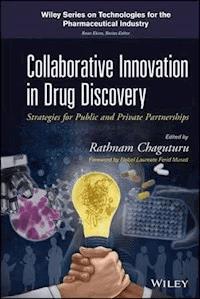
Collaborative Innovation in Drug Discovery E-Book
123,99 €
Mehr erfahren.
- Herausgeber: John Wiley & Sons
- Kategorie: Wissenschaft und neue Technologien
- Serie: Wiley Series on Technologies for the Pharmaceutical
- Sprache: Englisch
Can academia save the pharmaceutical industry? The pharmaceutical industry is at a crossroads. The urgent need for novel therapies cannot stem the skyrocketing costs and plummeting productivity plaguing R&D, and many key products are facing patent expiration. Dr. Rathnam Chaguturu presents a case for collaboration between the pharmaceutical industry and academia that could reverse the industry's decline. Collaborative Innovation in Drug Discovery: Strategies for Public and Private Partnerships provides insight into the potential synergy of basing R&D in academia while leaving drug companies to turn hits into marketable products. As Founder and CEO of iDDPartners, focused on pharmaceutical innovation, Founding president of the International Chemical Biology Society, and Senior Director-Discovery Sciences, SRI International, Dr. Chaguturu has assembled a panel of experts from around the world to weigh in on issues that affect the two driving forces in medical advancement. * Gain global perspectives on the benefits and potential issues surrounding collaborative innovation * Discover how industries can come together to prevent another "Pharma Cliff" * Learn how nonprofits are becoming the driving force behind innovation * Read case studies of specific academia-pharma partnerships for real-life examples of successful collaboration * Explore government initiatives that help foster cooperation between industry and academia Dr. Chaguturu's thirty-five years of experience in academia and industry, managing new lead discovery projects and forging collaborative partnerships with academia, disease foundations, nonprofits, and government agencies lend him an informative perspective into the issues facing pharmaceutical progress. In Collaborative Innovation in Drug Discovery: Strategies for Public and Private Partnerships, he and his expert team provide insight into the various nuances of the debate.
Sie lesen das E-Book in den Legimi-Apps auf:
Seitenzahl: 1446
Veröffentlichungsjahr: 2014
Ähnliche




















Table of Contents
Wiley Series on Technologies for the Pharmaceutical Industry
Title page
Copyright page
Dedication
Collaborative Drug Discovery Ethos
Foreword
Preface
About the Book
About the Editor
Contributors
Part I: Perspectives on Collaborative Innovation
1: Productive Relationships in Research and Development between Government, Industry, and Universities
Universities, Government, and Industry: Historical Beginnings in Prussia
Refinement and Broad Adoption: the United States
General Principles for Success
Notes
2: Divided We Fall
Challenges
Collaboration Models
Examples of Successful Biomedical Collaborations
Principles of Collaboration
Governance, Administration, and Autonomy
Human Factors
Conclusion
References
3: Innovation: Open Source and Nonprofit Models in Drug Discovery
Why Do People Innovate?
How Do We Encourage Innovation?
Why Is Innovation Important?
Warnings Regarding Innovation in Drug Discovery
Open Source Models
Nonprofit Models
Recommendations
References
4: The Changing Face of Innovation in Drug Discovery
Introduction
Core Objectives of the Drug Discovery Process
Major Innovations in Technology Have Advanced Drug Discovery
An Important Trend: Academic and Pharmaceutical Organizations Are Collaborating in Support of Drug Discovery
Future Perspectives: Where Is Innovation Leading?
References
5: Current Trends in Collaborative Drug Discovery and Strategies to De-Risk Precompetitive Initiatives
Pharmaceutical Industry's Perspective
Academia's Perspective
Open (Collaborative) Innovation: A New Business Model
Drug Discovery through Collaborations
Drug Discovery through Consortia
Drug Discovery through Repurposing Strategies
Probe Discovery in Public Domain
Effective Management of Academia–Pharma Collaborations
Concluding Remarks
References
Notes
6: A Perspective on the Evolution of Collaborative Drug Discovery and Future Challenges
Evolution of Collaborative Drug Discovery
Challenges for Collaborative Drug Discovery
Conclusion
References
Part II: Governmental Initiatives Accelerate Precompetitive Collaboration
7: The Value of University–Industry Partnerships
Guiding Principles for University–Industry Collaborations
The Johnson Continuum
Role of Cocreation: Companies, Government, and Universities
Funding for Collaborations with Academia
New Initiatives to Transform University–Industry Collaborations
Issues Affecting University–Industry Collaborations
Differences between Large- and Small-/Medium-Sized Companies
Large Companies Share Certain Characteristics
Small- and Medium-Sized Enterprises (SMEs) Offer a Contrasting Perspective
The National Academies' University–Industry Demonstration Partnership
Strategies for Building High-Value, High Return U-I Partnerships
Conclusion
Note on this Chapter
Note
References
8: Trends in the Public Sector Adoption of Translational Research Approaches
Steps to Successful Assay Development for HTS
Impact of the NIH Molecular Libraries Assay Development for HTS Initiative
Resourcing the Chemical Optimization of Small Molecule Probes
Using CTSA•IP to Identify and Assemble Translational Project Teams
Concluding Remarks
Notes
References
9: Partnerships for Drug Repositioning: Lessons from the CTSA Pharmaceutical Assets Portal
The CTSA Pharmaceutical Assets Portal
The Pharma Portal Members
Using the Foci-of-Expertise to Identify Potential Collaborators
Partnership for Cures
Material Transfer Agreements for Compound Transfers
Establishing an International Clinical Compound Library at CWHM
Industry Perspective
Conclusions
Acknowledgments
References
10: Development Programs at the U.S. National Cancer Institute: Use of Public–Private Partnerships as a Catalyst to Advance Cancer Therapy
Drug Screening Programs at the NCI
The Rapid Access to Intervention Development Program
The Decision Network/Drug Development Group
Natural Products
Cancer Therapy Evaluation Program: Sponsored Clinical Trials
NCI's Experimental Therapeutics Program
Early Discovery
Early Development Resources
Late-Stage Development: The CTEP Clinical Trials Network
Governance
Technology Transfer Mechanisms Utilized by The NExT Program
Discovery to Early-Stage Development: The Chemical Biology Consortium
Mid-Stage Development (Clinical Candidate Prior to Clinical Studies)
Late-Stage Development: The CTEP Clinical Trials Network
The CTEP IP Option: Then and Now
The Collaborative Process: Then and Now
Summary
Case Studies
Acknowledgments
References
11: Nonindustrial Pharmaceutical Research in the BRIC Countries: Lessons for Drug Discovery Partnerships with Academic and Governmental Institutions
BRIC Countries Can Provide a Model for Drug Discovery in Nonindustrial Institutions
Common Drug Development Activities across the BRIC Countries
India
Brazil
China
Russia
Brazil and India Provide Relatively Western Models of Collaboration
Collaboration With China Will Be Driven by the Opportunity to Enter a Major Pharmaceutical Market
Russia Will Remain a Complex Opportunity for Collaboration
Successful Collaborations in BRIC Countries Will Often Be Driven By Relationships with Their Western-Trained Scientists
Leveraging the Experience of Nonindustrial Drug Discovery in the BRIC Countries Will Help Inform Western Strategies
References
12: Death of Drugs and Rebirth of Health Care: Indian Response to Discovery Impasse
Health and Disease
Death of Drugs
Innovation Deficit
Reductionist Drug Discovery to Holistic Medicine Discovery
Indian Perspective
Indian Government Policy
Pharmaceutical Sector Landscape
Situation Analysis
Intellectual Property
New Paradigms
Council for Scientific and Industrial Research
Department of Science and Technology (DST)
Department of Biotechnology (DBT)
Indian Council of Medical Research
AYUSH
Building New Partnerships
Concluding Remarks
Acknowledgments
References
Part III: A Game Changer for Averting Future Pharma Cliff
13: Accelerating Innovation in the Bioscience Revolution
A Great Industry Faces a Painful “Kodak Moment”
The Transformation of a Great Industry
From Ethical Pharm to Animal Pharm
But There Are Other Issues
Myths and Facts about Innovation
Bringing Ethics Back to the Industry
It Does Not Need to Cost Billions
New Models for Innovation
The New Players
The New Collaborative Models
Where Have the Leaders Gone?
Priorities for Restoring Innovation
Note
References
14: Value-Driven Drug Development: Unlocking the Value of Your Pipeline
The Four Imperatives of Value-Driven Drug Development
Concluding Remarks
References
15: Unlocking the Market Potential of Academic Research
Where Does Drug Discovery Fit into the Drug Development Process?
How Does the Drug Discovery Process Work?
Science for Science's Sake and Science for Society's Sake
What Are the Causes of the Gap between Science for Science's Sake and Science for Investment's Sake?
Why Commercialization Is Important
Intellectual Property
Commercializing Nonpatentable Knowledge
Bridging the Gap between Science for Science's Sake and Science for Investment's Sake
Technology Transfer Offices
Have Technical Transfer Offices Fulfilled Their Objectives?
Barriers to Success of Technology Transfer Offices
Venture Capitalists
Nonprofit Organizations
Centers for Therapeutic Innovation (CTI)
Recommendations
Notes
References
16: Collaborative Innovation in Pharmaceutical Industry: Approaches and Requirements
Open Innovation versus Open Access
Open Innovation Models: Key Characteristics and Success Factors
Crowdsourcing Approaches Are Useful to Leverage the Know-How of a Large Group of People to Address Specific Questions
Strategic Alliances
Industry on Campus or Incubator Model
Precompetitive Consortia
Professional Alliance and Collaboration Management
Concluding Remarks
Acknowledgment
References
17: Close Contact: A Colocation Model for Academic–Industrial Partnerships in Drug Discovery
Stakeholders and Their Interests
Relationship Models between Industry and the Academy
Close Contact Case Study: Nordion and University of Ottawa Heart Institute
Research Agreement
Intellectual Property Agreement
Facility Agreement
Benefits of Close Contact
Risks and Challenges of Close Contact
Conclusions
Acknowledgments
18: Success Factors and Obstacles in Academia–Industry Partnerships: A Case Study of a Graduate Program within the Bayer–University of Cologne “Privileged Partnership”
SWOT Analysis of an Industry–Academia Partnership
Bayer–University of Cologne Collaboration
Original Concept and Implementation
Synergies in Graduate Education within the University
Synergies of Industry and Academia in Vocational Field Exploration
Lesen Sie weiter in der vollständigen Ausgabe!
Lesen Sie weiter in der vollständigen Ausgabe!
Lesen Sie weiter in der vollständigen Ausgabe!
Lesen Sie weiter in der vollständigen Ausgabe!
Lesen Sie weiter in der vollständigen Ausgabe!
Lesen Sie weiter in der vollständigen Ausgabe!
Lesen Sie weiter in der vollständigen Ausgabe!
Lesen Sie weiter in der vollständigen Ausgabe!
Lesen Sie weiter in der vollständigen Ausgabe!
Lesen Sie weiter in der vollständigen Ausgabe!
Lesen Sie weiter in der vollständigen Ausgabe!
Lesen Sie weiter in der vollständigen Ausgabe!
Lesen Sie weiter in der vollständigen Ausgabe!
Lesen Sie weiter in der vollständigen Ausgabe!
Lesen Sie weiter in der vollständigen Ausgabe!
Lesen Sie weiter in der vollständigen Ausgabe!
Lesen Sie weiter in der vollständigen Ausgabe!
Lesen Sie weiter in der vollständigen Ausgabe!
Lesen Sie weiter in der vollständigen Ausgabe!
Lesen Sie weiter in der vollständigen Ausgabe!
Lesen Sie weiter in der vollständigen Ausgabe!
Lesen Sie weiter in der vollständigen Ausgabe!
Lesen Sie weiter in der vollständigen Ausgabe!
Lesen Sie weiter in der vollständigen Ausgabe!
Lesen Sie weiter in der vollständigen Ausgabe!
Lesen Sie weiter in der vollständigen Ausgabe!
Lesen Sie weiter in der vollständigen Ausgabe!
Lesen Sie weiter in der vollständigen Ausgabe!
Lesen Sie weiter in der vollständigen Ausgabe!
Lesen Sie weiter in der vollständigen Ausgabe!
Lesen Sie weiter in der vollständigen Ausgabe!
Lesen Sie weiter in der vollständigen Ausgabe!
Lesen Sie weiter in der vollständigen Ausgabe!
Lesen Sie weiter in der vollständigen Ausgabe!
Lesen Sie weiter in der vollständigen Ausgabe!
Lesen Sie weiter in der vollständigen Ausgabe!
Lesen Sie weiter in der vollständigen Ausgabe!
Lesen Sie weiter in der vollständigen Ausgabe!
Lesen Sie weiter in der vollständigen Ausgabe!
Lesen Sie weiter in der vollständigen Ausgabe!
Lesen Sie weiter in der vollständigen Ausgabe!
Lesen Sie weiter in der vollständigen Ausgabe!
Lesen Sie weiter in der vollständigen Ausgabe!
Lesen Sie weiter in der vollständigen Ausgabe!
Lesen Sie weiter in der vollständigen Ausgabe!
Lesen Sie weiter in der vollständigen Ausgabe!
Lesen Sie weiter in der vollständigen Ausgabe!
Lesen Sie weiter in der vollständigen Ausgabe!
Lesen Sie weiter in der vollständigen Ausgabe!
Lesen Sie weiter in der vollständigen Ausgabe!
Lesen Sie weiter in der vollständigen Ausgabe!
Lesen Sie weiter in der vollständigen Ausgabe!
Lesen Sie weiter in der vollständigen Ausgabe!
Lesen Sie weiter in der vollständigen Ausgabe!
Lesen Sie weiter in der vollständigen Ausgabe!
Lesen Sie weiter in der vollständigen Ausgabe!
Lesen Sie weiter in der vollständigen Ausgabe!
Lesen Sie weiter in der vollständigen Ausgabe!




