


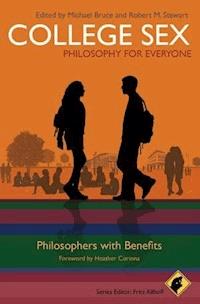
College Sex - Philosophy for Everyone E-Book
14,99 €
Mehr erfahren.
- Herausgeber: John Wiley & Sons
- Kategorie: Geisteswissenschaft
- Serie: Philosophy for Everyone
- Sprache: Englisch
Written with insight and humor, College Sex - Philosophy for Everyone investigates a broad array of philosophical issues relating to student sex. * Examines the ethical issues of dating, cheating, courtship, homosexual experimentation, and drug and alcohol use * Considers student-teacher relationships, sexual experimentation, the meaning of sex in a college setting and includes two essays based on influential research projects on 'friends with benefits' * Many of the authors teach classes that explore the philosophy of love and sex, and most are scholars from the Society of the Philosophy of Sex and Love
Sie lesen das E-Book in den Legimi-Apps auf:
Seitenzahl: 459
Veröffentlichungsjahr: 2010
Ähnliche




















CONTENTS
Foreword
Heather Corinna
Acknowledgments
Michael Bruce and Robert M. Stewart
Campus Orientation: An Introduction to College Sex – Philosophy for Everyone
Michael Bruce and Robert M. Stewart
PART I FRESHMAN YEAR: Hook-Up Culture
1 Sex and Socratic Experimentation
Sisi Chen and George T. Hole
2 The Straight Sex Experiment
Bassam Romaya
3 The Virtual Bra Clasp: Navigating Technology in College Courtship
Michael Bruce
4 Smeared Makeup and Stiletto Heels: Clothing, Sexuality, and the Walk of Shame
Brett Lunceford
5 Relations at a Distance
Bill Puka
PART II SOPHOMORE YEAR: Friends With Benefits
6 What’s Love Got to Do with It? Epicureanism and Friends with Benefits
William O. Stephens
7 Friends with Benefits: A Precarious Negotiation
Timothy R. Levine and Paul A. Mongeau
8 The Philosophy of Friends with Benefits: What College Students Think They Know
Kelli Jean K. Smith and Kelly Morrison
PART III JUNIOR YEAR: Ethics of College Sex
9 A Horny Dilemma: Sex and Friendship between Students and Professors
Andrew Kania
10 Philosophers and the Not So Platonic Student-Teacher Relationship
Danielle A. Layne
11 Thinking About Thinking About Sex
Ashley McDowell
12 Exploring the Association Between Love and Sex
Guy Pinku
13 Sex for a College Education
Matthew Brophy
PART IV SENIOR YEAR: Sex and Self-Respect
14 Meaningful Sex and Moral Respect
Robert M. Stewart
15 Can Girls Go Wild With Self-Respect?
John Draeger
16 Mutual Respect and Sexual Morality: How to Have College Sex Well
Yolanda Estes
17 Bad Faith or True Desire? A Sartrean View on College Sex
Antti Kuusela
Notes on Contributors
VOLUME EDITORS
MICHAEL BRUCE currently works in the non-profit sector withat-risk youth. Previously, he was a teaching assistant at California State University, Chico, and received his Master’s degree from San Diego State University, specializing in continental philosophy. He has published articles in the pop culture and philosophy genreand is currently editing Just the Arguments: 100 of the Most Important Arguments in Western Philosophy for Wiley-Blackwell.
ROBERT M. STEWART is Professor of Philosophy at California State University, Chico. He is the author of Moral Philosophy: A Comprehensive Introduction (1994), and editor of Philosophical Perspectives on Sex and Love (1995). He has published numerous journal articles.
SERIES EDITOR
FRITZ ALLHOFF is an Assistant Professor in the PhilosophyDepartment at Western Michigan University, as well as a SeniorResearch Fellow at the Australian National University’s Centre for Applied Philosophy and Public Ethics. In addition to editing thePhilosophy for Everyone series, Allhoff is the volume editor or co-editorfor several titles, including Wine & Philosophy (Wiley-Blackwell, 2007),Whiskey & Philosophy (with Marcus P. Adams, Wiley, 2009), and Food & Philosophy (with Dave Monroe, Wiley-Blackwell, 2007).
PHILOSOPHY FOR EVERYONE
Series editor: Fritz Allhoff
Not so much a subject matter, philosophy is a way of thinking. Thinking not just about the Big Questions, but about little ones too. This series invites everyone to ponder things they care about, big or small, significant, serious … or just curious.
Running & Philosophy: A Marathon for the MindEdited by Michael W. Austin
Wine & Philosophy: A Symposium on Thinking and DrinkingEdited by Fritz Allhoff
Food & Philosophy: Eat, Think and Be MerryEdited by Fritz Allhoff and Dave Monroe
Beer & Philosophy: The Unexamined Beer Isn’t Worth DrinkingEdited by Steven D. Hales
Whiskey & Philosophy: A Small Batch of Spirited IdeasEdited by Fritz Allhoff and Marcus P. Adams
College Sex – Philosophy for Everyone:Philosophers With BenefitsEdited by Michael Bruce and Robert M. Stewart
Cycling – Philosophy for Everyone: A Philosophical Tour de ForceEdited by Jesús Ilundáin-Agurruza and Michael W. Austin
Climbing – Philosophy for Everyone:Because It’s ThereEdited by Stephen E. Schmid
Hunting – Philosophy for Everyone:In Search of the Wild LifeEdited by Nathan Kowalsky
Christmas – Philosophy for Everyone:Better Than a Lump of CoalEdited by Scott C. Lowe
Cannabis – Philosophy for Everyone:What Were We Just Talking About?Edited by Dale Jacquette
Porn – Philosophy for Everyone:How to Think With KinkEdited by Dave Monroe
Serial Killers – Philosophy for Everyone:Being and KillingEdited by S. Waller
Dating – Philosophy for Everyone:Flirting With Big IdeasEdited by Kristie Miller and Marlene Clark
Gardening – Philosophy for Everyone:Cultivating WisdomEdited by Dan O’Brien
Motherhood – Philosophy for Everyone:The Birth of WisdomEdited by Sheila Lintott
Fatherhood – Philosophy for Everyone:The Dao of DaddyEdited by Lon S. Nease and Michael W. Austin
Forthcoming books in the series:
Fashion – Philosophy for EveryoneEdited by Jessica Wolfendale and Jeanette Kennett
Coffee – Philosophy for EveryoneEdited by Scott Parker and Michael W. Austin
Blues – Philosophy for EveryoneEdited by Abrol Fairweather and Jesse Steinberg
This edition first published 2010© 2010 Blackwell Publishing Ltd except for editorial material and organization© 2010 Michael Bruce and Robert M. Stewart
Blackwell Publishing was acquired by John Wiley & Sons in February 2007. Blackwell’s publishing program has been merged with Wiley’s global Scientific, Technical, and Medical business to form Wiley-Blackwell.
Registered OfficeJohn Wiley & Sons Ltd, The Atrium, Southern Gate, Chichester, West Sussex, PO19 8SQ, United Kingdom
Editorial Offices350 Main Street, Malden, MA 02148-5020, USA9600 Garsington Road, Oxford, OX4 2DQ, UKThe Atrium, Southern Gate, Chichester, West Sussex, PO19 8SQ, UK
For details of our global editorial offices, for customer services, and for information about how to apply for permission to reuse the copyright material in this book please see our website at www.wiley.com/wiley-blackwell.
The right of Michael Bruce and Robert M. Stewart to be identified as the authors of the editorial material in this work has been asserted in accordance with the UK Copyright, Designs and Patents Act 1988.
All rights reserved. No part of this publication may be reproduced, stored in a retrieval system, or transmitted, in any form or by any means, electronic, mechanical, photocopying, recording or otherwise, except as permitted by the UK Copyright, Designs and Patents Act 1988, without the prior permission of the publisher.
Wiley also publishes its books in a variety of electronic formats. Some content that appears in print may not be available in electronic books.
Designations used by companies to distinguish their products are often claimed as trademarks. All brand names and product names used in this book are trade names, service marks, trademarks or registered trademarks of their respective owners. The publisher is not associated with any product or vendor mentioned in this book. This publication is designed to provide accurate and authoritative information in regard to the subject matter covered. It is sold on the understanding that the publisher is not engaged in rendering professional services. If professional advice or other expert assistance is required, the services of a competent professional should be sought.
Library of Congress Cataloging-in-Publication Data
College sex – Philosophy for Everyone:philosophers with benefits / Michael Bruce and Robert M. Stewart (eds.); with a foreword by Heather Corinna.
p. cm. — (Philosophy for everyone)
Includes bibliographical references.
ISBN 978-1-4443-3294-0 (pbk.: alk. paper) 1. College students—Sexual behavior. 2. Sexual ethics. I. Bruce, Michael. II. Stewart, Robert Michael, 1952– III. Title: College sex – philosophy for everyone.
HQ35.2.C645 2010
176—dc22
2010004889
A catalogue record for this book is available from the British Library.
HEATHER CORINNA
FOREWORD
In the late 1980s I attended a college whose core curriculum was rooted in the classics of Western philosophy. I also had sex in college and studied sexuality in college, between the pages, not just the sheets. For me, college sex and philosophy were largely inseparable, and I had both in equal measure.
Here’s the crux of what I learned about Western philosophy in college: it is highly critical, systematic and relies upon – or states it does – logic and reason. It involves asking and exploring very big questions, sometimes about very large things, sometimes about very small things. It tended to mostly come from old, white men and be about men, even when those men are discussing women or others whose experiences they had not lived or had not lived lately.
Some of this stuff was seriously ancient, even when presented as shiny and new. Any given philosopher seemed to think that his – and with a hat-tip to Hannah Arendt, her – philosophical approach and ideas would make all others obsolete. Any given philosopher often used language (like the words “god,” “he,” or “moral”) or approaches that made it sound like their language and approaches were the only right or reasonable ones.
Very few people seemed interested in it, but people still liked to argue about it a lot. Just when I thought I had a handle on philosophy, some approach to or experience of it spun my head around and made me feel like a newbie.
Philosophy often seemed to be coming from a bunch of dead people who were coming from a world that largely was not mine. But even when those folks were talking about something that either wasn’t about them, or didn’t speak to my experience, even in question or profound disagreement, I could learn a whole lot about myself and my world from it.
It sometimes also really made my head hurt.
Here’s the crux of what I learned about sex in college, especially sex we have during the time of life when we’re in college: it is largely uncritical (when it is, is more so after the fact than during the act), only systematic when it sucks, and most often relies upon a partial suspension of reason. It often involves asking for and exploring very big things, sometimes via very large things, sometimes via very small things. It tended to come from pretty much everybody of every age, though some men did like to think that it was mostly about them, even when they had it with women or others whose experiences they had not lived or had not lived lately. The older and whiter those men got, the more they seemed inclined to think that, something I hardly need to tell a generation that has come of age under the Bush administration. If you’ve already started college courses, you also know exactly what I’m talking about. If not, you will.
Some of this stuff was seriously ancient, even when presented as shiny and new. Any given sexual partner didn’t seem think that his – or her – approach to and ideas about sex would make all others obsolete, but plenty seemed to hope for as much. Any given person often used language (like the words “oh-god,” “sex,” or “moral”) about or approaches to sexuality that made it sound like their language and approaches were the only right, or reasonable ones.
Pretty much everybody was interested in it, but people still liked to argue about it a lot. Just when I thought I had a handle on sex, some approach to or experience of it spun my head around and made me feel like a newbie.
While the sex I personally had in college never involved dead people, it did sometimes involve those coming from a world that was not mine. But for the most part, sex in college was centrally about me and my peers and about our world, not the worlds or experiences of those outside it, even if to our great annoyance those outsiders invaded or policed that world. Yet, even when other folks were having sex or had a sexuality in college that either wasn’t about me, or didn’t speak to my experience of sex, even in question or disagreement, I could learn a whole lot about myself and my world from it.
It sometimes also really made my head hurt.
In some ways, college sex and philosophy are excellent bedfellows. In others, they’re like those couples you see together and cannot figure out what the hell it is they see in one another. While adding sex to philosophy makes the latter far more compelling, the opposite is rarely true. Under the microscopic lens of philosophy, sex can sometimes appear nearly incomprehensible, painfully pat, or downright unappealing. Of course, some schools of philosophy are a better fit than others. Rationalism, analytic philosophy, or logical positivism? Highly incompatible. Skepticism or pragmatism? Not if you want to have a good time. Aesthetics, metaphysics, and existentialism? Sure. Poststructuralism? Depends on the sex you’re having. Idealism? And how. Absurdism? Perfect.
Most of the Western philosophers who have explored sexuality often seem either like the folks who have enjoyed or experienced sex the least or who wanted to hide their enjoyment of it the most. When reading philosophers addressing sexuality, you may hear a voice in your head saying, with great exasperation, “Just get laid already!” or “For the love of gawd, come out of that closet.” Many have seemed most focused on questions of what is and is not moral in human sexuality – and with infrequent self-analysis, mind – than the whole of the sexual experience or the more holistic sphere of what human sexuality entails. Much philosophy addressing sexuality can seem a determined attempt to take all the fun right out of it. For example, it’s a testament to the fortitude of queer and women’s sexuality and the drive we all have for pleasure that we of the female and/or not-hetero variety can still enjoy sex at all after reading and having culture influenced by most philosophical approaches to queer and women’s sexuality. We also owe philosophy no gratitude for its endless fixation on what is normal and what is abnormal in sexuality, an enterprise so vastly diverse that the only thing we know about sexual normality is that either all of us are normal or none of us are.
Neither philosophy nor sex in college is new. In fact, much of what any given generation posits as sexually new in the next one is not, it just may be occurring in new contexts and frameworks or look different once one is beyond a given age. In the 1980s and 1990s, the 1960s and 1970s, in the 1930s, 1940s, and 1950s, people were doing the horizontal mambo in college, “hooking up,” having or considering trysts with professors, sneaking or slinking home after staying out all night, communicating with long-distance partners, doing or utilizing sex work, sleeping with folks who weren’t a spouse, fiancée, or “steady,” having sex with and without romantic love. In short, they were exploring their own sexuality and sexual identity to try and find the right fit for who they were then and for who they wanted to become. Since most of the people applying philosophy to college sex are not college students having said sex (nor often sexologists), in some ways, I think the greatest information gleaned from philosophical analysis of young adult sex is what adultist attitudes and ideas about college sex and sexuality are.
Which is useful knowledge, really. After all, those not in college having sex have long been the greatest buzzkill of those who are, especially those who didn’t have the sex in college they wanted and knew – or imagined – everyone else to be having. Let’s be kind: adults who philosophically consider the sexuality of younger people probably had sex in college, too, and plenty of it was likely sex they enjoyed. (Or, being not so kind, did not have sex in college and are still royally pissed off about it.) Some of what you read in this book will be about your experiences with sex in college. Some won’t: it may be about experiences others have, instead, or may be about someone else’s perceptions of, ideas about, or even sexual fantasies of what you and your fellow students are doing. But whether it expands your mind or solidifies your own dissenting ideas, it’s all good.
Outside philosophical perspectives on your sex life will tend to include one’s own sexual history added to what they observe about yours now within the kind of rigorous structure philosophical approaches demand and require, and that’s useful, both when on-target and when off-base. You can use them to see them coming and cover your tracks a bit better. Alternately, you can use them to apply a different perspective than your own to your own sexual life: seeing our experiences through different eyes and ways of thinking can provide potentially important tools with which to evaluate our choices.
As a sexuality author and educator, I find it frustrating when sex and sexuality are presented solely as pursuits of the body, when in fact they are also – sometimes great, sometimes not-so-great – pursuits of heart and mind. Furthermore, sex is not just what we do when we’re engaging in it, it is what we think of it all, before, during, and after, in scarcity and in excess, about our own sexuality and sex lives and those of others, how we and everyone else contextualize, conceptualize, evaluate, enact, and represent it; how and if we say yes, maybe, or no, to whom and what we say it, what both our ideals and realities of sex – which often are not one and the same, nor universal for everyone – are. And having solid frameworks for thinking about something that can make us so dizzy in the head is mighty helpful. That is the aim of the authors of College Sex & Philosophy, and it’s most certainly a fine one. As they were for me in college, sex and philosophy remain a heady mix, one that poses unusual and unexpected challenges for writer and reader alike.
So, I invite you to go ahead, open the pages of this book, put sex and philosophy in bed together and see what happens. And don’t just lie there: let yourself really get into it and see where it takes you. Just like any other kind of “sexual experimenting,” you may find it expansive or a yawner, you might get off on it or you might not. But you’ll never know unless you give it a try.
Heather CorinnaFounder and Director, Scarleteen.com
ACKNOWLEDGMENTS
First, we would like to thank all of the contributors. They have been very patient and enthusiastic. We are impressed with the quality and creativity of their essays. The editorial process can feel grueling and tedious, amplified by the challenges of communicating electronically. We thank them for their persistence. Many of the contributors were writing during their summer break, and we thank them for using that precious time. We have an international group of authors, also authors specializing in different areas of philosophy, and interdisciplinary scholars from fields outside of philosophy as well. We are pleased with the collection of perspectives represented in this text.
Second, we would like to thank our publisher. Wiley-Blackwell has supported this project from the moment it was conceived. In particular, we acknowledge Fritz Allhoff and Marcus P. Adams. Fritz has been especially helpful, and we thank him for his patience and for believing in the project. Marcus was our invaluable resource behind the scenes, helping with careful manuscript preparation. We could not have realized this volume without help from both of you.
Third, Michael would like to thank Robert. Taking Robert’s “Philosophy of Sex and Love” class as an undergraduate made a lasting impression. Philosophy, as a discipline, increasingly has to defend its relevancy and practicality, and Robert’s class showed how philosophy can directly inform decisions and behaviors. Robert would like to thank Brenda Lowen for her technical help.
Finally, we thank you, the reader: enjoy the volume! The sexual dimension of human existence is a wonderful thing. We applaud your interest in exploring a topic that is unfortunately still taboo for many people.
Michael Bruce, Belmont, CaliforniaRobert M. Stewart, Chico, California
MICHAEL BRUCE AND ROBERT M. STEWART
CAMPUS ORIENTATION
An Introduction to College Sex – Philosophy for Everyone
College is a special time in Western culture. It is a unique social space where young adults are encouraged to sew their “wild oats,” cultivate a sense of self, and be exposed to a global economy of ideas and perspectives. As many students are away from their parents and communities – and their enmeshed values – for the first time, they often experiment and explore themselves, their new autonomy, and the academic world. Sexuality and sexual practices are some of the most important and interesting areas students navigate. This volume in the Philosophy for Everyone series investigates contemporary sexual practices, behaviors, and mores of college students from a philosophical perspective. This introduction will highlight the features and history of the philosophy of sex as an area of research and then briefly introduce the essays and the organization of the book.
The philosophy of sex is a relatively new subfield. Although the works of some major philosophers in the history of philosophy have included important discussions of sexuality, often in relation to love and the family or broader social issues, only in the last forty years have professional philosophers recognized this subject as a significant focus of research in its own right. Many essays, books, and college courses have appeared since the publication of a seminal journal article by the noted philosopher Thomas Nagel in the early 1970s on the topic of sexual perversion.1 Though widely criticized, and for good reason, in a series of subsequent publications by other philosophers, Nagel’s use of the techniques of modern analytic philosophy to elucidate a controversial concept seldom addressed by his fellow philosophers working within the Anglo-American tradition was pathbreaking. Continental European philosophers such as Søren Kierkegaard (1813–55), Arthur Schopenhauer (1788–1860), and Friedrich Nietzsche (1844–1900), and later Jean-Paul Sartre (1905–80) and Simone de Beauvoir (1908–86), had written about the nature of sexual desire and relations between the sexes, but English-speaking philosophers had done little during that period on the subject of human sexuality. Nagel’s “Sexual Perversion” was influenced by the insights of existentialist philosophers, particularly Sartre, but it had analytical rigor and clarity, advancing an argument for objective standards of sexual deviance and normality more liberal than one might find in orthodox Freudian accounts, for example, of homosexuality. His essay was thus an exercise in both conceptual clarification and applied moral philosophy.
Lesen Sie weiter in der vollständigen Ausgabe!
Lesen Sie weiter in der vollständigen Ausgabe!
Lesen Sie weiter in der vollständigen Ausgabe!
Lesen Sie weiter in der vollständigen Ausgabe!
Lesen Sie weiter in der vollständigen Ausgabe!
Lesen Sie weiter in der vollständigen Ausgabe!
Lesen Sie weiter in der vollständigen Ausgabe!
Lesen Sie weiter in der vollständigen Ausgabe!
Lesen Sie weiter in der vollständigen Ausgabe!
Lesen Sie weiter in der vollständigen Ausgabe!
Lesen Sie weiter in der vollständigen Ausgabe!
Lesen Sie weiter in der vollständigen Ausgabe!
Lesen Sie weiter in der vollständigen Ausgabe!
Lesen Sie weiter in der vollständigen Ausgabe!
Lesen Sie weiter in der vollständigen Ausgabe!
Lesen Sie weiter in der vollständigen Ausgabe!
Lesen Sie weiter in der vollständigen Ausgabe!
Lesen Sie weiter in der vollständigen Ausgabe!
Lesen Sie weiter in der vollständigen Ausgabe!
Lesen Sie weiter in der vollständigen Ausgabe!
Lesen Sie weiter in der vollständigen Ausgabe!
Lesen Sie weiter in der vollständigen Ausgabe!




