


7,19 €
Mehr erfahren.
- Herausgeber: Fitzcarraldo Editions
- Kategorie: Gesellschafts- und Liebesromane
- Sprache: Englisch
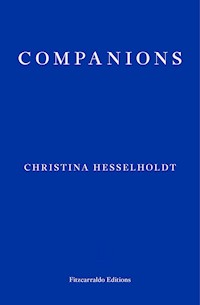
Camilla, Charles, Alma, Edward, Alwilda and Kristian are a circle of friends hurtling through mid-life. Structured as a series of monologues jumping from one friend to the next, Companions follows their loves, ambitions, pains and anxieties as they age, fall sick, have affairs, grieve, host dinner parties and move between the Lake District, Berlin, Lisbon, Belgrade, Mozambique, New York and, of course, Denmark. In her first book to be translated into English, Christina Hesselholdt explores everyday life, the weight of the past and the difficulty of intimacy in a uniquely playful and experimental style. At once deeply comic and remarkably insightful, Companions is an exhilarating portrait of life in the twenty-first century.
Das E-Book können Sie in Legimi-Apps oder einer beliebigen App lesen, die das folgende Format unterstützen:
Veröffentlichungsjahr: 2017
Ähnliche
















‘Wonderfully rich prose, what a precious companion.’ — Helle Helle, author of This Should Be Written in the Present Tense
‘Christina Hesselholdt is among the Danish writers who now occupy the very top rank. Her prose is lively, luminous, engaging, and fascinating.’ — Kristeligt Dagblad
‘Hesselholdt has never been better. Humour and grief go hand in hand, and the language shimmers from the drily caustic to the tenderly casual to the breathtakingly erotic.’ — Berlingske Tidende
‘I am quite certain that this book will do something to Danish literature. Hesselholdt is part of a generation of remarkable female authors who had their breakthroughs at the beginning of the 1990s and who in the past decade have turned their writing in new and surprising directions. None of them has moved to as wild and, yes, as promising a place as Hesselholdt has come to now.’ — Information
COMPANIONS
CHRISTINA HESSELHOLDT
Translated by PAUL RUSSELL GARRETT
CONTENTS
I. CAMILLA AND THE HORSE
‘… and the blood of love welled up in my heart with a slow pain.’
— Sylvia Plath
THE RAMBLE
[Alma]
Last summer I rambled through Wordsworth’s rolling landscape, where the shadows on the hills are so dark and so pronounced that the hilltops look like they are drenched in water, and the lakes are so deep that… when suddenly a fighter jet appeared and without thinking I threw myself to the ground, terror-stricken. I had neither seen nor heard the jet until it was directly above me. It wagged its wings, turned on its side and disappeared between two hills. It was so elegant, so fast and so sudden, and from that moment on I lived and breathed to see another one, preferably many more. I was lucky, because that summer RAF fighter pilots were performing training exercises there, weaving in and out of the hills of the Lake District, and perhaps they continued all the way to the Scottish Highlands before departing on a mission to Afghanistan; like predatory shadows above the endless opium fields and endless mountain ranges, ‘bearing their cargo of death’, something I repeated to myself in order to curb my enthusiasm – in any case I managed to see one or two every day. I made a few notes, this is what I came up with: ‘Typhoons, the sublime, flashing, wagging, a terrifying noise – then gone. In the very landscape where WW had one vision after the other, where in sudden flashes of insight, he looked and looked.’
As I walked around in Wordsworth’s landscape, dragging myself up his steep hills, I thought of the fighter planes as an embodiment of his inspiration, the sudden insight, a divine flash of realization, a thought like a bolt from the blue and full of load-bearing force – enough to carry a poem through. These are not words I would ordinarily use, but I do not think William Wordsworth would have shied away from them.
Though what consumed me more was that I could get so excited, so fulfilled by the sight of these fighter jets. I was not shameless. I was ashamed to sense delight at observing a phenomenon that was brought into the world to cause death and destruction. I was ashamed and I couldn’t wait till the next one arrived. The fact that the plane only appeared for a brief moment certainly played a part. I never tired of looking. I pursued my own ocular pleasure.
Perhaps I also pursued the inundation of the senses it entailed – the noise, the shock at its sudden appearance. I reminded myself that the suddenness which fascinated me… the purpose of which was so that the plane could appear out of nowhere, drop its bombs and be gone before anyone could even think of shooting it down; but it was no use. I simply waited for the next one. And they flew so low! It provided a sense of connection. The pilots might have seen me, and the one who saw me throw myself to the ground probably smiled.
The we that once existed, it no longer exists. How I loved that we. How it fulfilled me.
My husband was with me. He is tired of me never saying we any more, only I. But I forget to be mindful of that, and the next time I talk about a trip we went on, an experience we shared, I hear myself saying I again.
He was with me on my ramble through the Lake District, and Dorothy Wordsworth had rambled through these hills just as much as her brother William had; on several occasions WW wrote poems based on her notes. But regardless of whether the event was witnessed in the company of Dorothy or was Dorothy’s own unique experience, he always used the personal pronoun ‘I’ in his poems. For example, she was the first to see the daffodils, (hundreds of daffodils along a lake) and her description formed the basis for what must be his most famous poem of all, ‘I Wandered Lonely as a Cloud’.
Dorothy writes: ‘… as we went along there were more and yet more and at last under the boughs of the trees, we saw that there was a long belt of them along the shore, about the breadth of a country turnpike road. I never saw daffodils so beautiful they grew among the mossy stones about and about them, some rested their heads upon these stones as on a pillow for weariness and the rest tossed and reeled and danced and seemed as if they verily laughed with the wind that blew upon them over the lake, they looked so gay ever glancing ever changing.’
Lesen Sie weiter in der vollständigen Ausgabe!
Lesen Sie weiter in der vollständigen Ausgabe!
Lesen Sie weiter in der vollständigen Ausgabe!
Lesen Sie weiter in der vollständigen Ausgabe!
Lesen Sie weiter in der vollständigen Ausgabe!
Lesen Sie weiter in der vollständigen Ausgabe!
Lesen Sie weiter in der vollständigen Ausgabe!
Lesen Sie weiter in der vollständigen Ausgabe!
Lesen Sie weiter in der vollständigen Ausgabe!
Lesen Sie weiter in der vollständigen Ausgabe!
Lesen Sie weiter in der vollständigen Ausgabe!
Lesen Sie weiter in der vollständigen Ausgabe!
Lesen Sie weiter in der vollständigen Ausgabe!
Lesen Sie weiter in der vollständigen Ausgabe!
Lesen Sie weiter in der vollständigen Ausgabe!
Lesen Sie weiter in der vollständigen Ausgabe!
Lesen Sie weiter in der vollständigen Ausgabe!
Lesen Sie weiter in der vollständigen Ausgabe!
Lesen Sie weiter in der vollständigen Ausgabe!
Lesen Sie weiter in der vollständigen Ausgabe!
Lesen Sie weiter in der vollständigen Ausgabe!
Lesen Sie weiter in der vollständigen Ausgabe!
Lesen Sie weiter in der vollständigen Ausgabe!
Lesen Sie weiter in der vollständigen Ausgabe!
Lesen Sie weiter in der vollständigen Ausgabe!
Lesen Sie weiter in der vollständigen Ausgabe!
Lesen Sie weiter in der vollständigen Ausgabe!
Lesen Sie weiter in der vollständigen Ausgabe!
Lesen Sie weiter in der vollständigen Ausgabe!
Lesen Sie weiter in der vollständigen Ausgabe!
Lesen Sie weiter in der vollständigen Ausgabe!
Lesen Sie weiter in der vollständigen Ausgabe!
Lesen Sie weiter in der vollständigen Ausgabe!
Lesen Sie weiter in der vollständigen Ausgabe!
Lesen Sie weiter in der vollständigen Ausgabe!
Lesen Sie weiter in der vollständigen Ausgabe!
Lesen Sie weiter in der vollständigen Ausgabe!
Lesen Sie weiter in der vollständigen Ausgabe!
Lesen Sie weiter in der vollständigen Ausgabe!
Lesen Sie weiter in der vollständigen Ausgabe!
Lesen Sie weiter in der vollständigen Ausgabe!




