


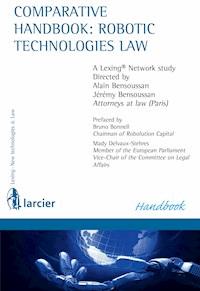
Comparative handbook: robotic technologies law E-Book
199,99 €
Mehr erfahren.
- Herausgeber: Éditions Larcier
- Kategorie: Fachliteratur
- Serie: Lexing - Technologies avancées & Droit
- Sprache: Englisch
Studies of the overall impact of robotics on the economy have shown that investments in its various sectors – industrial, professional and service robotics – are increasing globally and the markets associated with them are valued in billions. Robotization improves the competitiveness of enterprises, while collaborative robotics reinvents methods of production.
Beyond the economic outlook, service robotics, backed by the development of artificial intelligence, raises challenging ethical and social issues.
The legal analysis of robotics is no mean feat because it covers a very diverse technical reality. Companies whose businesses are focused on robotic technologies and applications can be confronted with a complex legal situation resulting from the plurality of the applicable rules which have not necessarily been conceived or adopted bearing in mind their specific constraints.
This situation should not hamper their development. It only implies taking cues from the economic legal norms which promote such developments and conducting an analysis of the legal risks which they face, given the applicable rules of liability.
This comparative study – carried out by members of the Lexing® Network – proposes an overview, having regard to the legislation of 17 different countries, of the legal issues raised by robotics and the way the law in force responds, in a more or less satisfactory manner. Discover the authors & contributors in details under the tab 'Extraits'.
Das E-Book können Sie in Legimi-Apps oder einer beliebigen App lesen, die das folgende Format unterstützen:
Seitenzahl: 782
Veröffentlichungsjahr: 2016
Ähnliche




















Cette version numérique de l’ouvrage a été réalisée pour le Groupe Larcier. Nous vous remercions de respecter la propriété littéraire et artistique. Le « photoco-pillage » menace l’avenir du livre.
For all information on our funds and our new products in your area of specialisation, please consult our websites via www.larciergroup.com.
© Groupe Larcier s.a., 2016 Éditions Larcier Espace JacqmotteRue Haute, 139 - Loft 6 - 1000 Bruxelles
All rights reserved for all countries. It is prohibited, without the publisher’s prior consent in writing, partially or completely to reproduce this work (especially by photocopying) , to store it in a database or to communicate it to the public, in whatsoever form or manner.
ISBN : 9782804491772
Lexing® is the first international network of lawyers specialized in digital and emerging technology law. Created by Alain Bensoussan, Lexing® brings together seasoned, tech-savvy lawyers who each combine solid expertise in technology and industry with a thorough knowledge of law (HYPERLINK “http://www.lexing.eu” www.lexing.eu).
Contributing Members of the Lexing ® Network :
Jean-François Henrotte, Alexandre Cassart, Fanny Coton (Belgium)
Silvia Regina Barbuy Melchior (Brazil)
Jun Yang (China)
Gabriel Lizama, Melissa Ramírez (Costa Rica)
Alain & Jérémy Bensoussan (France)
Andreas Lober, Tim Caesar, Wojtek Ropel (Germany)
George A. Ballas, Theodore J. Konstantakopoulos (Greece)
Russell D. Mayer (Israel)
Raffaele Zallone (Italy)
Koki Tada (Japan)
Rayan Kouatly, Abir Zaarour (Lebanon)
João P. Alves Pereira, Belén Granados (Portugal)
John Giles, Akaolisa Emma-Iwuoha (South Africa)
Marc Gallardo (Spain)
Sébastien Fanti (Switzerland)
Daniel Preiskel, Natalia Porto (United Kingdom)
Françoise Gilbert (United States of America)
Foreword
The use of robotic technologies is diversifying: while industrial robotics has already been deployed in a remarkable fashion, professional and service robotics are developing as the technologies that underpin them progress, particularly as the advances and innovations in these different sectors feed into each other.
This diversification illustrates the renewal of the robotics approach for professional purposes: besides the gross automation of activities, a new type of robotics, based on cooperation with man, is developing. This cooperation can take place on the physical plane – the act derived from human-robot cooperation can prove to be more accurate, faster or involve a lesser physical cost to the human operator. But it can also take place on an intellectual level, which is the case when man uses cognitive computing as an aid to decision making.
Relational and emotional service robotics can lead, over time, to new forms of social relations that are not exclusively human. Human-robot interactions resulting from them would be particularly deployed in the private sphere, since it is perfectly conceivable that the integration of humanoid robots in households will intensify and become widespread. This phenomenon is already occurring in Asia, leading to the first signs of a robotic empathy.
The identification of both economic and technical challenges in the development of robotics and its introduction in all spheres of society confirms the need to accompany its deployment with legal thinking. In this regard, sufficiently flexible and predictable regulation would encourage the establishment of businesses whose activity is focused on robotic technologies and their implementations.
Whatever the purpose of the robot, the law’s vocation is to secure the deployment of robotics, in business as well as for the general public, and to ensure its peaceful integration into our social fabric. The acceptability of robots seems to directly depend upon it.
This comparative study – carried out by members of the Lexing® Network – proposes an overview, having regard to the legislation of 17 different countries, of the legal issues raised by robotics and the way the law in force responds, in a more or less satisfactory manner.
Alain BENSOUSSAN
Jérémy BENSOUSSAN
Authors
ALAIN BENSOUSSAN is an attorney at law in Paris (France), specialized in Information and Communication Technologies Law and the founder of a law firm dedicated to computer and advanced technology law since 1978.
The Alain Bensoussan Avocats Lexing law firm focuses its practice on Advanced Technology Law. Innovation has always been the hallmark of the firm, which designs innovative strategies, encourages out-of-the-box thinking, and creates new concepts to anticipate the legal issues and challenges brought about by the development of new technologies. In keeping with this tradition, Alain Bensoussan pioneered the concept of “robot personality” and established the International Federation of Robots’ Law in June 2015.
Alain Bensoussan is also the founder of the Lexing® Network, the first global network of attorneys specialized in technology law, which currently comprises of 27 members in Africa, the Americas, Asia, Europa and Oceania.
He is also Chairman and Founder of the Robotic Law Association (RLA).
He is the author of many articles and books, including a comprehensive guide to data protection law (Code informatique, fichiers et libertés, Ed. Larcier, October 2014), a book on robot law (Droit des robots, Ed. Larcier, June 2015) and a handbook on information technology and telecommunications security (Code de la sécurité informatique et télécom, Ed. Larcier, may 2016). He has been writing a monthly column on robot law in the magazine “Planète Robots” since 2013 and spoke at TEDx Paris on robot law (“De l’urgence d’un droit des robots ?”) in November 2015.
JEREMY BENSOUSSAN is an attorney at law in Paris (France) and a graduate engineer of the Ecole Spéciale des Travaux Publics (ESTP Paris). Head of the Robotics Technology Law Department at the Alain Bensoussan Avocats Lexing law firm, he has co-authored a book with Alain Bensoussan on robot law (Droit des robots, Ed. Larcier, June 2015).
http://www.alain-bensoussan.com/
Contributors
APTS – ALVES PEREIRA & TEIXEIRA DE SOUSA, RL (partners João P. Alves Pereira and Belén Granados), in Lisbon (Portugal), which is a member of Lexing® Network. APTS was founded in 1990 and has offices in Lisbon, as well as associated law firms in Portuguese-speaking African countries. The law firm’s long-term national and foreign clientele originates from diverse areas, including advertising and media, entertainment, transportation, retailing, telecommunications, and IT. APTS has extensive experience in IP and TMT matters.
www.alvespereira.com
GEORGE A. BALLAS is senior and managing partner at the law firm Ballas, Pelecanos & Associates L.P.C. in Athens, Greece, a member of Lexing® Network. George heads the firm’s prominent IP, IT & CT practice group. He is a member of the Athens Bar Association, the International Bar Association and the International Trademark Association, an advocate before the Supreme Courts of Greece and a qualified European patent attorney. In addition to heading the firm’s litigation practice in complex pharmaceutical patents and anti-counterfeiting cases, he regularly advises clients in developing and managing strategic initiatives for optimizing intellectual assets protection, exploitation and enforcement. He also advises Fortune500 companies on contentious and non-contentious aspects of media, technology and telecommunications law. THEODORE J. KONSTANTAKOPOULOS is associate at the law firm Ballas, Pelecanos & Associates L.P.C. Theodore is a member of the firm’s IP, IT & CT Group, the Company, Tax & Employment Group and the Consumer Rights Group. He is a member of the Athens Bar Association. Theodore advises and litigates on all aspects of media, technology and telecommunications law, with particular focus on data protection. Ballas, Pelecanos & Associates L.P.C., one of the leading business law firms in Greece, provides a wide range of specialized legal services to both domestic and international clients.
www.ballas-pelecanos.com
SEBASTIEN FANTI is a lawyer and notary in Sion (Switzerland), founder of Sebastien Fanti law firm, a member of Lexing® Network. Sebastien Fanti law firm is made of legal specialists in a wide range of areas (notary public services, contracts, new technology etc.). To defend and assist clients in the best possible ways, Sebastien Fanti has developed a series of tool and acquired solid, specialized skills and knowledge in his various practice areas. Sebastien Fanti was elected Data Protection and Information Commissioner for the Canton of Valais in 2014.
www.sebastienfanti.ch
MARC GALLARDO is the founder and managing partner of Lexing Spain, a member of Lexing® Network. Lexing Spain is a professional services firm based in Barcelona that combines business consulting, technology and legal services. He has a mixed team (lawyers and consultants specializing in technology, telecommunications and the internet) that offers comprehensive advice on all aspects relating to the protection of intangible assets and advanced technology. His advanced technology expertise extends to any legal aspect of telecommunications, e-commerce and business on the Internet. He also provides ongoing assistance in adapting and monitoring compliance with the Spanish Data Protection Act.
www.lexing.es
FRANÇOISE GILBERT is a partner at Greenberg Traurig LLP in Silicon Valley, California (USA) and a member of Lexing® Network. Her practice focuses on US and global emerging technology issues in Internet, cloud computing, big data, connected devices, autonomous devices, robots and other markets. Her clients include cloud service providers, analytics companies, connected device developers, publishers, Internet stores, insurance companies, financial institutions, service providers, trade associations, nonprofit organizations, and others. She is the author and editor of the two volume treatise Global Privacy and Security Law (Wolters Kluwer). Greenberg Traurig’ s Emerging Technology practice group works with companies at all stages of their development from formation to financing, mergers and acquisitions to IPO. Its Cybersecurity, Privacy and Crisis Management practice group is dedicated to developing strategies to address privacy, data security, and other information management issues in the United States and around the world.
www.gtlaw.com
JOHN GILES is the managing attorney at Michalsons in South Africa, and a member of Lexing® Network. John Giles has years of practical experience applying his knowledge to organisations to help them grow and avoid legal problems, difficulties, or disputes. Michalsons is a leading specialist law firm, providing various practical corporate and ICT legal services, and covering all areas of ICT law, including data protection and robot law.
www.michalsons.com
JEAN-FRANÇOIS HENROTTE is a partner at Philippe & Partners in Brussels and Liège (Belgium), managing partner of Philippe & Partners, a member of Lexing® Network. He is specialized in information technology law and intellectual property law. Philippe & Partners is a Belgian-Luxembourgian law firm. FANNY COTON and ALEXANDRE CASSART are senior associates at Philippe & Partners in Liège (Belgium). Philippe & Partners’ lawyers are complementary to each other and are equally devoted to litigation, consultancy and transactional work. Members of Lexing® Network, the IP, IT & TMT Department, have developed specific expertise in the various branches of Information Technology and Intellectual Property law, so they are qualified to handle both the advisory and litigation aspects.
www.philippelaw.eu, www.lexing.be
RAYAN KOUATLY and ABIR ZAAROUR are lawyers at Kouatly & Associates in Beirut (Lebanon) and a member of the Lexing® Network. It has established itself as a leading law firm in Lebanon and the region providing creative and practical legal solutions across a wide range of practice areas, mainly in IP and IT Law, Business and Corporate law, Oil and Gas, and International Commercial Arbitration. It serves both the public and the private sectors and advises local and regional companies on a wide range of IT and new technologies related matters through its specialized IP and IT law unit.
www.kouatlylaw.com
GABRIEL LIZAMA is the founding partner of Lex Investments & Services SA Law-Firm in San José (Costa Rica), a member of Lexing® Network. He advices national and international companies in the technology sector, data protection, intellectual property, corporate and administrative law. The firm have extensive experience in the resolution of complex litigation and arbitration matters. Lexing Costa Rica and its dedicated lawyers based on the highest ethical and professional standards, innovation and proactivity, understand the needs of the client and provides quality legal services in Costa Rica.
www.lexingcostarica.com / www.lexisabogados.com
ANDREAS LOBER at Beiten Burkhardt law firm (Frankfurt am Main, Germany), TIM CHRISTOPHER CAESAR and WOJTEK ROPEL are lowyers and members of the IP/IT/Media practice group. They have a focus on technology and data protection and advise companies as well as investors in the technology sector in regard to all legal aspects relevant to their businesses. Beiten Burkhardt, a member of Lexing®, is a commercial law practice founded in 1990 in Munich (Germany) and active worldwide, with a range of expertise that covers all areas of commercial law.
www.beiten-burkhardt.com
RUSSELL D. MAYER is senior partner and a founding member of Livnat, Mayer & Co. law firm located in Jerusalem (Israel), and member of Lexing® Network. Mr. Mayer has acquired extensive legal and business experience assisting high-tech companies in all phases from incorporation through seed funding and eventually to exit. Livnat, Mayer & Co is a dynamic, boutique law firm with a broad based, commercial practice including information technology, privacy, intellectual property, corporate, labor/employment and litigation matters. The firm has extensive experience in advising on, and executing, a broad range of sophisticated transactions and strategies for clients in Israel and on a global scale.
SILVIA MELCHIOR is a founding partner of Melchior, Micheletti & Amendoeira Law Firm, in São Paulo (Brazil), which is a member of Lexing® Network. She has over 20 years’ experience in the telecommunications and high technology and IT fields. In particular, she advises the Brazilian Association of Competitive Telecommunications Providers (Telcomp), one of the most important ones in that sector and is a researcher of Society and Technology Study Center (or, CEST) at the University of São Paulo, where she also teaches in School of Engineering. Firm’s team is highly qualified and has concrete legal expertise and practical knowledge in operational areas, especially those related to Communication and Information Technology.
www.mmalaw.com.br
DANIEL PREISKEL is senior partner and a co-founder of Preiskel & Co in London (United Kingdom). The firm is member of Lexing® Network. Preiskel & Co is a boutique law firm based in the City of London that is independently recognized as a leader in the telecommunications, media and technology sectors, and possesses significant expertise across a range of other sectors including gaming, leisure and lifestyle retail. The firm acts for a broad range of corporate clients including multinationals SMEs, and start-ups, as well as for regulators, law firms and consultancies. It has extensive experience of advising on IT contracts for suppliers and customer, software agreements and Internet & E-Commerce matters.
www.preiskel.com
MELISSA RAMÍREZ, is an associate lawyer of Lexing Costa Rica located in San José (Costa Rica).She is member of the bar association of Costa Rica, she was formerly as a Judge at San José´s Civil Court and also was counsel of the Minister of Environment and Technology of Costa Rica, the Costa Rican Fisheries Federation and others international law firms. After a few years studying abroad in countries like India, Thailand, Japan and Indonesia, she is dedicated to new technologies, data protection, intellectual property, environmental law, litigation and arbitration matters.
www.lexingcostarica.com / www.lexisabogados.com
KOKI TADA is partner of the law firm Hayabusa Asuka Law Offices in Tokyo (Japan), a member of Lexing® Network. He is the Executive secretary of the International Relations Committee of the Japan Federation of Bar Association. Hayabusa Asuka Law Offices was established in 2007 through the merger of Hayabusa Kokusai Law Offices and Asuka Kyowa Law Firm. It provides a wide range of legal services covering the entire spectrum of domestic and international legal work in connection with commerce, management and intellectual property rights. The firm has built a multi-national team who can provide solutions to a large variety of legal issues in Japan and overseas.
www.halaw.jp
JUN YANG is the managing partner and co-head of the IP/IT and arbitration/litigation departments of Jade & Fountain PRC Lawyers (China), a member of Lexing® Network. He is member of the International Relation Commission of the Shanghai Bar Association. Jade & Fountain is one of the leading Chinese law firms, with offices in Shanghai, Beijing, Hefei and Chicago. As a full-service law firm, Jade & Fountain PRC Lawyers provides a broad range of services. IT and telecommunication is an important practice area of the firm. Its lawyers possess both industry knowledge and a thorough understanding of China’s regulatory framework on IT and telecommunication, and its IP expertise enables it to assist clients in formulating, improving and implementing effective systems to protect their technologies and IP rights in China.
www.jadefountain.com
RAFFAELE ZALLONE is the founding and managing partner of Studio Legale Zallone located in Milan (Italy), and member of Lexing® Network. Founded in 1997, Studio Legale Zallone provides legal assistance for all aspects of IT law (privacy, e-commerce, IT contracts, outsourcing, cloud computing, social networks, information technology and employment) to customers in different business sectors (insurance, pharmaceutical, retail, health, publishing, transport). The firm was one of the first in Italy to deal with the legal aspects of cloud computing and has gained significant experience in this area. It has also a well-established experience in issues related to the use of technologies in the workplace, with specific focus on privacy matters.
www.studiozallone.it
Acknowledgments
We would like to thank the members of the Alain Bensoussan Avocats Lexing law firm who have participated in the elaboration of this handbook:
– Pierre-Yves Fagot (Head of the Corporate Law division)
– Frédéric Forster (Head of the IT, Telecoms and Electronics Industries division and Vice President of the Lexing® Network)
– Didier Gazagne (Head of the Technological Risks and Competition division)
– Isabelle Pottier (Head of Studies and Publications)
– Marie Soulez (Head of the IP Litigation department)
– Chloé Torres (Head of the Data Protection & Privacy department)
– Véronique Delhaye (Head of Marketing)
Preface
Bruno Bonnell
Chairman of Robolution Capital
Robot, rights or wrong?
My personal definition of a robot is far from the fantasy humanoid described by science-fiction writers or movie directors. Less romantic but definitely more practical, the term robot stands for me as a smart machine with three main elements: a set of sensors to understand their surrounding and location, processors and software to make decision based on their collection of data and activators to be effective in their environment.
A robot is not defined by its shape or function but by the association of this technical tryptic, nothing more … but nothing less. A computer with a webcam is not a robot, it misses the action piece. A remote control tractor is not a robot because of its lack of sensors. Robots are more intriguing than software because they do seem to independently physically act on our physical world when computer’s outcomes are limited to virtual ones on a screen. They look like living creatures but unlike those, they have no survival instinct, no emotion, and no sense of fear or responsibility by itself.
There is no “he” or “she” in a bot, just an anonymous “it”.
Why then wondering about any rights for those “moving tin-cans”? Because, despite their outlook, they are not just about a marginal evolution of existing mechanical systems but a total disruption which opens a new era of mankind: the Robolution age.
A long time ago, the invention of the tools improved the human dexterity and later the machines increased its strengths. Robots are going to significantly augment their overall capacities both mentally and physically.
Using or not using robots is going to mark a tremendous difference in a competitive landscape questioning the ethic of its usage in many fields:
We rightly blame the professional sportsmen using medication to beef up their performances but admire the will of handicap competitors using prosthesis. What should we say about cyber-sportsmen mixing natural capacities and artificial devices to jump higher or run faster?
We love the family doctor using the good old stethoscope to check our lung as his father used to do to our old one. But at the same time, we download loads of monitoring apps to get information and follow their automated recommendation of self-medication. What is then in our near future the status of Doc robot if he masters the art of diagnostic and surgery?
Nothing is cooler than cruising with an open window by the beach but how many times have you dreamed of doing something else while waiting in an endless traffic? Here comes the time of driverless cars and all the questioning of the responsibility in the unfortunate case of an accident?
Those are just some examples but all the sectors are going to be impacted by robotics with unexpected consequences and new problematics. If we stick with a traditional perception of the machines which by essence are piloted by humans and therefore have an extremely limited autonomy, we will hit dead ends with most of the questions of our predictable robot society.
This first comparative handbook on robotic technologies law should be seen as the kick-start of an on-going process where the unchartered territories of robotic applications will necessitate adjustment, corrections and might even conduct to step back. But it clearly states the necessity to give to the Robolution a legal frame to escort this new generation of devices in their transformation of our everyday life.
In the field of robotics, the casebook is almost empty, the laws have still to be written and imagination has to be both stimulated and channeled.
What a wonderful challenge for innovative lawyers from all over the world! Welcome to the Robolution!
Preface
Mady Delvaux-Stehres
Member of the European Parliament, Vice-Chair of the Committee on Legal Affairs
The first time I met Alain Bensoussan was a sunny spring day in Brussels. He arrived from Paris to see me at a moment I had just assumed the presidency of a working group on the legal and ethical implications of robotics launched by the European Parliament’s Commission on Legal Affairs. This group’s objective is to write an own-initiative legislative report identifying the regulations required to permit the deployment of robots in the European Union.
Of course I was fascinated by robots - otherwise I would not have volunteered to write this report – but I was still at the very beginning of discovering the issue in more depth. I was hence looking to meet the biggest possible number of experts in the field to get a better grasp of the subject. It is not a surprise that I came across Bensoussan’s law firm in this search.
Alain Bensoussan, who is at the cutting-edge of digital and advanced technologies law for many years, obviously works on robots. By creating the Lexing network he succeeded in rallying a great number of technologist lawyers from around the world to a single platform. Together they search for answers to the legal questions associated with robots invading our daily lives.
I was dazzled by Alain Bensoussan when he engaged in an impressively eloquent discourse on human-robot interaction and the ineluctable closer connection between the human and the artificial, pointing at the necessity, even urgency to create a law on robotics. I enjoyed listening to this man, despite not understanding everything he said, and invited him again to elaborate his views in front of all the members of our working group. At this meeting he championed the cause of robots’ rights and presented us his intelligent and attractive robot assistant NAO.
The European Parliament has not yet concluded its decision-making process. However, it has become clear already that property law is not suitable for the new features of robots. The issue of responsibility has to be clarified, contract and intellectual property law has to be adapted, not to mention data and privacy protection.
Going beyond the purely legal questions, the working group also reflects on the robotic revolution’s impact on all aspects of our lives. Are robots going to destroy or instead create jobs? Are they going to liberate mankind from the burden of labour? And if so, what are humans going to devote their free time to? To what extent are robots going to alter relations between human beings? Will they be able to alleviate solitude by keeping company to lonely persons? Or are robots rather going to encourage man to disengage from its kind?
We also engage in the manifold ethical aspects related to the issue. Are the increasingly intelligent robots going to have a “moral” behaviour? How can we assure that those autonomous robots are going to respect our values, human rights, human dignity? Asimov’s Laws are most probably not going to be a sufficient guarantee. Which means will remain in the designers’ hands to equip their robotic creations with the necessary reflexes of mutual respect once they have become independent?
The debates are ongoing and they will be passionate. Let’s not turn a blind eye: robots are already a reality, their numbers will grow and they become increasingly efficient. We have to give ourselves codes of conduct and rules which allow us to organise this man-machine coexistence in the most harmonious way possible. To me it is especially crucial to guarantee the respect of human dignity and to assure robots are serving humans. The arrival of robots is a great opportunity, now it depends on us, humans, to put it to good use.
Contents
Foreword
Authors
Contributors
Acknowledgments
Preface
Bruno Bonnell
Preface
Mady Delvaux-Stehres
1. Belgium Chapter
2. Brazil Chapter
3. China Chapter
4. Costa Rica Chapter
5. France Chapter
6. Germany Chapter
7. Greece Chapter
8. Israel Chapter
9. Italy Chapter
10. Japan Chapter
11. Lebanon Chapter
12. Portugal Chapter
13. South Africa Chapter
14. Spain Chapter
15. Switzerland Chapter
16. United Kingdom Chapter
17. United States Chapter
Table of contents
1. Belgium Chapter
Jean-François Henrotte
Alexandre Cassart
Fanny Coton
1.1. Technical framework
– What is the state of the art in robotics? Standards for design, compliance, performance, compatibility, security of individuals, etc.
There is no Belgian law on robots.
Specific provision of various legislations may however apply to some aspects of the concept of “robots” in the meaning of present book (e.g. legislation dealing with medical devices, computer software, machine, etc.).
– Is there a regulatory body for robotics? If so, which one?
There is no Belgian regulatory authority in the field of robotics.
1.2. Economic framework
– Have some initiatives been taken by governmental economic bodies? For example: governmental program on robotics
There is no comprehensive government initiative in the field of robotics. Wallonia’s “MecaTech Cluster”1. is the closest public initiative. It is however not dedicated to robotics, but rather focuses on driving innovation in specific areas of mechanical engineering, such as materials and surfaces of the future or smart maintenance.
– If so, of what kind: civil, military? Give details (validity periods, public and private funding, amounts, services and industries covered, etc.)
Not relevant.
– Do they include an ethical, legal, standard component?
Not relevant.
– Are there any specific tax provisions? For example: incentive for innovation, accelerated depreciation, reduced VAT, etc.
Not relevant.
– If so, give details (legislation, target companies, hardware and software, amounts, eligibility criteria, etc.).
Not relevant.
1.3. Legal framework: legal status of the robot
– What is the status of a robot? Machine, tool, program…
There is a single definition of “robot” in the technical notes of the Royal Decree of 12 May 1989 on the transfer of nuclear materials, nuclear equipment, nuclear technological data and their derivatives to non-nuclear countries:
“Robot: A handling mechanism which may be of the “continuous path” or of the “point-to-point” variety, which may use “sensors” and has all the following characteristics:
a) is versatile,
b) is capable of positioning or orienting material, parts, tools or special devices through variable movements in three dimensions.
c) has three or more looped or closed servo, which may include stepping motors; and
d) has a “user accessible programmability” by means of a teaching playback method, or by means of a computer that can be controlled by programmed logic that is to say without mechanical intervention.”
It might be deduced from this definition that, from a Belgian legal point of view, a robot is an industrial machine.
– What is its legal category? Legal object (property law) or legal subject (animals, corporations, electronic personality, etc.)
From a Belgian legal point of view, a robot is a legal object.
The concept of “animal” is not defined as such within the Belgian law, but the Protection and Welfare of Animals Act of 14 August 1986 specifies the meaning of “experimental animal” as “any live vertebrate, including free-living larval and/or reproducing larval forms, excluding fetal or embryonic forms, used or to be used in experiments”. Therefore, animals might be defined as “every live vertebrate, including free-living larval and/or reproducing larval forms, excluding fetal or embryonic forms”. This definition excludes robots since they are neither living, nor vertebrate.
The concept of “corporation” is not defined per se in the Belgian Company Code but rather explained through the meaning of incorporation: “A corporation consists of a contract under which two or more people put something in common, to exercise one or more specific activities and in order to provide the partners with direct or indirect patrimonial benefit”. A corporation is thus a kind of contract. A robot cannot be considered as a contract but it can be an asset “put in common” by the parties to the contract, with the aim to achieve the corporate purpose.
– Is there any draft legislation underway to grant full status to robots? If so, give details (code of ethics, national ethics committee, etc.).
No.
– Does a robot have special rights? (conduct legal transactions, be legally represented in court, be on the board of directors of a company, etc.)
No.
1.4. Liability regime
– What are the mechanisms of civil liability at the national level? (fault-based liability, strict liability, defective products, etc.)
Liability in Belgium is mostly fault-based. Articles 1382 to 1386 of the Belgian Civil Code set out the principles of this tort regime.
Belgium law also provides other liability regimes such as strict liability (e.g. neighborhood disturbances or damage to third parties due to the operation of an aircraft) or defective products liability (Act of 25 February 1991 on liability for defective products).
– What are the mechanisms for compensation outside of a contractual relationship? (damages, compensable items of damage, class actions, etc.)
Damages may be claimed through lawsuit.
Belgian’s class action has been recently enacted within the Economic Code. This class action allows all consumers who have suffered damages attributable to a common cause to claim collective damages for personal injury.
– Are these mechanisms suitable for human-robot cooperation?
Probably not in the current state of law.
Since robots are complex intricate pieces of hardware and software which may be endowed with artificial intelligence, it could be impossible – or very long and expensive – to prove a fault which caused the damages.
Even in the case of a strict liability regime, such as defective products regime, risks for manufacturers of “everyday service robot” would be difficult and expensive to insure.
Currently, havoc caused by some kind of artificial intelligence, such as auto-pilot in aircraft or complex software in industrial machines, is considerable but, luckily, very rare. Long and costly procedures of expert investigation are therefore socially acceptable.
But any broad marketing of robots endowed with some kind of artificial intelligence, such as driverless car, would raise a growing number of legal disputes which would, in turn, require a review of the current liability regime to avoid overloading courts.
On the other hand, robots’ advocates argue that the number of accidents will decrease thanks to an increased machine reliability. Therefore, there should be no need to alter the current state of law.
– Are there any specific insurance policies?
No insurance policy specifically tailored to robots is available. However, many insurance companies cover industrial machinery or damages related to aircraft.
1.5. Intellectual property
– Can the works created by a robot be eligible for protection?
Neither Belgian law, nor EU law rules the hypothesis of a computer-created work.
– If so, under by which legislation? (industrial property, copyright, etc.)
euRobotics (European Robotics Coordination Action) makes a Suggestion for a green paper on legal issues in robotics2.. The Suggestion concludes that EU IP law is irrelevant for protecting computer-created work. According to euRobotics, the notion of originality – which is intrinsically linked to the person of the author and his subjective choices – would bar any possibility of protection. Robots are seen as inert tools, and this would exclude their creations from the scope of protection of EU copyright law (“droit d’auteur”).
Yet, the absence of a specific provision on the issue should not necessarily lead to the exclusion of computer-created works from the protection of copyright. In our opinion, one should distinguish computer-assisted works from those that are created only by a computer thanks to the functionalities coded in the robot’s software by its developer.
Under the first hypothesis, the creative process results from the activity of the physical person (i.e.: the user) who leaves the imprint of his/her personality in the work. The work could then meet the standard of originality and might be protected under Belgian copyright law.
Under the second hypothesis – for those works that are entirely created by computers and A.I.-based technologies – the identification of the imprint of a physical person is much more debated. A positivist approach commands to determine whether the work bears the imprint of the personality of the physical person who coded the functionalities needed for the creation of the work (i.e.: the developer). Protection under copyright law would then be directly correlated to the share of human intervention in the creative process and the (un)decisive influence of the development and programming stages over the final creation.
What would be the outcome where experts conclude that human intervention had no influence over the final work? No protection could be granted and the work would automatically fall within the public domain3.. Only a legislative initiative could enlarge the scope of protection for works solely created by robots without any decisive influence from a human being.
– Can the services rendered by robots be covered by a trademark application? (personal assistance services, transportation services, medical services, training and education…). If so, on what conditions?
The Nice classification does apprehend robots as products. No legal text considers robots as service providers.
Trademarks for robots may be registered under class 7 of the Nice classification, which is a class for products. Hence, trademark applications for robots must be submitted for registration under class 7 and under those classes that correspond to the nature, functions and destination of the concerned robot. For instance, a trademark for a toy-bot should be applied for registration under classes 7 and 28. A trademark for an automated accessory for cars should be applied for registration under classes 7 and 12.
Besides, considering the growing importance of services that robots will deliver, applicants should also consider applying for registration under class 45 for caring services, under class 39 for transport services, under class 44 for gardening services, medical services and surgical services or under class 41 for education and training services.
Considering the difficulties existing to extend the scope of a trademark, it is recommended to register the trademark for those classes of services that the concerned robot could deliver.
1.6. Protection of data stored by the robot
– What law is protecting the data stored by the robot?
Computer fraud law
The Belgian Criminal Code punishes computer hacking (art. 550bis) and sabotage of data and informatics (art. 550ter).
A robot is a computer system. Article 550bis applies to someone who accesses it without being allowed to do so. In that case, the owner of a robot can sue the hacker, without having to prove any damage. It is sufficient to prove that somebody accessed the system.
Unlawful access can also occur from within the computer system, by someone who exceeds his authorization with fraudulent intent or the intent to harm. Article 550ter refers to this hypothesis. If damage to data is committed, the sanction is higher.
Manufacturing, owning, selling, acquiring, importing or distributing tools, including software tools, which facilitate such crimes is also subject to penalty.
Data protection law and privacy protection law
The owner of a companion robot must be aware that his robot has the ability to collect and process personal data relating to him without necessarily informing him beforehand.
Privacy is protected under article 22 of the Belgian Constitution and article 8 of ECHR.
The data stored by the robot is protected by the law of 8 December 1992 on the protection of privacy with regard to the processing of personal data, which implements the European directive 95/46/EC of 24 October 1995 on the protection of individuals with regard to the processing of personal data and on the free movement of such data.
The provisions of the law of 8 December 1992 apply to all processing of personal data, wholly or partly made by automatic means, as well as all processing other than by automatic means of personal data which form part of a filing system or are intended to form part of a filing system.
The law does not apply to the processing of personal data carried out by a natural person in the course of purely personal or domestic activities. This exclusion does not seem appropriate for the processing of sensitive data collected and processed by companion robots.
– Are application vendors who collect and process personal data required to comply with special obligations? (notification of processing, duty to inform, safety device, etc.)
The robot owner must notify all personal processing operations involving the data recorded and stored by the robot to the Belgian Privacy Commission, prior to carrying out the processing operations, or else is subject to a criminal penalty.
This is not a request, but a notification4., which the Privacy Commission simply records within a public register. In practice, it consists in filing a form where the owner managing the data processing system must specify:
• the personal data stored in the robot;
• the different purposes of use of the data;
• the security devices implemented to protect the robot data against access by unauthorized third parties;
• the information provided to users about the processing of their personal data.
The person whose data are processed by the robot has the right to request access to, rectification or deletion of his data. That same person has to be informed similarly that he is able to exercise the rights granted to him by law, and has to be informed about the name and address of the data controller, the purposes of the processing, the person to whom the data might be disclosed. No specific form is required.
Personal data may be collected for specified, explicit and legitimate purposes only. The data collected must be appropriate, relevant and not excessive with regard to the purposes notified to the Belgian Privacy Commission. The principle is that the collection of personal data must be kept to a strict minimum. The recently adopted European General Data Protection regulation provides for a mandatory data protection by design and by default for all products, services and systems using personal data.
Data must be processed fairly and lawfully in accordance with the purposes initially declared and not in a way that is incompatible with the initial purposes.
The owner of the robot must ensure the security and confidentiality of the personal data stored in the robot. He has to take a series of technical and organizational measures to guarantee the confidentiality of the data processed and the security of the information system against the destruction, accidental loss, alteration, access and any other unauthorized processing of personal data. It is recommended to take basic security precautions, such as:
• protection of the robot by an individual and confidential password;
• use of a regularly updated antivirus if the robot is connected to the Internet or any other domestic or corporate network;
• avoiding installing programs that are free or of dubious origin.
1.7. Robot contracts
– Are there any robot contracts? (sales contract, service contract, lease agreement, terms and conditions of use and sale, etc.)
Robot Contracts or Smart Contracts – contracts automatically concluded by robots – are not specifically addressed under Belgian Law. However, in the current state of law, two parties to a contract may stipulate in this agreement that an automated system of any kind may take a number of decisions that shall bind them. Numerous companies in Belgium have been using electronic protocol such as EDI for years, to exchange documents and automate processes, including ordering, billing and performing payments. Processes are automated to a large extent, but they are based on a prior framework agreement made between human beings.
– If so, give examples (nature and content of the obligations, liability, damage repair, limitation or exemption liability clauses, etc.)
Not relevant.
1.8. Robots in the health sector
– Are medical robots subject to specific regulations? For example: medical devices.
The marketing of medical devices is governed under the 93/42 Directive concerning medical devices. This European Directive has been implemented within Belgian law into two Royal Decrees:
• Royal Decree of 15 July 1997 concerning active implantable medical devices;
• Royal Decree of 18 March 1999 concerning medical devices.
– If so, give details on the regulations and obligations imposed on professionals (safety requirements, conformity certification, liability, etc.)
The marketing of a medical device is subject to the prior granting of the CE marking reflecting its compliance with the safety and health requirements set out under EU legislation.
The manufacturer must build a case to prove that the means implemented meet the health and safety requirements imposed by the legislation.
In Belgium, the monitoring of medical device market is under the responsibility of the Ministry of Public Health, of the Federal Agency for Medicines and Health Products (FAMHP) and/or the Agency for Nuclear Control.
Liability
Considering the risks for the patients, the Royal Decree of 18 March 1999 requires health professionals to react and to inform the FAMHP of any possible incidents involving a medical device:
1) any malfunction or deterioration in the characteristics and/or performance of a device, as well as any inadequacy in the labelling or the instructions for use which might lead to or might have led to the death of a patient or user or to a serious deterioration in his state of health;
2) any technical or medical reason in relation to the characteristics or performance of a device for the reasons referred to in paragraph 1§, 1°, leading to systematic recall of devices of the same type by the manufacturer.
Professionals may be held liable if they fail to report an incident involving the use of a defective medical device to the FAMHP. Criminal penalties may be incurred:
Is punished by one to three years’ jail sentence and/or by a EUR1, 000 to EUR100, 000 fine the fact:
1) for the manufacturer, the importer or the distributor of a device with knowledge of an incident or risk of incident involving a medical device that resulted or may result in the death or serious decline of the state of health of a patient, user or third party, to refrain from immediately reporting it to the FAMHP;
2) for the health professional with personal knowledge, in performing his functions, of an incident or risk of incident involving a medical device that resulted or may result in the death or serious decline of the state of health of a patient, user or third party, to refrain from immediately reporting it to the FAMHP.
Security standards
Some ISO standards govern the safety of medical devices:
• Standard ISO 13482: 2014. Robots and robotic devices – Safety requirements for personal care robots.
• Standard ISO 13485: 2003. Medical devices – Quality management systems – Requirements for regulatory purposes. This standard specifies requirements for a quality management system where an organization needs to demonstrate its ability to provide medical devices and related services that consistently meet customer requirements and regulatory requirements applicable to medical devices and related services.
• ISO/DIS 13485.2 Standard. Medical devices – Quality management systems – Requirements for regulatory purposes. It revises ISO 13485: 2003 to set security requirements for personal care robots like HAL – the first of its kind cyborg robot in terms of integration between humans and robots.
1.9. Drones and surveillance robots for civil use
– Is there a specific legal framework? If so, give details (air law, CCTV law, privacy law, etc.)
Yes. The Royal Decree on the use of unmanned aircraft in Belgian airspace, Avril 10th 2016.
– What regulations are applied for recreational drones?
The legislation does not apply in case of private use of drones with a maximum take-off weight of less than 1kg. In this case a fly may take place if:
• drones are used solely for recreational purposes;
• drones fly at maximum 10 m above ground;
• drones are used for personal purposes, outside of any public space;
• they do not fly in a radius of 3km around airports or civilian and military airfields;
• they do not fly over industrial estates, jails, the LNG terminal in Zeebrugge, nuclear facilities, or a gathering of people in the open air;
• User shall ensure not to jeopardize the safety of other aircraft or persons and ground assets;
• User complies with the applicable legislation on privacy.
– Can drones be used for parcel delivery? If so, by which legislation and on what conditions?
No. The Royal Decree specifically prohibits the use of drones for freight.
1.10. Smart cars
– Is the use of autonomous driverless cars allowed? If so, by which legislation and on what conditions? Are there any specific insurance policies?
No, there are no specific rules governing the use of autonomous driverless cars under Belgian law.
The guiding principle in this matter is the Vienna Convention which has been implemented in Belgian law in 1968 within the Traffic Act (“Code de la route”). These two legislations provide basically that any vehicle in motion must be under the direct control of the driver.
Therefore, a modification of the Vienna Convention and of the Belgian Traffic Act would be necessary to authorize driverless cars in Belgium.
– If not, are there any draft legislations or experiments underway?
So far, the only initiative pending at the federal level is a proposal from the Federal Parliament called: “Resolution relating to the launch of pilot projects of driverless cars”.
This resolution suggests creating a legal framework to allow experiments with driverless cars on Belgian roads.
At the time of writing, this resolution has yet to be voted. The Federal government does not seem in a hurry to do so.
– Is it possible to claim rights on technical data? If so, who can claim rights therein, and based on which legislation?
Ownership, such as property rights of any kind, on technical data – data produced by the use of robot or smart cars, excluding personal data – is a complex issue which is not yet clearly addressed under Belgian law. Some authors believe that property rights as such should be applied to technical data, then seen as “product” (as defined in the Civil code). Others do not see the point, and are satisfied with intellectual property and privacy rights to manage data.
In the absence of a legislative or jurisprudential stance, it is recommended to deal with the situation of these technical data through contractual arrangements.
1 http://clusters.wallonie.be/mecatech-en/index.html?IDC=1471
2 euRobotics – Suggestion for a green paper on legal issues in robotics dated December 31, 2012 (contribution to deliverable D.3.2.1 on ELS issues in robotics).
3 The US Copyright Office dismissed a claim for copyright protection of a selfie made by a monkey, considering that animals are no legal persons and no authors. Compendium Of U.S. Copyright Office Practices, 19 August 2014.
4 https://www.privacycommission.be/elg/chooseDeclarationType.htm?siteLanguage=fr
2. Brazil Chapter
Silvia Regina Barbuy Melchior
2.1. General approach
2.1.1. Introduction
2.1.1.1. National legislation
To date, there is no Brazilian law on robots. However, some comprehensive legislation related to the protection of individuals and to civil, consumer and commercial relations apply and some specific legislations can also be found in few areas such as health (Public Health Regulation) and airspace/telecommunication related to drones/RPAS (Aviation Code and National Telecommunication Regulations).
Other key initiatives for robotics are mainly composed of development of technical standards and rules driven by industry:
• ISO Standards for industrial robotics – ISO/TC 184/SC 2 – Robots and robotic devices5.
• ABNT/CEE-199 – Special Study Commission on Integrated Systems for Industrial Robots – created by Technical Board of ABNT in March 2013. Its scope is the standardization in the field of integrated systems for industrial robots, including standardization, construction and use of robotics systems for manufacturing as well as criteria for automation and safe operation and maintenance.
However, as explained below, the existing legislation is not enough to deal with issues that already exist such as drones and interactions of equipment and applications with humans.
2.1.1.2. Regulatory bodies
There is no national regulatory authority in the field of robotics. However, some regulatory bodies regulate special areas such as ANAC (National Civil Aviation Authority) and ANATEL (National Telecommunication Agency) for unmanned aircraft or drones, the National Council of Traffic and DENATRAN (National Department of Traffic) for autonomous cars –, or the National Healthy Agency for prostheses . Brazil does not have a data protection law and therefore has no data protection authority.
2.1.2. Technical framework
The international standard ISO 8373:2012 “Robots and robotic devices – Vocabulary”6. and ISO/CD 19649 Robots and robotic devices – Vocabulary for mobile robots – contains several definitions of “robot”, which are also used by the International Federation of Robotics (IFR)7.:
• robot is defined as an “actuated mechanism programmable in two or more axes with a degree of autonomy8., moving within its environment, to perform intended tasks”9.;
• industrial robot is defined as an “automatically controlled, reprogrammable, multipurpose manipulator, programmable in three or more axes, which can be either fixed in place or mobile for use in industrial automation applications”10.;
• service robot is defined as a “robot that performs useful tasks for humans or equipment excluding industrial automation applications”11.. It can be either a personal service robot (i.e. a service robot for personal use “used for a non-commercial task, usually by lay persons”12.) or a professional service robot (i.e. a service robot for professional use “used for a commercial task, usually operated by a properly trained operator”13.);
• intelligent robot is defined as a “robot capable of performing tasks by sensing its environment and/or interacting with external sources and adapting its behaviour”; and
• mobile robots: definition and debate for new standardization currently in preparation: “a type of robot with its own engine or power able to move without constraints on its path”.
ISO 8373:2012 was prepared by Technical Committee ISO/TC 184, “Automation systems and integration”, Subcommittee SC 2, “Robots and robotic devices”. In the field of robot mobility ISO/CD 19649 is preparing a new document which will comprise vocabulary for wheeled, tracked and legged mobile service robots, containing e.g. definitions for the turning radius of a robot as well as various locomotion planning methods. Further standards dealing e.g. with terminology for other main skills of a service robot such as perception or navigation and planning probably will follow in the next years.
2.1.3. Economic framework
2.1.3.1. Initiatives of public authorities
There is no national initiative of public authorities in the field of robotics, as exists in France14. or South Korea15..
2.1.3.2. Public-Private partnerships and attractive taxation
There is no national initiative of public authorities in the specific field of robotics or any government economic initiatives aimed at stimulating investment through financial support and tax incentives. In Brazil some special tax incentives are found in general in innovation area. Projects related to deployment of public policies in technology, communication and media can also be supported by public funds if it is approved in the interest of country.
2.1.3.3. Study of ethical, legal and normative issues
In Brazil only nongovernmental organizations, universities and associations are involved in some debate or conferences about ethics and legal issues related to robots, and there are no legal or normative initiatives or even formal groups of discussions about legal problems and questions raised by robotics, except drones. Some privacy issues are being discussed because of the data protection bill of law but they are usually related to intelligent machines – and not specifically to robots – and automatic decisions (and the possibility to contest them).
Of course, it is only a question of time as the problems with domestic robots, decisions made by robots and the massive use of robots will become more and more frequent, and will certainly raise legal issues specially related to the responsibility and lawfulness of their actions and decisions. This is critical for the industry and consumers and the creation of a task force to debate on these issues will soon be necessary.
2.2. Legal status of robots
2.2.1. Legal framework
Currently in Brazil, there is no legal category for “robot”, no “law of robots”, and no regulatory framework generally applicable to robots. There is no legal category for intelligent machines or robots either. Except drone, which is considered an object (aircraft), the others intelligent machines such as autonomous cars have not been specifically addressed by the lawmaker.
Today, robots are like unidentified legal objects, or intelligent machines. Robots, like any other material or service, are tools that should be designed and operated to comply with existing legislation. In this sense, the existing legal framework shall be applied at least in a medium term approach.
Notwithstanding the existing rules regulating human relations, the interaction between intelligent machines and humans is not specifically addressed in the civil, commercial, labor, tax and penal areas. Existing principles may be used as a way to deal with robots by analogy, but it will certainly not be enough if we consider a more long term approach and the future development of robots (specially considering the potential to go beyond what humans designed and programmed for them). Actually several problems presented by some types of intelligent machines today, such as drones, still remain without an appropriate approach.
2.2.2. Robots vs. things
The Brazilian Civil Code defines different classes of things and applies different regimes for each one. The first approach distinguishes mobile things from real estate. Then several other classifications are made: fungible things vs. consumable materials; divisible things vs. indivisible things; unique things vs. collective things; principal vs. accessories).
Note that classifying robots in each of the above mentioned classes will be a hard and difficult task and several difficulties will be faced. First, because robot is a complex system: it combines material and immaterial parts (information/systems/value/features/capabilities); divisible and indivisible parts; it may be considered as a unique thing or a collective thing; the robot may create knowledge itself and can combine this with third party knowledge or information; it can also be seen as an accessory from a person or an asset itself or a corporation (principal).
Currently, the technical aspects of such intelligent machines are built on a case by case basis and the legal aspects (especially responsibilities) are dealt with in the private agreements entered into by involved parties, but in a near future this solution will be insufficient due to the rapid development and increasing complexity of robots.
2.2.3. Robots vs. animals
Although the Brazilian Civil Code does not have a specific definition of animal, all references consider animals as movable/real property things (depending on destination) including when referring to the liability of the owner or keeper (article 936).
In Brazil there are only protection measures against mistreatment of animals in the penal area (Law 9,605 of 1998 – Federal Environmental Crimes Law16. – article 32 – and Law 5,197 of 1967 – Federal Law of Fauna Protection17. – article 1).
There is no specific legal regime applicable to animals, which remains the one applicable to property, movables or real property by destination as appropriate, including some protection measures.
Without a legal personality, and hence without a capacity to enjoy rights, animals do not have a personal right to protection they can enforce through their owner. If animals suffer a behavior reprehensible, the claimant will always be either the human being or the society.
Legal system currently establishes that the only ones who can have rights are human beings (from the moment they are conceived and born until their death) and the entities to which substantive law confers (or recognize) legal personality (e.g. corporations, condominium).
2.2.4. Robots vs. legal entities
Legal personality is a pure legal construction designed to meet practical needs and grant structures that have no corporeal or physical existence access to legal life.
As such, “virtual” persons such as corporations, associations, condominiums or trade unions are granted rights identical to those of individuals, including:
➢ the right to own their own assets,
➢ the right to open a bank account,
➢ the right to take legal action to protect their interests; or
➢ the right to obtain damages for loss, including moral loss (damage to image or reputation).
2.2.5. Towards a robot personality
With the development of artificial intelligence, a robot can be seen as an intelligent machine capable of making decisions freely, of being mobile and of learning, interacting with its environment, in cooperation with humans. Anthropomorphic robots are becoming a reality and combined with artificial intelligence they may change human relations. Advances in robotics tend to be more disruptive and will create in the future independent legal approach between humans and robots.
The extraordinary increase of computer’s power is permeating society in a wide range of fields ranging from games and toys, to manufacturing, economics, health, political, and military and will lead to a dramatic and rapid acceptance of robots by users as they becomes more friendly than ever or assume anthropomorphic forms.
These interactions have legal consequences because of the convergence of the following situations:
1) Technology learning and self-improvement;
2) Technology decisions (economic, military, medical, legal, psychological and other judgments which will strongly impact on those people that are the objects or subjects of the decisions)
3) Technology acts and interactions (behavioral similarity – computers will be pre-programmed to “understand” the concepts of rights – i.e. property and freedom; will have sufficient sensory capability to detect changing environments)
These 3 phenomena allied to big data (which allows the access to information which is unknown for humanity and may be appropriated by computers and used for or against us) are fundamental to understand that robots as intelligent machines appear and play an important role and an increasingly significant part of our daily life. Robots will learn, decide and perform tasks.
It is important to understand how extending rights or recognizing legal personality to robots will be relevant, in the near future. It depends on relations between humans and computers and how relevant it will be specially because involves sensitive information, psychological aspects, feelings, relations with children, intimacy, privacy, property, patents and life (special in military arena).
A reasoned inquiry into whether to extend legal recognition to robots should take into account the humanization of machines or robots (volitional consciousness and singularity).
The Brazilian constitutional system allocates rights and obligations to persons or citizens, but not to things. The Courts have never been faced with a need to determine the legal status of robots. However, this situation may change in the near future.
In terms of person, the Brazilian system recognizes natural person and legal entities (legal fiction that allocates rights and obligations to non-persons).
At a first glance one possible approach may be to grant limited rights to computers/robots. Such rights can include for example:
1) Rights of Personality. The Brazilian system recognizes that some persons who can exercise a range of activities of civil life may be classified either as absolutely unable (i.e.: those under certain age; those who, due to illness or mental deficiency, do not have the necessary insight to such acts; those who, even for transitory cause, cannot express their will), or as relatively unable (for certain acts, or the manner of exercise as the usual drunks, addicts, and which in mental disability, have reduced discernment, exceptional without full mental development).
2) Property rights
3) Inheritance rights
4) Patent rights
Another approach can be to allocate rights and obligations to robots but without a personality, as it happens in the case of condominium. Legal entities are even more abstract than a robot and can assume several forms.
Lastly, the creation of a new legal personality – the robot personality18., “electronic personhood” or “artificial personality”19.




