


74,99 €
Mehr erfahren.
- Herausgeber: John Wiley & Sons
- Kategorie: Wissenschaft und neue Technologien
- Serie: Statistics in Practice
- Sprache: Englisch
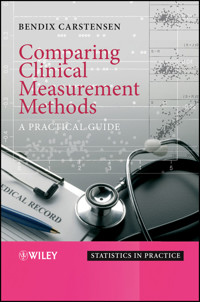
This book provides a practical guide to analysis of simple and complex method comparison data, using Stata, SAS and R. It takes the classical Limits of Agreement as a starting point, and presents it in a proper statistical framework. The model serves as a reference for reporting sources of variation and for providing conversion equations and plots between methods for practical use, including prediction uncertainty. * Presents a modeling framework for analysis of data and reporting of results from comparing measurements from different clinical centers and/or different methods. * Provides the practical tools for analyzing method comparison studies along with guidance on what to report and how to plan comparison studies and advice on appropriate software. * Illustrated throughout with computer examples in R. * Supported by a supplementary website hosting an R-package that performs the major part of the analyses needed in the area. * Examples in SAS and Stata for the most common situations are also provided. * Written by an acknowledged expert on the subject, with a long standing experience as a biostatistician in a clinical environment and a track record of delivering training on the subject. Biostatisticians, clinicians, medical researchers and practitioners involved in research and analysis of measurement methods and laboratory investigations will benefit from this book. Students of statistics, biostatistics, and the chemical sciences will also find this book useful.
Sie lesen das E-Book in den Legimi-Apps auf:
Seitenzahl: 170
Veröffentlichungsjahr: 2011
Ähnliche




















Contents
Acknowledgments
1 Introduction
2 Method comparisons
2.1 One measurement by each method
2.2 Replicate measurements by each method
2.3 More than two methods
2.4 Terminology and notation
2.5 What it is all about
3 How to …
3.1 … use this chapter
3.2 Two methods
3.3 More than two methods
4 Two methods with a single measurement on each
4.1 Model for limits of agreement
4.2 Non-constant difference between methods
4.3 A worked example
4.4 What really goes on
4.5 Other regression methods for non-constant bias
4.6 Comparison with a gold standard
4.7 Non-constant variance
4.8 Transformations
4.9 Summary
5 Replicate measurements
5.1 Pairing of replicate measurements
5.2 Plotting replicate measurements
5.3 Models for replicate measurements
5.4 Interpretation of the random effects
5.5 Estimation
5.6 Getting it wrong and getting it almost right
5.7 Summary
6 Several methods of measurement
6.1 Model
6.2 Replicate measurements
6.3 Single measurement by each method
7 A general model for method comparisons
7.1 Scaling
7.2 Interpretation of the random effects
7.3 Parametrization of the mean
7.4 Prediction limits
7.5 Estimation
7.6 Models with non-constant variance
7.7 Summary
8 Transformation of measurements
8.1 Log transformation
8.2 Transformations of percentages
8.3 Other transformations
8.4 Several methods
8.5 Variance components
8.6 Summary
9 Repeatability, reproducibility and coefficient of variation
9.1 Repeatability
9.2 Reproducibility
9.3 Coefficient of variation
10 Measures of association and agreement
10.1 Individual bioequivalence criterion
10.2 Agreement index
10.3 Relative variance index
10.4 Total deviation index
10.5 Correlation measures
10.6 Summary
11 Design of method comparison studies
11.1 Sample size
11.2 Repeated measures designs
11.3 Summary
12 Examples using standard software
12.1 SAS
12.2 Stata
12.3 R
13 The MethComp package for R
13.1 Data structures
13.2 Function overview
References
Index
Statistics in Practice
Advisory Editor
Human and Biological SciencesStephen Senn University College London, UK
Earth and Environmental SciencesMarian Scott University of Glasgow, UK
Industry, Commerce and FinanceWolfgang Jank University of Maryland, USA
Founding EditorVic Barnett Nottingham Trent University, UK
Statistics in Practice is an important international series of texts which provide detailed coverage of statistical concepts, methods and worked case studies in specific fields of investigation and study.
With sound motivation and many worked practical examples, the books show in down-to-earth terms how to select and use an appropriate range of statistical techniques in a particular practical field within each title’s special topic area.
The books provide statistical support for professionals and research workers across a range of employment fields and research environments. Subject areas covered include medicine and pharmaceutics; industry, finance and commerce; public services; the earth and environmental sciences, and so on.
The books also provide support to students studying statistical courses applied to the above areas. The demand for graduates to be equipped for the work environment has led to such courses becoming increasingly prevalent at universities and colleges.
It is our aim to present judiciously chosen and well-written workbooks to meet everyday practical needs. Feedback of views from readers will be most valuable to monitor the success of this aim.
A complete list of titles in the series appears at the end of this volume.
This edition first published 2010
© 2010 John Wiley & Sons Ltd
Registered office
John Wiley & Sons Ltd, The Atrium, Southern Gate, Chichester, West Sussex, PO19 8SQ, United
Kingdom
For details of our global editorial offices, for customer services and for information about how to apply for permission to reuse the copyright material in this book please see our website at www.wiley.com. The right of the author to be identified as the author of this work has been asserted in accordance with the Copyright, Designs and Patents Act 1988.
All rights reserved. No part of this publication may be reproduced, stored in a retrieval system, or transmitted, in any form or by any means, electronic, mechanical, photocopying, recording or otherwise, except as permitted by the UK Copyright, Designs and Patents Act 1988, without the prior permission of the publisher.
Wiley also publishes its books in a variety of electronic formats. Some content that appears in print may not be available in electronic books.
Designations used by companies to distinguish their products are often claimed as trademarks. All brand names and product names used in this book are trade names, service marks, trademarks or registered trademarks of their respective owners. The publisher is not associated with any product or vendor mentioned in this book. This publication is designed to provide accurate and authoritative information in regard to the subject matter covered. It is sold on the understanding that the publisher is not engaged in rendering professional services. If professional advice or other expert assistance is required, the services of a competent professional should be sought.
Library of Congress Cataloguing-in-Publication Data
Carstensen, Bendix.
Comparing clinical measurement methods: a practical guide/Bendix Carstensen.
p.; cm. Includes bibliographical references and index. ISBN 978-0-470-69423-7 (cloth)
1. Clinical trials - Evaluation. 2. Clinical trials - Statistical methods. I. Title.
[DNLM: 1. Clinical Medicine. 2. Case-Control Studies. 3. Models, Statistical. 4. Regression Analysis. 5. Statistics as Topic - methods. WA 950 C321c 2010] R853.C55C37 2010 610.72'4-dc22
2010010826
Statistics in Practice
Human and Biological Sciences
Berger – Selection Bias and Covariate Imbalances in Randomized Clinical Trials
Berger and Wong – An Introduction to Optimal Designs for Social and Biomedical Research
Brown and Prescott – Applied Mixed Models in Medicine, Second Edition
Carstensen – Comparing Clinical Measurement Methods Chevret (Ed) – Statistical Methods for Dose-Finding Experiments Ellenberg, Fleming and DeMets – Data Monitoring Committees in Clinical Trials: A Practical Perspective
Hauschke, Steinijans & Pigeot – Bioequivalence Studies in Drug Development: Methods and Applications
Lawson, Browne and Vidal Rodeiro – Disease Mapping with Win-BUGS and MLwiN
Lesaffre, Feine, Leroux & Declerck – Statistical and Methodological Aspects of Oral Health Research Lui – Statistical Estimation of Epidemiological Risk Marubini and Valsecchi – Analysing Survival Data from Clinical Trials and Observation Studies
Molenberghs and Kenward – Missing Data in Clinical Studies O’Hagan, Buck, Daneshkhah, Eiser, Garthwaite, Jenkinson, Oakley & Rakow – Uncertain Judgements: Eliciting Expert’s Probabilities Parmigiani – Modeling in Medical Decision Making: A Bayesian Approach
Pintilie – Competing Risks: A Practical Perspective Senn – Cross-over Trials in Clinical Research, Second Edition Senn – Statistical Issues in Drug Development, Second Edition Spiegelhalter, Abrams and Myles – Bayesian Approaches to Clinical Trials and Health-Care Evaluation
Walters – Quality of Life Outcomes in Clinical Trials and Health-Care Evaluation
Whitehead – Design and Analysis of Sequential Clinical Trials,
Revised Second Edition
Whitehead – Meta-Analysis of Controlled Clinical Trials
Willan and Briggs – Statistical Analysis of Cost Effectiveness Data
Winkel and Zhang – Statistical Development of Quality in Medicine
Earth and Environmental Sciences
Buck, Cavanagh and Litton – Bayesian Approach to Interpreting Archaeological Data
Glasbey and Horgan – Image Analysis in the Biological Sciences Helsel – Nondetects and Data Analysis: Statistics for Censored Environmental Data
Illian, Penttinen, Stoyan, H and Stoyan D–Statistical Analysis and Modelling of Spatial Point Patterns
McBride – Using Statistical Methods for Water Quality Management Webster and Oliver – Geostatistics for Environmental Scientists, Second Edition
Wymer (Ed) – Statistical Framework for Recreational Water Quality Criteria and Monitoring
Industry, Commerce and Finance
Aitken – Statistics and the Evaluation of Evidence for Forensic Scientists, Second Edition
Balding – Weight-of-evidence for Forensic DNA Profiles Brandimarte – Numerical Methods in Finance and Economics: A MATLAB-Based Introduction, Second Edition Brandimarte and Zotteri – Introduction to Distribution Logistics Chan – Simulation Techniques in Financial Risk Management Coleman, Greenfield, Stewardson and Montgomery (Eds) – Statistical Practice in Business and Industry Frisen (Ed) – Financial Surveillance Fung and Hu – Statistical DNA Forensics
Gusti Ngurah Agung – Time Series Data Analysis Using EViews Jank and Shmueli (Ed.) – Statistical Methods in e-Commerce Research
Lehtonen and Pahkinen – Practical Methods for Design and Analysis of Complex Surveys, Second Edition
Ohser and Mu¨cklich – Statistical Analysis of Microstructures in Materials Science
Pourret, Naim & Marcot (Eds) – Bayesian Networks: A Practical Guide to Applications
Taroni, Aitken, Garbolino and Biedermann – Bayesian Networks and Probabilistic Inference in Forensic Science
Taroni, Bozza, Biedermann, Garbolino and Aitken – Data Analysis in Forensic Science
Acknowledgments
My workplace, Steno Diabetes Center, has throughout the last decade provided an excellent academic working environment for me and has generously given me space to pursue the statistical aspects of method comparison studies.
I am grateful to Lyle Gurrin, School of Population Health, University of Melbourne, for a long-standing collaboration on this topic and particularly for his efforts in shaping the MethComp package. My wife, Lene Theil Skovgaard, Department of Biostatistics, University of Copenhagen, has exercised a remarkable patience with this endeavor as well as an astonishingly clear insight into the problems treated. Without her assistance the book would have been less complete, with more goofs and much delayed. I dedicate this book to my children Rolf, Thor, Mira and Vega, whose never failing distrust in my intellect kept the book at a tolerable level. Any incomprehensible sections and errors in the book are therefore attributable to me alone.
Lesen Sie weiter in der vollständigen Ausgabe!
Lesen Sie weiter in der vollständigen Ausgabe!
Lesen Sie weiter in der vollständigen Ausgabe!
Lesen Sie weiter in der vollständigen Ausgabe!
Lesen Sie weiter in der vollständigen Ausgabe!
Lesen Sie weiter in der vollständigen Ausgabe!
Lesen Sie weiter in der vollständigen Ausgabe!
Lesen Sie weiter in der vollständigen Ausgabe!
Lesen Sie weiter in der vollständigen Ausgabe!
Lesen Sie weiter in der vollständigen Ausgabe!
Lesen Sie weiter in der vollständigen Ausgabe!
Lesen Sie weiter in der vollständigen Ausgabe!
Lesen Sie weiter in der vollständigen Ausgabe!
Lesen Sie weiter in der vollständigen Ausgabe!
Lesen Sie weiter in der vollständigen Ausgabe!




