


25,99 €
Mehr erfahren.
- Herausgeber: John Wiley & Sons
- Kategorie: Wissenschaft und neue Technologien
- Serie: RGS-IBG Book Series
- Sprache: Englisch
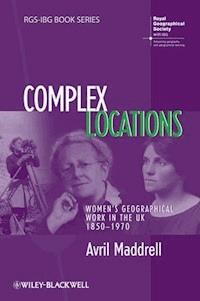
This enlightening book makes visible the lives and works of women who played a critical role in the development of geography as an academic field. * A rare and detailed analysis of the geographical work of 30 individual women geographers from 1850 to 1970 * Includes oral histories from women who have held appointments in British universities since World War II * Makes the work of women geographers visible and challenges the notion of pre 1970s geography as an overwhelmingly masculine field * Makes an important contribution to debates about the theoretical and methodological framing of the historiography of geography
Sie lesen das E-Book in den Legimi-Apps auf:
Seitenzahl: 882
Veröffentlichungsjahr: 2011
Ähnliche




















Contents
List of Figures
List of Tables
Preface
Series Editors’ Preface
Acknowledgements
Picture Acknowledgements
Chapter One Putting Women in their Place: Women in the Historiography of Geography
Introduction
Women qua Women
Women’s Place and Placing Women in the Historiography of Geography
Where Have All the Women Gone?
Complex Locations and Embodied Genealogy: More-than-Contextual History
Feminist History
Placing Texts in Context
Methodology: A Note on Selection, Sources, Representation and Ethics
Implications for the Historiography of Geography
Chapter Two Women and British Geographical Societies: Medals, Membership, Inclusion and Exclusion
Women’s Membership of British Geographical Societies
Lady Jane Franklin
Mary Somerville
Isabella Bird
Conclusion
Chapter Three Marion Newbigin and the Liminal Role of the Geographical Editor: Hired Help or Disciplinary Gatekeeper?
Biographical Background
The Production of Newbigin’s Work
The Reception of Newbigin’s Work and her Place in the History of Geography
Conclusion
Other Geographical Editors
Chapter Four Women Travellers: Inside or Outside the Canon?
Introduction
Mary Kingsley
Kate Marsden
Gertrude Bell
Freya Stark
Isobel Wylie Hutchison
Violet Cressy-Marcks
Other Twentieth-Century Women Travellers
Conclusion
Chapter Five Women in Geographical Education: Demand for Geography Teachers and Teaching by Example
Introduction
Ellen Rickard
F.D. Herbertson
J.B. Reynolds
Rachel Fleming
Charlotte A. Simpson
D.M. Preece
Gladys Marten
Jessie Watson
Patricia Pemberton
Olive Garnett
Gladys Hickman
I.M. Long
Sheila Jones
Conclusion
Chapter Six Diplomas, Degrees and Appointments: The First Generation of Women Geographers in Academia
Introduction
Nora MacMunn
Catherine Raisin
Blanche Hosgood
Hilda Ormsby (née Rodwell Jones)
Eva Taylor
Conclusion
Chapter Seven Fieldwork and War Work: Interwar University Geographers
Introduction
Alice Garnett
Catherine Snodgrass
Jean Brown Mitchell
Harriet Wanklyn/Steers
Margaret Shackleton/Mann
Dora Smee
Eunice Timberlake
Florence Miller
Katy Boswell
Alice Mutton
Dorothy Sylvester
Eila Campbell
Conclusion
Chapter Eight The War Years and Immediate Post-War Period
Margaret Dunlop/Davies
Lois R. Latham
Cuchlaine King
Mary Marshall
Kay MacIver
Swanzie Agnew
G. Joan Fuller
Jean Carter
Alice Coleman
Gillian E. Groom
Jean Sidebotham
Conclusion
Chapter Nine University Expansion, Specialisation and Quantification: 1950–70
Introduction
Monica Cole
Marjorie M. Sweeting
Hilary C. Chew
Jean Grove
Helen Wallis
Joy Tivy
Catherine Delano-Smith
Anne Buttimer
Margaret Storrie
Christine McCulloch
Doreen Massey
Barbara Kennedy
Part-Time and Short-Term Posts
Gwyneth Davies
Nicola Crosbie
Conclusion
Chapter Ten Conclusion: Mapping the ‘Hidden’ Women in British Geography 1900–70
I Empirical Findings
II Discursive Findings
III Reflections on the Historiography of Geography and the Geographical ‘Canon’
Notes
Bibliography
Index
RGS-IBG Book Series
Published
Complex Locations: Women’s Geographical Work in the UK 1850–1970
Avril Maddrell
Value Chain Struggles: Institutions and Governance in the Plantation Districts of South India
Jeff Neilson and Bill Pritchard
Arsenic Pollution: A Global Synthesis
Peter Ravenscroft, Hugh Brammer and Keith Richards
Queer Visibilities: Space, Identity and Interaction in Cape Town
Andrew Tucker
Resistance, Space and Political Identities: The Making of Counter-Global Networks
David Featherstone
Mental Health and Social Space: Towards Inclusionary Geographies?
Hester Parr
Climate and Society in Colonial Mexico: A Study in Vulnerability
Georgina H. Endfield
Geochemical Sediments and Landscapes
Edited by David J. Nash and Sue J. McLaren
Driving Spaces: A Cultural-Historical Geography of England’s M1 Motorway
Peter Merriman
Badlands of the Republic: Space, Politics and Urban Policy
Mustafa Dikeç
Geomorphology of Upland Peat: Erosion, Form and Landscape Change
Martin Evans and Jeff Warburton
Spaces of Colonialism: Delhi’s Urban Governmentalities
Stephen Legg
People/States/Territories
Rhys Jones
Publics and the City
Kurt Iveson
After the Three Italies: Wealth, Inequality and Industrial Change
Mick Dunford and Lidia Greco
Putting Workfare in Place
Peter Sunley, Ron Martin and Corinne Nativel
Domicile and Diaspora
Alison Blunt
Geographies and Moralities
Edited by Roger Lee and David M. Smith
Military Geographies
Rachel Woodward
A New Deal for Transport?
Edited by Iain Docherty and Jon Shaw
Geographies of British Modernity
Edited by David Gilbert, David Matless and Brian Short
Lost Geographies of Power
John Allen
Globalizing South China
Carolyn L. Cartier
Geomorphological Processes and Landscape Change: Britain in the Last 1000 Years
Edited by David L. Higgitt and E. Mark Lee
Forthcoming
Aerial Geographies: Mobilities, Subjects, Spaces
Peter Adey
Politicizing Consumption: Making the Global Self in an Unequal World
Clive Barnett, Nick Clarke, Paul Cloke and Alice Malpass
Living Through Decline: Surviving in the Places of the Post-Industrial Economy
Huw Beynon and Ray Hudson
Swept-Up Lives? Re-envisaging ‘the Homeless City’
Paul Cloke, Sarah Johnsen and Jon May
Millionaire Migrants: Trans-Pacific Life Lines
David Ley
In the Nature of Landscape: Cultural Geography on the Norfolk Broads
David Matless
Transnational Learning: Knowledge, Development and the North-South Divide
Colin McFarlane
Domesticating Neo-Liberalism: Social Exclusion and Spaces of Economic Practice in Post Socialism
Adrian Smith, Alison Stenning, Alena
Rochovská and Dariusz witek
State, Science and the Skies: Governmentalities of the British Atmosphere
Mark Whitehead
This edition first published 2009
© 2009 Avril Maddrell
Blackwell Publishing was acquired by John Wiley & Sons in February 2007. Blackwell’s publishing program has been merged with Wiley’s global Scientific, Technical, and Medical business to form Wiley-Blackwell.
Registered Office
John Wiley & Sons Ltd, The Atrium, Southern Gate, Chichester, West Sussex, PO19 8SQ, United Kingdom
Editorial Offices
350 Main Street, Malden, MA 02148–5020, USA
9600 Garsington Road, Oxford, OX4 2DQ, UK
The Atrium, Southern Gate, Chichester, West Sussex, PO19 8SQ, UK For details of our global editorial offices, for customer services, and for information about how to apply for permission to reuse the copyright material in this book please see our website at www.wiley.com/wiley-blackwell.
The right of Avril Maddrell to be identified as the author of this work has been asserted in accordance with the Copyright, Designs and Patents Act 1988.
All rights reserved. No part of this publication may be reproduced, stored in a retrieval system, or transmitted, in any form or by any means, electronic, mechanical, photocopying, recording or otherwise, except as permitted by the UK Copyright, Designs and Patents Act 1988, without the prior permission of the publisher.
Wiley also publishes its books in a variety of electronic formats. Some content that appears in print may not be available in electronic books.
Designations used by companies to distinguish their products are often claimed as trademarks. All brand names and product names used in this book are trade names, service marks, trademarks or registered trademarks of their respective owners. The publisher is not associated with any product or vendor mentioned in this book. This publication is designed to provide accurate and authoritative information in regard to the subject matter covered. It is sold on the understanding that the publisher is not engaged in rendering professional services. If professional advice or other expert assistance is required, the services of a competent professional should be sought.
Library of Congress Cataloging-in-Publication Data is available for this book.
9781405145565 (hardback)
9781405145558 (paperback)
A catalogue record for this book is available from the British Library.
For Bill, Sam and Breesha
List of Figures
2.1 Mary Somerville self-portrait
2.2 Isabella Bird
3.1 Marion Newbigin
4.1 Kate Marsden
4.2 Gertrude Bell
4.3 Freya Stark and companions in Jebel Druze
4.4 Isobel Wylie Hutchison
4.5 Photographs of plants observed in situ
4.6 Violet Cressy-Marcks
4.7 One of Thora Haslem’s travel accounts held by the GA
5.1 University of Oxford Diploma in Geography students and staff 1901 (Joan Reynolds seated next to Halford Mackinder, A.J. Herbertson on the right)
5.2 Staff of the Manchester High School for Girls, c. 1910; Gladys Marten far left bottom row
5.3 Manchester High School for Girls field trip, 1953
5.4 Gladys Hickman (centre) with Bertie and Molly Roberson, on a pre-war skiing trip
6.1 Blanche Hosgood
6.2 Hilda Ormsby DSc c. 1931
6.3 Eva Taylor
6.4 The axial belt of industry
7.1 Alice Garnett c. 1968
7.2 Scotland: number of women workers as a percentage of men workers
8.1 Le Play Society field party to Guernsey, Davies second from left front row
8.2 Cuchlaine King c. 1968
8.3 Cuchlaine King surveying in Iceland 1953
9.1 Monica Cole
9.2 Marjorie Sweeting
9.3 Jean and Dick Grove, with son Richard on research fieldwork in Norway 1957
9.4 Anne Buttimer c. 1968
9.5 Buttimer’s model of social space
10.1 Women editors of the Scottish Geographical Magazine 1900–70
10.2 Women members of the RSGS Council 1923–70
10.3 Women members of RGS Council 1930–70
10.4 Women members of IBG Council 1933–70
10.5 Women’s roles on the GA Executive Committee 1947–70
10.6 Women professors of geography in the UK 1930–70
List of Tables
1.1 Key dates 1850–1971
2.1 Women admitted to the Royal Geographical Society 1892–3
8.1 Foreign geography field group courses led by Joan Fuller
10.1 Women’s academic posts in British geography departments 1963–4
Preface
During my DPhil research I started to study women geographers working before 1918, including writers such as Mary Somerville, Isabella Bird and Marion Newbigin, and educationalists such as Nora MacMunn and Joan Reynolds, and their relationship to geographical societies, including the 1892-3 RGS women’s membership debate. This convinced me that there was a bigger ‘story’ to tell about women’s geographical work before secondwave feminism, not least because the popular perception of my own generation, based on the most widely read histories of the discipline, was that women had contributed little to the discipline before the 1970s and 1980s. For me it became a political project to repopulate the historiography of geography with women’s work and I was delighted when my long-standing proposal finally found a home in the relaunched RGS-IBG/Blackwell series.
My confidence about a quick completion of the manuscript proved false, as the primary and secondary materials were much richer than I had anticipated. This was to the ultimate benefit of the book, but not the publication schedule! I have found it engrossing and fascinating as the lives and work of individual women geographers took shape, and connections emerged in relation to each other, the wider discipline and the socioeconomic and political milieu. While some women were well known in their day and their work easily traceable, others were serendipitous ‘discoveries’ (as with most ‘discoveries’, there all the time and usually known to others). ‘Unearthing’ perhaps gives an appropriate sense of the archaeological nature of some of the historiographical work (see Foucault 1972) and the thrill of finding even shards which tell us something new and enlightening.
Complex Locations lived up to its name as I organised the structure of the book. The chapters focus on geographical societies, travellers, educationalists and academics and are organised in broad chronological order. By following this format the early chapters address topics such as women’s entry to geographical societies and travel writing, which have been discussed in detail elsewhere but are nonetheless important for a rounded discussion of women’s geographical work. The bulk of new research is found from Chapter Five onwards. For the most part the women studied were relatively easy to place, but there were numerous anomalies, where their chronology and/or multi-faceted careers challenged neat divisions. Having initially organised the academics under the headings of three successive ‘generations’, late in the day I realised that while a human reproductive generation might amount to my neat categories of about 20 years, academic reproduction, from new undergraduate to employable PhD holder can occur in as little as six years and some early academics were employed without higher degrees, making for much quicker production of successive academic generations. Thus the academic chapters have been divided into four broad periods reflecting wider socioeconomic and political periods in the UK: the ‘first generation’; the interwar years; the war and immediate post-war years; and 1950 to 1970. Marion Newbigin proved difficult to place, geographical societies perhaps the most obvious location, but that chapter didn’t allow enough space to discuss her influential writing; her dominance of a single chapter reflects the limitations of organisational structures (notably chapter length) rather than her pre-eminence within the discipline.
I started the book knowing I would have to be selective of women travellers and teachers of geography, but expected to be able to include all of the women academics working in geography 1900–70. In the event, this has not been possible, given (a) the number of women and (b) my decision to analyse the production and reception of individuals’ work in relation to personal biographical, disciplinary and wider contexts. I have been able to include most women academic geographers working before 1950, but have not been able to include/analyse in detail the work of all those working 1950-70. Some notable geographers beginning their careers at the very end of the 1960s are flagged briefly in Chapter Nine, but require a fuller treatment elsewhere. The selection made is intended to be representative of a geographical spread across the country and a range of research and teaching interests within the discipline, as well as departmental roles. While some chapters may be too long to read at one sitting I hope the reader will be tolerant of this, in the knowledge that this reflects the desire to be as inclusive as possible and to give the women ‘voice’ through the use of publications, archive sources and interview material. My hope is that the book will be read in a variety of ways, from those who wish to read it cover to cover, to those who read selective chapters or biographies; either (any) way I hope it will lead to further critical engagement with the complex locations of women’s geographical work in the historiography of geography.
Avril Maddrell 2009
Series Editors’ Preface
The RGS-IBG Book Series only publishes work of the highest international standing. Its emphasis is on distinctive new developments in human and physical geography, although it is also open to contributions from cognate disciplines whose interests overlap with those of geographers. The Series places strong emphasis on theoretically-informed and empirically-strong texts. Reflecting the vibrant and diverse theoretical and empirical agendas that characterize the contemporary discipline, contributions are expected to inform, challenge and stimulate the reader. Overall, the RGS-IBG Book Series seeks to promote scholarly publications that leave an intellectual mark and change the way readers think about particular issues, methods or theories.
For details on how to submit a proposal please visit: www.rgsbookseries.com
Kevin Ward
University of Manchester, UK
Joanna Bullard
Loughborough University, UK
RGS-IBG Book Series Editors
Acknowledgements
I have a great many people to acknowledge: those who have supported and assisted my research and those who have supported me in the long process of that research and writing the book.
I am grateful to the British Academy for a small grant funding a tranche of archive work 2004–5, and to Professors Morag Bell and Alison Blunt who supported my application. Although my research on women’s geographical work dates back to my doctoral research in the early 1990s, this BA grant was pivotal to progressing the book. Alison Blunt has been a resolute source of encouragement for this project over the years, including when there was little other academic interest in it, and I thank her sincerely for that, and for making the time in a pressing schedule to read and comment on a draft manuscript. I am also grateful to Helen Morse who was has been so generous with her offers of childcare and general support over recent years.
A large number of people and institutions have helped me source archive records, illustrations, departmental histories, publications and contacts. I have tried to acknowledge everyone appropriately in the text, but would like to underscore their assistance here. Special thanks go to Margaret Wilkes, who helped me develop my ‘map’ of women geographers in 2005, and to Liz Baigent for getting up early and reading and commenting on two draft chapters. I am also grateful to the two anonymous RGS-IBG series readers for their encouraging and helpful comments, as well as to the series editors and Blackwell’s commissioning editor, Jacqueline Scott, and copyeditor Tessa Hanford, for their patient support throughout the preparation of the manuscript.
I am grateful to Sarah Strong and Colleagues at the RGS Archive, the RSGS staff, Frances Soar at the GA and Sue Bird at the University of Oxford School of Geography and Environment Library, all of whom have assisted my work over the last decade and more. More recently I have been grateful to archivists at the British Library, National Library of Wales and National Library of Scotland, and numerous universities. Several have helped me trace sources and have extracted requested information for me from a distance, for which I am particularly grateful: Maria Castrillo (National Library of Scotland), Rachel Hart (St. Andrews), Chris Joy (Manchester High School for Girls), Ursula Mitchell (Queen’s University, Belfast), Kate Mooney (London Institute of Education), James Peters (University of Manchester), Anna Petre (University of Oxford), Ian Salmon (Aberystwyth, University of Wales), Lorraine Screene (QMUL) and James Webley (University of Bristol). My thanks to the QMUL and Southampton geography departments for giving me copies of their departmental histories, and to the Sheffield department, the RSGS, RHUL Archives, LSE Archives, RGS-IBG Picture Library and National Library of Scotland for providing illustrations, as well as to Anne Buttimer, Richard Hickman, Dick Grove and Cuchlaine King for providing photographs from their own collections. My thanks to Paul Ravell at UWE, Jamie Owen at the RGSIBG and Andy Morrison at Oxford Brookes for technical assistance with photographs. I am also grateful to colleagues who welcomed me to their own institutions and archive collections, including Mike Bradford, Felix Driver, Mike Hefferenan, David Matless, Chris Philo and Charlie Withers; and to Hugh Clout and Jan Monk who answered my queries and sent me information of interest.
I am particularly grateful to those who shared their own experiences of the geographical world and memories of others: Jay Appleton, the late William Balchin, Brain Blouet Rosemary Bromley, Sue BuckinghamHatfield, Nicola and Sandy Crosbie, Jack Davies, Dick Grove, David Herbert, Linda McDowell, Doreen Massey, David McEvoy, Bill Mead, Geoffrey North, Bruce Proudfoot, Derek Spooner, Mike Tanner, Roy Ward and Michael Wise. I owe a special debt of gratitude to those who allowed me to conduct autobiographical interviews with them, or sent me their autobiographical accounts: Anne Buttimer, Alice Coleman, Elizabeth Clutton, Nicola Crosbie, Gwyneth Davies, Catherine Delano-Smith, Gladys Hickman, Barbara Kennedy, Cuchlaine King, Sheila Jones, Kay MacIver, Janet Momsen, Christine McCulloch, Margaret Storrie, Jackie Tivers, and Margaret Wilkes.
My ultimate thanks go to Bill, Samuel and Breesha, who have lived with this project almost as much as I have, not least in my ‘absence’ when I have been away at archives, interrupted family holidays for archive visits or interviews, been preoccupied with the book and/or closeted in my study during evenings, Saturdays and swathes of school holidays. For their patience, understanding and continuous love and support I thank them, and dedicate this book to them.
Picture Acknowledgements
I am grateful to the following for granting permission to reproduce pictures: the RSGS for pictures of Marion Newbigin and Isobel Wylie Hutchison; the SGM for Figure 7.2; the RGS-IBG for pictures of Eva Taylor, Isabella Bird, Freya Stark, Gertrude Bell, Kate Marsden; GJ for Figures 4.5 and 6.4; TIBG for the pictures of Marjorie Sweeting and Monica Cole; the National Library of Scotland for a picture of Isobel Wylie Hutchison; the National Library of Wales for the picture of the Le Play Society field group in Guernsey; the School of Geography and Environment University of Oxford for Figure 5.1; the Principal and Fellows of Somerville College, Oxford for the portrait of Mary Somerville; the University of Sheffield Geography Department for the picture of Alice Garnett; Royal Holloway University of London for the photographs of Blanche Hosgood and Monica Cole; the London School of Economics for the photograph of Hilda Ormsby; Manchester High School for Girls for Figures 5.2 and 5.3; the Libertarian Alliance for the photograph of Alice Coleman; Cuchlaine King, Anne Buttimer, Dick Grove and Richard Hickman for photographs from their own collections.
Chapter One
Putting Women in their Place: Women in the Historiography of Geography
The kind of knowledge that emerges from a discipline depends very much on who produces that knowledge, what methods are used to procure knowledge, and what purposes knowledge is acquired for
Monk & Hanson 1982: 12
Introduction
This book is intended to offer a new perspective on the history of British geography by focusing on the geographical work of women from 1850 to 1970. In broad terms, historical studies allow us to trace the development of geographical ideas and can shed light on the nature and practice of geography today. As Holloway has argued, ‘The study of history is important if we are to understand why society is organized the way it is and how we canuse our understanding of the past to become agents of change in the present’ (2005: 2, my emphasis). Understanding the social construction of a discipline’s history also allows us to engage with that history epistemologically, to examine what is and is not accepted as ‘knowledge’ and how this defines membership of and practice within the academy. Women have been omitted largely from histories of geography (Domosh 1991a); and histories of geography that fail to consider what has been ‘left out’ – ‘what has been constructed as not-geography’ – tell only a partial story (Rose 1995).
Recent histories of British geography have stressed the role of enlightenment thought (Livingstone 1992; Livingstone & Withers 1999; Mayhew 2000) and the role of imperialism (Bell et al. 1995; Driver 2001). Others have traced shifts in theoretical and methodological schools of thought principally in the twentieth century (Cloke, Philo & Sadler 1991; Johnston & Sidaway 2004) or ‘key thinkers’ (Hubbard et al. 2004). Most of these have been consciously written in contrast to an earlier institutional approach to the discipline’s history (e.g. Mill 1930; Freeman 1960; Brown 1980). All of these approaches have brought new insight to understanding the ways in which geographical knowledge has been shaped, and are to be welcomed, not least in bringing a more ‘critical’ approach to understanding the history of geography, typically grounded in the contextual history approach blended with theoretical underpinnings ranging from Kuhn to Foucault to Marx. Whilst these studies have addressed feminism as a post-1980s’ school of thought, which has been significant in drawing attention to the underrepresentation of women and gender as an analytical concept, feminist approaches to the historiography of geography have been given little space. Feminist historiography has been articulated by Domosh (1991a,b), Rose (1993, 1995) Blunt and Rose (1994), Bell and McEwan (1996), the Women and Geography Study Group (1997), McEwan (1998a,b), Monk (2004, 2007), Maddrell (1997, 2004a, 2006, 2007, 2008) and others, 1 but there has been no sustained work to explicate the issues raised by these shorter engagements. As has been argued recently of political geography, ‘The marginalisation – and even exclusion – of gender and of feminist perspectives has yielded a field that is partial in the understandings and knowledges produced within it’ (Peake, Staeheli & Koffman 2004: 1). There remains a need for ‘documenting and explaining the gendering of knowledge production in geography in general, and how this is reflected in different places’ (Blumen & Bar-Gal 2006: 350).
This introduction will include five elements: (i) it will address the current place of women within the historiography of geography; (ii) it will discuss a ‘more-than-contextual’ approach to blending contextual and feminist approaches to history; (iii) the relationship between theoretical framing and methodologies will be explained, e.g. processes of selection, biographical approaches, oral history and reading texts such as obituaries and reviews; (iv) key contextual factors 1850–1970 will be indicated; and (v) central themes which emerge in women’s geographical work will be outlined.
Women qua Women
Is it desirable or possible to discuss ‘women’ as a group, as women per se? Whilst the prevailing feminist discourse of the 1970s represented an image of a universal sisterhood which needed only to recognise itself and unite in order to counter discrimination, by the mid-1990s feminist theory and practice increasingly recognised the diversity amongst and between women. This was partly as a product of feminism being caught in a tension between its modernist roots and critiques of modernism, and partly resulting from the awareness of the differences or ‘horizontal hostilities’ (Pratt & Hanson 1994) between women – largely resulting from postmodern and postcolonial feminist critique which highlighted differences between women according to socioeconomic class, race, sexuality etc. (see Liu 1991; Mills 1991; Nicholson & Fraser 1990). The salience of gender as an analytical category and basis for common interests has been fiercely debated within and beyond geography undermining earlier confidence in feminist project and necessitating the recognition of a number of , which in turn stress diversity and difference (see McDowell 1993a; Women and Geography Study Group 1997). However, the celebration of difference can obscure relations of power (Bondi 1990) including the hierarchy of white male privilege that has informed the creation of western intellectual tradition (Bordo 1990). These theoretical and political negotiations have led feminists to raise a number of questions, such as how to combine postmodern critiques of meta-narratives with the social-critical power of feminism/s? (Fraser & Nicholson 1990); how to refuse separation, but insist on non-identity? (McDowell 1993b). It is argued here that it is possible within a feminist historiography to blend strategic gendered subjectivity in methodology: i.e. to focus on women, within an analytical framework that acknowledges difference in its complexity. The different women geographers studied in this volume occupy different positions in time and space, in social class, education and politics. They have complex locations in relation to one another and to the institutions and discourses of geographical thought and practice, and this is what will be ‘mapped out’ in the following chapters. The complexity of the positionality and subjectivity of women travellers such as Mary Kingsley has been well documented by authors such as Mills (1991), Blunt (1994) McEwan (1998a) and Kearns (1998) (see Chapter Four). The same is true of women producing geographical work within the geographical establishment, for example Marion Newbigin (see Chapter Three) was both at the heart of a geographical institution and a producer of geographical knowledge, whilst simultaneously relatively marginalised from the growing university sector and the geographical establishment of the Royal Geographical Society (Maddrell 1997).
Lesen Sie weiter in der vollständigen Ausgabe!
Lesen Sie weiter in der vollständigen Ausgabe!
Lesen Sie weiter in der vollständigen Ausgabe!
Lesen Sie weiter in der vollständigen Ausgabe!
Lesen Sie weiter in der vollständigen Ausgabe!
Lesen Sie weiter in der vollständigen Ausgabe!
Lesen Sie weiter in der vollständigen Ausgabe!
Lesen Sie weiter in der vollständigen Ausgabe!
Lesen Sie weiter in der vollständigen Ausgabe!
Lesen Sie weiter in der vollständigen Ausgabe!
Lesen Sie weiter in der vollständigen Ausgabe!
Lesen Sie weiter in der vollständigen Ausgabe!




