


217,99 €
Mehr erfahren.
- Herausgeber: John Wiley & Sons
- Kategorie: Wissenschaft und neue Technologien
- Sprache: Englisch
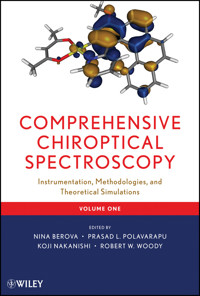
This book provides an introduction to the important methods of chiroptical spectroscopy in general, and circular dichroism (CD) in particular, which are increasingly important in all areas of chemistry, biochemistry, and structural biology. The book can be used as a text for undergraduate and graduate students and as a reference for researchers in academia and industry, with or without the companion volume in this set. Experimental methods and instrumentation are described with topics ranging from the most widely used methods (electronic and vibrational CD) to frontier areas such as nonlinear spectroscopy and photoelectron CD, as well as the theory of chiroptical methods and techniques for simulating chiroptical properties. Each chapter is written by one or more leading authorities with extensive experience in the field.
Sie lesen das E-Book in den Legimi-Apps auf:
Seitenzahl: 1581
Veröffentlichungsjahr: 2011
Ähnliche



















Table of Contents
Title Page
Copyright
Preface
Contributors
Part I: Introduction
Chapter 1: On the Interaction of Light with Molecules: Pathways to the Theoretical Interpretation of Chiroptical Phenomena
1.1 A Brief Historical Retrospective
1.2 Elements of the Semiclassical Theory
1.3 Chiroptical Phenomena
1.4 Concluding Remarks
References
Part II: Experimental Methods and Instrumentation
Chapter 2: Measurement of the Circular Dichroism of Electronic Transitions
2.1 Introduction
2.2 Theory
2.3 Operations
Acknowledgments
References
Chapter 3: Circularly Polarized Luminescence Spectroscopy and Emission-Detected Circular Dichroism
3.1 Introduction
3.2 Theoretical Principles
3.3 Measurement Techniques
3.4 Standards for CPL
3.5 Artifacts
3.6 Example Applications
3.7 Summary
Acknowledgments
References
Chapter 4: Solid-State Chiroptical Spectroscopy: Principles and Applications
4.1 Introduction
4.2 Theoretical Background [32]
4.3 Development of New Apparatuses
4.4 Application to Solid Samples
4.5 Multichannel (MC) CD Method: A Novel Method for Direct True CD Measurement [31]
4.6 Concluding Remarks
References
Chapter 5: Infrared Vibrational Optical Activity: Measurement and Instrumentation
5.1 Introduction
5.2 Stokes–Mueller Representations of Intensities
5.3 Fourier Transform Instrumentation
5.4 Advanced Methods for FT-VCD Measurement
5.5 Measurement of Dispersed Solids and Films
5.6 Conclusions
References
Chapter 6: Measurement of Raman Optical Activity
6.1 Introduction
6.2 Optical Activity Measured by Light Scattering
6.3 Scattering Zone, Light Collection, and Spectral Analysis
6.4 Signal Detection and Noise
6.5 Polarization Control and Detection
6.6 Final Remarks
References
Chapter 7: Nanosecond Time-Resolved Natural and Magnetic Chiroptical Spectroscopies
7.1 Introduction
7.2 Near-Null Ellipsometric CD Measurements
7.3 Near-Null Ellipsometric MCD Measurements
7.4 Near-Null Polarimetric ORD and MORD Measurements
7.5 Limitations of Near-Null Techniques
7.6 CD and MCD in Samples Oriented by Laser Photoselection
7.7 Applications of Nanosecond Chiroptical Spectroscopies
7.8 Other Approaches to Fast and Ultrafast TRCD Measurements
References
Chapter 8: Femtosecond Infrared Circular Dichroism and Optical Rotatory Dispersion
8.1 Introduction
8.2 Time Correlation Function Theory
8.3 Differential Intensity Measurement Method
8.4 Phase-and-Amplitude Measurement of IR Optical Activity
8.5 Active- and Self-Heterodyne Detections of IR Optical Activity
8.6 Experimental Demonstration: VCD and Vord Spectra of (1S)-β-Pinene
8.7 Summary and a Few Concluding Remarks
Acknowledgments
References
Chapter 9: Chiroptical Properties of Lanthanide Compounds in an Extended Wavelength Range
9.1 Introduction
9.2 The F Shell
9.3 Electronic Circular Dichroism and Circularly Polarized Luminescence
9.4 Coupling of Electronic and Vibrational States and VCD Enhancement
9.5 Applications
9.6 Conclusions
Acknowledgment
List of Abbreviations
References
Chapter 10: Near-Infrared Vibrational Circular Dichroism: NIR-VCD
10.1 Introduction
10.2 Acquiring and Interpreting NIR-VCD Spectra
10.3 A Worked-Out Example: Epichlorohydrin
10.4 Perspectives and Conclusions
References
Chapter 11: Optical Rotation and Intrinsic Optical Activity
11.1 Introduction
11.2 Theoretical Background
11.3 Experimental Methods
11.4 Intrinsic Optical Activity
11.5 Summary and Outlook
Acknowledgments
References
Chapter 12: Chiroptical Imaging of Crystals
12.1 Introduction
12.2 Differential Polarization Imaging
12.3 Complete versus Incomplete Polarimeters
12.4 Optical Rotation
12.5 Circular Dichroism/Extinction
12.6 Nanoscale
12.7 Mueller Matrix Microscopy
12.8 Artifacts
12.9 Outlook
References
Chapter 13: Nonlinear Optical Spectroscopy of Chiral Molecules
13.1 Introduction
13.2 Linear Chiroptics in Liquids: χ(1)
13.3 Nonlinear Chiroptics in Liquids
13.4 Nonlinear Chiroptics at Surfaces
13.5 Computation
13.6 Conclusions
13.7 Appendix
Acknowledgments
References
Chapter 14: In Situ Measurement of Chirality of Molecules and Molecular Assemblies with Surface Nonlinear Spectroscopy
14.1 Introduction
14.2 Theory and Formalism of SHG-LD and SFG-LD
14.3 Application of SHG-LD and SFG-LD
14.4 Perspectives and Future Directions
References
Chapter 15: Photoelectron Circular Dichroism
15.1 Introduction
15.2 The Photoelectron Angular Distribution and Circular Dichroism
15.3 Experimental Approaches
15.4 Experimental Results and Discussion
15.5 Prospects
Acknowledgments
References
Chapter 16: Magnetochiral Dichroism and Birefringence
16.1 Introduction
16.2 MChD in Luminescence
16.3 MChD in Optical Absorption
16.4 Enantioselective MChD Photochemistry
16.5 Magnetochiral Dichroism in a Ferromagnet
16.6 Magnetochiral Birefringence
16.7 Other Manifestations of MChA
16.8 Conclusion
Acknowledgments
References
Chapter 17: X-Ray Detected Optical Activity
17.1 Phenomenological Bases
17.2 Instrumentation and Methods
17.3 XDOA: Illustrative Examples
17.4 Unifying Theories, First Principles Simulations
17.5 Concluding Remarks
Acknowledgments
References
Chapter 18: Linear Dichroism
18.1 Introduction
18.2 Flow Linear Dichroism for Structure Analysis
18.3 LD to Follow Kinetic Processes
18.4 LD to Determine DNA Bending, Stiffening, and Relaxation
18.5 Practicalities of LD Spectroscopy
18.6 Orientation Methods of Samples for LD Spectroscopy
18.7 Some Derivations
18.8 Interplay of Theory and Experiment
References
Chapter 19: Electro-Optical Absorption Spectroscopy
19.1 Introduction
19.2 Working Equations for Polarized Spectroscopy and Electro-Optical Absorption Spectroscopy
19.3 Experimentals
19.4 Quantitative Analysis
19.5 Discussion
19.6 Summary
Acknowledgments
19.8 Appendix
References
Part III: Theoretical Simulations
Chapter 20: Independent Systems Theory for Predicting Electronic Circular Dichroism
20.1 Introduction
20.2 The Tinoco Theory
20.3 The Matrix Method
20.4 Classical Polarizability (DeVoe) Theory
20.5 Applications
20.6 Software Available
Appendix A
Appendix B
Supplement To Chapter 20: Derivation of Tinoco'S Equation in Dipole Velocity Form
References
Chapter 21: Ab Initio Electronic Circular Dichroism and Optical Rotatory Dispersion: From Organic Molecules to Transition Metal Complexes
21.1 Introduction
21.2 Calculating ECD and ORD Starting From First Principles
21.3 ECD and ORD Calculations for Organic Molecules
21.4 Metal Complexes and Metal Clusters
21.5 Concluding Remarks
Acknowledgments
References
Chapter 22: Theoretical Electronic Circular Dichroism Spectroscopy of Large Organic and Supramolecular Systems
22.1 Introduction
22.2 Theory
22.3 Examples
22.4 Summary
Acknowledgments
References
Chapter 23: High-Accuracy Quantum Chemistry and Chiroptical Properties
23.1 Introduction
23.2 Coupled Cluster Theory
23.3 Response Theory for Chiroptical Properties
23.4 Performance
23.5 Future Directions
Acknowledgments
References
Chapter 24: Ab Initio Methods for Vibrational Circular Dichroism and Raman Optical Activity
24.1 Introduction
24.2 Energy Derivative Theory and Perturbation-Dependent Basis Sets
24.3 The Theory Of Vibrational Circular Dichroism and Raman Optical Activity
24.4 The AB Initio Theory of Vibrational Circular Dichroism and Raman Optical Activity
24.5 Concluding Remarks and Outlook
Acknowledgments
24.7 Appendix: Determination of the Perturbed Density Matrices
References
Chapter 25: Modeling of Solvation Effects on Chiroptical Spectra
25.1 Introduction
25.2 Solvent models
25.3 Solvent Effects on Electronic Circular Dichroism and Natural Optical Rotation
25.4 Solvent Effects on Vibrational Circular Dichroism and Raman Optical Activity
25.5 Concluding Remarks
References
Chapter 26: Complexation, Solvation, and Chirality Transfer in Vibrational Circular Dichroism
26.1 Introduction
26.2 Concept of Robustness in VCD Spectroscopy
26.3 Effects of Molecular Complex Formation in VCD Spectra
26.4 Conclusions
26.5 Acknowledgment
References
Index
Color Plates
Copyright © 2011 by John Wiley & Sons, Inc. All rights reserved
Published by John Wiley & Sons, Inc., Hoboken, New Jersey
Published simultaneously in Canada
No part of this publication may be reproduced, stored in a retrieval system, or transmitted in any form or by any means, electronic, mechanical, photocopying, recording, scanning, or otherwise, except as permitted under Section 107 or 108 of the 1976 United States Copyright Act, without either the prior written permission of the Publisher, or authorization through payment of the appropriate per-copy fee to the Copyright Clearance Center, Inc., 222 Rosewood Drive, Danvers, MA 01923, (978) 750-8400, fax (978) 750-4470, or on the web at www.copyright.com. Requests to the Publisher for permission should be addressed to the Permissions Department, John Wiley & Sons, Inc., 111 River Street, Hoboken, NJ 07030, (201) 748-6011, fax (201) 748-6008, or online at http://www.wiley.com/go/permission.
Limit of Liability/Disclaimer of Warranty: While the publisher and author have used their best efforts in preparing this book, they make no representations or warranties with respect to the accuracy or completeness of the contents of this book and specifically disclaim any implied warranties of merchantability or fitness for a particular purpose. No warranty may be created or extended by sales representatives or written sales materials. The advice and strategies contained herein may not be suitable for your situation. You should consult with a professional where appropriate. Neither the publisher nor author shall be liable for any loss of profit or any other commercial damages, including but not limited to special, incidental, consequential, or other damages.
For general information on our other products and services or for technical support, please contact our Customer Care Department within the United States at (800) 762-2974, outside the United States at (317) 572-3993 or fax (317) 572-4002.
Wiley also publishes its books in a variety of electronic formats. Some content that appears in print may not be available in electronic formats. For more information about Wiley products, visit our web site at www.wiley.com.
Library of Congress Cataloging-in-Publication Data:
Advances in chiroptical methods/edited by Nina Berova . . . [et al.].
p. cm.
ISBN 978-0-470-64135-4 (hardback : set)—ISBN 978-1-118-01293-2 (v. 1)—ISBN 978-1-118-01292-5 (v. 2)
1. Chirality. 2. Spectrum analysis. 3. Circular dichroism. I. Berova, Nina.
Includes index.
QP517.C57A384 2012
541.7—dc23
2011021418
Preface
Chirality is a phenomenon that is manifested throughout the natural world, ranging from fundamental particles through the realm of molecules and biological organisms to spiral galaxies. Thus, chirality is of interest to physicists, chemists, biologists, and astronomers. Chiroptical spectroscopy utilizes the differential response of chiral objects to circularly polarized electromagnetic radiation. Applications of chiroptical spectroscopy are widespread in chemistry, biochemistry, biology, and physics. It is indispensable for stereochemical elucidation of organic and inorganic molecules. Nearly all biomolecules and natural products are chiral, as are the majority of drugs. This has led to crucial applications of chiroptical spectroscopy ranging from the study of protein folding to characterization of small molecules, pharmaceuticals, and nucleic acids.
The first chiroptical phenomenon to be observed was optical rotation (OR) and its wavelength dependence, namely, optical rotatory dispersion (ORD), in the early nineteenth century. Circular dichroism associated with electronic transitions (ECD), currently the most widely used chiroptical method, was discovered in the mid-nineteenth century, and its relationship to ORD and absorption was elucidated at the end of the nineteenth century. Circularly polarized luminescence (CPL) from chiral crystals was observed in the 1940s. The introduction of commercial instrumentation for measuring ORD in the 1950s and ECD in the 1960s led to a rapid expansion of applications of these forms of chiroptical spectroscopy to various branches of science, and especially to organic and inorganic chemistry and to biochemistry.
Until the 1970s, chiroptical spectroscopy was confined to the study of electronic transitions, but vibrational transitions became accessible with the development of vibrational circular dichroism (VCD) and Raman optical activity (ROA). Other major extensions of chiroptical spectroscopy include differential ionization of chiral molecules by circularly polarized light (photoelectron CD), measurement of optical activity in the X-ray region, magnetochiral dichroism, and nonlinear forms of chiroptical spectroscopy.
The theory of chiroptical spectroscopy also goes back many years, but has recently made spectacular advances. Classical theories of optical activity were formulated in the early twentieth century, and the quantum mechanical theory of optical rotation was described in 1929. Approximate formulations of the quantum mechanical models were developed in the 1930s and more extensively with the growth of experimental ORD and ECD studies, starting in the late 1950s. The quantum mechanical methods for calculations of chiroptical spectroscopic properties reached a mature stage in the 1980s and 1990s. Ab initio calculations of VCD, ECD, ORD, and ROA have proven highly successful and are now widely used for small and medium-sized molecules.
Many books have been published on ORD, ECD, and VCD/ROA. The present two volumes are the first comprehensive treatise covering the whole field of chiroptical spectroscopy. Volume 1 covers the instrumentation, methodologies, and theoretical simulations for different chiroptical spectroscopic methods. In addition to an extensive treatment of ECD, VCD, and ROA, this volume includes chapters on ORD, CPL, photoelectron CD, X-ray-detected CD, magnetochiral dichroism, and nonlinear chiroptical spectroscopy. Chapters on the related techniques of linear dichroism, chiroptical imaging of crystals and electro-optic absorption, which sometimes supplement chiroptical interpretations, are also included. The coverage of theoretical methods is also extensive, including simulation of ECD, ORD, VCD, and ROA spectra of molecules ranging from small molecules to macromolecules. Volume 2 describes applications of ECD, VCD, and ROA in the stereochemical analysis of organic and inorganic compounds and to biomolecules such as natural products, proteins, and nucleic acids. The roles of chiroptical methods in the study of drug mechanisms and drug discovery are described.
Thus, this work is unique in presenting an extensive coverage of the instrumentation and techniques of chiroptical spectroscopy, theoretical methods and simulation of chiroptical spectra, and applications of chiroptical spectroscopy in inorganic and organic chemistry, biochemistry, and drug discovery. In each of these areas, leading experts have provided the background needed for beginners, such as undergraduates and graduate students, and a state-of-the-art treatment for active researchers in academia and industry.
We are grateful to the contributors to these two volumes who kindly accepted our invitations to contribute and who have met the challenges of presenting accessible, up-to-date treatments of their assigned topics in a timely fashion.
Nina Berova
Prasad L. Polavarapu
Koji Nakanishi
Robert W. Woody
Contributors
Sergio Abbate, Department of Biomedical Sciences and Biotechnologies, University of Brescia, Brescia, Italy and CNISM (Consorzio Nazionale Interuniversitario per le Scienze Fisiche della Materia), Rome, Italy
Jochen Autschbach, Department of Chemistry, University at Buffalo, The State University of New York, Buffalo, New York, USA
Evert Jan Baerends, Division of Theoretical Chemistry, Faculty FEW/Chemistry, VU University, Amsterdam, The Netherlands and WCU Program, Department of Chemistry, Pohang University of Science and Technology, Pohang, South Korea
Nina Berova, Department of Chemistry, Columbia University, New York, New York, USA
Christian Brouder, Institute of Mineralogy and Physics of Condensed Media, Universities of Paris VI-VII, Paris, France
Ettore Castiglioni, Jasco Corporation, Tokyo, Japan and Department of Biomedical Sciences and Biotechnologies, University of Brescia, Brescia, Italy
Eefei Chen, Department of Chemistry and Biochemistry, University of California, Santa Cruz, California, USA
Minhaeng Cho, Department of Chemistry, Korea University, Seoul, South Korea and Korea Basic Science Institute, Seoul, South Korea
T. Daniel Crawford, Department of Chemistry, Virginia Tech, Blacksburg, Virginia, USA
Lorenzo Di Bari, Department of Chemistry and Industrial Chemistry, University of Pisa, Pisa, Italy
Peer Fischer, Max-Planck-Institute for Intelligent Systems, Stuttgart, Germany
Joerg Fleischhauer, Institute of Organic Chemistry, RWTH Aachen University, Aachen, Germany
John Freudenthal, Department of Chemistry and Molecular Design Institute, New York University, New York, New York, USA
Lars Goerigk, Institute of Theoretical Organic Chemistry and Organic Chemistry, University of Muenster, Muenster, Germany and School of Chemistry, The University of Sydney, Sydney, New South Wales, Australia
Robert A. Goldbeck, Department of Chemistry and Biochemistry, University of California, Santa Cruz, California, USA
Jose Goulon, European Synchrotron Radiation Facility, Grenoble, France
Stefan Grimme, Institute of Theoretical Organic Chemistry and Organic Chemistry, University of Muenster, Muenster, Germany
Takunori Harada, Department of Life Sciences, Graduate School of Arts and Sciences, The University of Tokyo, Tokyo, Japan
Werner Hug, Department of Chemistry, University of Fribourg, Fribourg, Switzerland
Bart Kahr, Department of Chemistry and Molecular Design Institute, New York University, New York, New York, USA
Werner Kaminsky, Department of Chemistry, University of Washington, Seattle, Washington, USA
David S. Kliger, Department of Chemistry and Biochemistry, University of California, Santa Cruz, California, USA
Holger Kruse, Institute of Theoretical Organic Chemistry and Organic Chemistry, University of Muenster, Muenster, Germany
Hans-Georg Kuball, Department of Chemistry—Physical Chemistry, Technical University of Kaiserslautern, Kaiserslautern, Germany
Reiko Kuroda, Department of Life Sciences, Graduate School of Arts and Sciences, The University of Tokyo, Tokyo, Japan
Giovanna Longhi, Department of Biomedical Sciences and Biotechnologies, University of Brescia, Brescia, Italy and CNISM Consorzio Nazionale Interuniversitario per le Scienze Fisiche della Materia, Rome, Italy
Gilles Muller, Department of Chemistry, San José State University, San José, California, USA
Laurence A. Nafie, Department of Chemistry, Syracuse University, Syracuse, New York, USA
Koji Nakanishi, Department of Chemistry, Columbia University, New York, New York, USA
Valentin Paul Nicu, Division of Theoretical Chemistry, Faculty FEW/Chemistry, VU University, Amsterdam, The Netherlands
Magdalena Pecul, Faculty of Chemistry, University of Warsaw, Warszawa, Poland
Prasad L. Polavarapu, Department of Chemistry, Vanderbilt University, Nashville, Tennessee, USA
Ivan Powis, School of Chemistry, University of Nottingham, Nottingham, United Kingdom
Gerhard Raabe, Institute of Organic Chemistry, RWTH Aachen University, Aachen, Germany
Hanju Rhee, Seoul Center, Korea Basic Science Institute, Seoul, South Korea
James P. Riehl, Department of Chemistry, University of Minnesota, Duluth, Minnesota, USA
G. L. J. A. Rikken, National Laboratory of Intense Magnetic Fields, Toulouse, France
Alison Rodger, Warwick Centre for Analytical Science and Department of Chemistry, University of Warwick, Coventry, United Kingdom
Andrei Rogalev, European Synchrotron Radiation Laboratory, Grenoble, France
Kenneth Ruud, Centre for Theoretical and Computational Chemistry, Department of Chemistry, University of Tromsø, Tromsø, Norway
Piero Salvadori, Department of Chemistry and Industrial Chemistry, University of Pisa, Pisa, Italy
Matthias Stolte, Institute of Organic Chemistry, University of Würzburg, Würzburg, Germany
John C. Sutherland, Department of Physics, East Carolina University, Greenville, North Carolina, USA and Biology Department, Brookhaven National Laboratory, Upton, New York, USA
Patrick H. Vaccaro, Department of Chemistry, Yale University, New Haven, Connecticut, USA
Georges H. Wagnière, Institute of Physical Chemistry, University of Zürich, Zürich, Switzerland
Hong-fei Wang, Environmental Molecular Science Laboratory, Pacific Northwest National Laboratory, Richland, Washington, USA
Robert W. Woody, Department of Biochemistry and Molecular Biology, Colorado State University, Fort Collins, Colorado, USA
Part I
INTRODUCTION




