


137,99 €
Mehr erfahren.
- Herausgeber: John Wiley & Sons
- Kategorie: Wissenschaft und neue Technologien
- Sprache: Englisch
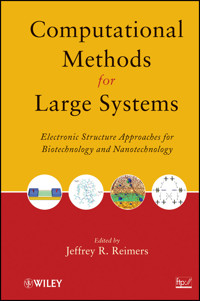
While its results normally complement the information obtained by chemical experiments, computer computations can in some cases predict unobserved chemical phenomena Electronic-Structure Computational Methods for Large Systems gives readers a simple description of modern electronic-structure techniques. It shows what techniques are pertinent for particular problems in biotechnology and nanotechnology and provides a balanced treatment of topics that teach strengths and weaknesses, appropriate and inappropriate methods. It’s a book that will enhance the your calculating confidence and improve your ability to predict new effects and solve new problems.
Sie lesen das E-Book in den Legimi-Apps auf:
Seitenzahl: 1201
Veröffentlichungsjahr: 2011
Ähnliche



















Table of Contents
Title Page
Copyright
Dedication Page
Preface
Contributors
Part A: DFT: The Basic Workhorse
Chapter 1: Principles of Density Functional Theory: Equilibrium and Nonequilibrium Applications
1.1 Equilibrium Theories
1.2 Local Approximations
1.3 Kohn–Sham formulation
1.4 Why DFT is so successful
1.5 Exact properties of DFTs
1.6 Time-Dependent DFT
1.7 TDDFT and transport calculations
1.8 Modeling Reservoirs in and Out of Equilibrium
References
Chapter 2: SIESTA: A Linear-Scaling Method for Density Functional Calculations
2.1 Introduction
2.2 Methodology
2.3 Future perspectives
References
Chapter 3: Large-Scale Plane-Wave-Based Density Functional Theory: Formalism, Parallelization, and Applications
3.1 Introduction
3.2 Plane-Wave Basis Set
3.3 Pseudopotential Plane-Wave Method
3.4 Charged Systems
3.5 Exact Exchange
3.6 Wavefunction Optimization for Plane-Wave Methods
3.7 Car–Parrinello Molecular Dynamics
3.8 Parallelization
3.9 AIMD Simulations of Highly Charged Ions in Solution
3.10 Conclusions
References
Part B: Higher-Accuracy Methods
Chapter 4: Quantum Monte Carlo, Or, Solving the Many-Particle Schrödinger Equation Accurately While Retaining Favorable Scaling with System Size
4.1 Introduction
4.2 Variational Monte Carlo
4.3 Wavefunctions and Their Optimization
4.4 Diffusion Monte Carlo
4.5 Bits and pieces
4.6 Applications
4.7 Conclusions
References
Chapter 5: Coupled-Cluster Calculations for Large Molecular and Extended Systems
5.1 Introduction
5.2 Theory
5.3 General structure of parallel coupled-cluster codes
5.4 Large-scale coupled-cluster calculations
5.5 Conclusions
References
Chapter 6: Strongly Correlated Electrons: Renormalized Band Structure Theory and Quantum Chemical Methods
6.1 Introduction
6.2 Measure of the Strength of Electron Correlations
6.3 Renormalized band structure theory
6.4 Quantum Chemical Methods
6.5 Conclusions
References
Part C: More-Economical Methods
Chapter 7: The Energy-Based Fragmentation Approach for Ab Initio Calculations of Large Systems
7.1 Introduction
7.2 The energy-based fragmentation approach and its generalized version
7.3 Results and discussion
7.4 Conclusions
7.5 Appendix: illustrative example of the GEBF procedure
References
Chapter 8: MNDO-like Semiempirical Molecular Orbital Theory and Its Application to Large Systems
8.1 Basic Theory
8.2 Parameterization
8.3 Natural history or Evolution of MNDO-like Methods
8.4 Large Systems
References
Chapter 9: Self-Consistent-Charge Density Functional Tight-Binding Method: An Efficient Approximation of Density Functional Theory
9.1 Introduction
9.2 Theory
9.3 Performance of standard SCC-DFTB
9.4 Extensions of standard SCC-DFTB
9.5 Conclusions
References
Chapter 10: Introduction to Effective Low-Energy Hamiltonians in Condensed Matter Physics and Chemistry
10.1 Brief Introduction to Second Quantization Notation
10.2 Hückel or tight-binding model
10.3 Hubbard Model
10.4 Heisenberg Model
10.5 Other effective low-energy Hamiltonians for correlated electrons
10.6 Holstein model
10.7 Effective Hamiltonian or semiempirical model?
References
Part D: Advanced Applications
Chapter 11: SIESTA: Properties and Applications
11.1 Ethynylbenzene Adsorption on Au(111)
11.2 Dimerization of Thiols on Au(111)
11.3 Molecular Dynamics of Nanoparticles
11.4 Applications to Large Numbers of Atoms
References
Chapter 12: Modeling Photobiology Using Quantum Mechanics and Quantum Mechanics/Molecular Mechanics Calculations
12.1 Introduction
12.2 Computational Strategies: Methods and Models
12.3 Applications
12.4 Conclusions
References
Chapter 13: Computational Methods for Modeling Free-Radical Polymerization
13.1 Introduction
13.2 Model Reactions for Free-Radical Polymerization Kinetics
13.3 Electronic Structure Methods
13.4 Calculation of Kinetics and Thermodynamics
13.5 Conclusions
References
Chapter 14: Evaluation of Nonlinear Optical Properties of Large Conjugated Molecular Systems by Long-Range-Corrected Density Functional Theory
14.1 Introduction
14.2 Nonlinear Optical response theory
14.3 Long-Range-Corrected Density Functional Theory
14.4 Evaluation of hyperpolarizability for long conjugated systems
14.5 Conclusions
References
Chapter 15: Calculating the Raman and HyperRaman Spectra of Large Molecules and Molecules Interacting with Nanoparticles
15.1 Introduction
15.2 Displacement of Coordinates Along Normal Modes
15.3 Calculation of Polarizabilities Using TDDFT
15.4 Derivatives of the Polarizabilities with Respect to Normal Modes
15.5 Orientation Averaging
15.6 Differential Cross Sections
15.7 Surface-Enhanced Raman and HyperRaman Spectra
15.8 Application of Tensor Rotations to Raman Spectra for Specific Surface Orientations
15.9 Resonance Raman
15.10 Determination of Resonant Wavelength
15.11 Summary
References
Chapter 16: Metal Surfaces and Interfaces: Properties from Density Functional Theory
16.1 Background, goals, and outline
16.2 Methodology
16.3 Structure and properties of iron surfaces
16.4 Structure and properties of iron interfaces
16.5 Summary, conclusions, and future work
References
Chapter 17: Surface Chemistry and Catalysis from Ab Initio–Based Multiscale Approaches
17.1 Introduction
17.2 Predicting Surface Structures and Phase Transitions
17.3 Surface Phase Diagrams from Ab initio Atomistic Thermodynamics
17.4 Catalysis and Diffusion from Ab initio kinetic Monte Carlo Simulations
17.5 Summary
References
Chapter 18: Molecular Spintronics
18.1 Introduction
18.2 Theoretical Background
18.3 Numerical implementation
18.4 Examples
18.5 Conclusions
References
Chapter 19: Calculating Molecular Conductance
19.1 Introduction
19.2 Outline of the NEGF Approach
19.3 Electronic Structure Challenges
19.4 Chemical trends
19.5 Features of Electronic transport
19.6 Applications
19.7 Conclusions
References
Index
Copyright © 2011 by John Wiley & Sons, Inc. All rights reserved
Published by John Wiley & Sons, Inc., Hoboken, New Jersey
Published simultaneously in Canada
No part of this publication may be reproduced, stored in a retrieval system, or transmitted in any form or by any means, electronic, mechanical, photocopying, recording, scanning, or otherwise, except as permitted under Section 107 or 108 of the 1976 United States Copyright Act, without either the prior written permission of the Publisher, or authorization through payment of the appropriate per-copy fee to the Copyright Clearance Center, Inc., 222 Rosewood Drive, Danvers, MA 01923, (978) 750-8400, fax (978) 750-4470, or on the web at www.copyright.com. Requests to the Publisher for permission should be addressed to the Permissions Department, John Wiley & Sons, Inc., 111 River Street, Hoboken, NJ 07030, (201) 748-6011, fax (201) 748-6008, or online at http://www.wiley.com/go/permission.
Limit of Liability/Disclaimer of Warranty: While the publisher and author have used their best efforts in preparing this book, they make no representations or warranties with respect to the accuracy or completeness of the contents of this book and specifically disclaim any implied warranties of merchantability or fitness for a particular purpose. No warranty may be created or extended by sales representatives or written sales materials. The advice and strategies contained herein may not be suitable for your situation. You should consult with a professional where appropriate. Neither the publisher nor author shall be liable for any loss of profit or any other commercial damages, including but not limited to special, incidental, consequential, or other damages.
For general information on our other products and services or for technical support, please contact our Customer Care Department within the United States at (800) 762-2974, outside the United States at (317) 572-3993 or fax (317) 572-4002.
Wiley also publishes its books in a variety of electronic formats. Some content that appears in print may not be available in electronic formats. For more information about Wiley products, visit our web site at www.wiley.com.
Library of Congress Cataloging-in-Publication Data:
Computational methods for large systems : electronic structure approaches for biotechnology and nanotechnology / [edited by] Jeffrey R. Reimers.
p. cm.
Includes index.
ISBN 978-0-470-48788-4 (hardback)
1. Nanostructured materials—Computer simulation. 2. Nanotechnology—Data processing.
3. Biotechnology—Data processing. 4. Electronics—Materials—Computer simulation.
I. Reimers, Jeffrey R.
TA418.9.N35C6824 2011
620′.50285—dc22
2010053392
To Noel Hush
who showed me the importance of doing things to understand the critical
experiments of the day and the need for simple models of complex phenomena,
and
to George Bacskay
who taught me the importance of getting the right answer for the right reason.
Preface: Choosing the Right Method for Your Problem
Computational methods have now advanced to the point where there is choice available for almost any problem in nanotechnology and biotechnology. In this book, the various methods available are presented and applications developed.
Given the difficulty in solving (relativistic) quantum mechanical equations for systems containing thousands of atoms, this situation is truly amazing and demonstrates the results of dedicated work by many researchers over a long period of time. Once demeaned by researchers as being useless for everything practical, computational methods have come into their own, providing fresh insight and predictive design power for wide-ranging problems: from superconductivity to semiconductivity to giant magnetoresistance to molecular electronics to spintronics to natural and synthetic polymer composition and properties to color design to nonlinear optics to energy flow to electron transport to catalysis to protein function to drug design.
Although much modern software is to be commended for its accessibility and ease of use, this advantage can be a luring trap. Electronic structure calculations on systems of any size are never simple. Many things can go wrong, and just because a method has always done the job in the past doesn't mean that it will continue to do so for a new problem that may appear very similar but which in fact embodies an additional unexpected effect. Proper understanding of the methods, including their strengths and weaknesses, is always essential. This book sets out to provide the background required for a range of approaches, containing extensive literature references to many of the subtle features that can arise. Practical examples of how this knowledge should be applied are then given.
Amazing as progress has been, many significant problems in physics, chemistry, biology, and engineering will forever remain outside the reach of direct quantum mechanical electronic structure calculations. By no means does this mean that the technologies now available cannot be usefully employed to tackle these problems, however, and a significant part of this book is devoted to multiscale-linking methods. For example, the surfaces of most heterogeneous catalysts are extremely complex, and hundreds of chemical reactions may be involved. Applications of this type of problem include the combustion of fossil fuels, atmospheric pollution modeling, and many industrial chemical reactions and smelting processes. Natural and synthetic polymers present similar challenges. What existing electronic structure methods offer is the data to go into more complex, perhaps multiscale models of the phenomena. Other examples in quite different areas include protein folding, biological processes on the microsecond-to-second time scale, including the origin of intelligence, and long-range strong electron correlations in superconductors and other materials.
The fortunate position that we are in today is owed primarily to the development of density functional theory (DFT). This is the basic workhorse for electronic structure computations on large systems, being appropriate for biological, chemical, and physical problems. Part A of the book is devoted to the fundamentals of DFT, stressing the basics in Chapter 1 and then its two most common implementations strategies, atomic basis sets in Chapter 2 and plane-wave basis sets in Chapter 3. In the early days, atomic basis sets were designed to solve the burning issues at the time, such as the nature of the hydrogen molecule and the water molecule, while plane-wave basis sets could tackle problems of similar difficulty, such as the structure of simple metals. Today, both types of methods can be applied to almost any problem, each with its own advantages and disadvantages. An important feature of Chapter 1 is that it describes not only traditional DFT for the ground state of molecules and materials but also modern time-dependent approaches designed for excited states and nonequilibrium transport environments.
Deliberately missing from this book is an extensive discussion of which density functional to use. This may seem a terrible oversight in a book that is really intended as a practical tool for a new science. DFT gives the exact answer if the exact density functional is used, but alas this is unknown and perhaps even unknowable. So what we now have is a situation in which computational programs can let the user select between hundreds of proposed approximate functionals, or even make a new one. However, from a practical perspective, the situation is not that bad. Only a handful of density functionals are in common use, with just 14 mentioned in this book (B3LYP, B97D, BLYP, BOP, BP86, CAM-B3LYP, LC-BOP, LDA, LDA+DMFT, LDA+U, PBE, PBE0, PW91, and SOAP), with the most commonly used functionals being B3LYP, LDA, PBE, and PW91. B3LYP is the most commonly used functional for chemical problems, owing to its inclusion of more physical effects, whereas PW91 and PBE are the most commonly used functionals in the physics community, as they are typically good enough in these applications and are much faster to implement.
A density functional is not a single unit but usually comes as a combination of various parts, each intended to include some physical effect. Choosing a functional that includes all of the physical effects relevant to a particular application is thus essential. In this book the applications chapters provide significant discussion as to which functionals are appropriate for common applications. Many specialized functionals exist that are not discussed, so although the book describes what is good for most, experienced users should be aware that other attractive options do exist.
The most common physical effects included in modern density functionals are short-range correlation, short-range exchange, long-range correlation, long-range exchange, asymptotic correction, and strong correlation. All density functionals include short-range correlation and short-range exchange, with LDA including only these contributions and thus being one of the simplest and most computationally expedient functionals available. LDA gives the exact answer for the free-electron gas, a problem to which many simple metals can realistically be compared. When the nature of the atomic nuclei become important, this functional takes the wrong qualitative form, however. Nevertheless, it provides a useful point even in the worst-case scenarios and hence forms a simple and useful approach. It does not provide results of sufficient accuracy to address any chemical question, however, so its realistic use is confined to a few problems involving simple metals. The next simplest functionals improve on LDA by adding a derivative correction to the local correlation description and are generically termed generalized-gradient (GGA) approximations, with classic functionals of this type including BP86, PW91, and PBE. In general, GGAs provide descriptions that attain chemical accuracy and hence can be widely applied. Sometimes LDA provides results in better agreement with experiment than common GGAs, however, and researchers are thus tempted simply to use LDA. This is a very bad practice, as GGAs always contain more of the essential physics than does LDA, and what is required instead is to move to a more complex functional that includes even more interactions. Get the right answer for the right reason.
In widespread use for chemical properties are hybrid functionals such as B3LYP and PBE0, which include long-range exchange contributions in the density functional. This improves magnetic properties, long-range interactions, excited- and transition-state energetics, and so on. Such methods are intrinsically much more expensive than GGAs, however. Recent advances of great relevance to biological simulations include the development of density functionals containing long-range exchange, such as B97D, as is required to model dispersive van der Waals intermolecular interactions. As the exchange and correlation parts of the density functionals are obtained independently, physical constraints concerning their balance are not usually met, leading to errors in their properties at long range that become important for charge separation processes, extended conjugation, band alignment at metal–molecule interfaces, and so on. Modern functionals such as CAM-B3LYP and LC-BOP contain corrections that reestablish the proper balance, improving properties computed. Finally, approaches such as LDA+U provide explicit empirical corrections for the extremely short range, strong electron correlation effects that dominate the chemistry of the rare earth elements, for example, and are often relevant for metal-to-insulator transitions and superconductivity.
Over the next decade, the future for density functional theory looks bright. There is much current interest not only in developing corrections to account for the shortcomings of standard GGA-type functionals, but there is also keen interest in developing new classes of functionals that contain intrinsically the correct asymptotic properties for electrons in molecules. This should dramatically simplify functional design and implementation, making the use of DFT much easier for users.
Certainly the most significant issue with current implementations of DFT is that no systematic process exists for improving functionals toward the illusive exact functional. This is where alternative computational strategies of an ab initio nature can be very useful. Part B of the book looks at methods that can be used when modern DFT just doesn't work. Historically, the most common ab initio method for electronic structure calculation has been Hartree–Fock configuration-interaction theory. This involves use of a simplistic approximation, that proposed by Hartree and Fock, followed by expansions that converge to or even explicitly determine the exact answer (within the basis set used). The Hartree–Fock approximation itself is about as accurate as LDA and is not suitable for studying chemical problems, but like LDA can provide good insight into the operation of more realistic approaches. Although codes exist that can in principle give the exact solution to any problem, in practice this can only be achieved for the smallest systems, certainly nothing of relevance to this book. As a result, some empirically determined level of truncation of the ab initio expansion is necessary (coupled to a choice of basis set, of course), making their practical use rather similar to that of DFT—always find out what works for your problem using model systems for which the correct answer is known. The coupled-cluster method provides the “gold standard” for chemical problems, often producing results to an order-of-magnitude higher accuracy than can be achieved by DFT, but at much greater computational expense. Nevertheless, how such methods can be applied to large systems of nanotechnological and biotechnological relevance is shown in Chapter 5. These methods fail for metals, however, and so are less popular in solid-state physics applications. They handle strong electron correlations properly and easily, of course, and how they may be combined with DFT to solve such key problems as those relevant to metal–insulator transitions and superconductivity, the combination allowing the strengths of each method to be exploited while circumventing the weaknesses, is described in Chapter 6.
Hartree–Fock-based approaches will always scale extremely poorly as the system size increases, and an alternative ab initio method exists that scales much better while being applicable to molecules and metals alike: quantum Monte Carlo. The problem with this method has always been its startup cost, as even the simplest systems require enormous computational effort. But the time has now come where algorithms and computers are fast enough to solve many chemical and physical problems to a specifiable degree of accuracy. The method has come of age, and these advances are reviewed in Chapter 4. Because of the excellent scaling properties of this method, applications to larger and larger systems can now be expected to appear at a rapid rate.
But no matter how far computational methods such as DFT, configuration interaction, or quantum Monte Carlo methods advance, the researcher will hunger for the ability to treat larger systems, even if at a more approximate level. Part C of this book addresses these needs. Chapter 7 covers approximate but accurate schemes for implementing DFT and other methods that allow complex systems to be broken down into discrete fragments, achieving considerable computational savings while allowing chemical intuition to be used to ensure accuracy. Chapter 8 describes semiempirical Hartree–Fock-based approaches in which most of the interactions are neglected and the remainder parameterized, leaving a priori computation schemes that at times achieve chemical accuracy and are available for all atoms except the rare earths. A similar approach, but this time modeled after DFT, is described in Chapter 9. The DFT approach widely applicable to both biological systems and materials science but requires parameters to be determined for every pair of atoms in the periodic table, providing increased accuracy at the expense of severe implementational complexity. It is now sufficiently parameterized to meet wide-ranging needs in biotechnology and nanotechnology.
Even so, some problems, such as superconductivity and the Kondo effect, require the study of electron correlations on length scales well beyond the reach of semiempirical electronic structure calculations. In Chapter 10 we look at a range of basic chemical models that describe the essential features of such systems empirically, leaving out all nonessential aspects of the phenomena in question. These methods follow from the analytical models used to put together the basics of chemical bonding and band structure theories in the 1930s–1960s, with the semiempirical methods described in Chapters 8 and 9 also originating from these sources. Accurate electronic structure calculations remain important, but in Chapter 10 we see that they only need to be applied to model systems to generate the empirical parameters that go in the electronic structure problem of the full system.
So, no matter what the size of the system, electronic structure methods are now in a position to contribute to the modeling of real-world problems in nanotechnology and biotechnology. Choosing whether to use empirical models parameterized by high-level calculations, use the DFT workhorse, or use methods that allow systematic improvement toward the exact answer is now a pleasant problem for researchers to ponder. Just because a certain type of problem has been solved historically by one type of approach does not mean that this is the best thing to do now. I hope that this book will allow informed choices to be made and set new directions for the future.
Part D presents applications of electronic structure methods to nanoparticle and graphene structure (Chapter 11), photobiology (Chapter 12), control of polymerization processes (Chapter 13), nonlinear optics (Chapter 14), nanoparticle optics (Chapter 15), heterogeneous catalysis (Chapters 16 and 17), spintronics (Chapter 18), and molecular electronics (Chapter 19).
This book has its origins in the Computational Methods for Large Systems satellite meeting at the very successful WATOC-2008 conference organized by Leo Radom in Sydney, Australia. I hope the book captures some of the excitement of that meeting and the overwhelming feeling that we are now at the tip of an enormous expansion of electronic structure computation into everyday research in newly emerging technologies and sciences.
I have had a go at most things described in this book at some stage of my career, and can vouch for a lot of it. As for the rest, well, they are things that I always wanted to do! I hope that you enjoy reading the book as much as I have enjoyed editing it.
Color Figures
Color versions of selected figures can be found online at
ftp://ftp.wiley.com/public/sci_tech_med/computational_methods
Acknowledgments
I would like to thank Dianne Fisher and Rebecca Jacob for their help in assembling the book, Anita Lekhwani at Wiley for the suggestion of making a book based around WATOC-2008, Leo Radom for organizing WATOC-2008, and the many referees whose anonymous but difficult work helped so much with its production.
Jeffrey R. Reimers
School of Chemistry
The University of Sydney
January 2010
Contributors
Jochen Autschbach, University at Buffalo–SUNY, Buffalo, New York
Eric Bylaska, William R. Wiley Environmental Molecular Sciences Laboratory, Pacific Northwest National Laboratory, Richland, Washington
Lung Wa Chung, Fukui Institute for Fundamental Chemistry, Kyoto University, Kyoto, Japan
Timothy Clark, Computer-Chemie-Centrum, Friedrich-Alexander-Universität Erlangen-Nürnberg, Erlangen, Germany
Michelle L. Coote, ARC Centre of Excellence for Free-Radical Chemistry and Biotechnology, Research School of Chemistry, Australian National University, Canberra, Australia
Wibe A. de Jong, William R. Wiley Environmental Molecular Sciences Laboratory, Pacific Northwest National Laboratory, Richland, Washington
Marcus Elstner, Institute of Physical Chemistry, Universität Karlsruhe, Karlsruhe, Germany; Institute for Physical and Theoretical Chemistry, Technische Universität Braunschweig, Braunschweig, Germany
Ferdinand Evers, Institute of Nanotechnology and Institut für Theorie der Kondensierten Materie, Karlsruhe Institute of Technology, Karlsruhe, Germany
Peng-Dong Fan, William R. Wiley Environmental Molecular Sciences Laboratory, Pacific Northwest National Laboratory, Richland, Washington
Tao Fang, School of Chemistry and Chemical Engineering, Key Laboratory of Mesoscopic Chemistry of Ministry of Education, Institute of Theoretical and Computational Chemistry, Nanjing University, Nanjing, China
Michael J. Ford, School of Physics and Advanced Materials, University of Technology, Sydney, NSW, Australia
Peter Fulde, Max-Planck-Institut für Physik komplexer Systeme, Dresden, Germany; Asia Pacific Center for Theoretical Physics, Pohang, Korea
Julian D. Gale, Department of Chemistry, Curtin University, Perth, Australia
Michael Gaus, Institute of Physical Chemistry, Universität Karlsruhe, Karlsruhe, Germany; Institute for Physical and Theoretical Chemistry, Technische Universität Braunschweig, Braunschweig, Germany
Niranjan Govind, William R. Wiley Environmental Molecular Sciences Laboratory, Pacific Northwest National Laboratory, Richland, Washington
Jeff R. Hammond, The University of Chicago, Chicago, Illinois
Kimihiko Hirao, Advanced Science Institute, RIKEN, Saitama, Japan
Liviu Hozoi, Max-Planck-Institut für Physik komplexer Systeme, Dresden, Germany
Weijie Hua, School of Chemistry and Chemical Engineering, Key Laboratory of Mesoscopic Chemistry of Ministry of Education, Institute of Theoretical and Computational Chemistry, Nanjing University, Nanjing, China
Lasse Jensen, Pennsylvania State University, University Park, Pennsylvania
Kwang S. Kim, Center for Superfunctional Materials, Pohang University of Science and Technology, Pohang, Korea
Woo Youn Kim, Center for Superfunctional Materials, Pohang University of Science and Technology, Pohang, Korea
Karol Kowalski, William R. Wiley Environmental Molecular Sciences Laboratory, Pacific Northwest National Laboratory, Richland, Washington
Shuhua Li, School of Chemistry and Chemical Engineering, Key Laboratory of Mesoscopic Chemistry of Ministry of Education, Institute of Theoretical and Computational Chemistry, Nanjing University, Nanjing, China
Wei Li, School of Chemistry and Chemical Engineering, Key Laboratory of Mesoscopic Chemistry of Ministry of Education, Institute of Theoretical and Computational Chemistry, Nanjing University, Nanjing, China
Xin Li, Fukui Institute for Fundamental Chemistry, Kyoto University, Kyoto, Japan
Ching Y. Lin, ARC Centre of Excellence for Free-Radical Chemistry and Biotechnology, Research School of Chemistry, Australian National University, Canberra, Australia
Akihide Miyazaki, Toyohashi University of Technology, Toyohashi, Japan
Keiji Morokuma, Fukui Institute for Fundamental Chemistry, Kyoto University, Kyoto, Japan; Cherry L. Emerson Center for Scientific Computation and Department of Chemistry, Emory University, Atlanta, Georgia
Simone Piccinin, CNR-INFM DEMOCRITOS National Simulation Center, Theory@Elettra Group, Trieste, Italy
Ben J. Powell, Centre for Organic Photonics and Electronics, School of Mathematics and Physics, The University of Queensland, Queensland, Australia
Mark A. Ratner, Northwestern University, Evanston, Illinois
George C. Schatz, Northwestern University, Evanston, Illinois
Hideo Sekino, Toyohashi University of Technology, Toyohashi, Japan
Ian K. Snook, Applied Physics, School of Applied Sciences, RMIT University, Victoria, Australia
Gemma C. Solomon, Northwestern University, Evanston, Illinois
Jong-Won Song, Advanced Science Institute, RIKEN, Saitama, Japan
Michelle J. S. Spencer, Applied Physics, School of Applied Sciences, RMIT University, Victoria, Australia
Catherine Stampfl, School of Physics, The University of Sydney, Sydney, Australia
James J. P. Stewart, Stewart Computational Chemistry, Colorado Springs, Colorado
Michael D. Towler, TCM Group, Cavendish Laboratory, Cambridge University, Cambridge, UK
Kiril Tsemekhman, University of Washington, Seattle, Washington
Marat Valiev, William R. Wiley Environmental Molecular Sciences Laboratory, Pacific Northwest National Laboratory, Richland, Washington
Nicholas Valley, Northwestern University, Evanston, Illinois
Dunyou Wang, William R. Wiley Environmental Molecular Sciences Laboratory, Pacific Northwest National Laboratory, Richland, Washington
Irene Yarovsky, Applied Physics, School of Applied Sciences, RMIT University, Victoria, Australia
Part A
DFT: THE BASIC WORKHORSE
Lesen Sie weiter in der vollständigen Ausgabe!
Lesen Sie weiter in der vollständigen Ausgabe!
Lesen Sie weiter in der vollständigen Ausgabe!
Lesen Sie weiter in der vollständigen Ausgabe!
Lesen Sie weiter in der vollständigen Ausgabe!
Lesen Sie weiter in der vollständigen Ausgabe!
Lesen Sie weiter in der vollständigen Ausgabe!
Lesen Sie weiter in der vollständigen Ausgabe!
Lesen Sie weiter in der vollständigen Ausgabe!
Lesen Sie weiter in der vollständigen Ausgabe!
Lesen Sie weiter in der vollständigen Ausgabe!
Lesen Sie weiter in der vollständigen Ausgabe!
Lesen Sie weiter in der vollständigen Ausgabe!
Lesen Sie weiter in der vollständigen Ausgabe!
Lesen Sie weiter in der vollständigen Ausgabe!
Lesen Sie weiter in der vollständigen Ausgabe!
Lesen Sie weiter in der vollständigen Ausgabe!
Lesen Sie weiter in der vollständigen Ausgabe!
Lesen Sie weiter in der vollständigen Ausgabe!
Lesen Sie weiter in der vollständigen Ausgabe!
Lesen Sie weiter in der vollständigen Ausgabe!
Lesen Sie weiter in der vollständigen Ausgabe!




