


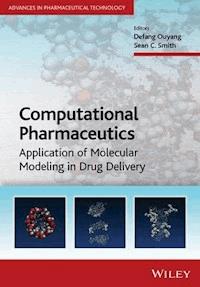
Computational Pharmaceutics E-Book
114,99 €
Mehr erfahren.
- Herausgeber: John Wiley & Sons
- Kategorie: Wissenschaft und neue Technologien
- Serie: Advances in Pharmaceutical Technology
- Sprache: Englisch
Molecular modeling techniques have been widely used in drug discovery fields for rational drug design and compound screening. Now these techniques are used to model or mimic the behavior of molecules, and help us study formulation at the molecular level. Computational pharmaceutics enables us to understand the mechanism of drug delivery, and to develop new drug delivery systems.
The book discusses the modeling of different drug delivery systems, including cyclodextrins, solid dispersions, polymorphism prediction, dendrimer-based delivery systems, surfactant-based micelle, polymeric drug delivery systems, liposome, protein/peptide formulations, non-viral gene delivery systems, drug-protein binding, silica nanoparticles, carbon nanotube-based drug delivery systems, diamond nanoparticles and layered double hydroxides (LDHs) drug delivery systems.
Although there are a number of existing books about rational drug design with molecular modeling techniques, these techniques still look mysterious and daunting for pharmaceutical scientists. This book fills the gap between pharmaceutics and molecular modeling, and presents a systematic and overall introduction to computational pharmaceutics. It covers all introductory, advanced and specialist levels. It provides a totally different perspective to pharmaceutical scientists, and will greatly facilitate the development of pharmaceutics. It also helps computational chemists to look for the important questions in the drug delivery field.
This book is included in the Advances in Pharmaceutical Technology book series.
Sie lesen das E-Book in den Legimi-Apps auf:
Seitenzahl: 703
Veröffentlichungsjahr: 2015
Ähnliche




















Advances in Pharmaceutical TechnologyA Wiley Book Series
Series Editors:
Dennis Douroumis, University of Greenwich, UKAlfred Fahr, Friedrich–Schiller University of Jena, GermanyJűrgen Siepmann, University of Lille, FranceMartin Snowden, University of Greenwich, UKVladimir Torchilin, Northeastern University, USA
Titles in the Series:
Hot-Melt Extrusion: Pharmaceutical ApplicationsEdited by Dionysios Douroumis
Drug Delivery Strategies for Poorly Water-Soluble DrugsEdited by Dionysios Douroumis and Alfred Fahr
Forthcoming titles:
Novel Delivery Systems for Transdermal and Intradermal Drug DeliveryEdited by Ryan F. Donnelly and Thakur Raghu Raj Singh
Pulmonary Drug Delivery: Advances and Challenges by Ali Nokhodhi and Gary P. Martin
Computational Pharmaceutics
Application of Molecular Modeling in Drug Delivery
Edited by
DEFANG OUYANG AND SEAN C. SMITH
This edition first published 2015© 2015 John Wiley & Sons, Ltd.
Registered OfficeJohn Wiley & Sons, Ltd, The Atrium, Southern Gate, Chichester, West Sussex, PO19 8SQ, United Kingdom
For details of our global editorial offices, for customer services and for information about how to apply for permission to reuse the copyright material in this book please see our website at www.wiley.com.
The right of the author to be identified as the author of this work has been asserted in accordance with the Copyright, Designs and Patents Act 1988.
All rights reserved. No part of this publication may be reproduced, stored in a retrieval system, or transmitted, in any form or by any means, electronic, mechanical, photocopying, recording or otherwise, except as permitted by the UK Copyright, Designs and Patents Act 1988, without the prior permission of the publisher.
Wiley also publishes its books in a variety of electronic formats. Some content that appears in print may not be available in electronic books.
Designations used by companies to distinguish their products are often claimed as trademarks. All brand names and product names used in this book are trade names, service marks, trademarks or registered trademarks of their respective owners. The publisher is not associated with any product or vendor mentioned in this book.
Limit of Liability/Disclaimer of Warranty: While the publisher and author have used their best efforts in preparing this book, they make no representations or warranties with respect to the accuracy or completeness of the contents of this book and specifically disclaim any implied warranties of merchantability or fitness for a particular purpose. It is sold on the understanding that the publisher is not engaged in rendering professional services and neither the publisher nor the author shall be liable for damages arising herefrom. If professional advice or other expert assistance is required, the services of a competent professional should be sought
The advice and strategies contained herein may not be suitable for every situation. In view of ongoing research, equipment modifications, changes in governmental regulations, and the constant flow of information relating to the use of experimental reagents, equipment, and devices, the reader is urged to review and evaluate the information provided in the package insert or instructions for each chemical, piece of equipment, reagent, or device for, among other things, any changes in the instructions or indication of usage and for added warnings and precautions. The fact that an organization or Website is referred to in this work as a citation and/or a potential source of further information does not mean that the author or the publisher endorses the information the organization or Website may provide or recommendations it may make. Further, readers should be aware that Internet Websites listed in this work may have changed or disappeared between when this work was written and when it is read. No warranty may be created or extended by any promotional statements for this work. Neither the publisher nor the author shall be liable for any damages arising herefrom.
Library of Congress Cataloging-in-Publication Data
Computational pharmaceutics : application of molecular modeling in drug delivery / edited by Defang Ouyang and Sean C. Smith. p. ; cm. – (Advances in pharmaceutical technology) Includes bibliographical references and index.
ISBN 978-1-118-57399-0 (cloth)I. Ouyang, Defang, editor. II. Smith, Sean C., editor. III. Series: Advances in pharmaceutical technology.[DNLM: 1. Drug Delivery Systems–methods. 2. Computational Biology–methods. 3. Drug Design. 4. Models, Molecular. QV 785] RM301.25 615.1′9–dc23
2014050194
A catalogue record for this book is available from the British Library.
List of Contributors
Amanda S. Barnard,CSIRO Virtual Nanoscience Laboratory, Australia
Alex Bunker,Centre for Drug Research, Faculty of Pharmacy, University of Helsinki, Finland
Robin Curtis,School of Chemical Engineering and Analytical Sciences, Manchester Institute of Biotechnology, University of Manchester, UK
Dennis E. Discher,Department of Chemical and Biomolecular Engineering, University of Pennsylvania, USA
Zhiwei Feng,Institute of Functional Nano and Soft Materials (FUNSOM), Soochow University, China
Yong Gan,Shanghai Institute of Materia Medica, Chinese Academy of Sciences, China
Jingkai Gu,Research Center for Drug Metabolism, Jilin University, China
Zhen Guo,Shanghai Institute of Materia Medica, Chinese Academy of Sciences, China; and Institute of Pharmaceutical Innovation, University of Bradford, UK
You He,Shanghai Synchrotron Radiation Facility, Shanghai Institute of Applied Physics, Chinese Academy of Sciences, China
Tingjun Hou,Institute of Functional Nano and Soft Materials (FUNSOM), Soochow University, China
Myungshim Kang,Department of Chemistry, College of Staten Island, City University of New York, USA
Peng Ke,Merck & Co, Inc., UK
Lin Lai,CSIRO Virtual Nanoscience Laboratory, Australia
Dennis Lam,Department of Chemistry, College of Staten Island, City University of New York, USA
Youyong Li,Institute of Functional Nano and Soft Materials (FUNSOM), Soochow University, China
Sharon M. Loverde,Department of Chemistry, College of Staten Island, City University of New York, USA
Vinuthaa Murthy,School of Psychological and Clinical Sciences, Charles Darwin University, Australia
Sang Young Noh,Department of Chemistry and Centre for Scientific Computing, University of Warwick, UK; and Molecular Organization and Assembly in Cells Doctoral Training Centre, University of Warwick, UK
Rebecca Notman,Department of Chemistry and Centre for Scientific Computing, University of Warwick, UK
David William O’Neill,Department of Chemistry and Centre for Scientific Computing, University of Warwick, UK
Defang Ouyang,Institute of Chinese Medical Sciences, University of Macau, Macau
Harendra S. Parekh,School of Pharmacy, The University of Queensland, Australia
Sarah L. Price,Department of Chemistry, University College London, UK
Sheng Qi,School of Pharmacy, University of East Anglia, UK
Xiaohong Ren,Shanghai Institute of Materia Medica, Chinese Academy of Sciences, China; and Research Center for Drug Metabolism, Jilin University, China
Dorota Roberts,School of Chemical Engineering and Analytical Sciences, Manchester Institute of Biotechnology, University of Manchester, UK
Gabriele Sadowski,Department of Biochemical and Chemical Engineering, TU Dortmund University, Germany
Carl H. Schwable,School of Life and Health Sciences, Aston University, UK
Qun Shao,Institute of Pharmaceutical Innovation, University of Bradford, UK
Raj K. Singh Badhan,Medicines Research Unit, School of Life and Health Sciences, Aston University, UK
Sean C. Smith,School of Chemical Engineering, University of New South Wales, Australia
Xiaotian Sun,Institute of Functional Nano and Soft Materials (FUNSOM), Soochow University, China
Sachin S. Thakur,School of Pharmacy, The University of Queensland, Australia
Jim Warwicker,Faculty of Life Sciences, Manchester Institute of Biotechnology, University of Manchester, UK
Li Wu,Shanghai Institute of Materia Medica, Chinese Academy of Sciences, China; and Research Center for Drug Metabolism, Jilin University, China
Tiqiao Xiao,Shanghai Synchrotron Radiation Facility, Shanghai Institute of Applied Physics, Chinese Academy of Sciences, China
Zhi Ping Xu,Australian Institute for Bioengineering and Nanotechnology, University of Queensland, Australia
Xianzhen Yin,Shanghai Institute of Materia Medica, Chinese Academy of Sciences, China; and Institute of Pharmaceutical Innovation, University of Bradford, UK
Peter York,Institute of Pharmaceutical Innovation, University of Bradford, UK
Jiwen Zhang,Shanghai Institute of Materia Medica, Chinese Academy of Sciences, China; and Research Center for Drug Metabolism, Jilin University, China
Series Preface
The series Advances in Pharmaceutical Technology covers the principles, methods, and technologies that the pharmaceutical industry use to turn a candidate molecule or new chemical entity into a final drug form and hence a new medicine. The series will explore means of optimizing the therapeutic performance of a drug molecule by designing and manufacturing the best and most innovative of new formulations. The processes associated with the testing of new drugs, the key steps involved in the clinical trials process, and the most recent approaches utilized in the manufacture of new medicinal products will all be reported. The focus of the series will very much be on new and emerging technologies and the latest methods used in the drug development process.
Lesen Sie weiter in der vollständigen Ausgabe!
Lesen Sie weiter in der vollständigen Ausgabe!
Lesen Sie weiter in der vollständigen Ausgabe!
Lesen Sie weiter in der vollständigen Ausgabe!
Lesen Sie weiter in der vollständigen Ausgabe!
Lesen Sie weiter in der vollständigen Ausgabe!
Lesen Sie weiter in der vollständigen Ausgabe!
Lesen Sie weiter in der vollständigen Ausgabe!
Lesen Sie weiter in der vollständigen Ausgabe!
Lesen Sie weiter in der vollständigen Ausgabe!
Lesen Sie weiter in der vollständigen Ausgabe!
Lesen Sie weiter in der vollständigen Ausgabe!
Lesen Sie weiter in der vollständigen Ausgabe!
Lesen Sie weiter in der vollständigen Ausgabe!
Lesen Sie weiter in der vollständigen Ausgabe!
Lesen Sie weiter in der vollständigen Ausgabe!
Lesen Sie weiter in der vollständigen Ausgabe!




