


79,99 €
Mehr erfahren.
- Herausgeber: John Wiley & Sons
- Kategorie: Wissenschaft und neue Technologien
- Sprache: Englisch
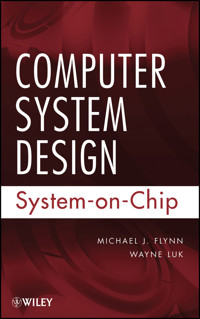
The next generation of computer system designers will be less concerned about details of processors and memories, and more concerned about the elements of a system tailored to particular applications. These designers will have a fundamental knowledge of processors and other elements in the system, but the success of their design will depend on the skills in making system-level tradeoffs that optimize the cost, performance and other attributes to meet application requirements. This book provides a new treatment of computer system design, particularly for System-on-Chip (SOC), which addresses the issues mentioned above. It begins with a global introduction, from the high-level view to the lowest common denominator (the chip itself), then moves on to the three main building blocks of an SOC (processor, memory, and interconnect). Next is an overview of what makes SOC unique (its customization ability and the applications that drive it). The final chapter presents future challenges for system design and SOC possibilities.
Sie lesen das E-Book in den Legimi-Apps auf:
Seitenzahl: 484
Veröffentlichungsjahr: 2011
Ähnliche



















Table of Contents
Cover
Title page
Copyright page
PREFACE
LIST OF ABBREVIATIONS AND ACRONYMS
1 Introduction to the Systems Approach
1.1 SYSTEM ARCHITECTURE: AN OVERVIEW
1.2 COMPONENTS OF THE SYSTEM: PROCESSORS, MEMORIES, AND INTERCONNECTS
1.3 HARDWARE AND SOFTWARE: PROGRAMMABILITY VERSUS PERFORMANCE
1.4 PROCESSOR ARCHITECTURES
1.5 MEMORY AND ADDRESSING
1.6 SYSTEM-LEVEL INTERCONNECTION
1.7 AN APPROACH FOR SOC DESIGN
1.8 SYSTEM ARCHITECTURE AND COMPLEXITY
1.9 PRODUCT ECONOMICS AND IMPLICATIONS FOR SOC
1.10 DEALING WITH DESIGN COMPLEXITY
1.11 CONCLUSIONS
2 Chip Basics: Time, Area, Power, Reliability, and Configurability
2.1 INTRODUCTION
2.2 CYCLE TIME
2.3 DIE AREA AND COST
2.4 IDEAL AND PRACTICAL SCALING
2.5 POWER
2.6 AREA–TIME–POWER TRADE-OFFS IN PROCESSOR DESIGN
2.7 RELIABILITY
2.8 CONFIGURABILITY
2.9 CONCLUSION
3 Processors
3.1 INTRODUCTION
3.2 PROCESSOR SELECTION FOR SOC
3.3 BASIC CONCEPTS IN PROCESSOR ARCHITECTURE
3.4 BASIC CONCEPTS IN PROCESSOR MICROARCHITECTURE
3.5 BASIC ELEMENTS IN INSTRUCTION HANDLING
3.6 BUFFERS: MINIMIZING PIPELINE DELAYS
3.7 BRANCHES: REDUCING THE COST OF BRANCHES
3.8 MORE ROBUST PROCESSORS: VECTOR, VERY LONG INSTRUCTION WORD (VLIW), AND SUPERSCALAR
3.9 VECTOR PROCESSORS AND VECTOR INSTRUCTION EXTENSIONS
3.10 VLIW PROCESSORS
3.11 SUPERSCALAR PROCESSORS
3.12 PROCESSOR EVOLUTION AND TWO EXAMPLES
3.13 CONCLUSIONS
4 Memory Design: System-on-Chip and Board-Based Systems
4.1 INTRODUCTION
4.2 OVERVIEW
4.3 SCRATCHPADS AND CACHE MEMORY
4.4 BASIC NOTIONS
4.5 CACHE ORGANIZATION
4.6 CACHE DATA
4.7 WRITE POLICIES
4.8 STRATEGIES FOR LINE REPLACEMENT AT MISS TIME
4.9 OTHER TYPES OF CACHE
4.10 SPLIT I- AND D-CACHES AND THE EFFECT OF CODE DENSITY
4.11 MULTILEVEL CACHES
4.12 VIRTUAL-TO-REAL TRANSLATION
4.13 SOC (ON-DIE) MEMORY SYSTEMS
4.14 BOARD-BASED (OFF-DIE) MEMORY SYSTEMS
4.15 SIMPLE DRAM AND THE MEMORY ARRAY
4.16 MODELS OF SIMPLE PROCESSOR–MEMORY INTERACTION
4.17 CONCLUSIONS
5 Interconnect
5.1 INTRODUCTION
5.2 OVERVIEW: INTERCONNECT ARCHITECTURES
5.3 BUS: BASIC ARCHITECTURE
5.4 SOC STANDARD BUSES
5.5 ANALYTIC BUS MODELS
5.6 BEYOND THE BUS: NOC WITH SWITCH INTERCONNECTS
5.7 SOME NOC SWITCH EXAMPLES
5.8 LAYERED ARCHITECTURE AND NETWORK INTERFACE UNIT
5.9 EVALUATING INTERCONNECT NETWORKS
5.10 CONCLUSIONS
6 Customization and Configurability
6.1 INTRODUCTION
6.2 ESTIMATING EFFECTIVENESS OF CUSTOMIZATION
6.3 SOC CUSTOMIZATION: AN OVERVIEW
6.4 CUSTOMIZING INSTRUCTION PROCESSORS
6.5 RECONFIGURABLE TECHNOLOGIES
6.6 MAPPING DESIGNS ONTO RECONFIGURABLE DEVICES
6.7 INSTANCE-SPECIFIC DESIGN
6.8 CUSTOMIZABLE SOFT PROCESSOR: AN EXAMPLE
6.9 RECONFIGURATION
6.10 CONCLUSIONS
7 Application Studies
7.1 INTRODUCTION
7.2 SOC DESIGN APPROACH
7.3 APPLICATION STUDY: AES
7.4 APPLICATION STUDY: 3-D GRAPHICS PROCESSORS
7.5 APPLICATION STUDY: IMAGE COMPRESSION
7.6 APPLICATION STUDY: VIDEO COMPRESSION
7.7 FURTHER APPLICATION STUDIES
7.8 CONCLUSIONS
8 What’s Next: Challenges Ahead
8.1 INTRODUCTION
I. THE FUTURE SYSTEM: AUTONOMOUS SYSTEM-ON-CHIP
8.2 OVERVIEW
8.3 TECHNOLOGY
8.4 POWERING THE ASOC
8.5 THE SHAPE OF THE ASOC
8.6 COMPUTER MODULE AND MEMORY
8.7 RF OR LIGHT COMMUNICATIONS
8.8 SENSING
8.9 MOTION, FLIGHT, AND THE FRUIT FLY
II. THE FUTURE DESIGN PROCESS: SELF-OPTIMIZATION AND SELF-VERIFICATION
8.10 MOTIVATION
8.11 OVERVIEW
8.12 PRE-DEPLOYMENT
8.13 POST-DEPLOYMENT
8.14 ROADMAP AND CHALLENGES
8.15 SUMMARY
APPENDIX: Tools for Processor Evaluation
REFERENCES
Index
Copyright © 2011 by John Wiley & Sons, Inc. All rights reserved.
Published by John Wiley & Sons, Inc., Hoboken, New Jersey.
Published simultaneously in Canada.
No part of this publication may be reproduced, stored in a retrieval system, or transmitted in any form or by any means, electronic, mechanical, photocopying, recording, scanning, or otherwise, except as permitted under Section 107 or 108 of the 1976 United States Copyright Act, without either the prior written permission of the Publisher, or authorization through payment of the appropriate per-copy fee to the Copyright Clearance Center, Inc., 222 Rosewood Drive, Danvers, MA 01923, (978) 750-8400, fax (978) 750-4470, or on the web at www.copyright.com. Requests to the Publisher for permission should he addressed to the Permissions Department, John Wiley & Sons, Inc., II 1 River Street, Hoboken, NJ 07030, (201) 748-601 1, fax (201) 748-6008, or online at http://www.wiley.com/go/permissions.
Limit of Liability/Disclaimer of Warranty: While the publisher and author have used their best efforts in preparing this book, they make no representations or warranties with respect to the accuracy or completeness of the contents of this book and specifically disclaim any implied warranties of merchantability or fitness for a particular purpose. No warranty may be created or extended by sales representatives or written sales materials. The advice and strategies contained herein may not be suitable for your situation. You should consult with a professional where appropriate. Neither the publisher nor author shall be liable for any loss of profit or any other commercial damages, including but not limited to special, incidental, consequential, or other damages.
For general infor-nation on our other products and services or for technical support, please contact our Customer Care Department within the United States at (800) 762-2974, outside the United States at (317) 572-3993 or fax (317) 572-4002.
Wiley also publishes its books in a variety of electronic formats. Some content that appears in print may not be available in electronic formats. For more information about Wiley products, visit our web site at www.wiley.com.
Library of Congress Cataloging-in-Publication Data:
Flynn, M. J. (Michael J.), 1934–
Computer system design : system-on-chip / Michael J. Flynn, Wayne Luk.
p. cm.
Includes bibliographical references and index.
ISBN 978-0-470-64336-5 (hardback)
1. Systems on a chip. I. Luk, Wayne. II. Title.
TK7895.E42F65 2011
004.1–dc22
2010040981
oBook ISBN: 9781118009925
ePDF ISBN: 9781118009901
ePub ISBN: 9781118009918
PREFACE
The next generation of computer system designers will be concerned more about the elements of a system tailored to particular applications than with the details of processors and memories.
Such designers would have rudimentary knowledge of processors and other elements in the system, but the success of their design would depend on their skills in making system-level trade-offs that optimize the cost, performance, and other attributes to meet application requirements.
This text is organized to introduce issues in computer system design, particularly for system-on-chip (SOC). Managing such design requires knowledge of a number of issues, as shown in Figure 1.
Figure 1 An approach to SOC system design described in this book.
After Chapter 1, the introduction chapter, Chapter 2 looks at issues that define the design space: area, speed, power consumption, and configurability. Chapters 3–5 provide background knowledge of the basic elements in a system: processor, memory, and interconnect.
The succeeding chapters focus on computer systems tailored to specific applications and technologies. Chapter 6 covers issues in customizing and configuring designs. Chapter 7 addresses system-level trade-offs for various applications, bringing together earlier material in this study. Finally, Chapter 8 presents future challenges for system design and SOC possibilities.
The tools that illustrate the material in the text are still being developed. The Appendix provides an overview of one such tool. Since our tools are evolving, please check from time to time to see what is available at the companion web site: www.soctextbook.com.
Moreover, material useful for teaching, such as slides and answers to exercises, is also being prepared.
This book covers a particular approach to computer system design, with emphasis on fundamental ideas and analytical techniques that are applicable to a range of applications and architectures, rather than on specific applications, architectures, languages, and tools. We are aware of complementary treatments on these and also on other topics, such as electronic system-level design, embedded software development, and system-level integration and test. We have included brief descriptions and references to these topics where appropriate; a more detailed treatment can be covered in future editions or in different volumes.
SOC is a quickly developing field. Although we focused on fundamental material, we were forced to draw a line on the inclusion of the latest technological advances for the sake of completing the book. Such advances, instead, are captured as links to relevant sources of information at the companion web site described above.
Many colleagues and students, primarily at Imperial College London and Stanford University, have contributed to this book. We are sorry that we are not able to mention them all by name here. However, a number of individuals deserve special acknowledgment. Peter Cheung worked closely with us from the beginning; his contributions shaped the treatment of many topics, particularly those in Chapter 5. Tobias Becker, Ray Cheung, Rob Dimond, Scott Guo, Shay Ping Seng, David Thomas, Steve Wilton, Alice Yu, and Chi Wai Yu contributed significant material to various chapters. Philip Leong and Roger Woods read the manuscript many times carefully and provided many excellent suggestions for improvement. We also greatly benefited from comments by Jeffrey Arnold, Peter Boehm, Don Bouldin, Geoffrey Brown, Patrick Hung, Sebastian Lopez, Oskar Mencer, Kevin Rudd, and several anonymous reviewers. We thank Kubilay Atasu, Peter Collingbourne, James Huggett, Qiwei Jin, Adrien Le Masle, Pete Sedcole, and Tim Todman, as well as those who prefer to remain anonymous, for their invaluable assistance.
Last, but not least, we thank Cassie Strickland, of Wiley, and Janet Hronek, of Toppan Best-set, for their help in the timely completion of this text.
LIST OF ABBREVIATIONS AND ACRONYMS
AC
Autonomous chip
A/D
Analog to digital
AES
Advanced Encryption Standard
AG
Address generation
ALU
Arithmetic and logic unit
AMBA
Advanced Microcontroller Bus Architecture
ASIC
Application-specific integrated circuit
ASIP
Application-specific instruction processor
ASOC
Autonomous system-on-chip
AXI
Advanced eXtensible Interface
BC
Branch conditional
BIST
Built-in-self-test
BRAM
Block random access memory
BTB
Branch target buffer
CAD
Computer aided design
CBWA
Copy-back write allocate cache
CC
Condition codes
CFA
Color filter array
CGRA
Coarse-grained reconfigurable architecture
CIF
Common Intermediate Format
CISC
Complex instruction set computer
CLB
Configurable Logic Block
CMOS
Complementary metal oxide semiconductor
CORDIC
COordinate Rotation Digital Computer
CPI
Cycles per instruction
CPU
Central processing unit
DCT
Discrete Cosine Transform
DDR
Double data rate
DES
Data Encryption Standard
3DES
Triple Data Encryption Standard
DF
Data fetch
DMA
Direct memory access
DRAM
Dynamic random access memory
DSP
Digital signal processing (or processor)
DTMR
Design Target Miss Rates
ECC
Error correcting code
eDRAM
Embedded dynamic random access memory
EX
Execute
FIFO
First in first out
FIR
Finite impulse response
FO4
Fan-out of four
FP
Floating-point
FPGA
Field programmable gate array
FPR
Floating-point register
FPU
Floating-point unit
GB
Giga bytes, a billion (109) bytes
GIF
Graphics interface
GPP
General-purpose processor
GPR
General-purpose register
GPS
Global Positioning System
GSM
Global System for Mobile Communications
HDTV
High definition television
HPC
High performance computing
IC
Integrated circuit
ICU
Interconnect interface unit
ID
Instruction decode
IF
Instruction fetch
ILP
Instruction-level parallelism
I/O
Input/output
IP
Intellectual property
IR
Instruction register
ISA
Instruction set architecture
JPEG
Joint Photographic Experts Group (image compression standard)
Kb
Kilo bits, one thousand (103) bits
KB
Kilo bytes, one thousand bytes
L1
Level 1 (for cache)
L2
Level 2 (for cache)
LE
Logic Element
LRU
Least recently used
L/S
Load-store
LSI
Large scale integration
LUT
Lookup table
Mb
Mega bits, one million (106) bits
MB
Mega bytes, one million bytes
MEMS
Micro electro mechanical systems
MIMD
Multiple instruction streams, multiple data streams
MIPS
Million instructions per second
MOPS
Million operations per second
MOS
Metal oxide semiconductor
MPEG
Motion Picture Experts Group (video compression standard)
MTBF
Mean time between faults
MUX
Multiplexor
NOC
Network on chip
OCP
Open Core Protocol
OFDM
Orthogonal Frequency-Division Multiplexing
PAN
Personal area network
PCB
Printed circuit board
PLCC
Plastic leaded chip carrier
PROM
Programmable read only memory
QCIF
Quarter Common Intermediate Format
RAM
Random access memory
RAND
Random
RAW
Read-after-write
rbe
Register bit equivalent
RF
Radio frequency
RFID
Radio frequency identification
RISC
Reduced instruction set computer
R/M
Register-memory
ROM
Read only memory
RTL
Register transfer language
SAD
Sum of the absolute differences
SDRAM
Synchronous dynamic random access memory
SECDED
Single error correction, double error detection
SER
Soft error rate
SIA
Semiconductor Industry Association
SIMD
Single instruction stream, multiple data streams
SMT
Simultaneous multithreading
SOC
System on chip
SRAM
Static random access memory
TLB
Translation look-aside buffer
TMR
Triple modular redundancy
UART
Universal asynchronous receiver/transmitter
UMTS
Universal mobile telecommunications system
UV
Ultraviolet
VCI
Virtual Component Interface
VLIW
Very long instruction word
VLSI
Very large scale integration
VPU
Vector processing unit
VR
Vector register
VSIA
Virtual Socket Interface Alliance
WAR
Write after read
WAW
Write after write
WB
Write back
WTNWA
Write-through cache, no write allocate
1
Introduction to the Systems Approach
1.1 SYSTEM ARCHITECTURE: AN OVERVIEW
The past 40 years have seen amazing advances in silicon technology and resulting increases in transistor density and performance. In 1966, Fairchild Semiconductor [84] introduced a quad two input NAND gate with about 10 transistors on a die. In 2008, the Intel quad-core Itanium processor has 2 billion transistors [226]. Figures 1.1 and 1.2 show the unrelenting advance in improving transistor density and the corresponding decrease in device cost.
Figure 1.1 The increasing transistor density on a silicon die.
Figure 1.2 The decrease of transistor cost over the years.
The aim of this book is to present an approach for computer system design that exploits this enormous transistor density. In part, this is a direct extension of studies in computer architecture and design. However, it is also a study of system architecture and design.
About 50 years ago, a seminal text, Systems Engineering—An Introduction to the Design of Large-Scale Systems [111], appeared. As the authors, H.H. Goode and R.E. Machol, pointed out, the system’s view of engineering was created by a need to deal with complexity. As then, our ability to deal with complex design problems is greatly enhanced by computer-based tools.
A system-on-chip (SOC) architecture is an ensemble of processors, memories, and interconnects tailored to an application domain. A simple example of such an architecture is the Emotion Engine [147, 187, 237] for the Sony PlayStation 2 (Figure 1.3), which has two main functions: behavior simulation and geometry translation. This system contains three essential components: a main processor of the reduced instruction set computer (RISC) style [118] and two vector processing units, VPU0 and VPU1, each of which contains four parallel processors of the single instruction, multiple data (SIMD) stream style [97]. We provide a brief overview of these components and our overall approach in the next few sections.
Figure 1.3 High-level functional view of a system-on-chip: the Emotion Engine of the Sony PlayStation 2 [147, 187].
While the focus of the book is on the system, in order to understand the system, one must first understand the components. So, before returning to the issue of system architecture later in this chapter, we review the components that make up the system.
1.2 COMPONENTS OF THE SYSTEM: PROCESSORS, MEMORIES, AND INTERCONNECTS
The term architecture denotes the operational structure and the user’s view of the system. Over time, it has evolved to include both the functional specification and the hardware implementation. The system architecture defines the system-level building blocks, such as processors and memories, and the interconnection between them. The processor architecture determines the processor’s instruction set, the associated programming model, its detailed implementation, which may include hidden registers, branch prediction circuits and specific details concerning the ALU (arithmetic logic unit). The implementation of a processor is also known as (Figure ).
Lesen Sie weiter in der vollständigen Ausgabe!
Lesen Sie weiter in der vollständigen Ausgabe!
Lesen Sie weiter in der vollständigen Ausgabe!
Lesen Sie weiter in der vollständigen Ausgabe!
Lesen Sie weiter in der vollständigen Ausgabe!
Lesen Sie weiter in der vollständigen Ausgabe!
Lesen Sie weiter in der vollständigen Ausgabe!
Lesen Sie weiter in der vollständigen Ausgabe!
Lesen Sie weiter in der vollständigen Ausgabe!
Lesen Sie weiter in der vollständigen Ausgabe!




