


Conservation Biology E-Book
66,99 €
Mehr erfahren.
- Herausgeber: John Wiley & Sons
- Kategorie: Wissenschaft und neue Technologien
- Sprache: Englisch
The late Navjot Sodhi conceived this book as a way of bringing to the forefront of our conservation planning for the tropics the views of people who were actually working and living there. In its 31 chapters, 55 authors present their views on the conservation problems they face and how they deal with them.
Effective long term conservation in the tropics requires the full participation of local people, organizations and governments. The human population of tropical countries is expected to grow by more than 2.5 billion people over the next several decades, with expectations of increased consumption levels growing even more rapidly than population levels; clearly there will be a need for more trained conservationists and biologists. Significant levels of local involvement are essential to conservation success, with the rights of local people fully recognized, protected and fostered by governmental and international assistance. Overarching conservation plans are necessary, but cannot in themselves lead to success.
The individual experiences presented in the pages of this book will provide useful models that may serve to build better and more sustainable lives for the people who live in the tropics and lead to the continued survival of as many species and functioning ecosystems as possible.
Sie lesen das E-Book in den Legimi-Apps auf:
Seitenzahl: 797
Veröffentlichungsjahr: 2013
Ähnliche




















Table of Contents
Title page
Copyright page
List of Contributors
Notes on Contributors
Acknowledgments
Remembering Navjot Sodhi: An Inspiring Mentor, Scholar, and Friend
The Émigré
The Big Ticket Science
The Fierce Competitor and Humanist
The Concern for Human Livelihoods
The Last Lunch
CHAPTER 1: Introduction: Giving a Voice to the Tropics
PART 1: From Within the Region
Section 1: Africa
CHAPTER 2: Conservation Paradigms Seen through the Eyes of Bonobos in the Democratic Republic of Congo
Summary
Conservation Paradigms
Paradigms in Wildlife Species Conservation
Great Apes and Conservation Paradigms
Conservation and Bonobos in DRC
Bonobos: Part of a Failing Conservation Paradigm?
Implications for Conservation of Bonobos
Bonobos and Parks as a Conservation Paradigm
Acknowledgments
CHAPTER 3: Governance for Effective and Efficient Conservation in Ethiopia
Summary
Introduction
Babile Elephant Sanctuary
Nech Sar National Park
Kafta Sheraro National Park
Agricultural Investment in Southern Ethiopia
Synthesis
The Way Forward
CHAPTER 4: Wildlife in Jeopardy Inside and Outside Protected Areas in Côte d'Ivoire: The Combined Effects of Disorganization, Lack of Awareness, and Institutional Weakness
Summary
Introduction
Disorganization of the Conservation Sector in Côte d'Ivoire
Lack of Awareness at Multiple Levels
Institutional Weakness in the Field of Conservation
Conclusion and Recommendations
CHAPTER 5: Conservation Challenges for Madagascar in the Next Decade
Summary
The State of Madagascar's Biodiversity
Conservation Progress
Threats to Madagascar's Biodiversity
Challenges
Sustaining the Expanded Protected Area Network
Improving Benefits Sharing and Equitable Use of Natural Resources
Ensuring that Science Is Better Used to Support Conservation
Conclusion
CHAPTER 6: Conservation in Mauritius and Rodrigues: Challenges and Achievements from Two Ecologically Devastated Oceanic Islands
Summary
Introduction
Daunting Conservation Challenges
Conservation and Successes
Remaining Challenges
Conclusion
Acknowledgments
CHAPTER 7: Design and Outcomes of Community Forest Conservation Initiatives in Cross River State of Nigeria: A Foundation for REDD+?
Summary
Introduction
Context and Drivers for Community Forestry in CRS, Nigeria
Donor Interventions and Accomplishments
Analysis and Discussion
A Case Study on a Local Systems Builder
Conclusion and Recommendations
CHAPTER 8: Shades of Green: Conservation in the Developing Environment of Tanzania
Summary
Introduction
The Lake Natron Soda Ash Project
The Kitulo National Park
Arguing for Sustainable Development and Conservation
CHAPTER 9: Sustainable Conservation: Time for Africa to Rethink the Foundation
Summary
Something Is Not Working
The Usual Suspects: Hedgehogs or Foxes
Sustainable Development
A Case for Sustainable Conservation
Conclusion: Which Way for Africa?
Section 2: Americas
CHAPTER 10: Challenges and Opportunities for Bridging the Research–Implementation Gap in Ecological Science and Management in Brazil
Summary
Introduction
Challenges and Opportunities
Recommendations
Conclusion
Acknowledgments
CHAPTER 11: Conserving Biodiversity in a Complex Biological and Social Setting: The Case of Colombia
Summary
Introduction
Current Conservation Context
Conservation and Management Challenges in the Territory
Territorial Issues and Socioeconomic Models
Ecosystem and Ecoregion-Specific Threats
Conservation Strategies
A Final Thought
Conclusions
CHAPTER 12: Indigenous Rights, Conservation, and Climate Change Strategies in Guyana
Summary
Introduction
Addressing Conservation of Natural Resources and Climate Change in Guyana
Role of Traditional Practices in Climate Change and Conservation in Guyana
Conclusion
CHAPTER 13: Challenges and Opportunities for Conservation of Mexican Biodiversity
Summary
Biodiversity in Mexico
Conservation Problems
Overview of Conservation Lines
Concluding Remarks
Acknowledgments
CHAPTER 14: Paraguay's Challenge of Conserving Natural Habitats and Biodiversity with Global Markets Demanding for Products
Summary
Introduction
Uniqueness of Paraguay
Deforestation and Protected Areas in Paraguay
Encouraging Signs Since 2004
The Predicament of the Chaco Region
Conservation Balances
Acknowledgments
Section 3: Asia
CHAPTER 15: Land-Use Change and Conservation Challenges in the Indian Himalaya: Past, Present, and Future
Summary
The Area
Formation of the Himalaya and the Build-up of Biodiversity
The First Axe
The Existing Scenario
Drivers of Biodiversity Loss
Meeting the Challenges Ahead
CHAPTER 16: Conservation Challenges in Indonesia
Summary
Introduction
Conservation Practices
Challenges
Acknowledgments
CHAPTER 17: Singapore: Half Full or Half Empty?
Summary
Introduction
Nineteenth Century: Exploitation and Deforestation
Twentieth Century: Extinctions, Invasions, and Conservation
Twenty-First Century Singapore: Half Full or Half Empty?
Acknowledgments
CHAPTER 18: Want to Avert Extinctions in Sri Lanka? Empower the Citizenry!
Summary
Introduction
Extinction and Endangerment
Where Must There be Change?
A Pathway to Reform
Conclusion
Acknowledgments
CHAPTER 19: Conservation of Hornbills in Thailand
Introduction
Conservation Issues in Thailand
Why Conserve Hornbills?
Threats to and the Conservation Status of Hornbills
Status of Hornbills in Thailand
Recommendations
Acknowledgments
Section 4: Oceania
CHAPTER 20: Tipping Points and the Vulnerability of Australia's Tropical Ecosystems
Summary
Introduction
Methods
Results: Vulnerable Ecosystems
Discussion
Acknowledgments
CHAPTER 21: Biodiversity and Conservation in the Pacific Islands: Why Are We Not Succeeding?
Summary
Introduction
Island Ecosystem Fragility
Loss of Traditional Knowledge and Practices
Shift in Resource Use Purpose and Land ownership
Sustainability and Climate Change
Values, Beliefs, and Religion
Income Generation
Leadership, Corruption, and Responsibility
Youth Education and Implementation Capacity
Conclusion
CHAPTER 22: When Worlds Collide: Challenges and Opportunities for Conservation of Biodiversity in the Hawaiian Islands
Introduction
Controlling the Impacts of Invasive Species
Implementing Conservation at an Effective Scale for Recovery
Social Factors
Climate Change
Final Thoughts
Acknowledgments
CHAPTER 23: The Chimera of Conservation in Papua New Guinea and the Challenge of Changing Trajectories
PART 2: Thoughts from Diaspora
CHAPTER 24: Complex Forces Affect China's Biodiversity
Summary
Introduction
Overall Status of China's Biodiversity
Complexity of Interacting Forces Affecting Biodiversity
Strategies and Actions for Biodiversity Conservation
The Future of China's Biodiversity
Acknowledgments
CHAPTER 25: Governance and Conservation in the Tropical Developing World
CHAPTER 26: Knowledge, Institutions, and Human Resources for Conservation of Biodiversity
Introduction
Usable Knowledge
Institutions
Human Resources
Epilogue
Acknowledgments
CHAPTER 27: People, Plants and Pollinators: Uniting Conservation, Food Security, and Sustainable Agriculture in East Africa
Summary
Introduction
Conservation Issues around Subsistence Agriculture
Tilling Common Ground: Pollinators as a Flagship for Mitigating Conservation Challenges
Conclusion
Acknowledgments
CHAPTER 28: Balancing Societies' Priorities: A Science-based Approach to Sustainable Development in the Tropics
Summary
Introduction
Food and Biofuel Demands
Forest Conservation and REDD+
Weathering the Storm
Outlook
CHAPTER 29: Biodiversity Conservation Performance of Sustainable-Use Tropical Forest Reserves
Summary
Introduction
SURs Worldwide and in Amazonia
Human Densities in Amazonian Reserves
Wildlife Conservation Performance of SURs
Discussion
Acknowledgments
CHAPTER 30: Concluding Remarks: Lessons from the Tropics
Index
This edition first published 2013 © 2013 by John Wiley & Sons, Ltd
Registered office: John Wiley & Sons, Ltd, The Atrium, Southern Gate, Chichester, West Sussex, PO19 8SQ, UK
Editorial offices: 9600 Garsington Road, Oxford, OX4 2DQ, UK
The Atrium, Southern Gate, Chichester, West Sussex, PO19 8SQ, UK
111 River Street, Hoboken, NJ 07030-5774, USA
For details of our global editorial offices, for customer services and for information about how to apply for permission to reuse the copyright material in this book please see our website at www.wiley.com/wiley-blackwell.
The right of the author to be identified as the author of this work has been asserted in accordance with the UK Copyright, Designs and Patents Act 1988.
All rights reserved. No part of this publication may be reproduced, stored in a retrieval system, or transmitted, in any form or by any means, electronic, mechanical, photocopying, recording or otherwise, except as permitted by the UK Copyright, Designs and Patents Act 1988, without the prior permission of the publisher.
Designations used by companies to distinguish their products are often claimed as trademarks. All brand names and product names used in this book are trade names, service marks, trademarks or registered trademarks of their respective owners. The publisher is not associated with any product or vendor mentioned in this book.
Limit of Liability/Disclaimer of Warranty: While the publisher and author(s) have used their best efforts in preparing this book, they make no representations or warranties with respect to the accuracy or completeness of the contents of this book and specifically disclaim any implied warranties of merchantability or fitness for a particular purpose. It is sold on the understanding that the publisher is not engaged in rendering professional services and neither the publisher nor the author shall be liable for damages arising herefrom. If professional advice or other expert assistance is required, the services of a competent professional should be sought.
Library of Congress Cataloging-in-Publication Data
Conservation biology : voices from the tropics / [edited by] Navjot S. Sodhi, Luke Gibson, Peter H. Raven.
pages cm
Includes bibliographical references and index.
ISBN 978-0-470-65863-5 (cloth)
1. Nature conservation–Tropics. 2. Conservation biology–Tropics. I. Sodhi, Navjot S.
QH77.T78C655 2014
333.720913–dc23
2013009680
A catalogue record for this book is available from the British Library.
Wiley also publishes its books in a variety of electronic formats. Some content that appears in print may not be available in electronic books.
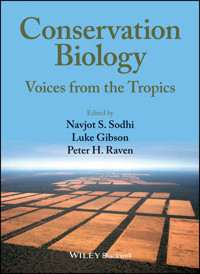
Cover image: Paraguay’s Chaco forest, one of the last wilderness frontiers in South America, is home to jaguars, giant anteaters, and several groups of indigenous people. But this remote habitat is now being plundered by rapid agricultural development, and much of the forest already has fallen to make way for widespread cattle pastures. Feeding the world’s growing population will present challenging problems for conservationists, as highlighted in the essay by Alberto Yanosky and other voices from the tropics. Photo by Alberto Yanosky.
Cover design by Design Deluxe
List of Contributors
Germán Ignacio Andrade-Pérez
School of Management, Universidad de Los Andes, Bogotá, Colombia
Email: [email protected]
Carter T. Atkinson
US Geological Survey, Pacific Island Ecosystems Research Center, P.O. Box 44, Hawaii National Park, Hawaii 96718
Email: [email protected]
Paul C. Banko
US Geological Survey, Pacific Island Ecosystems Research Center, P.O. Box 44, Hawaii National Park, Hawaii 96718
Email: [email protected]
Kamaljit S. Bawa
Department of Biology, University of Massachusetts, Boston, MA 02478, USA;
Sustainability Science Program, Harvard University, Cambridge, MA 02138, USA;
Ashoka Trust for Research in Ecology and the Environment, Bangalore 560 024, India
Email: [email protected]
Gilianne Brodie
School of Biological and Chemical Sciences, University of the South Pacific, Private Bag, Suva, Fiji Islands
Email: [email protected]
Gerardo Ceballos
Instituto de Ecología, Universidad Nacional Autónoma de México, 3er Circuito Exterior S/N Ciudad Universitaria, 04510 México, D.F. México
Email: [email protected]
Vijak Chimchome
Department of Forest Biology, Faculty of Forestry, Kasetsart University, Ngamwongwan Road, Bangkok 10900, Thailand
Email: [email protected]
Richard T. Corlett
Xishuangbanna Tropical Botanical Garden, Chinese Academy of Sciences, Menglun, Mengla, Yunnan 666303, China
Email: [email protected]
Wondmagegne Daniel
Texas Tech University, Department of Natural Resources Management, Goddard Building, Box 42125, Lubbock, TX 79409, USA
Email: [email protected] or [email protected]
Charbel El-Hani
Programa de Pós-Graduação em Ecologia e Biomonitoramento, Instituto de Biologia, Universidade Federal da Bahia, R. Barão de Jeremoabo S/N, CEP 40170-290, Salvador, BA, Brazil
Email: [email protected]
F.B. Vincent Florens
Department of Biosciences, University of Mauritius, Réduit, Mauritius;
UMR 53 PVBMT, Université de la Réunion, St Denis, La Réunion, France
Email: [email protected]
Andrés García
Estación de Biología Chamela, Instituto de Biología, Universidad Nacional Autónoma de México, Apdo. Postal 21. San Patricio, Melaque, Jalisco, México 48980
Email: [email protected]
Fikirte Gebresenbet
Oklahoma State University, Department of Zoology, 311 D Life Sciences West, Stillwater, OK 74078, USA
Email: [email protected] or [email protected]
Roy E. Gereau
Missouri Botanical Garden, P.O. Box 299, St. Louis, MO 63166-0299, USA
Email: [email protected]
Luke Gibson
Department of Biological Sciences, National University of Singapore, 14 Science Drive 4, Singapore 117543, Singapore
Email: [email protected]
Mwangi Githiru
Department of Zoology, National Museums of Kenya, P.O. Box 40658-00100, Nairobi, Kenya
Wildlife Works, P.O. Box 310-80300, Voi, Kenya
Email: [email protected]
Amleset Haile
Wageningen University and Research, The Netherlands; CASCAPE project, Addis Ababa, Ethiopia
Email: [email protected] or [email protected]
Bila-Isia Inogwabini
Durrell Institute of Conservation and Ecology (DICE), University of Kent at Canterbury, Canterbury, Kent CT2 7NR, UK
Email: [email protected]
James D. Jacobi
US Geological Survey, Pacific Island Ecosystems Research Center, P.O. Box 44, Hawaii National Park, Hawaii 96718
Email: [email protected]
Richard K.B. Jenkins
Durrell Institute of Conservation and Ecology, School of Anthropology, University of Kent, Canterbury, UK;
School of Environment, Natural Resources and Geography, Bangor University, Bangor, Gwynedd, UK;
Madagasikara Voakajy, B.P. 5181, Antananarivo 101, Madagascar
Email: [email protected]
Michelle Kalamandeen
Department of Biology, Faculty of Natural Sciences, University of Guyana, Turkeyen Campus, Georgetown, Guyana
Email: [email protected]
Gustavo H. Kattan
Departamento de Ciencias Naturales y Matemáticas, Pontificia Universidad Javeriana-Cali, Cali, Colombia
Email: [email protected]
Lian Pin Koh
Department of Environmental Sciences, ETH Zurich, CHN G 73.1, Universitatstrasse 16, 8092 Zurich, Switzerland
Email: [email protected]
Inza Koné
Centre Suisse de Recherches Scientifiques en Côte d'Ivoire, 01 BP 1303 Abidjan 01;
Laboratory of Zoology, Université Félix Houphouet-Boigny, Abidjan, Côte d'Ivoire, 22 BP 582 Abidjan 22
Email: [email protected]
Virendra Kumar
Centre for Interdisciplinary Studies of Mountain and Hill Environment, University of Delhi, Delhi – 110007, India
Email: [email protected]
William F. Laurance
Centre for Tropical Environmental and Sustainability Science (TESS) and School of Marine and Tropical Biology, James Cook University, Cairns, Queensland 4870, Australia
Email: [email protected]
Nigel Leader-Williams
Durrell Institute of Conservation and Ecology (DICE), University of Kent at Canterbury, Canterbury, Kent CT2 7NR, UK
Email: [email protected]
Jianguo Liu
Center for Systems Integration and Sustainability, Michigan State University, East Lansing, MI 48823-5243, USA
Email: [email protected]
Narong Mahannop
Director of Wildlife Conservation Office, Department of National Parks, Wildlife and Plant Conservation, Phahonyothin Road, Bangkhen, Bangkok 10900, Thailand
Email: [email protected]
Dino J. Martins
Insect Committee of Nature Kenya, The East Africa Natural History Society, P.O. Box 44486 GPO 00100, Museum Hill, Nairobi, Kenya;
Museum of Comparative Zoology, Harvard University Cambridge, MA, USA;
Turkana Basin Institute, Stony Brook University, Kenya
Email: [email protected]
Sittichai Mudsri
Director of Forest Fire Control Division, Department of National Parks, Wildlife and Plant Conservation, Thailand
Email: [email protected]
Carolina Murcia
Department of Biology, University of Florida, Gainesville, Florida, USA
Email: [email protected]
Maharaj K. Pandit
Department of Environmental Studies, University of Delhi, Delhi – 110007, India;
Centre for Interdisciplinary Studies of Mountain & Hill Environment, University of Delhi, Delhi – 110007, India
Email: [email protected]
Flavia Pardini
Página 22, Rua Itararé, 123, CEP 01308-030, São Paulo, SP, Brazil
Email: [email protected]
Renata Pardini
Departamento de Zoologia, Instituto de Biociências, Universidade de São Paulo, Rua do Matão – travessa 14, 101, CEP 05508-090, São Paulo, SP, Brazil
Email: [email protected]
Kelvin S.-H. Peh
Conservation Science Group, Department of Zoology, University of Cambridge, Downing Street, Cambridge CB2 3EJ, UK
Email: [email protected]
Carlos A. Peres
Centre for Biodiversity Research, School of Environmental Sciences, University of East Anglia, Norwich NR4 7TJ, UK
Email: [email protected]
Rohan Pethiyagoda
Ichthyology Section, Australian Museum, 6 College Street, Sydney, NSW 2010, Australia
Email: [email protected]
Patrick Pikacha
Solomon Islands Community Conservation Partnership, P.O. Box R82, Ranadi, Honiara, Solomon Islands
Email: [email protected]
Pilai Poonswad
Department of Microbiology, Faculty of Science, Mahidol University, Rama 6 Road, Bangkok 10400, Thailand
Email: [email protected]
Thane K. Pratt
US Geological Survey, Pacific Island Ecosystems Research Center, P.O. Box 44, Hawaii National Park, Hawaii 96718
Email: [email protected]
Dewi M. Prawiradilaga
Division of Zoology, Research Centre for Biology, Indonesian Institute of Sciences, Cibinong-Bogor, Indonesia
Email: [email protected] or [email protected]
Hajanirina Rakotomanana
Department of Animal Biology, Faculty of Science, University of Antananarivo, Antananarivo 101, Madagascar
Email: [email protected]
Jonah Ratsimbazafy
Groupe d'Etude et de Recherche sur les Primates de Madagascar 34, Cité des Professeurs, Fort Duschenne, Antananarivo 101, Madagascar;
Department of Paleontology and Biological Anthropology, Faculty of Science, University of Antananarivo, Antananarivo 101, Madagascar;
Durrell Wildlife Conservation Trust – Madagascar Programme, B.P. 8511, Antananarivo (101) Madagascar
Email: [email protected]
Peter H. Raven
President Emeritus
Missouri Botanical Garden
P.O. Box 299
St. Louis, MO 63166-0299, USA
Email: [email protected]
Pedro L.B. da Rocha
Programa de Pós-Graduação em Ecologia e Biomonitoramento, Instituto de Biologia, Universidade Federal da Bahia, R. Barão de Jeremoabo S/N, CEP 40170-290, Salvador, BA, Brazil
Email: [email protected]
Navjot S. Sodhi
Department of Biological Sciences, National University of Singapore, 14 Science Drive 4, Singapore 117543, Singapore
Herwasono Soedjito
Division of Botany, Research Centre for Biology, Indonesian Institute of Sciences (LIPI), Cibinong Science Centre, Jl. Raya Jakarta Bogor KM 46, Cibinong-Bogor 16911, Indonesia
Email: [email protected]
Flora I. Tibazarwa
Department of Botany, University of Dar es Salaam, P.O Box 35060, Dar es Salaam, Tanzania
Email: [email protected]
Marika Tuiwawa
South Pacific Regional Herbarium, University of the South Pacific, Private Bag, Suva, Fiji Islands
Email: [email protected]
Bethany L. Woodworth
Department of Environmental Studies,
University of New England,
11 Hills Beach Road, Biddeford, ME 04005, Maine, USA
Email: [email protected]
Notes on Contributors
Sylvanus Abua, with a background in geography, lives and works in Cross River State where he has observed first-hand the donor-supported conservation efforts presented as case studies in this paper. He has extensive social research experience with a focus on local communities' capacities for participatory forestry management. He holds a masters' degree in environment and development from the University of Reading, United Kingdom. His education also includes a masters' degree in geographical information systems from the University of Ibadan, Nigeria.
Germán Ignacio Andrade-Pérez is a Professor of Ecosystem Management and Global Environmental Change at the School of Management at Universidad de los Andes in Bogotá, Colombia. He is a biologist with a Master's in Environmental Studies from Yale University. He has been scientific director and executive director of the Colombian non-governmental organization (NGO) Fundación Natura, and coordinator of the Conservation Biology Program of the Colombian Alexander von Humboldt Institute. He has advised conservation programs for international organizations in Colombia, Ecuador, Peru, Bolivia, and Venezuela with the World Conservation Union, World Bank, International Development Bank, United Nations, and international NGOs.
Carter T. Atkinson is a Research Microbiologist with US Geological Survey, Pacific Island Ecosystems Research Center and has worked in Hawaii and the Pacific Basin for over 20 years on the ecology and impacts of introduced diseases and disease vectors on native and indigenous forest birds. He has either served on or advised on a number of US Fish and Wildlife Service Recovery Teams on disease issues that may affect recovery of threatened and endangered island birds.
Paul C. Banko is a Research Wildlife Biologist with US Geological Survey, Pacific Island Ecosystems Research Center, where his research is focused on the conservation biology of Hawaiian birds. Most of his research has focused on the ecology of endangered forest bird species, with special emphasis on historical population trends, feeding ecology and specialization, threats to food webs, and species restoration.
Hans Bauer has lived in Ethiopia since 2008, building research capacity at several universities. Previously he studied conservation of large carnivores, with a focus on West and Central Africa. Dr Hans Bauer specializes in biodiversity conservation and capacity building in Africa. With an interdisciplinary conservation science background, he has focused on higher education development, human–wildlife conflict, management of protected areas, sustainable development, and community-based management of natural resources. He has ample experience with sectoral support in conservation and in education, with knowledge management, and with international policy dialogue. He coordinates lion conservation and research in several African countries for WildCRU, University of Oxford.
Kamal S. Bawa is a Distinguished Professor of Biology at the University of Massachusetts Boston, and Founder-President of the Bangalore-based Ashoka Trust for Research in Ecology and the Environment (ATREE). He has published more than 190 scientific papers and 10 authored or edited books and monographs. Among the many awards he has received are: Giorgio Ruffolo Fellowship at Harvard University, Guggenheim Fellowship, Pew Scholar in Conservation and the Environment, the Distinguished Service Award from the Society for Conservation Biology, and the Gunnerus Award in Sustainability Science from the Royal Norwegian Society of Sciences and Letters. His latest book, Himalaya: Mountains of Life (www.Himalayabook.com), a sequel to Sahyadris: India's Western Ghats was published earlier this year. www.kbawa.com
Gilianne Brodie has lived and worked in the tropics and on islands for almost 30 years. She has predominantly studied invertebrate biodiversity in marine, freshwater, and terrestrial ecosystems. Gilianne is currently biodiversity and conservation research group leader for the Faculty of Science, Technology and Environment at the University of the South Pacific (USP) where since 2008 she has taught invertebrate biology and conservation biology. Gilianne received her PhD from James Cook University, Australia, where she also lectured for 16 years in the School of Marine Biology and Aquaculture. Gilianne has a long history with the Pacific Islands having also been a postgraduate student at USP in the late 1980s and more recently having worked with the Secretariat of Pacific Community Land Resources Division from 2005 to 2007.
Lesen Sie weiter in der vollständigen Ausgabe!
Lesen Sie weiter in der vollständigen Ausgabe!
Lesen Sie weiter in der vollständigen Ausgabe!
Lesen Sie weiter in der vollständigen Ausgabe!
Lesen Sie weiter in der vollständigen Ausgabe!
Lesen Sie weiter in der vollständigen Ausgabe!
Lesen Sie weiter in der vollständigen Ausgabe!
Lesen Sie weiter in der vollständigen Ausgabe!
Lesen Sie weiter in der vollständigen Ausgabe!
Lesen Sie weiter in der vollständigen Ausgabe!
Lesen Sie weiter in der vollständigen Ausgabe!
Lesen Sie weiter in der vollständigen Ausgabe!
Lesen Sie weiter in der vollständigen Ausgabe!
Lesen Sie weiter in der vollständigen Ausgabe!
Lesen Sie weiter in der vollständigen Ausgabe!
Lesen Sie weiter in der vollständigen Ausgabe!
Lesen Sie weiter in der vollständigen Ausgabe!
Lesen Sie weiter in der vollständigen Ausgabe!
Lesen Sie weiter in der vollständigen Ausgabe!
Lesen Sie weiter in der vollständigen Ausgabe!
Lesen Sie weiter in der vollständigen Ausgabe!
Lesen Sie weiter in der vollständigen Ausgabe!
Lesen Sie weiter in der vollständigen Ausgabe!
Lesen Sie weiter in der vollständigen Ausgabe!
Lesen Sie weiter in der vollständigen Ausgabe!
Lesen Sie weiter in der vollständigen Ausgabe!
Lesen Sie weiter in der vollständigen Ausgabe!
Lesen Sie weiter in der vollständigen Ausgabe!
Lesen Sie weiter in der vollständigen Ausgabe!
Lesen Sie weiter in der vollständigen Ausgabe!
Lesen Sie weiter in der vollständigen Ausgabe!
Lesen Sie weiter in der vollständigen Ausgabe!
Lesen Sie weiter in der vollständigen Ausgabe!
Lesen Sie weiter in der vollständigen Ausgabe!
Lesen Sie weiter in der vollständigen Ausgabe!




