


50,99 €
Mehr erfahren.
- Herausgeber: John Wiley & Sons
- Kategorie: Wissenschaft und neue Technologien
- Sprache: Englisch
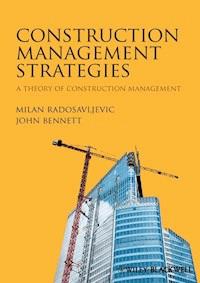
An authoritative textbook on construction management offering a clear model for understanding theoretical aspects.
The construction industry has become a truly global network of interconnected stakeholders making demands which require the involvement of skilled workforces from all over the world. Construction Management Strategies sets the foundations for understanding and managing construction’s inherent complexity and uniqueness. It establishes clear definitions of commonly accepted terms like built environment, construction, civil engineering, etc. which are often given confusing and conflicting interpretations. It cuts through the plethora of overlapping role titles currently used in the construction sector that make it difficult to establish how projects are actually managed.
Construction Management Strategies:
- Offers a robust and consistent theoretical basis to explain the performance of the main approaches to construction management.
- Describes corporate and project management in construction as an integrated whole.
- Provides the basic toolkit a student needs to think through the practical situations they will later face.
- Helps bring the theory of construction management to international students who struggle to find a solid grounding in this complex and fragmented subject.
- Includes a companion website featuring a wealth of directly transferable examples for students, as well as PPT slides and topic discussion ideas for lecturers.
Sie lesen das E-Book in den Legimi-Apps auf:
Seitenzahl: 571
Veröffentlichungsjahr: 2012
Ähnliche



















Contents
Cover
Title Page
Copyright
Acknowledgements
About the Authors
Preface
Tekla
Chapter 1: Introduction and Background
1.1 Construction Viewed from Space
1.2 What is Construction?
1.3 Why a Theory of Construction Management is Needed
1.4 Who can Manage Construction?
1.5 Construction Managed by Designers
1.6 Construction Managed by Customers
1.7 Construction Managed by Contractors
1.8 Construction Managed by Facilities Managers
1.9 Construction Managed by Independent Project Managers
1.10 Construction Managed by Independent Construction Managers
1.11 How the Construction Industry Works
1.12 Designer-Led Practice
1.13 Manager-Led Practice
1.14 Contractor-Led Practice
1.15 Conclusions
Chapter 2: The Built Environment
2.1 Introduction
2.2 Forces which Shape the Built Environment
2.3 Climate and Geology
2.4 Economy
2.5 Government
2.6 Culture and Fashion
2.7 Technology
2.8 Customers
2.9 Buildings and Infrastructure
2.10 Architecture
2.11 Civil Engineering
2.12 Thinking about the Forces which Shape the Built Environment
Chapter 3: Construction Concepts
3.1 Introduction
3.2 Construction Products
3.3 Customers
3.4 Construction Actions
3.5 Construction
3.6 Construction Organizations
3.7 Common Characteristics of Construction Organizations
3.8 Interactions and Relationships
3.9 Double-Loop Learning in Construction Networks
3.10 Categories of Relationship
3.11 Factors Influencing Construction Performance
3.12 Construction Management
3.13 Construction Efficiency
Chapter 4: Theory of Construction Management
4.1 Introduction
4.2 A Worst Case Construction Project
4.3 A Straightforward and Certain Construction Project
4.4 Barriers to Effective Relationships
4.5 Inherent Difficulty Caused by Design
4.6 Inherent Difficulty Caused by Construction Teams
4.7 Inherent Difficulty Caused by Construction Environments
4.8 Inherent Difficulty
4.9 Construction Management
4.10 Construction Management Strategies
4.11 Basic Theorems
4.12 Basic Propositions About Construction Management Decisions
4.13 Construction Teams Efficiency Conditions
4.14 Propositions About Construction Management Decisions Relating to Construction Teams
4.15 Construction Team Relationships Efficiency Conditions
4.16 Propositions About Construction Management Decisions Relating to Construction Team Relationships
4.17 Construction Companies' Efficiency Conditions
4.18 Propositions About Construction Management Decisions Relating to Construction Companies
4.19 Common Organizational Characteristics Efficiency Conditions
4.20 Propositions About Construction Management Decisions Relating to Common Characteristics of Construction Organizations
4.21 Double-Loop Learning Condition
4.22 Propositions About Construction Management Decisions Relating to Double-Loop Learning
4.23 Construction Efficiency
4.24 Inherent Difficulty Indicators
4.25 IDIs in Practice
4.26 Size of Construction Projects
4.27 Using the Theory of Construction Management
Chapter 5: Traditional Construction
5.1 Introduction
5.2 Fundamental Traditional Construction
5.3 Project Organization
5.4 Strengths and Weaknesses
5.5 Construction Management Propositions and Fundamental Traditional Construction
5.6 New Technologies
5.7 Demanding Customers
5.8 Developed Traditional Construction
5.9 Internal and Boundary Relationships
5.10 Strengths of Developed Traditional Construction
5.11 Weaknesses of Developed Traditional Construction
5.12 Construction Management Propositions and Developed Traditional Construction
5.13 Scenarios to Rescue Developed Traditional Construction
5.14 Projects Led by Design Consultants
5.15 Specialist Contractor Design
5.16 Architects and Engineers Design
5.17 Conclusions
Chapter 6: Design Build
6.1 Introduction
6.2 Design Build Customers
6.3 Design Build Companies
6.4 Design Build Process
6.5 Design Build Performance
6.6 Design Build Efficiency
6.7 Construction Management Propositions
6.8 The Theory of Construction Management
Chapter 7: Management Approaches
7.1 Introduction
7.2 Customers
7.3 Designers
7.4 Construction Managers
7.5 Works Contractors
7.6 Construction Management Process
7.7 Construction Management Propositions
7.8 Construction Management Performance
7.9 Other Management Approaches
7.10 The Theory of Construction Management
Chapter 8: Partnering
8.1 Introduction
8.2 Project Partnering
8.3 Strategic Partnering
8.4 Strategic Collaborative Working
8.5 Partnering Efficiency
8.6 Construction Management Propositions
8.7 Partnering Performance
8.8 The Theory of Construction Management
Chapter 9: Total Construction Service
9.1 Introduction
9.2 Total Construction Service Providers
9.3 Industrialised Housing
9.4 General Construction
9.5 Other Total Construction Service Companies
9.6 Total Construction Service Efficiency
9.7 Construction Management Propositions
9.8 Total Construction Service Performance
9.9 The Theory of Construction Management
Chapter 10: Implications for Industry
10.1 Introduction
10.2 Implications for Customers
10.3 Implications for Construction Companies
10.4 Construction Company Strategies
10.5 Implications for Construction Companies Providing a Total Construction Service
10.6 Implications for Project Management Companies
10.7 Implications for Construction Management Companies
10.8 Implications for Design Companies
10.9 Implications for Specialist Contractors
10.10 Implications for Other Construction Companies
Chapter 11: The Future for Construction Management
11.1 Introduction
11.2 The Theory of Construction Management and Practice
11.3 The Theory of Construction Management and Research
11.4 Testing the Theory of Construction Management
11.5 Research Data
11.6 Research Proposals
11.7 A Basis for Future Practice and Research
Appendix: Theory of Construction Management Propositions
Theory of Construction Management Propositions
Glossary
Index
This edition first published 2012
© 2012 John Wiley & Sons, Ltd
Blackwell Publishing was acquired by John Wiley & Sons in February 2007.
Blackwell's publishing program has been merged with Wiley's global Scientific, Technical and Medical business to form Wiley-Blackwell.
Registered office:
John Wiley & Sons, Ltd, The Atrium, Southern Gate, Chichester, West Sussex, PO19 8SQ, UK
Editorial offices:
9600 Garsington Road, Oxford, OX4 2DQ, UK
The Atrium, Southern Gate, Chichester, West Sussex, PO19 8SQ, UK
2121 State Avenue, Ames, Iowa 50014-8300, USA
For details of our global editorial offices, for customer services and for information about how to apply for permission to reuse the copyright material in this book please see our website at www.wiley.com/wiley-blackwell.
The right of the author to be identified as the author of this work has been asserted in accordance with the UK Copyright, Designs and Patents Act 1988.
All rights reserved. No part of this publication may be reproduced, stored in a retrieval system, or transmitted, in any form or by any means, electronic, mechanical, photocopying, recording or otherwise, except as permitted by the UK Copyright, Designs and Patents Act 1988, without the prior permission of the publisher.
Designations used by companies to distinguish their products are often claimed as trademarks. All brand names and product names used in this book are trade names, service marks, trademarks or registered trademarks of their respective owners. The publisher is not associated with any product or vendor mentioned in this book. This publication is designed to provide accurate and authoritative information in regard to the subject matter covered. It is sold on the understanding that the publisher is not engaged in rendering professional services. If professional advice or other expert assistance is required, the services of a competent professional should be sought.
Library of Congress Cataloging-in-Publication Data
Radosavljevic, Milan.
Construction management strategies : a theory of construction management /
Milan Radosavljevic, John Bennett.
p. cm.
Includes bibliographical references and index.
ISBN 978-0-470-65609-9 (pbk. : alk. paper)
1. Construction industry–Management–Study and teaching. I. Bennett, John, 1936- II. Title.
TH438.R324 2012
624.06804–dc23
2011035228
Acknowledgements
The authors would like to express sincere gratitude to people and organizations that helped in the creation of our book. In particular we wish to thank Andrew Bellerby Managing Director of Tekla UK, for providing a series of BIM images from past projects and their kind contribution towards the colour printing of the book, Afra Bindewald and Sascha Schneider for providing the information for the case study in Chapter 9, and Brian Moone, Mace Business School Director, for providing the information for the case study in Chapter 10.
About the Authors
Dr Milan Radosavljevic, u.d.i.g. PhD ICIOB
Dr Milan Radosavljevic is a lecturer in Construction Management, Director of Postgraduate Programmes and Director of the prestigious MSc Project Management in the School of Construction Management and Engineering of the University of Reading.
Dr Radosavljevic currently serves as a committee member of the Association of Researchers in Construction Management (ARCOM), he sits on the Board of the International Council for Research and Innovation in Building and Construction (CIB), and represents the University of Reading in the UK Construction Industry Research and Information Association (CIRIA) and Constructing Excellence in the Built Environment (CEBE). He is also a Visiting Professor at the University of Ljubljana in Slovenia.
Before joining the University of Reading Dr Radosavljevic worked as a Production Director in the medium size off-site construction company in Central Europe from 1997 to 2001, as a Research Assistant at the Construction Information Technology Centre (CITC) of the University of Maribor in Slovenia where he administered the EU funded ITC Euromaster programme between 2001 and 2002, and as a Demonstration Projects Coordinator for Scotland on behalf of the Communities Scotland and Constructing Excellence between 2003 and 2006.
He has made contributions on various courses at institutions around the world, including the Norwegian School of Management, Tallinn University of Technology in Estonia, University of Ljubljana in Slovenia, Shandong University in China, and has developed and run executive courses in Project Management in the United Kingdom and abroad.
He was a Principal Investigator in the KanBIM project. This was an international project involving researchers from the University of Reading and Technion in Israel aimed at developing a Building Information Modelling (BIM) based lean production management system for construction jointly funded by the Innovative Construction Research Centre (ICRC) of the University of Reading and Tekla Oy, a major BIM software vendor from Finland. The initial year-long project culminated in a paper published by Automation in Construction journal where it has soon become the second most popular and downloaded research paper.
Apart from BIM and digital technologies in their broadest sense, his current research interests include programme and project management, and computational simulation of construction organizations as heterogeneous and evolving networks.
Key Publications
Cus Babic, N., Rebolj, D., Magdic, A., and Radosavljevic, M (2003) MC as a means for supporting information flow in construction processes. Concurrent Engineering: Research and Applications, 11(1), 37–46.
Radosavljevic, M. (2008) Autopoiesis vs. social autopoiesis: critical evaluation and implications for understanding firms as autopoietic social systems. International Journal of General Systems, 37(2), 215–30.
Radosavljevic, M. and Horner, R.M.W (2002) The evidence of complex variability in construction labour productivity. Construction Management and Economics, 20(1), 3–12.
Radosavljevic, M. and Horner, R.M.W (2007) Process planning methodology: dynamic short-term planning for off-site construction in Slovenia. Construction Management and Economics, 25(2), 143–56.
Sacks, R., Radosavljevic, M. and Barak, R. (2010) Requirements for building information modeling based lean production management systems for construction. Automation in Construction, 19(5), 641–55.
Sergeeva, N. and Radosavljevic, M. (2011) Towards a Theoretical Framework for Creative Participation: How Personal Characteristics Influence Employees' Willingness to Contribute Ideas. In A. Mesquita, (ed.) Technology for Creativity and Innovation: Tools, Techniques and Applications. IGI Global.
Professor John Bennett, DSc, FRICS
John Bennett is Professor Emeritus of The University of Reading where he was Professor in the Department of Construction Management & Engineering from 1975 to 2001. He was the United Kingdom's first Professor of Quantity Surveying following a successful career in both the public and private sectors. This included being Senior Quantity Surveyor in the CLASP Development Group which pioneered the use of industrialised building and subsequently Chief Quantity Surveyor at Hampshire County Council.
Professor Bennett was Director of the Centre for Strategic Studies in Construction from 1986 to 1997 where he took the lead in publishing reports based on rigorous academic research that influenced practice. Important examples include Building Britain 2001 and Investing in Building 2001 which provide an action plan for UK construction endorsed by the then Prime Minister, Margaret Thatcher.
Professor Bennett's research provided the basis for the UK construction industry's approach to partnering. This is reflected in his influential publications: Trusting the Team, The Seven Pillars of Partnering and most recently Partnering in the Construction Industry; Code of Practice for Strategic Collaborative Working.
In 1991 Professor Bennett was employed as Professor in the Research Centre for Advanced Science and Technology (RCAST) at the University of Tokyo where he continued research, begun in 1985, into the management methods of the 'big five' Japanese contractors. In 2002 he was an international visitor providing strategic advice to the Australian Cooperative Research Centre for Construction Innovation based at the Queensland University of Technology in Brisbane.
He was the principle academic member of the consortium, led by W S Atkins International, which produced the Strategic Study on the Construction Sectors for the Commission of the European Union. He was one of two main authors of the Final Report, Strategies for the European Construction Sector, published in 1994 to provide a factual and theoretical basis for the EU's strategy towards construction.
He was Chairman of the SMM Development Unit that drafted SMM7 and the first Chairman of the joint ACE/BEC/RIBA/RICS Building Project Information Committee set up to run the UK's co-ordinated conventions for production information for building projects.
He was founding editor of the leading international refereed journal Construction Management and Economics, and remained in this role from 1982–91. His main theoretical publications are International Construction Project Management, which provides a contingency theory of construction project management based on practice in the United States, Japan and the United Kingdom and Construction – The Third Way, which describes construction organizations in terms of self organizing networks of teams guided by open information and feedback.
Publications
Atkins, W. S. and consultants including the Centre for Strategic Studies in Construction (1993) Secteur, Strategic Study on the Construction Sector: Final report: strategies for the construction sector. W.S. Atkins International.
Bennett, J. (1991) International Construction Project Management: General theory and practice. Butterworth Heinemann.
Bennett, J. (2000) Construction – The Third Way: Managing Cooperation and Competition in Construction. Butterworth.
Bennett, J., Croome, D. and Atkin, B. (1989) Investing in Building 2001. Centre for Strategic Studies in Construction.
Bennett, J., Flanagan, R., Lansley, P.R., Gray, C., Atkin, B.L. and Norman, G. (1988) Building Britain 2001. Centre for Strategic Studies in Construction.
Bennett, J. and Jayes, S.J. (1995) Trusting the Team: The Best Practice Guide to Partnering in Construction. Thomas Telford.
Bennett, J. and Jayes, S.L. (1998) The Seven Pillars of Partnering: A Guide to Second Generation Partnering. Thomas Telford.
Bennett, J., and Peace, S. (2006) Partnering in the Construction Industry; Code of Practice for Strategic Collaborative Working. Elsevier.
Preface
Construction management involves unique challenges. It has features which are similar to the systematic improvement of products and production processes which characterise manufacturing but it also has features more usually associated with the controlled innovation and creativity which characterise project based industries, such as software development. The distinctive characteristics of construction result from buildings and our physical infrastructure involving many different technologies. Some are based on very local industries, some depend on companies which operate nationally but an increasing number of construction technologies depend on global networks of organizations often with widely different approaches to business. All this is further complicated by construction projects having individual locations which inevitably throw up at least a few surprises.
This combination of challenges is not comprehended by general management theories. Yet historically these provided the basis of most construction management courses. The inevitable result is young construction managers quickly discover the ideas they have been taught do not fit the practical situations they face. They find it difficult to make sense of bewildering mixes of terms, responsibilities and roles. Eventually most learn from experience in one sector of construction how to work reasonably effectively but that provides a poor basis for working in other sectors.
Similar limitations characterise construction management research. Too much of what is published distorts the realities of construction to make it fit theories developed in other industries. Inevitably the results appear remote from practice which has created a gulf between researchers and practitioners. The subject needs a new foundation which is firmly grounded in the characteristics of construction. This book attempts to provide that foundation by proposing a theory of construction management which identifies the actions which help construction projects and companies to be efficient.
The theory and the practical guidance which flows from it draw on knowledge and experience from two generations of construction management. The authors between them have been involved with the leading edge of construction management from the earliest days of its emergence as a distinct profession and academic subject through to contemporary best practice. When Milan Radosavljevic and John Bennett met in 2008 they rapidly found common ground in understanding the need for construction management to have a robust theoretical basis. They both recognised the absence of this essential foundation results in too much practice and far too much research being based on individual ideas and isolated initiatives. As a result good ideas are lost; systems to ensure year-on-year improvements in performance are weak or non-existent and progress in practice and research is painfully slow.
The fundamental aim of this book is to provide a basis for construction management to develop systematically on robust theoretical foundations. Theory is essential for practice and research to make the steady, relentless progress which is the hallmark of all outstanding industries and bodies of knowledge.
Given this high ambition, the book is organized to provide a coherent message for construction managers at all levels. It recognises that students and practitioners have different needs by developing the material in four sections, each designed to match the knowledge and experience of a distinct group of readers. In addition the authors have recognised the needs of the ever growing number of international students who come from different cultures and are not familiar with English construction terminology. The book therefore carefully defines all the key terms needed to understand the theory of construction management.
The book begins with a basic introduction to construction processes and products. This is in Chapters 1 and 2 and is suitable for first year undergraduate students in courses for all the professions involved in modern construction. The next section of the book describes the theory of construction management. It begins in Chapter 3 which defines the basic concepts of the subject. This is necessary because the construction management literature lacks consistent definitions of commonly used terms like built environment, construction, design, and so forth. Throughout the existing literature different terms are used for the same or similar concepts and the same terms are used for obviously different concepts. For example, a plethora of muddled and overlapping role titles are currently used in construction which makes it difficult to establish how projects are actually managed and by whom. Chapter 3 provides a set of clear and consistent definitions of the basic concepts needed to understand construction management.
The resulting set of fundamental definitions is used in Chapter 4 to describe the theory of construction management. This provides a rigorous way of understanding the factors which determine the performance of construction projects and companies. In a distinct break with most existing construction management literature, project and company management are treated as an integrated whole. This is vital in enabling the theory to take account of the major influence company managers have on projects, and the impact of project managers on companies. Chapter 4 also describes how the complexity and uncertainty endemic in construction can be expressed in mathematical terms to provide effective indicators of the inherent difficulty of the tasks facing construction managers in practice. The website linked to this book, www.wiley.com/go/constructionmanagementstrategies, includes a basic guide for readers not familiar with mathematical terms. The mathematics introduced in Chapter 4 is straightforward but nevertheless provides a powerful tool to guide decisions about appropriate strategies for construction projects and companies. The theoretical material in Chapters 3 and 4 is designed for undergraduate students in their final years as they become familiar with construction.
Chapters 5 to 9 describe the practical implications of the theory in the major construction management approaches currently used in practice. These include traditional approaches, the various management-based approaches as well as recent developments designed to foster cooperation including partnering and strategic cooperation. The book goes further in describing a totally integrated approach capable of delivering, in the right circumstances, outstanding performance. Each major approach has its own chapter which describes the main roles and actions and relates them to the theory of construction management. This rich mixture of theory and practice is designed for final year undergraduate students.
The first nine chapters are ideal for postgraduate students who have not studied the subject at undergraduate level. They provide a coherent and rigorous description of construction management in theoretical and practical terms. The subject matter is expressed in clear descriptions, diagrams and mathematics to make it accessible to the widest possible range of postgraduate students.
The first nine chapters provide an essential introduction to the fourth section which comprises Chapters 10 and 11. Chapter 10 describes how the theory of construction management benefits practice by providing 25 propositions about construction management actions which improve the efficiency of projects and companies. These are set out and explained in Chapter 4. The propositions provide a checklist of best practice. Practitioners who decide to act on any of the propositions will find a mass of useful advice and guidance on the strength and application of each of the propositions in the body of the book. As they consider using any of the major approaches to construction management, they will find the chapter which describes it helps ensure they are making a good choice and provides direct advice on using it effectively. All this is brought together in Chapter 10.
Chapter 11 describes the implications of the theory of construction management for future research. It then uses this analysis to propose a radical new basis for construction management research. It explains how this can be set up and developed by the construction management research community in a manner which enables individual projects and companies to use the best available knowledge and research. At present too much practice and research is isolated so that knowledge remains fragmented and lacks a robust basis for making progress with any confidence. Chapter 11 is intended to change this by proposing a major step forward for the subject. This important development is supported by the website linked to this book, www.wiley.com/go/constructionmanagementstrategies, which demonstrates the use of the proposed new knowledge base for construction management.
The book is based on the authors' very diverse knowledge and experience. It also takes account of the best of the construction management literature by including in each chapter a list of Further Reading. This lists the most significant books and papers which are relevant to the chapter. This approach has been adopted to avoid interrupting the text with detailed references to the sources of particular ideas. The authors fully understand why references are essential in research reports but the book is a textbook for students and a guide and checklist of best practice for construction managers. The needs of these readers are best served by guiding them towards the most outstanding construction management literature not by interrupting their focus on understanding the subject with a multitude of references.
Milan RadosavljevicJohn BennettThe University of Reading, UK
Tekla
With an ambition to multiply its customers' potential to think and achieve big, Tekla provides a BIM (Building Information Modeling) software environment that can be shared by contractors, structural engineers, steel detailers and fabricators, as well as concrete detailers and manufacturers.
The highly detailed as-built 3D models created, combined and distributed with Tekla software enable the highest level of constructability and production control. Centralizing building information into the model allows for more collaborative and integrated project management and delivery. This translates into increased productivity and elimination of waste, thus making construction and buildings more sustainable.
www.tekla.com
Chapter One
Introduction and Background
Construction provides many of humanity's greatest achievements: Salisbury Cathedral (Figure 1.1); the Taj Mahal (Figure 1.2); Sydney Opera House (Figure 1.3); high rise buildings in Dubai (Figure 1.4); and incredible buildings in modern China (Figure 1.5). Construction gives us places to live, eat, sleep, work, play, entertain, worship and be cared for. It provides the basis for transport systems and sophisticated services which make modern living comfortable and efficient.
Figure 1.1 Computer Model of Salisbury Cathedral.
Figure 1.2 Computer Model of the Taj Mahal.
Figure 1.3 Computer Model of Sydney Opera House.
Figure 1.4 Computer Model of a Residential Area in Dubai.
Figure 1.5 Computer Model of the CCTV Tower in Beijing. Source: Tekla Oy, Building Information Modelling software vendor
Buildings and infrastructure involve virtually every human technology which makes them the most complex of products. They include technologies like brickwork and carpentry, which have their origins in ancient times, technologies based on heavy machinery, many of which developed during the first industrial revolution, right through to highly advanced, modern technologies including the most sophisticated communication systems and intelligent materials. Ensuring this diversity of technologies is used effectively and efficiently requires highly skilled management.
This book provides a rigorous guide to the situations and decisions which face construction managers. It is based on extensive research into the most effective ways of managing construction. Much of this research has been undertaken by the authors but the book also draws on published research into all aspects of construction management. The most important sources are listed at the end of each chapter as further reading.
Practice and research have identified fundamental concepts and relationships which guide effective and efficient construction management. These are described in this book in the form of a theory of construction management because this allows the ideas to be applied to every kind of construction project. More than this a rigorous theory allows the ideas to be developed by practitioners as new situations arise and robust ways of managing them are developed. It also allows the ideas to be tested by academic research and confirmed or replaced by better management ideas.
Lesen Sie weiter in der vollständigen Ausgabe!
Lesen Sie weiter in der vollständigen Ausgabe!
Lesen Sie weiter in der vollständigen Ausgabe!
Lesen Sie weiter in der vollständigen Ausgabe!
Lesen Sie weiter in der vollständigen Ausgabe!
Lesen Sie weiter in der vollständigen Ausgabe!
Lesen Sie weiter in der vollständigen Ausgabe!
Lesen Sie weiter in der vollständigen Ausgabe!
Lesen Sie weiter in der vollständigen Ausgabe!
Lesen Sie weiter in der vollständigen Ausgabe!
Lesen Sie weiter in der vollständigen Ausgabe!
Lesen Sie weiter in der vollständigen Ausgabe!
Lesen Sie weiter in der vollständigen Ausgabe!




