


73,99 €
Mehr erfahren.
- Herausgeber: John Wiley & Sons
- Kategorie: Wissenschaft und neue Technologien
- Sprache: Englisch
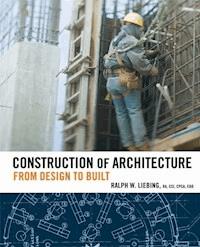
Buildings don't just appear. While the aesthetics and theory ofarchitecture have their glamour, architecture would not existwithout the hands-on, nuts-and-bolts process of construction.Construction of Architecture gives architects, contractors,managers, trade workers, and anyone else involved in a buildingproject a thorough overview of the process of taking or convertinga fine design concept from a paper exercise to a finished,full-sized, occupiable and usable building. In an easy-to-read, conversational style, Ralph Liebing distillsthe often-complex procedures in the construction of architectureinto clear, understandable phases. Connecting each phase to thenext, he takes you step-by-step from project inception anddocumentation to code compliance to bidding and the contractthrough finalization of the project and occupancy of the completedbuilding. This book is enhanced with features such as: * Drawings and photographs of the building process. * Samples of documents used in construction. * A concise narrative of the construction of a typical commercialbuilding, from start to finish. * An Instructor Companion Site with an expanded glossary andadditional resources. With this primer in hand, every aspiring building professionalwill have the solid foundation in the concepts and skills needed tobring any building project to fruition, from inception tooccupancy.
Sie lesen das E-Book in den Legimi-Apps auf:
Seitenzahl: 499
Veröffentlichungsjahr: 2011
Ähnliche



















This book is printed on acid-free paper.
Copyright © 2008 by John Wiley & Sons, Inc. All rights reserved
Published by John Wiley & Sons, Inc., Hoboken, New Jersey Published simultaneously in Canada
Wiley Bicententenial LOGO: Richard J. Pacifico
No part of this publication may be reproduced, stored in a retrieval system, or transmitted in any form or by any means, electronic, mechanical, photocopying, recording, scanning, or otherwise, except as permitted under Section 107 or 108 of the 1976 United States Copyright Act, without either the prior written permission of the Publisher, or authorization through payment of the appropriate per-copy fee to the Copyright Clearance Center, 222 Rosewood Drive, Danvers, MA 01923, (978) 750-8400, fax (978) 646-8600, or on the web at www.copyright.com. Requests to the Publisher for permission should be addressed to the Permissions Department, John Wiley & Sons, Inc., 111 River Street, Hoboken, NJ 07030, (201) 748-6011, fax (201) 748-6008.
Limit of Liability/Disclaimer of Warranty: While the Publisher and the author have used their best efforts in preparing this book, they make no representations or warranties with respect to the accuracy or completeness of the contents of this book and specifically disclaim any implied warranties of merchantability or fitness for a particular purpose. No warranty may be created or extended by sales representatives or written sales materials. The advice and strategies contained herein may not be suitable for your situation. You should consult with a professional where appropriate. Neither the Publisher nor the author shall be liable for any loss of profit or any other commercial damages, including but not limited to special, incidental, consequential, or other damages.
For general information about our other products and services, please contact our Customer Care Department within the United States at (800) 762-2974, outside the United States at (317) 572-3993 or fax (317) 572-4002.
Wiley also publishes its books in a variety of electronic formats. Some content that appears in print may not be available in electronic books. For more information about Wiley products, visit our web site at www.wiley.com.
Library ofCongress Cataloging-in-Publication Data:
Liebing, Ralph W., 1935-
Construction of architecture : from design to built / Ralph W. Liebing.
p. cm.
Includes bibliographical references and index.
ISBN 978-0-471-78355-8 (cloth)
1. Building. 2. Construction contracts. 3. Architectural contracts. I. Title.
TH146.L54 2007
690—dc22
2007028892
Limit of Liability/Disclaimer of Warranty: While the publisher and the author have used their best efforts in preparing this book, they make no representations or warranties with respect to the accuracy or completeness of the contents of this book and specifically disclaim any implied warranties of merchantability or fitness for a particular purpose. No warranty may be created or extended by sales representatives or written sales materials. The advice and strategies contained herein may not be suitable for your situation. The inclusion of legal (case law) citations, contract information, and other legal information in this book is not intended as, and should not be used or construed as, legal advice. Neither the Publisher nor the author shall be liable for any loss or profit or any other commercial damages, including but not limited to special, incidental, consequential, or other damages.
The drawings, tables, descriptions, techniques, and photographs in this book have been obtained from many sources, including government organizations, trade associations, suppliers of building materials, and professional architects or architecture firms. They are presented in good faith, but the author and Publisher do not warrant, and assume no liability for, the accuracy or completeness of the content or its fitness for any particular purpose. It is the responsibility of the users to apply their professional knowledge in the use of information contained in this book, to consult the original sources for additional information when appropriate, and to seek expert advice when appropriate. The fact that an organization or Web site is referred to in this work as a citation and/or potential source of further information does not mean that the author or the Publisher endorses the information that the organization or Web site may provide or recommendations it may make.
The reader is expressly warned to consider and adopt all safety precautions that might be indicated by the activities described herein and to avoid all potential hazards. By following the instructions contained herein, the reader willingly assumes all risks in connection with such information.
To my wife, Arlene, my daughter, Alissa, and my son-in-law, Bob—for their continual love, understanding, tolerance, and encouragement.
To my students past and present, for their interest in hearing and reading what I have to share.
To new readers, offering what I hope is a unique opportunity for understanding projects from a new perspective.
To my dear buddy and friend, Emerson, a French Bulldog who always manages to calm me down and keep me humble—and loves me even at my worst.
Title Page
Copyright
Dedication
Preface
Acknowledgments
Prologue
Chapter 1: Introduction and Context
Definitions
Elements of Architecture
Contractor’s Position
Project Development
Recent Changes
The Axiom
Construction
Totality of Work
A Fully Collaborative Team Effort
Genesis of Architecture
The Blend
The Need
Basic Respect
Dispelling the Issue
Understanding the Progression
Example of Progression Flexibility
Except
Chapter 2: Project Inception and Determination
The Cause
Project Inception/Initiation
Selection of Design Professional
The Design Team
Owner–Design Professional Relationship
Down Side of the Relationship
Site Selection and Feasibility
Property Surveys
Matching Project to Total Land Configuration
Project Delivery System
Site Topographical Survey
Chapter 3: Resolution and Design
Predesign Phase
The Project Program
Design Phase
Design Approval (By Owner)
Design Development Phase
Chapter 4: Selection, Incorporation, and Documentation
Constructibility
Conversion
Document Production Phase
Chapter 5: The Documents and Code Compliance
Documents
Project (Contract) Specifications
Relationships Among Contract Documents
The Construction Specifications Institute
Code Compliance Review and Permitting
Responsibilty for Code Compliance
Chapter 6: Bidding, Award, and Contract
Contractor Selection
Preparation for Bidding
Assistance in Bidding
Receipt of Bids
Submittal of Bids
Bidding
Bid Review and Analysis
Award of Contract(s); Notice to Proceed
Preconstruction Conference Meeting (Kick-Off)
Project Modifications
Chapter 7: Constructing, Erecting, and Installing
Construction Phase
Toward Finale
Chapter 8: Refinement and Enhancement
Wrap Up, Close Out
Substantial Completion and Final Inspection
The “Punch List”
Impact of Substantial Completion
Finale
Certification for Occupancy Through Final Payment
Chapter 9: Completion and Occupancy
Postsubstantial Completion
Owner Occupancy (Partial or Full)
Final Completion
Chapter 10: Postoccupancy
After Final Completion
Postoccupancy Evlauation (POE)
Appendix A: Trade Associations Standards-Generating Organizations Governing Authorities
Glossary
Index
Preface
Most people, including many architectural, engineering and construction management students, tend to think of architecture as something that somehow "merely appears." They do not yet have a feel for or understanding of the long process involved in the design and construction of an architectural project, nor the progression of events and work necessary.
Whether in an old neighborhood being refurbished, or in a fresh new, undeveloped site, the "piece of architecture" appears! This is understandable for the layperson but is more of a shortcoming for students. While perhaps steeped in theory and design principles in their academic process, students also need to understand the process of taking or converting a very fine design concept from a paper exercise to a finished, full-size, occupiable and usable building.
The process of delivering the finished project is simply called "construction." Those attuned wholly to the aesthetics and theory of architecture may well disdain this process, and look down upon it with less than understanding and respect. But if the truth be known, no architecture would exist without construction!
The basic issue is that no matter what one's position in the professions or in the project work, there is a fundamental and unavoidable requirement to understand the whole of the process of delivering a project. One can be totally dedicated to one phase of the project, but understanding of all phases is imperative to successful execution of work in that one phase. But understanding and appreciating the totality of a project is virtually impossible to do, looking from just the one end, the inception.
Construction and architectural projects are not a series of isolated events, each executed by separate groups of individuals, doing as they see fit. There is a need for coordination, cooperation, collectivism, and a drive to produce the project in the best fashion possible. Design professionals play a significant role in all this, as they produce the directions, instructions, graphics, and expertise addressing what is to be built, why, and how.
This is not to divert attention from the contractors, constructors, managers, trade workers, et cetera, who function in construction, but rather to point out that design is as much a tutorial on how the project is to be built, as it is a depiction of what is to be built. The overall design scheme (concept) is a function of, and a product of the designer— be they architect or engineer. Here the effort is to provide the composite of elements that best will contain, convert, provide for, and establish the many tangles and requirements of the owner's program: that specific document wherein the owner expresses exactly what is desired of the finished project. All owners want fully functional projects—lots of space, current problems resolved, costs within a reasonable budget, et cetera. And few, if any, want an ugly, errant, out-of-place piece of architecture.
So there is an essential and directed effort to first of all design the project, receive owner approval, and then to faithfully, assiduously, and finitely construct the project, in full size, as depicted at some reduced scale on a drawing. Simple? Yes, if you understand that construction is needed, and how that process progresses. Hence, the thrust of this book is to overview the whole sequence of the project.
This effort is activity oriented, depicting the chronological progression of work on the project, from inception to completion. It is not an in-depth dissertation on materials, systems, types of construction, and so forth. Such discussion would involve volumes of explanation due to the number of variations and combinations that are used. An appendix to this book lists trade associations that provide resources and information for various systems and materials. These associations have innumerable members who individually produce the massive array of products available for construction.
There are thousands of resources for various portions of construction of architecture, from design principles and theory to individual attributes of materials, systems, and equipment. The assortment chosen for each project is unique, to meet the requirements and desired results. What is often overlooked is the step-by-step progression of activities and tasks required to gather pertinent information, create and develop an appropriate design concept, develop accurate and wide-ranging communication documents (drawings and specifications), and install the pieces of construction.
No matter the pieces, there needs to be a fundamental understanding of the project process and progression from inception to occupancy.
Ralph W. Liebing
Cincinnati, Ohio
Acknowledgments
My deep and sincere gratitude to J. Robert (“Bob”) Welling for his tremendous contribution of the photographs of construction details to this effort. As both an architect in his own right and my son-in-law, his patience and skill are much appreciated, and hopefully will assist the readers in their appreciation of the points illustrated.
Thanks, too, to Jupiter Images for their assistance in providing photos of wide-ranging and widely dispersed projects completed over a number of years. This historical information and these illustrations serve to also highlight the breadth and uniqueness of projects all well classified as “architecture,” but all having been through the progression of construction.
Thanks also to generalcontractor.com and constructionphotographs.com (“Photo courtesy of constructionphotographs.com”) for their photos showing the various construction tasks and work. These are a great depiction of the actual construction work and help readers better see and understand the work.
Last, but certainly not least, I am grateful for the risk Paul Drougas of John Wiley & Sons took in giving me a contract for this work, and for his confidence in my approach to the topic and my ability to provide readers with correct and meaningful information. And I am grateful for his tremendous patience and that of Lauren LaFrance and Donna Conte, all of whom put up with my quirks and misconceptions. They made this book from the roughness of my manuscript—no small task.
Prologue
The following is so poignant to this effort that it must be included as the focus for the book. It is a message to all readers, no matter their profession, perspective, philosophy, or position.
This is from one of a series of papers written by William W. Caudill, FAIA—architect, educator, philosopher, and visionary—whose wonderful insight still pervades the profession.
This I Believe
Caudill-Rowlett-Scott Team: Procedures
21 April 1970 WWC
Each has its time.
When I was a young practitioner, drawings were precious to us. We were taught to love drawings—beautiful working drawings, sexy renderings, and impressive full-size details—more than buildings.
Today, the young practitioners are taught to love methods and procedures—system approach, computerized programming, and design methodology—more than buildings.
In both cases, buildings take second place, then and now. The buildings do not get the love and tender care which they should get to possess architecture so necessary for satisfying human needs.
Ever so often, we need to remind ourselves—young and old practi-tioners—that both drawings and methods are simply necessary evils to obtain functional, beautiful buildings.
To get “from here to there,” one must go through certain periods and places. The important thing is not these periods and places but the THERE.
When there is no THERE, then our mission has failed regardless of how we have traveled or where we have been.
The THERE is architecture—that aura that surrounds fine buildings and their spaces.
William W. Caudill, FAIA
Mr. Caudill addresses a very important issue, and one that needs to be included here. While his remarks are aimed at design professionals, the unaddressed void he includes is the period of construction. Certainly, his “THERE” is the common point and goal of both design and construction professionals. However, the commonality of goal does involve different perspectives and processes.
Mr. Caudill, in addressing design professionals, sets the project itself as the THERE that comes only by propriety in all processes leading up to the start of construction. The caring and love that saturates the design and documentation needs to be carried forth so the final THERE is indicative of the initial solution.
Mr. Caudill highlights exactly and distinctly the relationship of design personnel to construction personnel—and of design to construction to architecture. Construction is the “fit” between initial solution and final THERE! The projects produced vary widely in scope, complexity, form, shape, size, coloration, function, construction methodology, detail, and material. But each design scheme or concept is specific to the client and the purpose of the project. This accounts for the precision, enforcement, caring, and demands that design professionals place on constructors, to ensure faithful reproduction of the design concept in the final THERE!
Oddly enough, one can perceive that the commonality is really separated as it functions. Design professionals are concerned about the basic design form: the interplay of forms, planes, and shapes: the impact and image of the project and the functional inner working of the project; the style of architecture used as its motif; and the overall impression that the project should project.
Constructors are concerned about how specific portions of the work will or must be executed. They take a more pragmatic approach. Their skilled, hands-on work is seated in the concept of doing one's best in the area of the project work, similar to creating a single piece of a jigsaw puzzle (but one crucial to completing the puzzle properly).
For example, the designer sees “brick wall” for some element of the project. The constructor sees brick wall in the sense of what type of brick; how many; type of wall required; technique required for laying the brick; reinforcing and tie to structure; scaffolding and jump-up boards; logistics of getting material to the site and to the individual workstations; whether or not special effort to provide a fire rating is required; and so forth.
The design professional will make a more sweeping assessment and will view the finished wall in the sense of, “Does it provide the image and contribute to the design concept as I perceived it?” “Does it do what I wanted done?” “Is the coloration what I intended?” “Is the massing as I anticipated?” with little thought to how it was constructed.
It should be noted that individuals in the construction industry are overtaken, moved, and filled with pride by their participation in, and contribution to, the sheer impact and excellence of the project they work on, and come to understand and appreciate more acutely their contribution to a masterful example of building.
So it is obvious that both parties seek a good final solution but for much different reasons. That is, theirs is a commonality reached via different routes. This is the most distinctive interface between design, construction, and architecture. It shows the initial concept, its construction, and the resulting architecture produced by their mutual but different efforts.
This relationship and context is the preeminent and most crucial element at play in the design and production of architecture. Construction may be considered, without stigma, to be the vehicle that makes architecture become real, usable, occupiable, and influential.
It is impossible to overstate the importance of this linkage/relationship/progression being fully, clearly, and completely understood by all parties to every project.
Lesen Sie weiter in der vollständigen Ausgabe!
Lesen Sie weiter in der vollständigen Ausgabe!
Lesen Sie weiter in der vollständigen Ausgabe!
Lesen Sie weiter in der vollständigen Ausgabe!
Lesen Sie weiter in der vollständigen Ausgabe!
Lesen Sie weiter in der vollständigen Ausgabe!
Lesen Sie weiter in der vollständigen Ausgabe!
Lesen Sie weiter in der vollständigen Ausgabe!
Lesen Sie weiter in der vollständigen Ausgabe!
Lesen Sie weiter in der vollständigen Ausgabe!
Lesen Sie weiter in der vollständigen Ausgabe!
Lesen Sie weiter in der vollständigen Ausgabe!




