


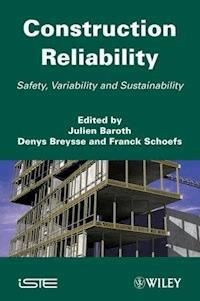
Construction Reliability E-Book
139,99 €
Mehr erfahren.
- Herausgeber: John Wiley & Sons
- Kategorie: Wissenschaft und neue Technologien
- Sprache: Englisch
This book provides answers to the following problems: how to identify the most probable critical failures; how to describe and use data-concerning materials that are either heterogeneous, time-variant, or space-variant; how to quantify the reliability and lifetime of a system; how to use feedback information to actualize reliability results; and how to optimize an inspection politic or a maintenance strategy. Numerous authors from public research centers and firms propose a synthesis of methods, both new and well-known, and offer numerous examples concerning dams, geotechnical study, and structures from nuclear and civil engineering.
Sie lesen das E-Book in den Legimi-Apps auf:
Seitenzahl: 450
Veröffentlichungsjahr: 2013
Ähnliche




















Table of Contents
Preface
Introduction
PART 1 - Qualitative Methods for Evaluating the Reliability of Civil Engineering Structures
Introduction to Part 1
Chapter 1. Methods for System Analysis and Failure Analysis
1.1. Introduction
1.2. Structural analysis
1.3. Functional analysis
1.4. Failure Modes and Effects Analysis (FMEA)
1.5. Bibliography
Chapter 2. Methods for Modeling Failure Scenarios
2.1. Introduction
2.2. Event tree method
2.3. Fault tree method
2.4. Bow-tie method
2.5. Criticality evaluation methods
Chapter 3. Application to a Hydraulic Civil Engineering Project
3.1. Context and approach for an operational reliability study
3.2. Functional analysis and failure mode analysis
3.3. Construction of failure scenarios
3.4. Scenario criticality analysis
3.5. Application summary
3.6. Bibliography
PART 2 - Heterogeneity and Variability of Materials: Consequences for Safety and Reliability
Introduction to Part 1
Chapter 4. Uncertainties in Geotechnical Data
4.1. Various sources of uncertainty in geotechnical engineering
4.2. Erroneous, censored and sparse data
4.3. Statistical representation of data
4.4. Data modeling
4.5. Conclusion
4.6. Bibliography
Chapter 5. Some Estimates on the Variability of Material Properties
5.1. Introduction
5.2. Mean value estimation
5.3. Estimation of characteristic values
5.4. Principles of a geostatistical study
5.5. Bibliography
Chapter 6. Reliability of a Shallow Foundation Footing
6.1. Introduction
6.2. Bearing capacity models for strip foundations – modeling errors
6.3. Effects of soil variability on variability in bearing capacity and safety of the foundation
6.4. Taking account of the structure of the spatial correlation and its influence on the safety of the foundation
6.5. Conclusions
6.6. Bibliography
PART 3 - Metamodels for Structural Reliability
Introduction to Part 3
Chapter 7. Physical and Polynomial Response Surfaces
7.1. Introduction
7.2. Background to the response surface method
7.3. Concept of a response surface
7.4. Usual reliability methods
7.5. Polynomial response surfaces
7.6. Conclusion
7.7. Bibliography
Chapter 8. Response Surfaces based on Polynomial Chaos Expansions
8.1. Introduction
8.2. Building of a polynomial chaos basis
8.3. Computation of the expansion coefficients
8.4. Applications in structural reliability
8.5. Conclusion
8.6. Bibliography
PART 4 - Methods for Structural Reliability over Time
Introduction to Part 4
Chapter 9. Data Aggregation and Unification
9.1. Introduction
9.2. Methods of data aggregation and unification
9.3. Evaluation of evacuation time for an apartment in case of fire
9.4. Conclusion
9.5. Bibliography
Chapter 10. Time-Variant Reliability Problems
10.1. Introduction
10.2. Random processes
10.3. Time-variant reliability problems
10.4. PHI2 method
10.5. Industrial application: truss structure under time-varying loads
10.6. Conclusion
10.7. Bibliography
Chapter 11. Bayesian Inference and Markov Chain Monte Carlo Methods
11.1. Introduction
11.2. Bayesian Inference
11.3. MCMC methods for weakly informative data
11.4. Estimating a competing risk model from censored and incomplete data
11.5. Conclusion
11.6. Bibliography
Chapter 12. Bayesian Updating Techniques in Structural Reliability
12.1. Introduction
12.2. Problem statement: link between measurements and model prediction
12.3. Computing and updating the failure probability
12.4. Updating a confidence interval on response quantities
12.5. Bayesian updating of the model basic variables
12.6. Updating the prediction of creep strains in containment vessels of nuclear power plants
12.7. Conclusion
12.8. Acknowledgments
12.9. Bibliography
PART 5 - Reliability-based Maintenance Optimization
Introduction to Part 5
Chapter 13. Maintenance Policies
13.1. Maintenance
13.2. Types of maintenance
13.3. Maintenance models
13.4. Conclusion
13.5. Bibliography
Chapter 14. Maintenance Cost Models
14.1. Preventive maintenance
14.2. Maintenance based on time
14.3. Maintenance based on age
14.4. Inspection models
14.5. Structures with large lifetimes
14.6. Criteria for choosing a maintenance policy
14.7. Example of a corroded steel pipeline
14.8. Conclusion
14.9. Bibliography
Chapter 15. Practical Aspects: Industrial Implementation and Limitations in a Multi-criteria Context
15.1. Introduction
15.2. Motorway concession with high performance requirements
15.3. Ageing of civil engineering structures: using field data to update predictions
15.4. Conclusion
15.5. Bibliography
Conclusion
List of Symbols
List of Authors
Index
First published 2011 in Great Britain and the United States by ISTE Ltd and John Wiley & Sons, Inc.
Apart from any fair dealing for the purposes of research or private study, or criticism or review, as permitted under the Copyright, Designs and Patents Act 1988, this publication may only be reproduced, stored or transmitted, in any form or by any means, with the prior permission in writing of the publishers, or in the case of reprographic reproduction in accordance with the terms and licenses issued by the CLA. Enquiries concerning reproduction outside these terms should be sent to the publishers at the undermentioned address:
ISTE Ltd
John Wiley & Sons, Inc.
27-37 St George's Road
111 River Street
London SW19 4EU
Hoboken, NJ 07030
UK
USA
www.iste.co.uk
www.wiley.com
© ISTE Ltd 2011
The rights of Julien Baroth, Franck Schoefs, Denys Breysse to be identified as the authors of this work have been asserted by them in accordance with the Copyright, Designs and Patents Act 1988.
Library of Congress Cataloging-in-Publication Data
Construction reliability / edited by Julien Baroth, Franck Schoefs, Denys Breysse.
p. cm.
Includes bibliographical references and index. ISBN 978-1-84821-230-5
1. Buildings--Reliability. 2. Public works--Reliability. 3. Structural failures--Prevention. I. Baroth, Julien. II. Schoefs, Franck. III. Breysse, D. TA656.C68 2011 624--dc23
2011019207
British Library Cataloguing-in-Publication Data
A CIP record for this book is available from the British Library
ISBN 978-1-84821-230-5
Preface
From 26 to 28 March 2008, a conference entitled “Fiabilité des matériaux et des structures" (“Reliability of materials and structures", JNFiab’08)1 took place at the University of Nantes, France, bringing together the French scientific communities interested in reliability and risk analysis, as applied to materials and structures. This colloquium followed on from several different events: the fifth “Reliability of materials and structures" conference, the second Méc@proba training day2 and the second scientific session in the subject area of “Understanding risk in civil engineering" (MRGenCi scientific interest group3).
It combined their themes and concerns as an extension of the first shared workshop between the Associations Françaises de Génie Civil (AFGC, or French Associations of Civil Engineering4) and the Associations Françaises de Méchanique (AFM, or French Associations of Mechanical Engineering)5, during the twenty-fifth annual meeting of the Association Universitaire de Génie Civil (AUGC, Universities civil engineering association6) held on 23–25 May 2007, in Bordeaux, France.
This book was first conceived during these sessions, organized by the MRGenCi and Méc@Proba scientific interest groups, where the authors gave presentations on the advances they have made in their respective fields.
Although the examples of structures that can be found in this book fall under the umbrella of civil engineering (nuclear and oil industries, buildings and dams), themethods we consider are just as applicable to any sort of complex mechanical system involving a large number of uncertainties. Thus the book is of interest to the civil engineering community but also to mechanical engineers or those interested in reliability theory, whether their background is in industry or academia, who have been exposed to research and development processes. Masters students, engineering students and doctoral students, engineers and research associates will all find a detailed discussion of methods and applications.
The authors are indebted to the two main proofreaders, with their complementary backgrounds. The first is Maurice Lemaire, a university professor who teaches at the Institut Français de Mécanique Avancée (IFMA, French Institute for Advanced Mechanical Engineering7) and at the Blaise Pascal University8 (UBP) at Clermont-Ferrand, and who is consultant to the company Phimeca9 which he co-founded. The second is André Lannoy, Vice-President of the Institut pour la Maîtrise des Risques (IMdR, Institute for Risk Management10), who built his career as a research engineer and subsequently as scientific adviser to the research and development section of EDF. In particular, André Lannoy co-organizes the working group “Sécurité et sûreté des structures" (GTR 3S, Safety and reliability of structures11), a group which counts several of the authors of this book among its members.
The authors would like to express their particular gratitude to Maurice Lemaire for his contributions to the development of the field of structural reliability. The few brief paragraphs below give a short overview of his career and his contributions to scientific production, advocacy and above all to training, which has inspired several of the authors to pursue their career paths.
After receiving his diploma from the Institut National des Sciences Appliquées, (INSA12, National Institute for Applied Sciences), in Lyon in 1968, followed by further studies in applied mathematics (1969), Maurice Lemaire received his doctorate in engineering (1971). Following his higher state doctorate (1975), he was appointed a position at CUST (the engineering school that became the Polytech’ Clermont-Ferrand13), within the Blaise Pascal University (1976). He was involved in the founding of the IFMA (1987), where he has been a professor since 1991.
Maurice Lemaire founded the Laboratoire de Recherches et applications en Mécanique Avancée (LaRAMA, Research and applications in advanced mechanics research group) in 1989 (and the IFMA/UBP laboratory, which is now LaMI14), where he has been a director since 2005. Head of research at IFMA from 1991 to 2007, he has supervised 44 doctoral students and participated in 180 thesis examinations.
Co-founder of the “Fiabilité des matériaux et des structures" symposium15 (Cachan, 1994), co-organizer of the 7th International Conference on Applications of Statistics and Probability in Civil Engineering (ICASP16, 1995 in Paris), and then president of the International Civil Engineering Risk and Reliability Association (CERRA17) from 1995 to 1999, he is a member of the scientific committee of the International Federation for Information Processing’s working group 7.5 (IFIP WG 7.5) on the reliability and optimization of structural systems18. Maurice Lemaire is also a founder of the Méc@proba meetings19 (Marne-la-Vallée, France, 2006).
He is a promoter for the scientific commission “Mécanique probabiliste des matériaux et des structures" (Probabilistic mechanics of materials and structures20) of the AFM), and is responsible for numerous industrial research projects. He also contributes scientific insight and ongoing supervision into the growth of the company Phimeca Engineering, which he co-founded in 2001.
There can be no doubt that Maurice Lemaire has contributed to the development of the science of structural reliability at a national and international level.
The authors therefore recommend that readers consult his publications, which are cited throughout this book.
The authors would like to express their gratitude towards the MRGenCi scientific interest group which made it possible to write this book. That group, created on the initiative of Messrs Breysse (Professeur at University of Bordeaux I), Boissier (Professeur at UBP), Melacca (SMA-BTP) and Gérard (PDG OXAND SA), now consists of more than 30 industrial companies, learned societies, universities and engineering schools.
We cannot speak highly enough of the authors, proofreaders and all the other people who have contributed to this book and to ensuring that it is received by a wide audience.
Julien BAROTHFranck SCHOEFSDenys BREYSSEJUNE 2011
1 http://www.sciences.univ-nantes.fr/jfms2008/DownloadJFMS2008.pdf.
2 http://www.lamsid.cnrs-bellevue.fr/vf/actualites/journee_proba/plaquette_proba.pdf
3 http://www.mrgenci.u-bordeaux1.fr/.
4 http://www.afgc.asso.fr/.
5 http://www.afm.asso.fr/.
6 http://www.augc.asso.fr/.
7 http://www.ifma.fr/.
8 http://www.univ-bpclermont.fr/.
9 http://www.phimeca.com/.
10 http://www.imdr.eu.
11 http://www.imdr.eu/v2/extranet/detail_gtr.php?id=36.
12 http://www.insa-france.fr/.
13 http://www.polytech-clermontferrand.fr/.
14 www.ifma.fr/lami/.
15 www.sciences.univ-nantes.fr/jfms2008/DownloadJFMS2008.pdf
16 www.icassp2011.com/.
17 www.ce.berkeley.edu/projects/cerra/.
18 www.era.bv.tum.de/IFIP/.
19 www.lamsid.cnrs-bellevue.fr/vf/actualites/journee_proba/plaquette_proba.pdf
20 www.afm.asso.fr/PrésentationdelAFM/Commissions/MPMS.
Introduction1
Background and objectives
This book describes and illustrates methods to improve prediction of the lifetime and management of civil engineering structures. This contributed collection aims to complete the existing literature and to provide access to both recent scientific approaches and examples of applications in study cases. The authors are drawn from amongst university academics, senior engineers and scientific managers in companies. Amongst others, Ditlevsen & Madsen [DIT 96], Melchers [MEL 99] and Lemaire [LEM 09] have already made significant contributions to structural reliability, that is to say, the study of the ability of a structure to perform a function (depending on its environment, life, etc.). Favre [FAV 04], [SUD 08b], by contrast, studied geotechnical structures. These last books introduced concepts of uncertainty related to materials and loads, as well as statistical and probabilistic methods applied to civil engineering. This book also uses these basic concepts, and notions of uncertainty or reliability, in particular, are discussed in this introduction.
The authors’ main objective in this book is the presentation of recent methods of data processing and computation which have not been widely disseminated. Many of these methods have already been used in industrial applications: this book aims to present these applications through case studies and examples over a wide set of materials, buildings and structures in civil engineering.
If the examples of structures presented in the following pages are limited to the field of civil engineering (whether in nuclear, oil, or dam building applications), the methods presented are applicable to any complex mechanical system in an uncertain environment. This book is mainly intended for those familiar with civil engineering, engineering mechanics or the theory of reliability, both from industry and academia, involved in research and development. Students, especially engineering students and PhD students, engineers and research fellows may also have an interest in the book.
A civil engineering project is considered here to be a system that ensures one or more global functions. It consists of components, sub-structures, structures, human actors, procedures, and organization in a given environment. It performs the basic functions that contribute to the achievement of these global functions. The system is identifiable, and can be broken down into the functions it performs (a functional approach), or into structurally interdependent elements or subsystems (a structural approach). A civil engineering project is considered safe when it is fit for duty for the duration of its service life, without damage to itself or to its environment (French norm X60-010). The safety of a structure can be quantified by its probability of not providing any of its functions, at any moment of its expected lifetime.
Lesen Sie weiter in der vollständigen Ausgabe!
Lesen Sie weiter in der vollständigen Ausgabe!
Lesen Sie weiter in der vollständigen Ausgabe!
Lesen Sie weiter in der vollständigen Ausgabe!
Lesen Sie weiter in der vollständigen Ausgabe!
Lesen Sie weiter in der vollständigen Ausgabe!
Lesen Sie weiter in der vollständigen Ausgabe!
Lesen Sie weiter in der vollständigen Ausgabe!
Lesen Sie weiter in der vollständigen Ausgabe!
Lesen Sie weiter in der vollständigen Ausgabe!
Lesen Sie weiter in der vollständigen Ausgabe!
Lesen Sie weiter in der vollständigen Ausgabe!
Lesen Sie weiter in der vollständigen Ausgabe!
Lesen Sie weiter in der vollständigen Ausgabe!
Lesen Sie weiter in der vollständigen Ausgabe!
Lesen Sie weiter in der vollständigen Ausgabe!
Lesen Sie weiter in der vollständigen Ausgabe!
Lesen Sie weiter in der vollständigen Ausgabe!
Lesen Sie weiter in der vollständigen Ausgabe!
Lesen Sie weiter in der vollständigen Ausgabe!
Lesen Sie weiter in der vollständigen Ausgabe!
Lesen Sie weiter in der vollständigen Ausgabe!
Lesen Sie weiter in der vollständigen Ausgabe!
Lesen Sie weiter in der vollständigen Ausgabe!
Lesen Sie weiter in der vollständigen Ausgabe!
Lesen Sie weiter in der vollständigen Ausgabe!
Lesen Sie weiter in der vollständigen Ausgabe!
Lesen Sie weiter in der vollständigen Ausgabe!
Lesen Sie weiter in der vollständigen Ausgabe!




