


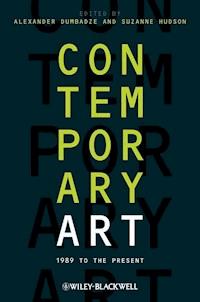
Contemporary Art E-Book
47,99 €
Mehr erfahren.
- Herausgeber: John Wiley & Sons
- Kategorie: Geisteswissenschaft
- Sprache: Englisch
An engaging account of today’s contemporary art world that features original articles by leading international art historians, critics, curators, and artists, introducing varied perspectives on the most important debates and discussions happening around the world.
- Features a collection of all-new essays, organized around fourteen specific themes, chosen to reflect the latest debates in contemporary art since 1989
- Each topic is prefaced by an introduction on current discussions in the field and investigated by three essays, each shedding light on the subject in new and contrasting ways
- Topics include: globalization, formalism, technology, participation, agency, biennials, activism, fundamentalism, judgment, markets, art schools, and scholarship
- International in scope, bringing together over forty of the most important voices in the field, including Sofía Hernández Chong Cuy, David Joselit, Michelle Kuo, Raqs Media Collective, and Jan Verwoert
- A stimulating guide that will encourage polemical interventions and foster critical dialogue among both students and art aficionados
Sie lesen das E-Book in den Legimi-Apps auf:
Seitenzahl: 947
Veröffentlichungsjahr: 2012
Ähnliche




















CONTENTS
CONTRIBUTORS
INTRODUCTION
A User’s Guide to Contemporary Art: 1989 to the Present
1 THE CONTEMPORARY AND GLOBALIZATION
Worlds Apart: Contemporary Art, Globalization, and the Rise of Biennials
“Our” Contemporaneity?
The Historicity of the Contemporary is Now!
2 ART AFTER MODERNISM AND POSTMODERNISM
Elite Art in an Age of Populism
“Of Adversity we Live!”
Making it Work: Artists and Contemporary Art in China
3 FORMALISM
Form Struggles
Formalism Redefined
The World in Plain View: Form in the Service of the Global
4 MEDIUM SPECIFICITY
The (Re)Animation of Medium Specificity in Contemporary Art
Medium Aspecificity/Autopoietic Form
Specificity
5 ART AND TECHNOLOGY
Test Sites: Fabrication
Inhabiting the Technosphere: Art and Technology Beyond Technical Invention
Conceptual Art 2.0
6 BIENNIALS
In Defense of Biennials
Curating in Heterogeneous Worlds
Biennial Culture and the Aesthetics of Experience
7 PARTICIPATION
Participation
The Ripple Effect: “Participation” as an Expanded Field
Publicity and Complicity in Contemporary Art
8 ACTIVISM
Activism
Knit Dissent
Light from a Distant Star: A Meditation on Art, Agency, and Politics
9 AGENCY
Participation in Art: 10 Theses
Fusions of Powers: Four Models of Agency in the Field of Contemporary Art, Ranked Unapologetically in Order of Preference
Life Full of Holes: Contemporary Art and Bare Life
10 THE RISE OF FUNDAMENTALISM
Monotheism à la Mode
Freedom’s Just Another Word
On the Frontline: The Politics of Terrorism in Contemporary Pakistani Art
11 JUDGMENT
Judgment’s Troubled Objects
A Producer’s Journal, or Judgment A Go-Go
After Criticism
12 MARKETS
Globalization and Commercialization of the Art Market
Three Perspectives on the Market
Untitled
13 ART SCHOOLS AND THE ACADEMY
Lifelong Learning
Art without Institutions
“Will the Academy Become a Monster?”
14 SCHOLARSHIP
Our Literal Speed
Globalization, Art History, and the Specter of Difference
The Academic Condition of Contemporary Art
INDEX
This edition first published 2013© 2013 John Wiley & Sons, Inc.
Wiley-Blackwell is an imprint of John Wiley & Sons, formed by the merger of Wiley’s global Scientific, Technical and Medical business with Blackwell Publishing.
Registered OfficeJohn Wiley & Sons, Ltd, The Atrium, Southern Gate, Chichester, West Sussex, PO19 8SQ, UK
Editorial Offices350 Main Street, Malden, MA 02148-5020, USA9600 Garsington Road, Oxford, OX4 2DQ, UKThe Atrium, Southern Gate, Chichester, West Sussex, PO19 8SQ, UK
For details of our global editorial offices, for customer services, and for information about how to apply for permission to reuse the copyright material in this book please see our website at www.wiley.com/wiley-blackwell.
The right of Alexander Dumbadze and Suzanne Hudson to be identified as the authors of the editorial material in this work has been asserted in accordance with the UK Copyright, Designs and Patents Act 1988.
All rights reserved. No part of this publication may be reproduced, stored in a retrieval system, or transmitted, in any form or by any means, electronic, mechanical, photocopying, recording or otherwise, except as permitted by the UK Copyright, Designs and Patents Act 1988, without the prior permission of the publisher.
Wiley also publishes its books in a variety of electronic formats. Some content that appears in print may not be available in electronic books.
Designations used by companies to distinguish their products are often claimed as trademarks. All brand names and product names used in this book are trade names, service marks, trademarks or registered trademarks of their respective owners. The publisher is not associated with any product or vendor mentioned in this book. This publication is designed to provide accurate and authoritative information in regard to the subject matter covered. It is sold on the understanding that the publisher is not engaged in rendering professional services. If professional advice or other expert assistance is required, the services of a competent professional should be sought.
Library of Congress Cataloging-in-Publication Data
Contemporary art : 1989 to the present / edited by Alexander Dumbadze and Suzanne Hudson.pages cmIncludes bibliographical references and index.
ISBN 978-1-4443-3860-7 (hardback) – ISBN 978-1-4443-3866-9 (paperback)1. Art, Modern–20th century. 2. Art, Modern–21st century. I. Dumbadze, Alexander Blair, 1973– editor of compilation.N6490.C65665 2013709.05′1–dc23
2012035615
A catalogue record for this book is available from the British Library.
Cover design by E&P Design
CONTRIBUTORS
Atteqa Ali is an art historian and writer based in Lahore. She is the officiating Head of the Communication and Cultural Studies Department at the National College of Arts. Her forthcoming book investigates the rise of Pakistani art that addresses sociopolitical concerns.Monica Amor holds a PhD from the Graduate Center of the City University of New York and is Professor of Modern and Contemporary Art at the Maryland Institute College of Art. She is currently completing a book entitled Theories of the Non-Object: The Postwar Crisis of Geometric Abstraction.Ayreen Anastas is an artist living in Brooklyn.Jean-Philippe Antoine is Professor of Aesthetics and Contemporary Art Theory at Paris 8 University. His research bears on images and the social construction of memory, as well as modern definitions of art. He has recently published La traversée du XXesiècle. Joseph Beuys, l’image et le souvenir (2011).Ina Blom is a Professor at the Institute of Philosophy, Classics, History of Art and Ideas at the University of Oslo, specializing in modernism/avant-garde art, contemporary art, and media aesthetics. She is the author of On the Style Site: Art, Sociality, and Media Culture (2007).Julia Bryan-Wilson is Associate Professor of Modern and Contemporary Art in the Department of History of Art at the University of California, Berkeley. She is the author of Art Workers: Radical Practice in the Vietnam War Era (2009).Sabeth Buchmann is an art historian and critic based in Berlin and Vienna. She is a Professor of the History of Modern and Postmodern Art at the Academy of Fine Arts, Vienna. Her publications include: Denken gegen das Denken. Produktion- Technologie-Subjektivität bei Sol LeWitt, Yvonne Rainer und Hélio Oiticica (2007) and a forthcoming monograph on Hélio Oiticica (with M. Hinderer-Cruz).Johanna Burton is an art historian and critic based in New York City. She is the Director of the Graduate Program at the Center for Curatorial Studies, Bard College.T. J. Demos teaches in the Art History Department at University College London. He writes widely on modern and contemporary art, and is currently completing two books: The Migrant Image: The Art and Politics of Documentary During Global Crisis and Return to the Postcolony: Spectres of Colonialism in Contemporary Art.Anne Ellegood is the Senior Curator at the Hammer Museum. Recent exhibitions include the Hammer’s first biennial of Los Angeles-based artists, Made in L.A., the group show All of this and nothing, and Hammer Projects with Shannon Ebner and Sara VanDerBeek. Ellegood served as the Curator for Hany Armanious’s 2011 Australian Pavilion in the Venice Biennale.Rene Gabri is an artist living in New York.Liam Gillick is an artist based in London and New York. He has exhibited widely, and represented Germany for the 53rd Venice Biennale in 2009. His numerous writings, which include Proxemics: Selected Writings 1988–2006 (2006) and a critical reader titled Meaning Liam Gillick (2009), function in parallel to his artwork.Massimiliano Gioni is Associate Director and Director of Exhibitions at the New Museum. He is the Curator of the 55th Venice Biennale (2013). Among the many exhibitions he has either curated or co-curated are the 2010 Gwangju Biennial, the 4th Berlin Biennale, and Manifesta 5.Andrea Giunta is an art historian, curator, and Professor of Latin American Art at The University of Texas at Austin, where she is Endowed Chair in Latin American Art History and Criticism and the Director of the Center for Latin American Visual Studies. She received her PhD from the University of Buenos Aires, Argentina.Tim Griffin is Executive Director and Chief Curator of The Kitchen, New York. Previously he was editor-in-chief of Artforum from 2003 to 2010. His book of essays, Compression, dealing with shifts in the terms for site-specificity in contemporary art, is forthcoming.Sofía Hernández Chong Cuy works with visual artists in conceptualizing meetings points—whether these take the form and space of exhibitions, events, or printed matter—for audiences to experience art unconventionally. Sofia is Curator at the Colección Patricia Phelps de Cisneros, develops projects independently, and writes regularly in www.sideshows.org.Caroline A. Jones is Professor of Art History and Director of the History, Theory, Criticism Program at MIT. Editor of Sensorium (2006), author of Eyesight Alone (2005/8), Machine in the Studio (1996/8), and other works, her next book is titled Desires for the World Picture: The Global Work of Art.David Joselit is Carnegie Professor in the History of Art Department at Yale University. His books include Feedback: Television against Democracy (2007) and After Art (2012).Geeta Kapur is a critic and curator from Delhi. Her books include Contemporary Indian Artists (1978), When Was Modernism: Essays on Contemporary Cultural Practice in India (2000), Ends and Means: Critical Inscriptions in Contemporary Art (forthcoming). She co-curated “Bombay/Mumbai” for Century City, Tate Modern (2001). The founder-editor of the Journal of Arts and Ideas, she is also an advisory editor for Third Text and Marg. She has lectured and held fellowships worldwide.Joan Kee is an Assistant Professor at the University of Michigan. A specialist in modern and contemporary art with interests in East and Southeast Asia, her latest book is entitled Methods: Tansaekhwa and Contemporary Korean Art.Sylvia Kouvali lives in Istanbul, Turkey, where she runs Rodeo Gallery.Michelle Kuo is the Editor in Chief of Artforum. She is a regular contributor to publications including October and The Art Bulletin, and most recently published the catalogue essay for the exhibition “Otto Piene: Lichtballett” at the MIT List Visual Arts Center. Michelle is also a PhD candidate at Harvard University in history of art and architecture; her dissertation concerns the organization Experiments in Art and Technology.Carrie Lambert-Beatty is an art historian at Harvard University, where she received the Roslyn Abramson Award for Excellence in Undergraduate Teaching. She is the author of Being Watched: Yvonne Rainer and the 1960s (2008).Pi Li is a critic, curator, and gallerist based in Beijing.Maria Lind is a curator and critic based in Stockholm, and currently the Director of Tensta konsthall. She previously was the Director of the Graduate Program, Center for Curatorial Studies at Bard College, Director of Iaspis in Stockholm and Kunstverein München. She received the 2009 Walter Hopps Award for Curatorial Achievement and her book, Selected Maria Lind Writing, was published in 2010.Our Literal Speed is an ongoing media opera/textual archive based in Selma, Alabama. Since 2006, the project has been presented as a series of events in the vicinity of art and history in Europe and North America.Sven Lütticken teaches art history at VU University Amsterdam. He regularly publishes on contemporary art and is the author of the books Secret Publicity: Essays on Contemporary Art (2006), Idols of the Market: Modern Iconoclasm and the Fundamentalist Spectacle (2009), and History in Motion (2012).Chika Okeke-Agulu, a curator, critic, and art historian, is Assistant Professor in the Department of Art and Archaeology and Center for African American Studies, Princeton University. His books include Contemporary African Art since 1980 (2009), and Who Knows Tomorrow (2010). He is co-editor of Nka: Journal of Contemporary African Art.Mihai Pop is a visual artist and Coordinator of Galeria Plan B in Cluj, Romania, and Berlin. He commissioned the Romanian Pavilion at the 52nd Venice Biennale in 2007, and co-curated the Staging the Grey exhibition for Prague Biennale 4 in 2009. He is an initiator of the Fabrica de Pensule / The Paintbrush Factory in Cluj, Romania, a collective independent cultural center opened in 2009.Raqs Media Collective was founded in 1992 by Jeebesh Bagchi, Monica Narula, and Shuddhabrata Sengupta. Based in New Delhi, Raqs remains closely involved with the Sarai program at the Centre for the Study of Developing Societies (www.sarai.net), an initiative they co-founded in 2000.Juliane Rebentisch is Professor of Philosophy and Aesthetics at the University of Art and Design in Offenbach am Main, Germany. Recent publications include: Aesthetics of Installation Art (2012); Kreation und Depression: Freiheit im gegenwärtigen Kapitalismus (co-edited with Christoph Menke, 2010); and Die Kunst der Freiheit: Zur Dialektik demokratischer Existenz (2012).Lane Relyea is Associate Professor and Chair of Art Theory and Practice at Northwestern University and editor of Art Journal. He has written widely on contemporary art since 1983, and his book on the effects of networks on artistic practice and its contexts is forthcoming.João Ribas is Curator at the MIT List Visual Arts Center in Cambridge, Massachusetts, and was previously Curator at The Drawing Center in New York. His writing has appeared in numerous publications, and he is the recipient of four consecutive AICA Awards (2008–11) and an Emily Hall Tremaine Award (2010).Andrea Rosen opened her gallery in 1990 with an inaugural exhibition of work by Felix Gonzalez-Torres. The gallery is known for discovering new artists as well as developing the career of emerging and established artists. The gallery also has an ongoing reputation for mounting significant historical exhibitions. Rosen was born in Canada and worked in numerous galleries, including Diane Brown Gallery and Daniel Newburg Gallery.Richard Shiff is Effie Marie Cain Regents Chair in Art at The University of Texas at Austin, where he directs the Center for the Study of Modernism. He is the author of Doubt (2008) and Between Sense and de Kooning (2011).Katy Siegel is a Professor of Art History at Hunter College, The City University of New York and contributing editor to Artforum. She was the Curator of High Times, Hard Times: New York Painting, 1967–1975, and her books include Since ′45: America and the Making of Contemporary Art (2011) and Abstract Expressionism (2011).Irene V. Small is Assistant Professor of Art and Archaeology, Princeton University. She has contributed to journals including Artforum, Third Text, and RES: Anthropology and Aesthetics. Her forthcoming book, Hélio Oiticica: Folding the Frame, examines the emergence of a participatory art paradigm in mid-1960s Brazil.Frank Smigiel is Associate Curator of Public Programs at the San Francisco Museum of Modern Art, where he designs and implements live events from artists’ talks and public projects to visual arts-based performance and film. His curatorial and research interests include the intersection of theatrical and live art forms, commerce by artists, and information/knowledge-based art projects. He teaches at the San Francisco Art Institute and holds a doctorate in English Literature.Terry Smith, Andrew W. Mellon Professor of Contemporary Art History and Theory, Department of the History of Art and Architecture, University of Pittsburgh, and Distinguished Visiting Professor, National Institute for Experimental Arts, University of New South Wales, is the 2010 Australia Council Visual Arts Laureate, and winner of the CAA’s Mather Award for Art Criticism.Julian Stallabrass is a writer, curator, photographer, and lecturer. He is Professor in Art History at the Courtauld Institute of Art, and is the author of Art Incorporated (2004). He curated the 2008 Brighton Photo Biennial, “Memory of Fire: Images of War and the War of Images.”Olav Velthuis is Associate Professor in Cultural and Economic Sociology at the University of Amsterdam. He is the author of, among others, Talking Prices: Symbolic Meanings of Prices on the Market for Contemporary Art (2005), and has published on art markets in Artforum, the Art Newspaper, and the Financial Times.Jan Verwoert is a critic whose writing has appeared in numerous journals, anthologies, and monographs. He teaches at the Piet Zwart Institute Rotterdam, the de Appel curatorial program, the Ha’Midrasha School of Art, Tel Aviv, and Bergen Academy of Art. He is the author of Bas Jan Ader: In Search of the Miraculous (2006) and Tell Me What You Want What You Really Really Want (2010).Anton Vidokle is an artist and co-founder of e-flux and time/bank.Terri Weissman’s book, The Realisms of Berenice Abbott: Documentary Photography and Political Action (2011), examines the politics of Berenice Abbott’s realist, communicatively oriented model of documentary photography. She has also co-curated (with Jessica May and Sharon Corwin) an exhibition titled American Modern: Abbott, Evans, Bourke-White.Pauline J. Yao is an independent curator and scholar based in Beijing, where she co-founded the nonprofit art space Arrow Factory in 2008. She is the author of In Production Mode: Contemporary Art in China (2008), and co-edited 3 Years: Arrow Factory (2011).Tirdad Zolghadr is a writer and curator who teaches at the Center for Curatorial Studies, Bard College.
INTRODUCTION
ALEXANDER DUMBADZE AND SUZANNE HUDSON
This volume comprises newly commissioned essays on contemporary art since 1989. The contemporary art world has expanded exponentially—in size and complexity—over the last two decades, precipitating a general uncertainty as to what matters and why, much less how we should look at, write about, and historicize these recent practices. Admitting from the outset the implications of this profound and often antagonistic situation, we have eschewed producing a descriptive text of our own and have instead brought together nearly fifty leading international creative, critical, and curatorial voices to examine what contemporary art is today. This book follows the principle given poetic shape in the Indian parable of the blind men and the elephant, in which a company of individuals feels a single region of the elephant’s body. One might grope a leg, while another the tusk, or an ear. Each touch yields a different tactile experience, as well as a distinct vantage from which to extrapolate the contours of the whole. Precisely because of the variability of the animal’s features—much less the horizon of one’s perception—the resultant points of view are at once catholic and incommensurate.
The history presented in this book is necessarily partial, and the better for its aggregation of conflicting opinions, interpretations, and approaches. It goes without saying that Contemporary Art: 1989 to the Present is neither meant to be absolute nor prescriptive, but investigative, even speculative. It aims to generate a picture of a heterogeneous whole through the specificity of positions moored in disparate practices, locations, and philosophies. It is with this goal in mind that the essays in Contemporary Art: 1989 to the Present emphasize the virtues of partisanship in the task of understanding the recent past, and the book’s success depends upon the vigor of debate it generates—debates we hope will provide the groundwork for successive histories of contemporary art.
While the essays themselves establish a discussion of the contemporary quite apart from our brief introduction of them, one basic point of structural and historiographical organization is our periodization of the contemporary from 1989. We do this for a number of reasons. The unprecedented growth of the contemporary art world coincided with the fall of the Berlin Wall and the tumultuous events surrounding the Tiananmen Square protests. The Velvet Revolution in Czechoslovakia, the Solidarity Movement in Poland, and the collapse of communism in the Soviet Union and the rest of the Eastern Bloc irrevocably modified the landscape of contemporary European Art; it also provided the economic means for local collectors to become highly influential players in the international art world. Meanwhile, the contemporary art scene in China, post-Tiananmen, evolved into an economic and cultural phenomenon independent from Western critical and economic systems of distribution, and as such represents a willful excision from, or the complete indifference to, the New York–Western Europe “hegemony” of contemporary art.
No matter the importance of such cities as New York, Berlin, or Beijing, the contemporary art world has experienced not just a multiplication of centers, but a deep constitutional adjustment regarding the nature of borders, travel, and the global economy. The increased number of biennials and triennials spread across the globe—something virtually unheard of before 1989, with the exception of stalwarts like São Paulo and Venice—made artists “peripatetic travelers” who created site-specific installations in response to the phenomena of globalization. Oft criticized for engendering a touristic, entertainment-oriented experience, these shows likewise gave rise to a kind of participatory art, taking advantage of the absence of traditional institutional structures for new, contingent presentational styles.
Such differences in exhibition practice notwithstanding, it may seem contentious to link aesthetic change to the geopolitical shifts of 1989—an argument that applies to other momentous dates, such as 1945 and 1968, which routinely arrange the writing of art history, the teaching of its classes, as well as the chronological installations of museum collections. To be sure, the events of 1989 and the years surrounding it were prepared for by longer-term cultural, economic, and political histories, the implications of which are decisive for the comprehension of the recent past. But much art produced in the last twenty years arises, on the one hand, from artists who have grown up, been educated, and work in a context removed or critically distant from normative, Western art historical and social historical concerns. On the other hand, for those who have been educated in the Western/North Atlantic tradition—an obviously diverse body of individuals—many have at best an ambivalent relationship to the history of Western art and see themselves participating in an integrated international art system.
Despite these many transformations, the problems of power, distribution networks, conflicting senses of history, and the various contingencies surrounding both ideas of subjectivity and political agency remind us of how fraught this moment of art production and reception really is. When taken together, these complex conditions have gradually serrated the art made after 1989 from the art preceding it. Related to this, the authors assembled in these pages are, by and large, members of generations formed by the events of 1989, rather than the Vietnam War. (This latter fact has the advantage of setting aside the animating tensions between social art history and formalism that have driven much of “high” art critical writing since the 1970s, while making apparent the ways in which both approaches have been retooled, whether by means of new philosophical reference points or emergent aspects of practice.)
But to reiterate: There are numerous connections—many of which go back decades, if not longer—that caution against taking a stance of historical exceptionalism. Nevertheless the social and political alterations of the last twenty or so years have impacted how artists and commentators look at both their practice and the world, often regarding art as a source of critique as well as a tool for comprehending contemporary life under coeval conditions of holistically integrated cultures and temporalities. It is here that Contemporary Art: 1989 to the Present begins and leaves us, in medias res, which does not obviate the gesture toward understanding but renders it urgent.
A User’s Guide to Contemporary Art: 1989 to the Present
The ubiquity and variance of contemporary art since 1989 challenges art historians, curators, and critics attempting to account for works of art created and circulated in a truly, if imperfectly, global context. At the root of this problem is how to order thematically art defined by a multiplicity of contents—art that is far from determined or accommodating to extant, particularly Western, critical categories. Indeed, the openness of post-1989 art abets both its possibility and potential vacuity, and in response, we have grouped the essays into fluid rubrics that range from theoretically oriented problems to medium-based investigations: The Contemporary and Globalization; Art After Modernism and Postmodernism; Formalism; Medium Specificity; Art and Technology; Biennials; Participation; Activism; Agency; The Rise of Fundamentalism; Judgment; Markets; Art Schools; and Scholarship.
Each section is prefaced by a brief editorial statement, which introduces the material in broad strokes. We have included three essays per section to highlight the respective range of standpoints, and while the approaches and writing techniques vary from the straightforwardly scholarly to the self-consciously casual, each text is relatively brief in length. The essays aremeant for a wide audience—as befits the topic at hand. Their concision provides a forum for deft, polemical interventions. We have made the editorial decision to avoid the imposition of a house style in order to show how the essays reflect recent developments in the contemporary art world and current methodological approaches to its interpretation, whether through a case study, survey-of-literature, journalistic brief, or experimental script.
The essays also manifest critical pedagogical concerns: Authors implicitly or otherwise evaluate the distinction between primary and secondary material; balance social, historical, material, theoretical, and aesthetic issues; and come to terms with the distinctions between contemporary art history and criticism. While Contemporary Art: 1989 to the Present originated in the academy—one of the main impetuses for this book arose from our experiences in the classroom—it is, most importantly, also intended for artists, curators, critics, and anyone interested in a strongly argued, sustained, and disputatious inquiry into the structures and belief systems of the international contemporary art world.
1
THE CONTEMPORARY AND GLOBALIZATION
In the middle of the twentieth century there was much art-world excitement regarding “internationalism”—the notion that art might reflect or impact the complex relations between distinct, politically sovereign nations. Greatly accelerated by the geopolitical events of 1989, critical attention has shifted to globalization, a difficult, even slippery term that downplays political powers, emphasizing how the deregulation of trade has largely eroded traditional nation-state boundaries. The forces of globalization—often abstracted away from the specific people, corporations, or governments that occasion its usage—its proponents believe, have promoted an effortless, even naturalized, flow of materials, goods, and services. For globalization’s detractors that “unification” levels local distinctions through processes of acculturation.
Tim Griffin argues in his essay “Worlds Apart: Contemporary Art, Globalization, and the Rise of Biennials” that globalization is fundamental for understanding how institutional frameworks now shape contemporary art. Certainly, globalization was celebrated in the early to mid-1990s in conjunction with the rise of international biennials. Many curators, critics, and artists believed in the potential of working in interstitial spaces and traveling to and among them. These optimistic attitudes changed with the turn of the millennium, when globalization became something actively to counter both in art and in writing, for reasons ranging from its flattening of difference to multinational corporations’ disregard for human sovereignty and environmental responsibility.
Of late, commentators have focused on the rise of the contemporary, a concept that sits alongside globalization. Like modernism, the contemporary suggests an aesthetic phenomenon that is necessarily global in scope, and for Terry Smith, as he outlines in his “‘Our’ Contemporaneity?”, this also represents a historical shift toward a cultural condition that continually reveals new worlds, new senses of being, and ultimately new ways to exist in our collective, yet particularized, time. Modernism arose in fits and starts around the world, and meant different things in different places. The contemporary assumes globalization as its foundational criteria and in a narrow sense describes what it literally means to be with the times. The contemporary speaks less about stylistic concerns (although they are implied) or ideological beliefs (they are still coming to the fore). In the conjunction of globalization and the contemporary we find two central concepts for comprehending on a macro level art production and distribution of the last twenty or so years. The question becomes just how this will be historicized. As Jean-Philippe Antoine suggests in his “The Historicity of the Contemporary is Now!” a new type of art historical practice is already under way, one which need be reciprocally informed by the work done by artists who assume the role of historian.
Worlds Apart: Contemporary Art, Globalization, and the Rise of Biennials
Tim Griffin
If art is necessarily bound up with its institutions—in other words, made legible as “art” only through and within its various apparatuses of production, display, and circulation, in addition to its discourses—then nothing is so crucial to our conception of contemporary art as globalization. Yet this is only to suggest that nothing else is so implicated in art’s dense weaving (or even dissolution) into the broader cultural field today.
To explain, globalization, utilized as a term in recent economic and political theory, often pertains to, in the words of Fredric Jameson, “the sense of an immense enlargement of world communication, as well as of a horizon of a world market.”1 Within artistic circles, the word has been used more specifically to describe an exponentially increased audience for (and financing of) contemporary art, attended by a radical proliferation of public and private museums and exhibitions throughout the world and, further, an expanded and ever-more rapid travel network and exchange of information among constituents of art on all points of the compass. (To illustrate this point simply with a hypothetical example: A work produced and debuted in São Paolo, Brazil, can be purchased in the artist’s studio by a committee of visiting trustees from a major institution in New York, where the piece is placed on view within the next month for tens of thousands of both local audiences and tourists from dozens of countries.) Precisely such circumstances, however, demand that art be seen in correspondence with the larger context of a world shaped principally by the forces and flows of global capital.2 For amid a postindustrial landscape it becomes clear, as put succinctly by Michael Hardt and Antonio Negri in their benchmark volume on globalism, Empire (2000), that “the economic, the political, and the cultural increasingly overlap and invest one another.” Rather than imagining that art can be placed at an idealistic remove from these societal shifts, we arrive at a better grasp of art’s real contours—or better, of art’s institutions—by examining just to what degree it is steeped in those shifts. And nowhere in art is such an examination so possible or sustained—or so telling of both contemporary art’s predicament and potential, or of its waning and waxing singularity within the greater field of culture—as among biennials of the past twenty years. In fact, in order to grasp the conditions for art-making today fully, one begins most productively with a consideration of their historical development and implications.
Lesen Sie weiter in der vollständigen Ausgabe!
Lesen Sie weiter in der vollständigen Ausgabe!
Lesen Sie weiter in der vollständigen Ausgabe!
Lesen Sie weiter in der vollständigen Ausgabe!
Lesen Sie weiter in der vollständigen Ausgabe!
Lesen Sie weiter in der vollständigen Ausgabe!
Lesen Sie weiter in der vollständigen Ausgabe!
Lesen Sie weiter in der vollständigen Ausgabe!
Lesen Sie weiter in der vollständigen Ausgabe!
Lesen Sie weiter in der vollständigen Ausgabe!
Lesen Sie weiter in der vollständigen Ausgabe!
Lesen Sie weiter in der vollständigen Ausgabe!
Lesen Sie weiter in der vollständigen Ausgabe!
Lesen Sie weiter in der vollständigen Ausgabe!




