


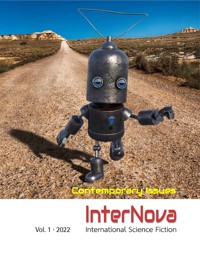
CONTEMPORARY ISSUES E-Book
1,99 €
Mehr erfahren.
- Herausgeber: p.machinery
- Kategorie: Fantasy und Science-Fiction
- Sprache: Englisch
Issue #1 is titled "Contemporary Issues" and its content is: Brandon Crilly (Canada) "Remembrance" Adriana Alarco de Zadra (Peru) "The Jellyfish" Louis Evans (USA) "Babies Come from Earth" Bruce Golden (USA) "The Withering" Guy Hasson (Israel) "The Assassination" Helmuth W. Mommers (Austria) "Download" Ana Cristina Rossi (Costa Rica) "Abel" C.M. Teodorescu (Romania) The Death of Mr. Teodorescu" Frank Roger (Belgium) "The Colony"
Das E-Book können Sie in Legimi-Apps oder einer beliebigen App lesen, die das folgende Format unterstützen:
Seitenzahl: 158
Veröffentlichungsjahr: 2022
Ähnliche




















InterNOVA online
Volume 01 · 2022
This e-book is free for personal use only. It may be obtained via direct download from www.pmachinery.de/internova/online/in01.zip. It is not permitted to share this e-book via social media, peer to peer networks and the like.
Unauthorized distribution might be persecuted as a copyright violation.
The copyright of all contributions remains with the respective writers.
© of this issue: August 2022
p.machinery Michael Haitel
Editor: Michael K. Iwoleit
Proofreading: Adriana Kantcheva
Cover picture: Anaterate (Pixabay)
Layout & cover design: global:epropaganda
Production: global:epropaganda
Publisher: p.machinery Michael Haitel
Norderweg 31, DE-25887 Winnert
www.pmachinery.de
www.internova-sf.de
ISBN ePub: 978 3 95765 804 3
ISBN PDF: 978 3 95765 803 6
Editorial
When in summer 2002 Helmuth W. Mommers, Ronald M. Hahn and me founded the science fiction magazine Nova which was primarily conceived as a forum for contemporary science fiction stories in German, it was part of our concept to include in each issue one translated story by a foreign guest writer. Although famous writers such as Brian W. Aldiss and Greg Egan supported our endeavor with contributions and we published a number of British and Northern American writers over the years, our focus was on countries and regions whose local science fiction production was, like the German, generally neglected by the Anglo-American centered science fiction markets, regardless of their quality. While looking for interesting stories, we established so many new contacts that soon the idea came up to publish an international edition of our magazine that would feature stories from all over the world in English or English translation. The first and unfortunately only issue of InterNova, as Nova's sister magazine was dubbed, was published in 2005, but the time wasn't ripe for a magazine like that, especially due to distribution problems. Still, InterNova made its contribution to a movements towards a global science fiction that has continuously grown stronger and more comprehensive since then. Especially our successful fellow Lavie Tidhar from Israel and the Apex Book Company in the USA played a major role in it. Around 2010 I continued InterNova as a web magazine for a while. A planed relaunch with new design and regular publishing schedule didn't come about as health problems kept me unable to work for several years, The idea of an international science fiction magazine, however, was never given up.
After moving Nova to its new publisher p.machinery it turned out soon that owner Michael Haitel and me not only collaborate marvelously but also have in common that both like to take risks and start something new. It didn't take me much, thus, to convince Michael to give InterNova another chance. The preparations for the restart took some time. Writers from all over the world submitted almost hundred short stories and novellas as well as numerous articles and interviews. The first result of our efforts is presented to you here now. It is planed that InterNova will run with four to six online issues and one printed issue each year, the latter published by p.machinery and available internationally through all common distribution channels. The online issues will alternate between mixed issues with writers from various countries and themed issues about the science fiction of particular countries and regions. But even the general issues will have a theme motto and present stories with a lose thematic connection. In the present issue writers tackle, in very different ways, topics that are of relevance in the current world situation. We hope that our readers will enjoy reading these remarkable tales.
I have to thank all writers who contributed stories to the new InterNova and to all the fans and editors who helped me to make contacts. A special thanks goes to Adriana Kantcheva who was the first to join in as a volunteer editorial helper.
Michael K. Iwoleit
July 2022
Brandon Crilly: Remembrance
Anna turned from the cutting board when she heard the door open behind her and saw her father finally emerge from the basement.
He rubbed his bleary eyes as he shuffled into the kitchen, the servos in his right leg whirring and squeaking. He was still wearing his cotton pajamas and fleecy blue robe even though it was nearing one o’clock in the afternoon. Without a word, he sat down at the kitchen table and idly scratched at the stubble on his jaw.
It took all of her will for Anna not to say something. She chewed the top of her lip until it started to sting but stopped before she drew blood like she had last time. With a sigh, she went back to chopping the celery for their lunch.
She heard the front door slide open and sighed, knowing that only one person was supposed to be visiting them that day. The sound of heels clicking reached the kitchen a few moments ahead of Dorothy, her father’s physiotherapist — or “air-headed technician” as far as Anna was concerned. Cheery, red-headed Dorothy was supposed to be a specialist, assigned by the company that donated the artificial leg to Anna’s dad, but somehow she hadn’t gotten the whir or the squeak out of it yet.
“Afternoon, Mr. Sheldon!” Dorothy greeted as she walked past the counter where Anna was standing. “Everything going well today?”
“Already played a few rounds of cards with the squad,” Anna’s father said. “Just finished a few minutes ago.”
Anna could picture his eyes lighting up as he spoke. She finished chopping the celery with more gusto than necessary and dropped it into the food processor with enough force to make it rattle.
Neither of them seemed to notice the outburst. Dorothy was in front of the fridge, calling up the calendar on the embedded touch screen. For some reason she could never remember how long her session with Anna’s father was supposed to be even though the length rarely changed. Anna needed to get some more vegetables from the fridge, so she waited with arms crossed for Dorothy to finish. Her father had gone back to scratching his stubble.
Dorothy finished checking her schedule. Then, as per usual, she noticed the screen’s background image had been changed to a rolling springtime meadow, and with a casual flick of one finger changed it to a close-up shot of five figures in army uniforms. Her daily ritual complete, she left to get her equipment, which was stored in a cupboard elsewhere.
Anna glared at Dorothy’s retreating back and then crossed to the fridge. As calmly as she could, she retrieved a few more vegetables for the ground medley she was making. When she shut the door, she spent a moment staring at the new image on the screen — or rather, the old one. She and Dorothy fought a weekly battle over that image, two women in their early thirties feuding like little girls. Anna refused to give up. She would not look at the photo of those five soldiers every time she came into the kitchen. It didn’t matter that it was one of her father’s favorite pictures, or even that he was in it, smiling and laughing with his old comrades from Afghanistan. Anna refused to have that image showing in their home.
Dorothy returned with her equipment, a small scanner and an adjustor, as Anna was adding the last ingredients to the processor. The physiotherapist crouched down in front of Anna’s father and asked him to start moving his artificial leg while she ran the scanner over it.
“So, how is the squad today, Mr. Sheldon?” she asked cheerily.
“Oh, they’re fine, just fine,” Anna’s father said. His voice gained more inflection as he spoke as though each word was an energy boost. “I actually managed to beat Rick today. You should have seen his face! He said he’s never going to play cards with me again, but I know he’ll be up for it again tomorrow. I think we’re going down to the river after lunch.”
“Well, that sounds lovely!” Dorothy said, practically cooing. “Be sure to say ‘hi’ to them for me, as always.”
“You know I will...”
Anna tried to tune them out. While every word brightened her father, it only tightened the knot in her stomach. She preferred to be elsewhere when Dorothy was around, but she had to make sure her father got his lunch. The gnawing hunger he must have been feeling was the only reason he left the basement, after all.
For the hundredth time, she wished her mother were there. Her mother had been able to deal with everything far better than Anna could. She could have handled Dorothy. Anna just stood there, making lunch and trying to ignore the conversation behind her.
After a few minutes, Dorothy clicked her tongue in satisfaction, signaling that her father’s session was over. At the same time, the processor poured the ground vegetables onto three plates, which Anna deftly carried over to the table. Anna always made enough for Dorothy to eat when she was around, but only because her father had once insisted that it was polite.
Dorothy didn’t even acknowledge Anna as the plates were set down; she seldom did. Instead, she turned to Anna’s father and said, “Now, you be sure to have a nice, long walk with the squad when you go to the river. I want you to keep that leg from seizing, but more importantly, you deserve to have fun with your friends!”
The last plate of food hit the table with a clang. Dorothy jumped, and turned to look at Anna for the first time that day.
“Can I talk to you?” Anna said, gesturing to the hallway nearby. She hoped her tone made it clear she wasn’t really asking.
Dorothy just nodded and left the kitchen. Anna smiled at her father, who looked as though he had stopped paying attention again. As soon as she had her back to him, she let the smile fall.
In the hallway, she said to Dorothy, “I need you to stop.”
Dorothy sighed, her cheeriness abruptly vanishing. “We’ve had this discussion before, Anna.”
“Except I keep asking politely. Now, you’re just going to stop. As of today.”
“I maintain it’s not only beneficial, but healthy for your father —”
“What in God’s name is healthy about what he’s doing?” Anna demanded. She had planned on keeping her voice low, to not disturb her father, but she didn’t care anymore. She was going to deal with this; she was the one taking care of him now that her mother was gone. “Is it healthy for him to spend the entire day in the basement, hooked up to that damn computer? Is it beneficial for him not to interact with anyone but what that computer feeds him?”
“There’s nothing wrong with him seeing his friends —”
“They’re not real!” Anna shouted. Her hands were shaking now, and she was surprised she wasn’t crying. “Nothing about his life is real anymore because of what you people gave him! I never should’ve let you bring that machine into our home!”
“I understand how you’re feeling,” Dorothy said. She raised her hands and put on a soothing tone, similar to how she spoke to Anna’s father only not as cheery. “But you must realize that this is the best way for your father to cope. PTSD is a hard thing to live with, and our company’s remembrance program —”
“Don’t,” Anna said. “Don’t give me those corporate lines again. How can you call yourself his therapist? You’re supposed to make him better.”
“Anna —”
“Get out.”
Dorothy tried to speak again, but Anna just pointed at the door and said, “Just get out. And if you come back, and you talk to my father about the squad again, I’ll be speaking to your superiors.”
That seemed to shut her up. Dorothy stared at Anna for a moment longer, then turned and headed for the front door without another word, scanner and adjustor clenched tightly in her arms.
When she heard the front door slide closed again, Anna let out a long, shuddering breath. She quickly wiped away the tears that had leaked down her face. She knew she shouldn’t have been so harsh, but Dorothy just didn’t understand. Neither did that company, or even the military. They could all talk to her about making her father better, but, in the end, they were only making him worse.
After taking a minute to calm down, she returned to the kitchen. Her father wasn’t there. His lunch was sitting untouched on the table. He never left without finishing his meal, so Anna instantly knew something was wrong, and regretted shouting. Luckily, she knew exactly where her father had gone.
She could hear his shuffling footsteps and squeaking leg as she walked down the narrow, rickety staircase into the basement. The room was surprisingly small and completely unfinished; her father had been overseas for most of his service, and, since then, he hadn’t had the energy or inclination to improve it. There were a few boxes of odds and ends stacked in one corner, with the water heater in another, next to the fuse box. In the center of the room, there was a cushy, blue chair that almost matched the color of her father’s robe. It sat in front of the long, metal table the corporate technicians had brought to support their invention: the sleek, black computer that Anna hated, with its virtual reality system, its thin fluid injectors, and the innocent-looking neural jack.
Her father was checking the settings on the computer, as he did with every piece of technology before using it. Seeing that aspect of his personality unchanged made Anna feel a little better, until she saw him pick up one of the fluid injectors. After the injectors were hooked to his arm, the neural jack would follow.
“Dad,” she said, and he stopped and turned to her, his expression calm and mild. She didn’t know how to begin; she had kept quiet for so long that the words weren’t coming. “I’m sorry I shouted up there. I kind of lost it on Dorothy.”
“You don’t have to apologize,” her father said. He smiled, and, though it looked sad to Anna, it was still the most genuine expression she had seen on him in a long time. It wasn’t a fading effect from his time connected to that computer, or his usual benign expression. “I understand why you’re upset.”
“Do you?” Anna asked, taking a step toward him.
“Yeah,” he said, and looked down at the neural jack. She wondered if it gave him comfort. “I realize a lot more than you think, honey. I know how much you wish I didn’t use this thing. And how you think I don’t know that what it shows me ... isn’t real.”
Her father looked up at her again, and she saw his eyes were wet. “I know they’re not real. I know that when I’m hooked up, I’m not overseas with the squad. That when I talk to Rick, and Joan, and Andre, and the rest, I’m not actually with them. It doesn’t change anything.”
“How can it not?” Anna asked, after finding her voice again. “If you know it’s not real, why do you stay down here all day, pretending you’re playing cards or walking by a river?”
“You don’t know what it’s like.” His voice started to shake.
“Dad,” Anna pleaded, “I need to understand.”
He sighed. “We … we trained together. We were like a family. They ...” He struggled to find the words. “We were trained how to work together, to be like brothers and sisters ... but not how to deal with ... afterwards.”
This was becoming the longest conversation she’d had with her father in a while. Listening to him trying to voice a sense of loss and longing that must have reached to his core, she felt her own tears start falling again. She crossed her arms to steady herself, knowing she had to continue. Her father seemed coherent, but she had no idea if she could ever have this conversation with him again.
“Staying down here won’t help you come to grips with that, Dad. It won’t get any easier.”
“How can you know?” His eyes widened, and he looked at her with more intensity as though he had woken up. “This remembrance program ... when I see the squad, they don’t judge me, or accuse me of leaving them behind, like they do in my dreams. They try to comfort me. When I’m with them ... I can forget what really happened.”
“But ... it’s not real. They’re not real...” Anna said.
“They don’t realize that. I know they’re just simulations, using data to pretend to be my friends, but if I didn’t know, I wouldn’t doubt who they are. Now that I have them back...”
Her father shook his head, looking up at the ceiling. “You know, we decided not to say anything like goodbye. As if ... as if it was a bad omen. I ... I just need more time with them...”
He wiped his eyes as his voice faded, and Anna suspected she wouldn’t get anything else from him. She could see his expression turning distant, one of his favorite defense mechanisms. He was still holding the neural jack, though tighter than before.
For a while, Anna just stared at him, trying to understand how someone could become so damaged. Her father never told her any stories about the war, not even anecdotes about the squad. She knew they were important to him, but she wondered how they could be so important that he had to spend every day seeing them, for years, because he couldn’t come to grips with surviving where they died. It was a product of PTSD, of course, but that didn’t change her father’s feelings.
Is there anything that would make me so ... obsessed? she wondered.
Again, she wished her mother were there to help her. Her mother would have sat her down, told her what to do and that everything would be all right. It wasn’t just the support Anna missed, though. It was singing while they cooked meals, watching holofilms in the living room — decades of experiences that were only memories now. She knew she would give anything to spend just a little more time with her mother.
Anna’s breath caught.
Her mother had been taken away just as suddenly, though by a brain hemorrhage instead of a war. Anna hadn’t been able to say goodbye, but she thought that, over the years, she had come to grips with losing her. But she knew if she were given the chance, she wouldn’t pass on spending more time with her mother. As strongly as she felt about her father’s behavior, watching him disappear into the basement so he could ignore the world and his only daughter to laugh it up with his war buddies ... she had to wonder if she would behave any differently.




