


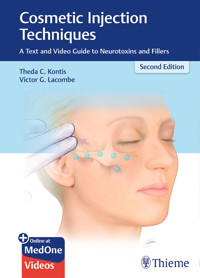
Cosmetic Injection Techniques E-Book
119,99 €
Mehr erfahren.
- Herausgeber: Thieme Medical Publishers
- Kategorie: Fachliteratur
- Sprache: Englisch
The quintessential guide to state-of-the-art cosmetic injection approaches, from two renowned experts!
This revised and updated second edition of Cosmetic Injection Techniques: A Text and Video Guide to Neurotoxins and Fillers by esteemed facial plastic surgeons Theda Kontis and Victor Lacombe builds on their bestselling first edition. Content is designed to augment knowledge of beginner injectors and train veteran injectors on how to finesse facial fillers and muscle-relaxing injections. Since publication of the first edition, understanding of the aging face has increased, while the number of non-surgical facial enhancements has continued to skyrocket. The book's primary focus is the improvement of minor facial irregularities and asymmetries using the latest injection procedures.
Divided into six sections and four appendices, the book starts with the patient consultation and concludes with a new section on fat-dissolving techniques using Kybella. The fillers section features new chapters on choosing the right filler, fine lines and skin boosters, the de Maio technique, the mandibular angle, poly-l-lactic acid for the décolleté, and gender-specific injections. All chapters follow a reader-friendly, consistent format with succinct paragraphs covering indications, injection techniques, anatomic considerations, precautions, risks, pearls, illustrations or photos, and additional reading. Select chapters reflect North American techniques utilized by the authors that vary from East Coast to West Coast.
Key Highlights
- Precise, full-color illustrations by Sarah Faris afford a detailed look at underlying anatomy
- 75 superb short video clips narrated by Dr. Kontis provide procedural guidance
- A section dedicated to neurotoxin injections details the use of neuromodulators such as Botox and Dysport, with new chapters on neurotoxins for the décolleté and profusely sweating forehead
- A full spectrum of facial augmentation, rejuvenation, and volumization techniques are described, using hyaluronic acid fillers, hyaluronidase, Sculptra, Radiesse, BellaFill, and others
- Appendix A lists chapters by degree of difficulty, enabling injectors to safely advance to more challenging injection techniques
This is the essential quick-reference guide on injection techniques. Plastic surgeons, cosmetic surgeons, dermatologists, nurse injectors, and physician assistant/nurse practitioner injectors who wish to increase their knowledge of injection methods and refine skills will greatly benefit from this outstanding, easy-to-use manual.
This print book includes a scratch off code to access a complimentary digital copy on MedOne.
Publisher's Note: Products purchased from Third Party sellers are not guaranteed by the publisher for quality, authenticity, or access to any online entitlements included with the product.
Das E-Book können Sie in Legimi-Apps oder einer beliebigen App lesen, die das folgende Format unterstützen:
Veröffentlichungsjahr: 2019
Ähnliche




















To access the additional media content available with this e-book via Thieme MedOne, please use the code and follow the instructions provided at the back of the e-book.
Cosmetic Injection Techniques
A Text and Video Guide to Neurotoxins and Fillers
Second Edition
Theda C. Kontis, MD, FACSAssociate ProfessorThe Johns Hopkins University HospitalBoard-Certified Facial Plastic SurgeonFacial Plastic SurgicenterBaltimore, Maryland
Victor G. Lacombe, MDBoard-Certified Facial Plastic SurgeonSanta Rosa, California
Sarah E. Faris, MA, CMIAssistant ProfessorVirginia Commonwealth UniversitySchool of the ArtsMedical IllustratorRichmond, Virginia
Foreword byJean D. Carruthers, MD, FRCSC, FRC(Ophth)Fellow, American Society of Ophthalmic Plastic and Reconstructive SurgeryClinical Professor, Department of OphthalmologyUniversity of British ColumbiaVancouver, British Columbia, Canada
127 illustrations
ThiemeNew York • Stuttgart • Delhi • Rio de Janeiro
Executive Editor: Stephan Konnry
Managing Editor: J. Owen Zurhellen IV
Editorial Assistant: Holly Bullis
Director, Editorial Services: Mary Jo Casey
International Production Director: Andreas Schabert
Editorial Director: Sue Hodgson
International Marketing Director: Fiona Henderson
International Sales Director: Louisa Turrell
Director of Institutional Sales: Adam Bernacki
Senior Vice President and Chief Operating Officer: Sarah Vanderbilt
President: Brian D. Scanlan
Library of Congress Cataloging-in-Publication Data
Names: Kontis, Theda C., author. | Lacombe, Victor G., author.
Title: Cosmetic injection techniques : a text and video guide to neurotoxins and fillers / Theda C. Kontis, Victor G. Lacombe ; Sarah E. Faris, medical illustrator ; foreword by Jean D. Carruthers.
Description: Second edition. | New York : Thieme, [2019] | Includes bibliographical references and index.
Identifiers: LCCN 2018051037| ISBN 9781626234574 (hardback : alk. paper) | ISBN 9781626234581 (e-book)
Subjects: | MESH: Cosmetic Techniques | Face–surgery | Injections, Subcutaneous–methods | Neurotoxins– therapeutic use | Dermal Fillers–therapeutic use | Face–anatomy & histology
Classification: LCC RD119.5.F33 | NLM WE 705 | DDC 617.5/20592–dc23
LC record available at https://lccn.loc.gov/2018051037
Copyright © 2019 by Thieme Medical Publishers, Inc.
Thieme Publishers New York333 Seventh Avenue, New York, NY 10001 USA+1 800 782 3488, [email protected]
Thieme Publishers StuttgartRüdigerstrasse 14, 70469 Stuttgart, Germany+49 [0]711 8931 421, [email protected]
Thieme Publishers DelhiA-12, Second Floor, Sector-2, Noida-201301Uttar Pradesh, India+91 120 45 566 00, [email protected]
Thieme Publishers Rio de Janeiro, Thieme Publicações Ltda.Edifício Rodolpho de Paoli, 25° andarAv. Nilo Peçanha, 50 – Sala 2508,Rio de Janeiro 20020-906 Brasil+55 21 3172 2297/+55 21 3172-1896www.thiemerevinter.com.br
Cover design: Thieme Publishing GroupTypesetting by DiTech Process Solutions 5 4 3 2 1
Printed in India by Replika Press Pvt. Ltd.
ISBN 978-1-62623-457-4
Also available as an e-book:eISBN 978-1-62623-458-1
Important note: Medicine is an ever-changing science undergoing continual development. Research and clinical experience are continually expanding our knowledge, in particular our knowledge of proper treatment and drug therapy. Insofar as this book mentions any dosage or application, readers may rest assured that the authors, editors, and publishers have made every effort to ensure that such references are in a ccordance with the state of knowledge at the time of production of the book.
Nevertheless, this does not involve, imply, or express any guarantee or responsibility on the part of the publishers in respect to any dosage instructions and forms of applications stated in the book. Every user is requested to examine carefully the manufacturers’ leaflets accompanying each drug and to check, if necessary in consultation with a physician or specialist, whether the dosage schedules mentioned therein or the contraindications stated by the manufacturers differ from the statements made in the present book. Such examination is particularly important with drugs that are either rarely used or have been newly released on the market. Every dosage schedule or every form of application used is entirely at the user’s own risk and responsibility. The authors and publishers request every user to report to the publishers any discrepancies or inaccuracies noticed. If errors in this work are found after publication, errata will be posted at www.thieme.com on the product description page.
Some of the product names, patents, and registered designs referred to in this book are in fact registered trademarks or proprietary names even though specific reference to this fact is not always made in the text. Therefore, the appearance of a name without designation as proprietary is not to be construed as a representation by the publisher that it is in the public domain.
This book, including all parts thereof, is legally protected by copyright. Any use, exploitation, or commercialization outside the narrow limits set by copyright legislation, without the publisher’s consent, is illegal and liable to prosecution. This applies in particular to photostat reproduction, copying, mimeographing, preparation of microfilms, andelectronicdata processing and storage.
I dedicate this second edition to David and Alexandra, for their love and support; to Mom, my greatest fan; and to the memory of my father, my angel.
– TCK
I dedicate, with love, this second edition to my wife, Alice, and to my children, Victoria and Max: you all mean the world to me.
– VGL
We jointly dedicate this book to our patients, whose trust and feedback allow us to improve and refine our injection techniques.
– TCK and VGL
Contents
denotes a chapter with video content on MedOne
Foreword
Preface
Acknowledgments
Menu of Accompanying Videos
Section I Introduction to Injectables
1The Consultation
2The Physicians Aesthetic Coalition for Injectable Safety
Section II Introduction to Neurotoxins
3Neurotoxins Overview
4Neurotoxin Preparation
5Instrumentation for Neurotoxin Injections
Section III Neurotoxin Injection Techniques
6Neurotoxin Injection for Glabellar Frown Lines
7Neurotoxin Injection for Forehead Wrinkles
8Neurotoxin Injection for Smile Lines and Crow’s Feet
9Neurotoxin Injection for Lateral Brow Lift
10Neurotoxin Injection for Chemical Brow Lift
11Neurotoxin Injection for Lower Eyelid Roll
12Neurotoxin Injection for Bunny Lines
13Neurotoxin Injection for Nasal Tip Lift
14Neurotoxin Injection for Nasal Flare
15Neurotoxin Injection for Elevating the Oral Commissures
16Neurotoxin Injection for Lip Lift
17Neurotoxin Injection for Smoker’s Lines
18Neurotoxin Injection for Gummy Smile
19Neurotoxin Injection for Dimpled Chin
20Neurotoxin Injection for Platysmal Banding
21Neurotoxin Injection for Necklace Lines
22Neurotoxin Injection for the Décolleté
23Neurotoxin Injection for Nefertiti Neck Lift
24Neurotoxin Injection for Masseter Hypertrophy
25Neurotoxin Injection for Parotid Gland Hypertrophy
26Neurotoxin Injection for Submandibular Gland Hypertrophy
27Neurotoxin Injection for Gustatory Sweating (Frey Syndrome)
28Neurotoxin Injection for Profusely Sweating Underarms
29Neurotoxin Injection for Profusely Sweating Scalp and Forehead
30Neurotoxin Injection for Profusely Sweating Hands
31Neurotoxin Injection for Profusely Sweating Feet
32Neurotoxin Injection for Chronic Migraines
33Management of Neurotoxin Injection Complications
Section IV Introduction to Fillers
34Fillers Overview
35Anesthesia Techniques
36Filler Injection Methods
37Choosing the Right Filler
Section V Filler Injection Techniques
38Filler Injection for Nasolabial Folds
39Filler Injection with Polymethyl Methacrylate (Bellafill)
40Fine Line Fillers and Skin Boosters
41Filler Injection for Marionette Lines
42Filler Injection for Lip Augmentation
43Filler Injection for Elevating the Oral Commissures
44Filler Injection for Vertical Lip Lines
45Filler Injection for Glabellar Frown Lines
46Filler Injection for Forehead Wrinkles
47Filler Injection for Tear Trough Deformity
48Filler Injection for Sunken Upper Eyelids
49Filler Injection for Lateral Brow Lift
50Filler Injection for Sunken Temples
51Filler Injection for Nonsurgical Rhinoplasty
52Filler Injection for Nasal Valve Stenting
53Filler Injection for Medial Midface Hollowing
54Filler Injection for Cheekbone Augmentation
55Filler Injection for Sunken Cheeks
56Filler Injection for Cheek Lift: de Maio Technique
57Filler Injection for Chin Augmentation
58Filler Injection for the Mental Crease
59Filler Injection for Jawline Rejuvenation
60Filler Injection for Mandibular Angle Augmentation
61Filler Injection for Earlobe Rejuvenation
62Filler Injection for Acne Scars
63Filler Injection for Aging Hands
64Filler Injection with Poly-L-Lactic Acid for Facial Volumizing (Sculptra)
65Filler Injection with Poly-L-Lactic Acid for the Décolleté
66The “Liquid Facelift”
67Gender-Specific Injections
68Management of Filler Injection Complications
Section VI Fat-Dissolving Injections
69Submental Fat Reduction
Section VII Appendices
Appendix A: Neurotoxin/Filler Injection Techniques by Advancing Difficulty and Injector’s Experience
Appendix B: Sample Informed Consent Form for Neurotoxin Injections
Appendix C: Sample Informed Consent Form for Filler Injections
Appendix D: Sample Informed Consent Form for Kybella Treatment
Index
Foreword
Dr. Theda C. Kontis and Dr. Victor G. Lacombehave now published their combined experiences in this second edition of their practical handbook, Cosmetic Injection Techniques. The first edition was not only a bestseller but also had such quality videos that they were the most accessed videos in all of Thieme’s library. The authors have again done a superb job in making facial tissue “transparent” for everyone interested in this increasingly important subject area. New subjects covered include the injectable consultation, choosing the right filler, neurotoxin and filler treatment for the décolleté, filler to the mandibular angle and jawline, the de Maio technique for midface volumization, neurotoxins for sweaty scalps and foreheads, fillers for fine lines, and gender-specific indications/injections. With the new use of sodiumdeoxycholate there is a further section on submental fat injections.
Cosmetic surgeons have the privilege of using transcutaneous treatments to restore patients’ faces to their natural best. This book with its videos is a labor of love written by highly respected authors who discuss variations in techniques from the East and the West Coasts of the United States. I recommend it to all readers who choose to review their treatment plans from start to finish and who value learning from experts who teach with passion as well as knowledge.
Jean D. Carruthers, MD, FRCSC, FRC(Ophth)Fellow, American Society of Ophthalmic Plastic and Reconstructive SurgeryClinical Professor, Department of OphthalmologyUniversity of British ColumbiaVancouver, British Columbia, Canada
Preface
I hear and I forget.I see and I remember.I do and I understand.
– attributed to Confucius (551–479 BCE)
We are pleased to present this revised second edition of Cosmetic Injection Techniques: A Text and Video Guide to Neurotoxins and Fillers. This new edition includes new fillers and new techniques as well as information on fat-dissolving injections. The accompanying videos have also been updated. Our readers found the first edition to be a handy quick-reference guide as well as a guide to new injection techniques. Patients in the office have enjoyed looking through this text so they may better understand the injections they are about to receive, and injectors have found the diagrams to be useful for patient education.
The number of non-surgical facial enhancements has continued to skyrocket since our first edition was published. As a consequence of patient demand, many physicians, nurses, and physician assistants have begun to treat such patients. This book, with its accompanying videos, is meant to be a guide and quick reference for the many professionals and paraprofessionals who have become facial injectors. It is not, however, a training manual for the naive injector. We highly discourage the novice injector from using this book as a primer on injections. In our opinion, nothing can replace training that is offered by courses and by one-on-one preceptorships.
This book is designed to augment the knowledge of a beginner injector and to train the experienced injector in how to perform “finesse” injections. The face can be shaped and minor irregularities and asymmetries improved by performing the techniques we describe. In addition, we hope to help the injector “look through” the skin to the underlying anatomy. This will help with both the targets of injection and the important structures to avoid. The authors are aware that there is more than one way to treat a given anatomic region. It was our aim, by having authors from two very different locales (the East and the West Coasts of the United States) and different practices, to describe the “best” injection technique by comparing our techniques of injection. In cases where the authors’ techniques differ markedly, both techniques are presented.
The products described herein are all U.S. Food and Drug Administration (FDA)-approved fillers and neurotoxins; however, most of the techniques described are considered “off-label” uses of the products. The doses of products described serve as a general guide for injection. While the utmost care was taken to assure the accuracy of the dosages listed, we urge injectors to use their best judgment or experience in the unlikely event that a misprint suggests an inappropriate dose. The comments we make about specific products are often our opinion derived from clinical observation. Others may have different observations clinically, and we respect these variations in clinical practices and results.
We realize that this book will be utilized by injectors with differing skill levels. In an attempt to promote safety in the use of these products, we have devised a rating scale for each technique. Each injection technique is evaluated in terms of difficulty for the trainer, risks involved in performing the injection, and patient satisfaction with the results. Appendix A lists the chapters by degree of difficulty, as a cross reference for injectors who would like to safely advance to more challenging injection techniques. The rating system is summarized as follows:
Degree of difficulty for the injector:
• Easy
•• Intermediate
••• Advanced
•••• Expert (only expert injectors should attempt these injections)
Patient satisfaction with the procedure:
• Variable results, results may be subtle
•• Good results, patients usually pleased
••• High patient satisfaction, predictable results
Risks of complications:
• Low
•• Medium
••• High
The products described in this book include Botox, Dysport, Xeomin, Restylane, Restylane Lyft, Restylane Silk, Restylane Refyne, Restylane Defyne, Juvéderm Volbella, Juvéderm Vollure, Belotero, Radiesse, Sculptra, and Bellafill. These products are the most commonly used fillers and neurotoxins at the time this manual is being written. New products are continually being developed and may be available by the time of publication. However, because we have no experience with these new products, they are necessarily not described in this second edition. Experienced injectors, however, will be able to extrapolate the techniques and dosing strategies described in this book to newer products, if they so desire.
Disclosures: Theda C. Kontis is a speaker/trainer for Allergan and for Galderma. Victor G. Lacombe is a speaker/trainer for Allergan and for Galderma and served as a principal investigator for Juvéderm Voluma.
Disclaimer: The material presented is a compilation of the clinical experiences of the authors. Off-label uses of FDA-approved products are described. A qualified health care professional should be consulted before using any therapeutic procedure discussed. Readers should verify all information and data before treating patients or employing any therapies described in this publication.
Acknowledgments
The authors believed that a simplified, well-illustrated, and thorough guide to injectables was needed in the medical literature. The editors at Thieme Publishers, in particular Timothy Hiscock, trusted our vision, and in the first edition we produced one of the best-selling books and most accessed videos in Thieme’s collection. We were delighted when asked to produce this second edition.
We appreciate the editorial support and assistance from J. Owen Zurhellen and Sue Hodgson at Thieme, who kept the project moving forward. The qualityof this book has much to do with the fine artwork of our medical illustrator, Sarah E. Faris, who graciously agreed to continue the work in this edition. Her attention to detail and artistic skill made this textbook one that is not only thorough but easy to read and understand.
Finally, and most importantly, we thank our patients who have agreed to have their procedures filmed so that medical professionals can learn safe and effective injection techniques.
Menu of Accompanying Videos
Video 6.1 Neurotoxin Injection for Glabellar Frown Lines
Video 6.2 Neurotoxin Injection for Glabellar Frown Lines
Video 6.3 Neurotoxin Injection for Glabellar Frown Lines
Video 6.4 Neurotoxin Injection for Glabellar Frown Lines, Forehead Wrinkles, Smile Lines, and Crow’s Feet
Video 6.5 Neurotoxin Injection for Glabellar Frown Lines, Forehead Wrinkles, and Lower Eyelid Roll
Video 6.6 Neurotoxin Injection for Glabellar Frown Lines and Forehead Wrinkles
Video 6.7 Neurotoxin Injection for Glabellar Frown Lines and Dimpled Chin
Video 6.8 Neurotoxin Injection for Glabellar Frown Lines
Video 6.9 Neurotoxin Injection for Glabellar Frown Lines
Video 6.10 Neurotoxin Injection for Glabellar Frown Lines
Video 7.1 Neurotoxin Injection for Forehead Wrinkles
Video 7.2 Neurotoxin Injection for Forehead Wrinkles
Video 7.3 Neurotoxin Injection for Forehead Wrinkles
Video 7.4 Neurotoxin Injection for Forehead Wrinkles
Video 7.5 Neurotoxin Injection for Glabellar Frown Lines, Forehead Wrinkles, Smile Lines, and Crow’s Feet
Video 7.6 Neurotoxin Injection for Glabellar Frown Lines and Forehead Wrinkles
Video 7.7 Neurotoxin Injection for Glabellar Frown Lines, Forehead Wrinkles, and Lower Eyelid Roll
Video 7.8 Neurotoxin Injection for Forehead Wrinkles
Video 7.9 Neurotoxin Injection for Forehead Wrinkles
Video 8.1 Neurotoxin Injection for Glabellar Frown Lines, Forehead Wrinkles, Smile Lines, and Crow’s Feet
Video 8.2 Neurotoxin Injection for Lower Eyelid Roll
Video 8.3 Neurotoxin Injection for Smile Lines and Crow’s Feet
Video 8.4 Neurotoxin Injection for Smile Lines and Crow’s Feet
Video 8.5 Neurotoxin Injection for Smile Lines and Crow’s Feet
Video 9.1 Neurotoxin Injection for Lateral Brow Lift
Video 10.1 Neurotoxin Injection for Chemical Brow Lift
Video 10.2 Neurotoxin Injection for Chemical Brow Lift
Video 11.1 Neurotoxin Injection for Glabellar Frown Lines, Forehead Wrinkles, and Lower Eyelid Roll
Video 12.1 Neurotoxin Injection for Bunny Lines
Video 13.1 Neurotoxin Injection for Nasal Tip Lift
Video 15.1 Neurotoxin Injection for Elevating the Oral Commissures
Video 16.1 Neurotoxin Injection for Lip Lift
Video 17.1 Neurotoxin Injection for Smoker’s Lines
Video 18.1 Neurotoxin Injection for Gummy Smile
Video 19.1 Neurotoxin Injection for Dimpled Chin
Video 19.2 Neurotoxin Injection for Glabellar Frown Lines and Dimpled Chin
Video 19.3 Neurotoxin Injection for Elevating the Oral Commissures and for Dimpled Chin
Video 19.4 Neurotoxin Injection for Elevating the Oral Commissures and for Dimpled Chin
Video 19.5 Neurotoxin Injection for Dimpled Chin
Video 20.1 Neurotoxin Injection for Platysmal Banding
Video 21.1 Neurotoxin Injection for Necklace Lines
Video 22.1 Neurotoxin Injection for the Décolleté
Video 23.1 Neurotoxin Injection for Nefertiti Neck Lift
Video 24.1 Neurotoxin Injection for Masseter Hypertrophy
Video 24.2 Neurotoxin Injection for Masseter Hypertrophy
Video 28.1 Neurotoxin Injection for Profusely Sweating Underarms
Video 35.1 Dental Block 1
Video 35.2 Dental Block 2
Video 38.1 Filler Injection for Nasolabial Folds and Elevating the Oral Commissures
Video 38.2 Filler Injection for Nasolabial Folds, Marionette Lines, and Elevating the Oral Commissures
Video 38.3 Filler Injection for Nasolabial Folds, Marionette Lines, and Elevating the Oral Commissures
Video 38.4 Filler Injection for Nasolabial Folds, Marionette Lines, Elevating the Oral Commissures, and Jawline Rejuvenation
Video 38.5 Filler Injection for Nasolabial Folds, Marionette Lines, and Jawline Rejuvenation
Video 38.6 Filler Injection for Nasolabial Folds, Marionette Lines, Elevating the Oral Commissures, and Mental Crease
Video 38.7 Filler Injection for Nasolabial Folds, Elevating the Oral Commissures, Tear Trough Deformity, and Sunken Cheeks
Video 38.8 Filler Injection for Nasolabial Folds, Marionette Lines, and Jawline Rejuvenation
Video 38.9 Filler Injection for Nasolabial Folds, Elevating the Oral Commissures, Mental Crease, and Jawline Rejuvenation
Video 38.10 Filler Injection for Nasolabial Folds
Video 40.1 Fillers for Fine Lines and Skin Boosters
Video 40.2 Fillers for Fine Lines and Skin Boosters
Video 41.1 Filler Injection for Marionette Lines
Video 41.2 Filler Injection for Marionette Lines, Lip Augmentation, and Elevating the Oral Commissures
Video 41.3 Filler Injections for Nasolabial Folds, Marionette Lines, and Jawline Rejuvenation
Video 41.4 Filler Injections for Nasolabial Folds, Marionette Lines, and Jawline Rejuvenation
Video 41.5 Filler Injections for Nasolabial Folds, Marionette Lines, Elevating the Oral Commissures, and Mental Crease
Video 41.6 Filler Injections for Nasolabial Folds, Marionette Lines, Elevating the Oral Commissures, and Jawline Rejuvenation
Video 42.1 Filler Injection for Lip Augmentation
Video 42.2 Filler Injection for Marionette Lines, Lip Augmentation, and Elevating the Oral Commissures
Video 42.3 Filler Injection for Lip Augmentation, Elevating the Oral Commissures, and for Vertical Lip Lines
Video 42.4 Filler Injection for Lip Augmentation
Video 43.1 Filler Injection for Nasolabial Folds, Marionette Lines, Elevating the Oral Commissures, and Mental Crease
Video 43.2 Filler Injection for Lip Augmentation and for Elevating the Oral Commissures
Video 43.3 Filler Injection for Nasolabial Folds, Elevating the Oral Commissures, Tear Trough Deformity, and Sunken Cheeks
Video 43.4 Filler Injection for Nasiolabial Folds, Marionette Lines, Elevating the Oral Commissures, and Jawline Rejuvenation
Video 43.5 Filler Injection for Marionette Lines, Lip Augmentation, and Elevating the Oral Commissures
Video 43.6 Filler Injection for Lip Augmentation, Elevating the Oral Commissures, and for Vertical Lip Lines
Video 43.7 Filler Injection for Elevating the Oral Commissures
Video 43.8 Filler Injection for Elevating the Oral Commissures
Video 43.9 Filler Injection for Elevating the Oral Commissures
Video 43.10 Filler Injection for Elevating the Oral Commissures
Video 44.1 Filler Injection for Lip Augmentation, Elevating the Oral Commissures, and for Vertical Lip Lines
Video 44.2 Filler Injection for Vertical Lip Lines
Video 44.3 Filler Injection for Vertical Lip Lines
Video 45.1 Filler Injection for Glabellar Frown Lines
Video 47.1 Filler Injection for Tear Trough Deformity and Cheekbone Augmentation
Video 47.2 Filler Injection for Tear Trough Deformity and Medial Midface Hollowing
Video 49.1 Filler Injection for Lateral Brow Lift
Video 49.2 Filler Injection for Lateral Brow Lift
Video 49.3 Filler Injection for Lateral Brow Lift
Video 50.1 Filler Injection for Sunken Temples
Video 51.1 Filler Injection for Non-Surgical Rhinoplasty
Video 52.1 Filler Injection for Nasal Valve Stenting
Video 53.1 Filler Injection for Medial Midface Hollowing
Video 54.1 Filler Injection for Cheekbone Augmentation
Video 54.2 Filler Injection for Cheekbone Augmentation
Video 55.1 Filler Injection for Nasolabial Folds, Elevating the Oral Commissures, Tear Trough Deformity, and Sunken Cheeks
Video 56.1 Filler Injection for Cheek Lift: The de Maio Technique
Video 58.1 Filler Injection for the Mental Crease
Video 58.2 Filler Injection for Nasolabial Folds, Marionette Lines, Elevating the Oral Commissures, and Mental Crease
Video 59.1 Filler Injection for Jawline Rejuvenation
Video 59.2 Filler Injection for Nasolabial Folds, Marionette Lines, and Jawline Rejuvenation
Video 59.3 Filler Injection for Nasolabial Folds, Marionette Lines, and Jawline Rejuvenation
Video 59.4 Filler Injection for Jawline Rejuvenation
Video 61.1 Filler Injection for Earlobe Rejuvenation
Video 63.1 Filler Injection for Aging Hands
Video 63.2 Filler Injection for Aging Hands
Video 64.1 Filler Injection with Poly-L-Lactic Acid for Facial Volumizing (Sculptra)
Video 64.2 Filler Injection with Poly-L-Lactic Acid for Facial Volumizing (Sculptra)
Video 69.1 Injection Technique for Submental Fat Reduction
Section I
Introduction to Injectables
I
1 The Consultation
2 The Physicians Aesthetic Coalition for Injectable Safety
1 The Consultation
Initial Evaluation
A combination of factors can lead a patient to visit a provider for injectable treatment or evaluation. Often it is a result of the patient looking or feeling tired, or being told that they give that impression to others. Sometimes it is the drive for youthful appearance or for simply a different look (whether that is fewer wrinkles, fuller lips, or higher cheek bones). The motivation for change may be preparation for an event that is fast approaching, like a wedding or reunion, or a longer-term goal, such as maintaining a competitive edge in the job market. All of these factors must be determined in the first discussions prior to developing the plan. The time frame for treatment and recovery, longevity of results, and patient expectations must be part of the planning.
Anatomic Considerations
The injector must have a thorough and comprehensive understanding of facial bone structure, muscle location and function, skin structure and thicknesses, as well as the location of nerve and vascular supplies to the face and neck. Greater familiarity will lead to increased comfort, sophistication, and talent with both diagnosing and treating the changes seen in facial aging. Most aging changes are a result of facial fat loss and redistribution away from key areas of the face, which leads to sagging, undesirable folds, and skeletonization. Loss of fat in the forehead and temples leads to dropping brows and hollowing of the temples. Loss of fat on the cheeks and around the eyes causes dark circles under the eyes and drooping of the malar skin, creating deeper nasolabial folds as well as hollowing, melolabial folding, and jowling. Buccal fat loss contributes to a gaunt look in the lower cheek and can create the effect of a “pouch” lateral to the mouth (which is really just a prominent modiolus due to hollowing anteriorly and posteriorly). Intrinsic changes of the skin due to solar exposure and collagen and elastin loss can accentuate these changes. Recognizing, understanding, and explaining to patients the global effects of these anatomic changes will greatly facilitate the consultation.
Consultation Techniques
A mirror placed on a desk in front of the patient (or a hand-held mirror) is used so that the patient’s facial features can be analyzed, both at rest and in animation. It is important to ask patients about what bothers them the most when they look into the mirror. Sometimes the practitioner’s trained eye targets an area that turns out not to bother the patient at all. Patients are happiest when we listen to and address their concerns first. After we discuss how we can (or cannot) improve what bothers them, then we can help them develop a plan for total facial rejuvenation, if they so desire.
Pointing out facial asymmetries or irregularities should be done as part of the pre-injection teaching. Patients may not see their asymmetries pre-injection but will note them post-injection. Photographic documentation is essential to document the pre-injection appearance. Three-dimensional photography is another helpful tool that can be used as an objective means to demonstrate areas of concavity and asymmetry as well as skin changes.
Once the need for treatment is established, a summary of the tools available, including neurotoxins for relaxing, fillers for volume restoration, skin boosting, and line filling, is in order. Patients may have heard of the different brand names but are often ignorant of where they go, how they work, and how long the results will last. One should develop clear, concise talking points on the products used, which include safety and recovery profiles. Next, the injector should recommend the quantity of product necessary for a complete correction and a conservative estimate as to when that would need to be re-treated. This should also be provided in written estimate form to avoid any later confusion. An example would be 50 units of Botox to treat the glabella, forehead, and crow’s feet, and six syringes of hyaluronic acid (HA) filler to treat under eyes, upper cheek bones, melolabial folds, lip lines, and jawline. The patient should understand that the injections can be done either all at once or in stages, as the patient’s budget allows. This would complete the consultation and leave the patient well educated and not feeling like they were pressured.
Some patients will want to be injected at their initial consultation, and others will just want to develop a plan by gaining information and having their questions answered. The initial consultation can be overwhelming for a patient new to injectables. It is important to proceed slowly at first. If a patient is not a candidate for neurotoxins or fillers, be honest about it.
Precautions
The injector must listen to patients and take cues from their body language about how comfortable they are with the concept of injectables and how willing they are to proceed. Some patients are very timid and self-conscious about discussing aesthetic issues. In those cases, it is best not to overwhelm them with too many things that they did not initially seek advice about lest they be be scared away. Other patients may be open to a clinician’s advice as to what is available and will want to learn all that is possible. Listen carefully to patients and address their primary aesthetic concerns first.
Body dysmorphic disorder (BDD) is a syndrome that all injectors should understand. Know that BDD patients often desire our expertise: these patients have abnormal body perceptions, and small abnormalities are magnified in their mind. It is difficult, if not impossible, to please such patients, so proceed with caution. In practice, it is more likely to regret injecting someone than to regret not injecting them!
Additional Reading
[1] Coleman SR, Grover R. The anatomy of the aging face: volume loss and changes in 3-dimensional topography. Aesthet Surg J. 2006; 26 1S: S4‐S9 PubMed
[2] Crerand CE, Menard W, Phillips KA. Surgical and minimally invasive cosmetic procedures among persons with body dysmorphic disorder. Ann Plast Surg. 2010; 65(1): 11‐16 PubMed
[3] Matarasso A, Nikfarjam J, Abramowitz L. Incorporating Minimally Invasive Procedures into an Aesthetic Surgery Practice. Clin Plast Surg. 2016; 43(3): 449‐457 PubMed
2 The Physicians Aesthetic Coalition for Injectable Safety
The increased popularity of injectable procedures has been accompanied by an unfortunate increase in the performance of these procedures by unqualified personnel. It is the authors’ concern that the use of this book by untrained individuals could produce disastrous results. The Physicians Aesthetic Coalition (PAC) was created to provide information on qualified injectors, on materials approved by the U.S. Food and Drug Administration (FDA), and on injectable training that can be obtained by qualified professionals. We direct patients and injectors to http://www.physiciansaestheticcoalition.org for appropriate information about the safe use of injectable materials.
The PAC is represented by over 5,000 board-certified members of the American Society for Aesthetic Plastic Surgery (ASAPS), the American Society for Dermatologic Surgery (ASDS), the American Academy of Facial Plastic and Reconstructive Surgery (AAFPRS), and the American Society of Ophthalmic Plastic and Reconstructive Surgery (ASOPRS). We encourage professionals to utilize the PAC website for up-to-date information about injectables and injectable safety, laws, and ethical guidelines pertaining to the purchase of injectables, research and statistics, and courses available for training in the use of injectables.
Section II
Introduction to Neurotoxins
II
3 Neurotoxins Overview
4 Neurotoxin Preparation
5 Instrumentation for Neurotoxin Injections
3Neurotoxins Overview
Action
Peripheral neuromuscular blocking agents.
Mechanism of Action
Botulinum toxins irreversibly bind to the presynaptic terminal of the neuromuscular junction and prevent release of acetylcholine, thereby preventing muscle contraction.
Botulinum Toxin A (BoNTA) Formulations
Botox: OnabotulinumtoxinA (BoNTA-ONA)
100 BU (Botox units) per vial (also contains 0.5 mg human serum albumin, 0.9 mg sodium chloride)
Vacuum dried
Store in freezer until reconstituted; refrigerate after reconstitution
Dysport: AbobotulinumtoxinA (BoNTA-ABO)
300 DU (Dysport units) per vial (also contains 0.125 mg human serum albumin, 2.5 mg lactose)
Lyophylized
Store in freezer until reconstituted; refrigerate after reconstitution
Xeomin: IncobotulinumtoxinA (BoNTA-INC)
100 XU (Xeomin units) per vial (also contains 1.0 mg human albumin, 4.7 mg sucrose)
Lyophylized
Store at room temperature; refrigerate after reconstitution
Neuronox
Approved in 2004 by the South Korean Ministry of Food and Drug Safety (MFDS), manufactured by Medy-Tox Inc. (Seoul, Korea)
Not U.S. FDA-approved in the United States
50, 100, and 200 U vials available (100 U contains 0.5 mg human serum albumin and 0.9mg sodium chloride)
Lyophilized
Conversion ratio appears to be 1:1 with Botox
Store in freezer until reconstituted; refrigerate after reconstitution
PurTox
Pending FDA approval
Similar to Xeomin without complexing proteins
CBTXA
Not FDA-approved in the United States
The only botulinum toxin A registered with the Chinese government
Lyophilized
Contains 5 mg bovine serum albumin, 25 mg dextran, 25 mg sucrose per 100 units
Conversion ratio to Botox unknown
Store in freezer, refrigerate after reconstituted
Botulinum Toxin B (BoNTB) Formulation
Myobloc: BoNTB (rimabotulinumtoxinB)
Solstice Neurosciences Inc., Malvern, PA
Trade names: MyoBloc, NeuroBloc
Minimal use cosmetically due to painful injection and limited duration
FDA-approved only for cervical dystonia in adult
Additional Reading
[1] Flynn TC. Advances in the use of botulinum neurotoxins in facial esthetics. J Cosmet Dermatol. 2012; 11(1): 42‐50 PubMed
[2] Nettar K, Maas C. Neuromodulators: available agents, physiology, and anatomy. Facial Plast Surg. 2011; 27(6): 517‐522 PubMed
[3] Moers-Carpi M, Dirschka T, Feller-Heppt G, et al. A randomised, double-blind comparison of 20 units of onabotulinumtoxinA with 30 units of incobotulinumtoxinA for glabellar lines. J Cosmet Laser Ther. 2012; 14(6): 296‐303 PubMed
[4] Walker TJ, Dayan SH. Comparison and overview of currently available neurotoxins. J Clin Aesthet Dermatol. 2014; 7(2): 31‐39 PubMed
Table 3.1
Comparison of Botulinum Toxin A Formulations.
Product
Year of FDA Approval
Generic Name l
Composition
Manufacturer
Similar Product Trade Names
Dosing Ratio Compared with Botox
Botox
2002
OnabotulinumtoxinA
900 kD
Allergan Inc., Irvine, CA
Botox cosmetic, Vistabel, Vistabex
NA
Dysport
2009
AbobotulinumtoxinA
500–900 kD
Medicis Aesthetics Inc., Scottsdale, AZ
Reloxin, Azzalure
2.5–3:1
Xeomin
2011
IncobotulinumtoxinA
150 kD
No complexing proteins
Merz Aesthetics Inc., Franksville, WI
Xeomeen, Bocouture
1–1.5:1
Neuronox
N/A
N/A
940 kD
Medy-Tox Inc., Seoul, Korea
Meditoxin, Cunox, Siax, and Botulift
1:1
PurTox
Pending
N/A
150 kD
No complexing proteins
Mentor Corp., Santa Barbara, CA
1–1.5:1
CBTXA
N/A
N/A
900 kD
Lanzhou Biologics, Lanzhou, China
Prosigne, Lantox
?
Abbreviations: kD, kilodalton; N/A, not applicable.
4Neurotoxin Preparation
Package inserts for the neurotransmitters state that they should be reconstituted with nonpreserved saline (0.9% sodium chloride). However, clinical practice has determined that using preserved saline (containing benzyl alcohol) results in much less patient discomfort.
Botox, Botox Cosmetic—100 BU (Botox units) may be reconstituted with
1 mL preserved saline, which produces a solution of 10 BU per 0.1 mL
2 mL preserved saline, which produces a solution of 5 BU per 0.1 mL
2.5 mL preserved saline, which produces a solution of 4 BU per 0.1 mL
4 mL preserved saline, which produces a solution of 2.5 BU per 0.1 mL
Xeomin—100 XU (Xeomin units) may be reconstituted and used similarly to Botox, above.
Dysport—300 DU (Dysport units) may be reconstituted with
2.5 mL preserved saline, which produces a solution of 12 DU per 0.1 mL
1.5 mL preserved saline, which produces a solution of 20 DU per 0.1 mL
1.0 mL preserved saline, which produces a solution of 30 DU per 0.1 mL
General conversion ratios
Additional Reading
[1] Bass Kaplan J. The dilution confusion: easy dosing for botulinum toxins. Plast Surg Nurs. 2016; 36(1): 24‐27 PubMed
[2] Moers-Carpi M, Tan K, Fulford-Smith A. A multicentre, randomized, double-blind study to evaluate the efficacy of OnabotulinumtoxinA (20 units) in the treatment of glabellar lines when compared to IncobotulinumtoxinA (30 units). European Masters in Aesthetic and Anti-aging Medicine, September 30–October 1, 2011, Paris




