


19,99 €
Mehr erfahren.
- Herausgeber: John Wiley & Sons
- Kategorie: Wissenschaft und neue Technologien
- Sprache: Englisch
How to make digital photography lighting more creative--and less challenging! How do you master the art of lighting your photographs? Go beyond the basics, go beyond the "rules," and get creative with the help of renowned photographer Harold Davis. In this book, Harold shows you how to break the boundaries of conventional wisdom and create unique, lively, and beautifully lit photographs. Packed with tips and tricks as well as stunning examples of the author's creativity, this book will both inform and inspire you to create your own lighting style. * Teaches you when and how to control the light in your photographs * Reviews the basic "rules" of digital photography lighting and shows you how to break the rules to create your own uniquely lit images * Helps you start building a lighting style of your own * Includes stunning examples of the author's photography and lighting techniques Whether you're a beginner or a seasoned digital photographer, you'll find ideas and techniques to spark your creativity.
Sie lesen das E-Book in den Legimi-Apps auf:
Seitenzahl: 210
Veröffentlichungsjahr: 2011
Ähnliche




















200mm macro, 1/640 of a second at f/5 and ISO 100, tripod mounted
To get the lighting right, I combined an exposure of the rising full moon with a longer exposure (to let more light in) of the San Francisco skyline.400mm, 2 combined exposures at 1/30 of a second and 1/2 of a second, each exposure at f/5.6 and ISO 400, tripod mounted
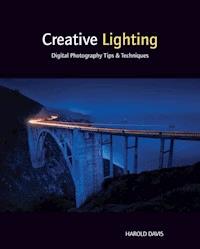
Creative Lighting
Digital Photography Tips & Techniques
Harold Davis
200mm macro lens, 24mm extension tube, close-up filter, 1/2 of a second at f/32 and ISO 200, tripod mounted
Creative Lighting: Digital Photography Tips & Techniques by Harold Davis
Published by Wiley Publishing, Inc. 10475 Crosspoint Boulevard Indianapolis, IN 46256 www.wiley.com
Copyright © 2011 by Wiley Publishing, Inc., Indianapolis, Indiana
All photographs © Harold Davis
Published simultaneously in Canada
ISBN:978-0-470-87823-1
Manufactured in the United States of America
10 9 8 7 6 5 4 3 2 1
No part of this publication may be reproduced, stored in a retrieval system or transmitted in any form or by any means, electronic, mechanical, photocopying, recording, scanning or otherwise, except as permitted under Sections 107 or 108 of the 1976 United States Copyright Act, without either the prior written permission of the Publisher, or authorization through payment of the appropriate per-copy fee to the Copyright Clearance Center, 222 Rosewood Drive, Danvers, MA 01923, (978) 750-8400, fax (978) 750-4744. Requests to the Publisher for permission should be addressed to the Legal Department, Wiley Publishing, Inc., 10475 Crosspoint Blvd., Indianapolis, IN 46256, (317) 572-3447, fax (317) 572-4355, or online at http://www.wiley.com/go/permissions.
Limit of Liability/Disclaimer of Warranty: The publisher and the author make no representations or warranties with respect to the accuracy or completeness of the contents of this work and specifically disclaim all warranties, including without limitation warranties of fitness for a particular purpose. No warranty may be created or extended by sales or promotional materials. The advice and strategies contained herein may not be suitable for every situation. This work is sold with the understanding that the publisher is not engaged in rendering legal, accounting, or other professional services. If professional assistance is required, the services of a competent professional person should be sought. Neither the publisher nor the author shall be liable for damages arising herefrom. The fact that an organization or Web site is referred to in this work as a citation and/or a potential source of further information does not mean that the author or the publisher endorses the information the organization or Web site may provide or recommendations it may make. Further, readers should be aware that Internet Web sites listed in this work may have changed or disappeared between when this work was written and when it is read.
For general information on our other products and services or to obtain technical support, please contact our Customer Care Department within the U.S. at (800) 762-2974, outside the U.S. at (317) 572-3993 or fax (317) 572-4002.
Wiley also publishes its books in a variety of electronic formats. Some content that appears in print may not be available in electronic books.
Library of Congress Control Number: 2011920610
Trademarks: Wiley and the Wiley Publishing logo are trademarks or registered trademarks of John Wiley and Sons, Inc. and/or its affiliates. All other trademarks are the property of their respective owners. Wiley Publishing, Inc. is not associated with any product or vendor mentioned in this book.
Acknowledgements
Special thanks to Courtney Allen, Graham Bird, Mark Brokering, Steven Christenson, Gary Cornell, Barry Pruett, Sandy Smith, and Matt Wagner.
Credits
Acquisitions Editor: Courtney Allen
Project Editor: Matthew Buchanan
Technical Editor: Chris Bucher
Copy Editor: Matthew Buchanan
Editorial Manager: Robyn Siesky
Business Manager: Amy Knies
Senior Marketing Manager: Sandy Smith
Vice President and Executive Group Publisher: Richard Swadley
Vice President and Publisher: Barry Pruett
Book Designer: Phyllis Davis
Media Development Project Manager: Laura Moss
Media Development Assistant Project Manager: Jenny Swisher
200mm, 1/160 of a second at f/5.6 and ISO 100, hand held
Introduction
Without light there is no photography. By using the gerund—“lighting” rather than light—an active role is implied: to some extent the photographer is involved in creating, manipulating or engineering the light used to create the photo.
In fact, active intervention by a photographer who manipulates or creates light varies on a spectrum from none to complete. For example, a photographer who creates a landscape may leave the lighting up to weather and chance circumstance. In this passive scenario, the photographer chooses moment, position, lens and camera setting—but the rest is left to nature.
At the other extreme, in the context of studio photography, the photographer completely creates an environment and set, as well as the lighting that will be used to illuminate it.
In between these extremes is the photographer who takes advantage of ambient lighting but adds some light of their own—or who improvises a combination of natural sunlight and artificial light to create a masterful still life or portrait.
It’s a strange thing, but no matter how active the photographer is in creating light used in an image, the most crucial skill for the photographer is the ability to accurately and creatively observe light. Without encouraging and training this talent, all types of photographers—whether they shoot in the natural landscape using ambient light or in the studio with artificial illumination—will not be able to master lighting. If you cannot deeply feel and see the impact of lighting, you can’t effectively use or modify lighting in your work—and you will not be the best photographer you can be.
With this in mind, Creative Lighting: Digital Photography Tips & Techniques starts with some ideas about how to nurture your talent for observing light. Note that this concern is pragmatic: I care about the impact of light on a photo, not light as a wave or light from the viewpoint of a physicist.
Lighting in a photo involves not only the illumination cast upon a scene but also the exposure settings used to capture that scene. I’ll explain the variables in this exposure equation so that you’ll understand how to use your camera to best respond to the light you observe.
Next, I’ll show you how to best use lighting in the natural world. How can you take advantage of—and possibly modify and improve—ambient and directional lighting? And, how can you modify or manipulate existing lighting to get great creative images?
In the studio, the lights used for still life compositions generally give out continuous light. I’ll show you how to master creative still life effects that involve transparency, reflectivity, shadow play, and more.
In contrast to the continuous lights used in still life work, the strobes used to capture people and motion produce short bursts of extremely intense light. I’ll explain the basics of studio strobe lighting—and show you how to create some great figure study and portrait lighting effects.
You can completely change the lighting of a photo in post-processing using software such as Adobe Photoshop. The extent of flexibility regarding lighting in the digital darkroom would have been unimaginable only a few short years ago. The final section of the book shows you how to use Photoshop to enhance the lighting in your photos.
My hope in Creative Lighting is to be your companion and guide by providing inspiration, ideas, and techniques as we work together to create photos that are masterfully lit—enjoy!
Best wishes in photography,
200mm, circular polarizer, 10 seconds at f/32 and ISO 100, tripod mounted
Seeing the Light
200mm macro, 8 seconds at f/36 and ISO 100, tripod mounted
Quality of Light
Without light there is no photograph. But light bears a more important and subtle relationship to photography than this statement of absolutes suggests. In fact, the quality of light makes or breaks a photo across a wide range of potential subjects. No matter what the subject matter, when the photographer creatively and perceptively sees and captures light, then great photos are possible. But humdrum and ordinary use of light leads to boring and ordinary imagery.
Since you are reading this book, you probably agree that the quality of light is very important to good photography. Actually, I think it would be hard not to agree. But this assessment leads to more questions: What is this mysterious concept of “quality” associated with light? For that matter, what is this mysterious substance “light?”
Understanding Light
Anything you can see is a source of light, unless it is completely black. Otherwise, the world around us would be invisible. Things you can see are either transmitting light sources—for example, the sun, a light bulb, or a strobe—or are reflective light sources. A reflective light source is essentially anything that doesn’t itself generate the light; if you shine a light on a model, and use this lighting for a photo, the model is a reflective light source.
In fact, we don’t actually see things. If you stop to think about it for a moment, you’ll realize that for an object to be visible it must be illuminated. What you are actually seeing is light creating apparent contours, shapes, colors, and so on. Light caresses objects to make them visible, so we think we see them—but we are actually interpreting the action of light in our minds (or cameras) rather than looking at objects themselves, and none of this would be possible without light.
Without us being consciously aware of it, our brains are continuously decoding the electromagnetic radiation that reaches our retinas and using this information to provide us with our “pictures” of the world—often with powerful emotional impact solely based on the perceived lighting.
Light itself is not a substance in the normal way we think of things. Instead, it consists of waves ofelectromagnetic radiation. As these waves “wash” over and around objects over time, we (and our cameras) are able to create a visual impression of the objects that are illuminated.
Usually, this impression is created almost instantaneously—because light moves very quickly, and because the visual processing handled by our brains takes place mostly at a speed faster than conscious thought. But when cameras are involved, things slow down to the camera’s shutter speed range, or to the pulse of a strobe if studio lighting is used.
It’s important to note that in the context of photography time is always involved in lighting—whether it is the brief fraction of a second needed to light a landscape or studio scene or the hours needed to capture a dark landscape at night. An object is illuminated by waves of light energy over time—although the amount of time may be very short indeed.
The statement that “anything you can see is a source of light” is an oversimplification—particularly in the digital era—because there are energy waves close in frequency to visible light that our camera sensors can capture but we cannot see. In normal usage, light means electromagnetic waves on a spectrum—a wavelength—that is visible to the human eye, but to scientists light can also mean electromagnetic waves on parts of this spectrum that are not visible to us.
If you can see something, it is certainly a source of reflective or transmitted visible light—but there are other sources of “near light” that our cameras can pick up and use in photographic imaging. Taking advantage of illumination from energy sources beyond the visible spectrum tends to only be important to a few specialized areas of photography, such as infrared and night photography (see pages 150–157). But it’s important to realize that there are some sources of “light” that you may not be able to see—but your camera can.
Characteristics of Light
With the understanding that light itself is an electromagnetic wave, that people and objects only appear real if they are illuminated by light, and that time is always involved in photographic lighting, it’s appropriate to give some thought to understanding what makes the elusive quality of light that is so essential to photography.
First, light quality is no one thing, no single effect or setting. Photographs in which the quality of light differ greatly in many important characteristics can each be said to have excellent quality of light. For example, an image with strong and harsh light might be a spectacular character study, while a delicate close-up might require subdued, subtle, and diffuse light. So there’s no one-size-fits-all answer to what makes high-quality lighting, and it always depends upon the context. This implies that in thinking about light and lighting one should try to understand the palette of available options.
Since the lighting in a photo largely controls the mood and emotions that the image communicates, your understanding of the quality of light needs to take place at least partially at a gut or emotional level. You can spend your life parsing out the technical factors that go into lighting—and knowing these are a good thing—but knowing them cold won’t lead to something more important. The ability to use lighting to manipulate the emotions of people looking at your images is an invaluable skill.
From the viewpoint of physics, a light wave has a number of properties. The most important of these are intensity, meaning the strength of the light (see pages 22–27), and the wavelength, which corresponds to the color temperature, or perceived color of the light source (see pages 34–39 and 102–107).
As I’ve noted, a light source is either transmitting light or reflecting light. It’s very different photographing into the sun as compared with photographing something lit by the sun. This is the distinction between light transmission and reflectivity. Reflectivity is explained further on pages 52–55 and 186–189.
When I evaluate light and lighting, besides intensity and reflectivity, I try to understand a number of factors:
The direction of light (pages 28–33)The color of the light (pages 34–39) and whether it is diffuse or harsh (pages 40–43)Whether my intentions are to create a dark or light image (pages 46–49)Whether transparency plays a role in the image (pages 56–59 and 178–181)The importance of strong shadows to the photo I have in mind (pages 60–63 and 182–185)If I’ve pre-visualized a black and white photo, then I need to consider the impact of lighting on my monochromatic rendition (see pages 64–67).
It’s worth noting that pre-visualization is an important part of understanding the quality of lighting. (For more on pre-visualizing the impact of lighting, see pages 108–111). Ultimately, I rely on my sense of what shifting a choice in lighting will do to inform the actual changes I make—so it is important to develop your skills relating to pre-visualization.
Justice Potter Stewart of the United States Supreme Court famously noted that he couldn’t easily define obscenity, but he knew it when he saw it. The same thing is true about great photographic lighting. You won’t necessarily be able to put your finger on why the lighting is great for a particular photo, but if you work to better understand lighting and hone your pre-visualization skills, you will come to know it when you see it—and become able to deliver great quality of lighting in your images.
48mm, 1/160 of a second at f/14 and ISO 200, hand held
The fairly long exposure (30 seconds) involves enough time so that the lights from objects in motion—such as the car headlights—are rendered in a path rather than in the crisp snapshot view that we are more used to.
12mm, 30 seconds at f/5.6 and ISO 100, tripod mounted
200mm macro, 1/125 of a second at f/16 and ISO 100, tripod mounted
The Golden Hour
It is hard to define great lighting—and good quality of light differs from photographic situation to situation. However, there’s one kind of lighting that almost always produces good results: photographs taken outdoors during the so-called “golden hour.”
Depending upon who you talk to, atmospheric conditions, time of year, and your geographic location, golden hour lighting extends before and after sunrise and sunset, perhaps about an hour in either direction. This time of great lighting lasts longer at sunset than it does at sunrise. I’ve heard a quip from professional location photographers that they could photograph at sunrise, go to sleep for the bulk of the day, and wake to photograph at sunset—there’s not much point working outdoors at any other times.
What makes golden hour lighting so great? To answer this question it makes sense to carefully observe what happens to the lighting at sunset. Colors get yellower and redder as the color temperature becomes warmer. Things seem more heavily saturated. As the sun hits the horizon line, the quality of the light becomes more diffuse due to haze and atmospheric distortion. At the same time, the light stays intense and strong until the sun has literally set.
These are qualities to emulate if you are creating light wholly or partially by artificial means—warm, diffuse, and strongly directional lighting seems to inherently produce a significantly positive emotional response in those who see it.
15mm, six captures at shutter speeds ranging from 1/6 of a second (lightest) to 1/160 of a second (darkest), each capture at 15mm, f/8 and ISO 100, tripod mounted, captures combined in Photomatix and Photoshop
Unfortunately, photographers aren’t the only creatures aware of the golden hour. Mosquitoes seem to emerge just as thelight gets good. In the couple of hours I spent photographing this lake, I fended off hordes of the little buzzing winged carnivores.
I like using a polarizer filter to amp the colors of golden hour landscapes even further. This is particularly true when water and reflections are involved. Using a polarizer can help bring out reflections, and it also serves to make golden hour lighting seem even more grand and spectacular than it already is.
18mm, circular polarizer, 1/60 of a second and f/11, tripod mounted
Intensity of Light
Light intensity refers to the strength of the light—and this is something that can, of course, be measured by your camera or an external light meter. This kind of measurement can be a helpful starting place. But as I’ll discuss later in this book in the Exposure section (pages 68–111), the point of an exposure—and of knowing the strength of your lighting—is not to use this data in a preset formula; rather, it isuseful as a basis for making creative decisions.
It’s worth noting that effective light intensity depends upon the distance of your subject from the light source, as well as the intensity of the light itself. For some lighting sources, this fact is irrelevant—for example, you can’t move the sun. However, you can position artificial lights—and it’s helpful to realize that intensity has an inverse ratio to the distance of light to subject. Actually, light intensity falls off roughly according to an inverse-squared ratio. For more on lighting placement, see pages 162–209.
In a photographic rendering, the absolute intensity of lighting is not usually the most important thing about the intensity. What matters is the contrast, or perceived relative intensity of lighting, compared to the darker areas of a photo. A photo in a dimly lit room with a single shaft of strong sunlight can seem to be more intensely lit than a photo taken on a bright sunny day outdoors. Objectively, there is far stronger lighting in the outdoor scene—but the mixed lighting seems more intense.
A great deal of the emotional power in a photo comes from the photographer’s ability to control the dynamic range—tonal range from lights to darks—in a photo. Using digital darkroom controls and specialized techniques designed to increase dynamic range (see pages 210–247), along with the ability to extend and modulate the range of tones in a photo gives modern photographers more power over their image creation than ever before.
When working with light intensity in your photos, you should first understand whether the emotional appeal of lighting in your photo comes from overall flat lighting without high contrast, or whether the difference between dark and light areas makes the image.
In either case, your next goal should be to emphasize the effect you desire. If the image works because the lighting is overall flat, diffuse, and at the same time glowing—make sure your lighting, exposure, and post-processing delivers the impact you have pre-visualized.
If the emotional appeal of the image comes from the contrast between a few bright,overlit areas and dark background shadows, make sure that your technique follows your intentions. In this kind of image, apparent intensity combined with deep shadows can enhance compositions by cloaking unwanted areas—and adding an overall sense of tension and mystery.
24mm, 1/160 of a second at f/8 and ISO 100, hand held
This portrait works because of the overall evenness of the low-contrast lighting. The model was literally in the water in an outdoor swimming pool. I achieved the lighting effect by filtering the relatively harsh sunlight bouncing off the water through a beach umbrella (you can see the umbrella as red in the background), and by using a fill card to bounce sunlight into the shadowed areas of the model’s face.200mm, 1/250 of a second at f/5.6 and ISO 100, hand held
200mm macro, 1/180 of a second and f/40 at ISO 200, tripod mounted
Lensbaby Composer, 1/160 of a second using f/5.6 aperture ring and ISO 500, hand held




