


16,99 €
Mehr erfahren.
- Herausgeber: John Wiley & Sons
- Kategorie: Wissenschaft und neue Technologien
- Sprache: Englisch
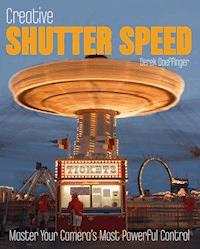
A unique guide to creative shutter speed techniques, illustratedwith striking full-color examples Along with available light and aperture, shutter speed is one ofthe variables that determine exposure-the amount of lightthat reaches the camera's sensor. Set on automatic modes, camerastypically attempt to reduce or eliminate blur in a picture. But bymanipulating shutter speed creatively, photographers can achieve arange of striking motion blur or stop-action effects. Using anarray of inspiring photographs depicting people, wildlife, andlandscapes, Creative Power of Shutter Speed explains how to "read"the light and movement in a potential photograph and identify thebest shutter speed for the desired effect.
Sie lesen das E-Book in den Legimi-Apps auf:
Seitenzahl: 249
Veröffentlichungsjahr: 2011
Ähnliche




















Derek Doeffinger
Creative Shutter Speed: Master Your Camera’s Most Powerful Control
Published by Wiley Publishing, Inc.10475Crosspoint BoulevardIndianapolis, IN46256 www.wiley.com
Copyright ©2009by Wiley Publishing, Inc., Indianapolis, Indiana
Published simultaneously in Canada
ISBN: 978-0-470-45362-9
Manufactured in the United States of America
10 9 8 7 6 5 4 3 2 1
No part of this publication may be reproduced, stored in a retrieval system or transmitted in any form or by any means, electronic, mechanical, photocopying, recording, scanning or otherwise, except as permitted under Sections 107 or 108 of the 1976 United States Copyright Act, without either the prior written permission of the Publisher, or authorization through payment of the appropriate per-copy fee to the Copyright Clearance Center, 222 Rosewood Drive, Danvers, MA 01923, (978) 750-8400, fax (978) 750-4744. Requests to the Publisher for permission should be addressed to the Legal Department, Wiley Publishing, Inc., 10475 Crosspoint Blvd., Indianapolis, IN 46256, (317) 572-3447, fax (317) 572-4355, or online at http://www.wiley.com/go/permissions.
Limit of Liability/Disclaimer of Warranty:The publisher and the author make no representations or warranties with respect to the accuracy or completeness of the contents of this work and specifically disclaim all warranties, including without limitation warranties of fitness for a particular purpose. No warranty may be created or extended by sales or promotional materials. The advice and strategies contained herein may not be suitable for every situation. This work is sold with the understanding that the publisher is not engaged in rendering legal, accounting, or other professional services. If professional assistance is required, the services of a competent professional person should be sought. Neither the publisher nor the author shall be liable for damages arising herefrom. The fact that an organization or Web site is referred to in this work as a citation and/or a potential source of further information does not mean that the author or the publisher endorses the information the organization or Web site may provide or recommendations it may make. Further, readers should be aware that Internet Web sites listed in this work may have changed or disappeared between when this work was written and when it is read.
For general information on our other products and services or to obtain technical support, please contact our Customer Care Department within the U.S. at (800) 762-2974, outside the U.S. at (317) 572-3993 or fax (317) 572-4002.
Wiley also publishes its books in a variety of electronic formats. Some content that appears in print may not be available in electronic books.
Library of Congress Control Number:2009928481
Trademarks: Wiley and the Wiley Publishing logo are trademarks or registered trademarks of John Wiley and Sons, Inc. and/or its affiliates. All other trademarks are the property of their respective owners. Wiley Publishing, Inc. is not associated with any product or vendor mentioned in this book.
About the Author
Derek Doeffinger started writing, editing, conceiving, photographing, and marketing Kodak photo books when film SLRs were the rage back in the 1980s. When Kodak started down the digital photography path in the early 1990s, he joined their digital imaging division and participated in the launch of Kodak’s first consumer digital camera. He’s been participating in digital photography for over fifteen years now. In recent years, in addition to writing about digital photography, he has also written and photographed several regional photo books about upstate New York.
Credits
Acquisitions Editor: Courtney Allen
Project Editor: Carol Doeffinger
Technical Editor: Alan Hess
Copy Editor: Carol Doeffinger
Editorial Manager: Robyn Siesky
Business Manager: Amy Knies
Senior Marketing Manager: Sandy Smith
Vice President and Executive Group Publisher: Richard Swadley
Vice President and Publisher: Barry Pruett
Book Designer: Erik Powers
Author’s Acknowledgments
Thanks to the many people involved in this project for both their patience and expertise. My daughter Bari Doeffinger, a fine writer in her own right, who edited the rough draft. To Carol Doeffinger for her meticulous (and I do mean meticulous) editing of the final manuscript. To John Wiley’s Courtney Allen for taking on this project and providing valuable guidance. To fellow author, photographer, and friend Jeff Wignall for his suggestions, insights, and support. To Gary Whelpley, good friend and inspirational photo buddy, for the use of his photos. To photographer friends Stewart Hecht, Mike Brown, and Herb Chong for use of their photos. And to book designer Erik Powers for patiently handling many suggestions while producing a design that so nicely features both words and photos.
Chapter 1: Tap the Power of Every Shutter Speed
Have you ever counted how many shutter speeds your camera has? Like many digital SLRs, my camera has over fifty marked shutter speeds. Yours probably has a similar number. That’s a lot of shutter speeds and it can be an overwhelming number when it comes time to choose the appropriate setting for a specific situation.
That tally raises an important question: What can you possibly do with over fifty different shutter speeds?
Well, that’s what this introductory chapter is all about. These pages show you some of the fantastic pictures you can take once you learn how to use the full range of your camera’s shutter speeds. As you look at the photographs and begin reading, you may want to pick up your camera and experiment with some of the shutter speed settings used in these introductory pages. That’s not a bad idea. In fact, whenever you get inspired by a tip or a photo or one of your own ideas, bookmark your place and go out and shoot some pictures of your own.
I’ll introduce you to some major players in the shutter speed lineup, but I’m not going to bore you by talking about every single shutter speed setting. After all, there’s not much difference between the results delivered by neighboring shutter speeds such as 1/15 second and 1/13 second, or 1/500 second and 1/640 second. Instead, I’ll give you an overview of a shutter speed series as its duration doubles, starting with the fastest shutter speed available—1/8000 second. So the sequence of shutter speeds I’ll cover goes something like this: 1/8000 second, 1/4000 second, 1/2000 second, 1/1000 second—all the way up to 8 hours.
In the discussion of each shutter speed, you’ll find the subjects it’s best suited for, some of the challenges it presents, some techniques associated with that shutter speed, and occasionally a bit of shutter speed history or technology. Best of all, you’ll see the types of pictures you can take with each shutter speed. Keep in mind this is just an introductory chapter that shows you the power and potential of shutter speed selection: the real nitty-gritty nuts and bolts about using shutter speeds comes in the later chapters.
Although thus far I’ve dodged the question of why your camera has so many shutter speeds, the answer is fairly simple. Your camera has so many different settings for the same reason your golf bag holds so many different clubs and your tool kit has so many sizes of drill bits.
The answer to my question is that variety—be it in golf clubs, drill bits, or shutter speeds—allows you to match the correct tool to your situation: a driver to make a long tee shot, a sand wedge to blast out of a trap, a putter for the green. And so it is with shutter speeds: with so many settings to select from, you can confidently reach beyond your comfort zone for fresh, more-challenging subjects. You can adapt to most lighting conditions and not feel intimidated by inclement weather or poorly-lit interiors. With so many shutter speeds to choose from, you can take excellent photos in almost any situation, anytime you like, anywhere you want.
Still not so sure of that? Well, read on and seefor yourself.
Selecting the right shutter speed can transform a subject. Carol Doeffinger used a shutter speed of 1/125 second (f/5.6) to transform this reflection of a bridge in the Ohio River into a colorful abstract.
Photo © 2008 Carol Doeffinger
When you want to be absolutely certain to stop the movement of a fast flying subject like an eagle, set your camera to a high ISO (800 to 1200) and your shutter speed to 1/8000 second. Photo by Herb Chong. Exposure at 1/8000 second, f/5.6.
Photo © 2007 Herb Chong
1/8000 Second—the shutter speed of NASA
As of this writing, the absolute fastest shutter speed available on a production modelsingle-lens-reflex cameramade anywhere in the world is 1/8000 second. It’s blazingly fast and, not surprisingly, it’s the best choice to use when you’re photographing blazingly fast subjects.
It’s a shutter speed so fast, in fact, that it strains your camera’s ability to deliver it. To use 1/8000 second, you need to meet four conditions: a sunny day, an ISO of 1000 or higher, a large aperture lens (f/2.8 to f/4), and a board certification that indicates you’re qualified to handle a camera that’s faster than your brain. These are the challenges. Let’s find out more about what 1/8000 second has to offer you.
What sort of jet-propelled subjects can you stop with 1/8000 second? Well, a trip to the Bonneville Salt Flats, Cape Canaveral, or the Blue Angels training grounds can give you the answer to that question. And would there be any members of the animal world that 1/8000 second can’t freeze in-flight or on-the-run? Well, neither stooping peregrine falcons nor charging cheetahs can escape its lightning-swift blink. Possibly, on a good day, the one living creature that can outrace 1/8000 second is the humble hummingbird, or to be more precise, just its rapidly beating wings.
Some human artifacts can also easily outrace this top shutter speed. As swift as it may be, not even 1/8000 second can freeze a speeding bullet—not even a slow one, with a doddering muzzle velocity of 1000 feet per second. During that 1/8000 of a second, the bullet actually moves over a full inch, thus rendering it blurred in a hypothetical photo. The only recourse to halt objects so fast that they slip the grasp of 1/8000 second iselectronic flash. Advanced electronic flash can emit bursts as short-lived as 1/100,000 second, fast enough to make a speeding bullet dawdle even more than it does in the movie,The Matrix. The last two pages in this chapter talk a bit more about the stopping powers of electronic flash.
Have you ever taken a picture at 1/8000 second? Well, let’s get to it. On the next sunny day that you’re out with your camera, find some very fast action, set your ISO to 1200 and your shutter speed to 1/8000 second, and give it a whirl.
1/4000 Second—the shutter speed of NASCAR
This is the fastest shutter speed on many top-of-the-line consumer and prosumer dSLR cameras. (Prosumer cameras are for photographers who shoot like pros, but don’t need all of the bells and whistles that professional cameras feature.) Although a step behind its 1/8000-second big brother, 1/4000 second is extraordinarily fast and more practical. It’s more practical because you don’t need a super sunny day or an extremely high ISO to achieve a good exposure.
Keep in mind that while you may need 1/8000 second to freeze the action of super-charged subjects, for nearly all other fast subjects 1/4000 second will do nicely. For NASCAR racers, Olympic sprinters, trampoline jumpers, speeding motorcyclists, and charging elephants, 1/4000 second can put them on your gallery wall as sharp as a tack.
To achieve a good exposure with such a fast shutter speed typically requires a bright day, a high ISO setting (400 to 800), and a lens with a fairly large aperture, such as f/4 or f/5.6. More important than the demands fast-action photography puts on the camera are the demands it puts on you.
Fast-action photography requires you to demonstrate both lightning-like reflexes and superb anticipation. Facilitate your quick reflexes with good planning by picking out a spot you know the subject will pass in front of. Then, instead of trying to track the subject with your camera, pre-focus the camera on that spot. With such fast-moving subjects, you may need to press the shutter button the instant the subject noses into the viewfinder. You should certainly set your camera for fast-sequence shooting, but don’t expect the camera to think or react for you. You still need to perfectly time that first picture, because the acceleration of a determined sprinter or a hungry cheetah can defeat even the rapid-shooting settings of your camera.
Many short-lived moments—slices of life—that you can’t even perceive can be magically captured using this shutter speed. With your camera set to 1/4000 second, your finger poised on the shutter release and your eyes peeled on your speedy subject, some infinitesimally brief and hitherto invisible actions are sure to be revealed.
With a shutter speed of 1/4000 second, the fastest shutter speed on many cameras, you can freeze even speeding motorcycles. Exposure at 1/4000 second, f/6.3.
1/2000 Second—the optimal fast shutter speed
If I could have only two shutter speeds on my camera, 1/2000 second is one I’d insist on. Why? Well, because as the heading here says—it’s the optimal fast shutter speed. The reason it’s my choice for best fast shutter speed is because it’s so versatile. It’s an extremely fast shutter speed that can stop the majority of high-speed photo subjects that appeal to most of us—things like wave runners, motorcycles, and Triple Crown winners.
Unlike 1/4000 and 1/8000 second, which both require very bright light, you can use 1/2000 second on a cloudy day at a moderate ISO of 400 and still get a good exposure. Altogether then, shooting at 1/2000 second lets you stop the motion of most subjects under a wide variety of lighting conditions at moderate ISOs (200 to 800), to give you exceptional quality images that delight your eye. That sounds optimal to me.
But there’s more. At 1/2000 second, you can handhold even a 600mm telephoto lens and get sharp results. A shutter speed of 1/2000 second counteracts the picture blur that can result from the slight movement of handholding a camera with a long telephoto lens attached, so you don’t need to use—and shouldn’t use—image stabilizationwhen shooting fast-moving subjects at this setting. Image stabilization is a fantastic technology, but in the fraction of a second it takes for the stabilization to lock in each time you focus, your subject could have slipped around the bend or have already made the winning goal.
And—just like when you open a bank account and get a free toaster—you get an added bonus when you choose 1/2000 second for your shutter speed. In this case, your bonus is having the option of usingselective focuson a sunny day. Selective focus is the technique that relies on the shallowdepth of fieldyou obtain when you use a telephoto lens at a large aperture setting and focus on a nearby subject. Selective focus presents the foreground subject with emphasis because you see it sharply-focused against a very out-of-focus background. On a sunny day you achieve selective focus by using a low ISO, such as 100, a fairly large aperture, such as f/4, and a telephoto lens—all made possible by 1/2000 second.
With a slightly slower shutter speed, such as 1/2000 second, you can use a smaller aperture for just a bit more depth of field. Here a sharp wake reinforces the effect of stopping the wave runner. Exposure at 1/2000 second, f/8.
1/1000 Second— a former record holder
Although it’s been quite a while since 1/1000 second could claim the title of the world’s fastest shutter speed, it did indeed hold the title at a singular time in history. This shutter speed—once a milestone innovation—began appearing in cameras about the time Jesse Owens took center stage at the 1936 Summer Olympics in Berlin. That newfangled 1/1000 second shutter speed meant that Owens, his contemporary Sea Biscuit, and all the other speed demons of the sports world could be stopped in their tracks.
Even today, 1/1000 second stands out among action-stopping shutter speeds. While it may be part of the old guard, 1/1000 second is no slouch when it comes to stopping fast action. It’s ideal for everyday school sports like football, track, soccer, baseball, and basketball. It’s the slowest setting you can use to reliably stop a high school hurdler in mid-stride. And 1/1000 second is still the slowest shutter speed that eliminates the annoying picture blur caused by handholding a camera that’s equipped with a non-stabilized 300, 400, or 500mm telephoto lens.
Equally important is that on a bright day, you can use 1/1000 second with a fairly low ISO of 100 or 200 and achieve noise-free images that shout quality. Another good point for 1/1000 second is that it lets you use a medium aperture such as f/8 or f/11. Using one of these mid-range apertures works to your advantage in two ways: it maximizes image quality for most lenses by giving you the sweet spot of optical image sharpness, and it also provides your pictures with a bit more depth of field to convey sharpness in critical areas.
Yet don’t put too much trust in 1/1000 second. Athletes and machines are faster than ever and when they’re zipping directly across the frame, you’re better off notching the shutter speed up to 1/2000 or even 1/4000 second to be sure you freeze even small details like the spokes of a racing cyclist or the eyelets on the shoes of that hurdler.
Be careful when using 1/1000 second shutter speed. It can stop fast subjects but not super fast subjects. Some of my action pictures show a very slight blur because 1/1000 second didn’t quite freeze the action. Exposure at 1/1000 second, f/8.
1/500 Second—a nostalgic favorite
My first single-lens-reflex camera, purchased in the late 1960s, featured a top shutter speed of 1/500 second. Back then it was the fastest shutter speed on low-end, single-lens-reflex (SLR) cameras. I had no choice but to use it whenever faced with fast action, which is why it’s my nostalgic favorite.
Lesen Sie weiter in der vollständigen Ausgabe!
Lesen Sie weiter in der vollständigen Ausgabe!
Lesen Sie weiter in der vollständigen Ausgabe!
Lesen Sie weiter in der vollständigen Ausgabe!
Lesen Sie weiter in der vollständigen Ausgabe!
Lesen Sie weiter in der vollständigen Ausgabe!
Lesen Sie weiter in der vollständigen Ausgabe!
Lesen Sie weiter in der vollständigen Ausgabe!
Lesen Sie weiter in der vollständigen Ausgabe!
Lesen Sie weiter in der vollständigen Ausgabe!
Lesen Sie weiter in der vollständigen Ausgabe!
Lesen Sie weiter in der vollständigen Ausgabe!
Lesen Sie weiter in der vollständigen Ausgabe!
Lesen Sie weiter in der vollständigen Ausgabe!
Lesen Sie weiter in der vollständigen Ausgabe!
Lesen Sie weiter in der vollständigen Ausgabe!
Lesen Sie weiter in der vollständigen Ausgabe!
Lesen Sie weiter in der vollständigen Ausgabe!
Lesen Sie weiter in der vollständigen Ausgabe!
Lesen Sie weiter in der vollständigen Ausgabe!
Lesen Sie weiter in der vollständigen Ausgabe!
Lesen Sie weiter in der vollständigen Ausgabe!
Lesen Sie weiter in der vollständigen Ausgabe!
Lesen Sie weiter in der vollständigen Ausgabe!
Lesen Sie weiter in der vollständigen Ausgabe!
Lesen Sie weiter in der vollständigen Ausgabe!
Lesen Sie weiter in der vollständigen Ausgabe!
Lesen Sie weiter in der vollständigen Ausgabe!
Lesen Sie weiter in der vollständigen Ausgabe!
Lesen Sie weiter in der vollständigen Ausgabe!
Lesen Sie weiter in der vollständigen Ausgabe!
Lesen Sie weiter in der vollständigen Ausgabe!
Lesen Sie weiter in der vollständigen Ausgabe!
Lesen Sie weiter in der vollständigen Ausgabe!
Lesen Sie weiter in der vollständigen Ausgabe!
Lesen Sie weiter in der vollständigen Ausgabe!
Lesen Sie weiter in der vollständigen Ausgabe!
Lesen Sie weiter in der vollständigen Ausgabe!
Lesen Sie weiter in der vollständigen Ausgabe!
Lesen Sie weiter in der vollständigen Ausgabe!
Lesen Sie weiter in der vollständigen Ausgabe!
Lesen Sie weiter in der vollständigen Ausgabe!
Lesen Sie weiter in der vollständigen Ausgabe!
Lesen Sie weiter in der vollständigen Ausgabe!
Lesen Sie weiter in der vollständigen Ausgabe!
Lesen Sie weiter in der vollständigen Ausgabe!
Lesen Sie weiter in der vollständigen Ausgabe!
Lesen Sie weiter in der vollständigen Ausgabe!
Lesen Sie weiter in der vollständigen Ausgabe!
Lesen Sie weiter in der vollständigen Ausgabe!
Lesen Sie weiter in der vollständigen Ausgabe!
Lesen Sie weiter in der vollständigen Ausgabe!
Lesen Sie weiter in der vollständigen Ausgabe!
Lesen Sie weiter in der vollständigen Ausgabe!
Lesen Sie weiter in der vollständigen Ausgabe!
Lesen Sie weiter in der vollständigen Ausgabe!
Lesen Sie weiter in der vollständigen Ausgabe!
Lesen Sie weiter in der vollständigen Ausgabe!
Lesen Sie weiter in der vollständigen Ausgabe!
Lesen Sie weiter in der vollständigen Ausgabe!
Lesen Sie weiter in der vollständigen Ausgabe!
Lesen Sie weiter in der vollständigen Ausgabe!
Lesen Sie weiter in der vollständigen Ausgabe!
Lesen Sie weiter in der vollständigen Ausgabe!
Lesen Sie weiter in der vollständigen Ausgabe!
Lesen Sie weiter in der vollständigen Ausgabe!
Lesen Sie weiter in der vollständigen Ausgabe!
Lesen Sie weiter in der vollständigen Ausgabe!
Lesen Sie weiter in der vollständigen Ausgabe!
Lesen Sie weiter in der vollständigen Ausgabe!
Lesen Sie weiter in der vollständigen Ausgabe!
Lesen Sie weiter in der vollständigen Ausgabe!
Lesen Sie weiter in der vollständigen Ausgabe!
Lesen Sie weiter in der vollständigen Ausgabe!
Lesen Sie weiter in der vollständigen Ausgabe!
Lesen Sie weiter in der vollständigen Ausgabe!
Lesen Sie weiter in der vollständigen Ausgabe!
Lesen Sie weiter in der vollständigen Ausgabe!
Lesen Sie weiter in der vollständigen Ausgabe!
Lesen Sie weiter in der vollständigen Ausgabe!
Lesen Sie weiter in der vollständigen Ausgabe!
Lesen Sie weiter in der vollständigen Ausgabe!
Lesen Sie weiter in der vollständigen Ausgabe!
Lesen Sie weiter in der vollständigen Ausgabe!
Lesen Sie weiter in der vollständigen Ausgabe!
Lesen Sie weiter in der vollständigen Ausgabe!
Lesen Sie weiter in der vollständigen Ausgabe!
Lesen Sie weiter in der vollständigen Ausgabe!
Lesen Sie weiter in der vollständigen Ausgabe!
Lesen Sie weiter in der vollständigen Ausgabe!
Lesen Sie weiter in der vollständigen Ausgabe!
Lesen Sie weiter in der vollständigen Ausgabe!
Lesen Sie weiter in der vollständigen Ausgabe!
Lesen Sie weiter in der vollständigen Ausgabe!




