


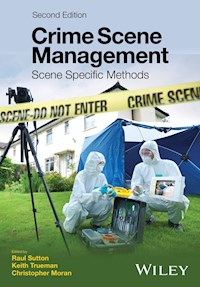
Crime Scene Management E-Book
48,99 €
Mehr erfahren.
- Herausgeber: John Wiley & Sons
- Kategorie: Wissenschaft und neue Technologien
- Sprache: Englisch
Second edition of an established text on common procedures for the identification and processing of evidence at scenes of crime
- Includes chapters on quality assurance and credibility of practices and processes
- issues surrounding major and complex crime
- Forensic handling of mass fatalities
- Crime scene reconstruction and impact on evidence recovery processes
Sie lesen das E-Book in den Legimi-Apps auf:
Seitenzahl: 533
Veröffentlichungsjahr: 2016
Ähnliche




















Table of Contents
Cover
Title Page
Introduction and Use of this Text
List of Contributors
About the Companion Website
PART I: Crime Scene Principles
1 The Crime Scene Context
1.1 Introduction
1.2 What is a crime?
1.3 The nature of the UK legal system
1.4 The legal system in England and Wales
1.5 Other courts
1.6 The judicial system in Northern Ireland
1.7 The Scottish legal system
1.8 Judicial processes that deal with causes of death
1.9 What constitutes evidence?
1.10 The chain of events in evidence gathering
1.11 The relationship between evidence gatherers and analysts
1.12 Health and safety considerations
Suggested further reading
2 First Officer Attending
2.1 Introduction
2.2 Response to incident report
2.3 Personnel involved in the investigative process
2.4 Recording and recovery of scientific evidence
2.5 Initial considerations of the First Officer Attending (FOA)
2.6 Dealing with the victim
2.7 Dealing with witnesses
2.8 Dealing with suspects
2.9 Dealing with the crime scene(s)
2.10 Documentation
2.11 Dealing with violent crime
2.12 Summary and conclusion
3 The Role of the Crime Scene Investigator
3.1 Introduction
3.2 Training the CSI
3.3 The responsibilities of a CSI
3.4 Forensic evidence
3.5 Request for CSI attendance at crime scenes
3.6 Actions when attending the crime scene
3.7 Initial scene assessment (including health and safety considerations)
3.8 Planning evidence recovery
3.9 Recording the evidence
3.10 The elimination process
3.11 Details of evidence recovered
3.12 Integrity, continuity and contamination
3.13 Packaging materials
3.14 Conclusion
PART II: Evidence‐gathering Techniques
4 Police Photography, Video Recording, 3D Laser Scanning
4.1 Introduction
4.2 General guidelines
4.3 Equipment
4.4 Exposure
4.5 Image quality/size
4.6 Depth of field
4.7 White balance
4.8 Image data
4.9 Flash photography
4.10 Room interiors
4.11 Vehicles
4.12 Evidential items
4.13 Recording injuries to the person
4.14 Night photography
4.15 Footwear impressions
4.16 Fingerprints
4.17 Recording video evidence at crime scenes
4.18 The use of digital images in court
4.19 3D laser scanning of scenes
Suggested further reading
5 Fingerprints
5.1 Introduction
5.2 The nature of friction ridge skin
5.3 The structure of friction ridge skin
5.4 Friction ridge growth
5.5 Principles of friction ridge identification
5.6 Comparison methodology
5.7 Chemical composition of latent prints
5.8 Identification of common locations for prints
5.9 The use of powdering techniques to enhance latent finger marks
5.10 Chemical development techniques
5.11 Laboratory and scene applications
5.12 Fingerprints in bodily fluids
5.13 Scenes of fire
5.14 Optical methods to reveal fingerprints (laser and other light sources)
5.15 New and emerging techniques
5.16 Remote transmission
5.17 Chapter summary
Acknowledgements
Selected further reading
Reports (all web addresses are correct at the time of publication)
6 DNA‐rich Evidence
6.1 Introduction and historical background
6.2 The structure and properties of DNA
6.3 DNA analysis
6.4 Types of DNA testing
6.5 Biological evidence
6.6 Procedures for collection of biological evidence: general considerations
6.7 Limitations of DNA evidence
6.8 Elimination and reference samples
6.9 Summary
References
7 Blood Pattern Analysis
7.1 Introduction
7.2 History of the development of blood spatter as a scientific discipline
7.3 Composition of blood
7.4 Physical properties of blood
7.5 Causes of bleeding
7.6 Blood dynamics
7.7 Drop‐surface impact and droplet pattern
7.8 Determination of area of origin of spatter
7.9 Cast‐off patterns
7.10 Arterial damage patterns
7.11 Non‐spatter patterns
7.12 Physiologically altered bloodstains
7.13 Volume bloodstains
7.14 Composite patterns
7.15 Investigative transfer and contamination issues
7.16 Recording traces
7.17 Summary
Suggested further reading
8 Physical Evidence
8.1 Introduction
8.2 Tool marks
8.3 Clothing
8.4 Fibres
8.5 Footwear impressions
8.6 Glass fragments
8.7 Glass fragmentation
8.8 Soils
8.9 Firearms
8.10 Scene recovery of firearms
8.11 Gunshot residues (GSR)
8.12 Drugs of abuse (DOA)
8.13 The crime scene characteristics of various DOA
8.14 Presumptive tests for drugs
8.15 Amateur explosives
8.16 Summary
Suggested further reading
PART III: Specialised Scenes and Report Writing
9 Fire Scene Examination
9.1 Introduction
9.2 The nature of fire
9.3 The oxygen demand of fuels
9.4 Flame and fire classifications; fire development
9.5 Types of evidence specific to fire scenes
9.6 Locating the origin of the fire
9.7 Fire cause determination and evidence‐gathering methods
9.8 Methods for ascertaining whether a crime has been committed
9.9 Health and safety considerations
9.10 Summary
Suggested further reading
10 Examination of Recovered Stolen Motor Vehicles
10.1 Introduction
10.2 What is a motor vehicle?
10.3 The definition of an auto crime
10.4 Auto crime scene examinations
10.5 Requests to attend an auto crime scene
10.6 The examination process
10.7 Conclusion
11 Managing Complex Scenes and Multiple or Mass Fatality Scenes
11.1 Introduction
11.2 Self‐briefing
11.3 Communication
11.4 Establishing priorities
11.5 Avoidance of contamination
11.6 The forensic strategy
11.7 ‘Defence’ case review meeting
11.8 Incident debrief
11.9 Introduction to mass fatality incidents
11.10 The range and nature of mass fatality incidents
11.11 The type of investigation conducted
11.12 Sequence of events in managing disaster victim identification scenes
11.13 Recovery of mortal remains
Suggested further reading
12 Preparing Reports and Statements
12.1 Introduction
12.2 Documentation at the crime scene
12.3 Photography
12.4 Plans, sketches and diagrams
12.5 The exhibit label
12.6 Handling the evidence
12.7 Statements of evidence
12.8 Criminal Justice Act 1967, section 9
12.9 Crime scene examination statements
12.10 Conclusion
13 Quality Assurance in Crime Scene Investigation
13.1 Introduction
13.2 Informal aspects of quality assurance
13.3 The development of formal quality assurance
13.4 The role of the Forensic Science Regulator
13.5 Responsibility for measuring quality assurance
13.6 The accreditation process
13.7 Organisational requirements for accreditation
13.8 Personnel requirements for accreditation
13.9 Resource requirements for accreditation
13.10 Process requirements for accreditation
13.11 Management requirements for accreditation
13.12 Maintaining accreditation
Suggested further reading
APPENDICES
Police Service Rank Structure
Photography Appendix
Finger Mark Visualisation Appendix
Index
End User License Agreement
List of Tables
Chapter 03
Table 3.1 Exhibit packaging and storage
Chapter 05
Table 5.1 The major chemical constituents of the glandular secretions
Chapter 06
Table 6.1 DNA content of biological samples
Table 6.2 Sources of biological evidence
Chapter 07
Table 7.1 Some properties of human blood
Chapter 08
Table 8.1 The typical dependency of common drugs of abuse
Table 8.2 A summary of drug categories with common DOA and indicative maximum sentences
Table 8.3 Some common presumptive tests for drugs of abuse
Chapter 09
Table 9.1 Approximate theoretical oxygen and air demands of some common fuels
Table 9.2 Types of flame
Table 9.3 The classes of fire
Table 9.4 Heat release rates of common materials
Table 9.5 Melting temperatures of common materials
Chapter 10
Table 10.1 Types and descriptions of motor vehicles
List of Illustrations
Chapter 02
Figure 2.1 Diagram showing inner cordon and common approach paths.
Figure 2.2 Diagram showing inner and outer cordons.
Chapter 03
Figure 3.1 Crime Scene Examination Form.
Figure 3.2 Correct process for using a paper bag to package evidence items.
Chapter 04
Figure 4.1 Photographic image and exposure histogram. (a) Correct exposure. (b) Underexposure; note that the histogram has moved to the left. (c) Overexposure; note that the histogram has moved to the right.
Figure 4.2 Depth of field at large and small apertures: (a) captured at f‐32 (b) captured at f‐3.2.
Figure 4.3 Bite mark photography.
Figure 4.4 Image of shoe mark.
Figure 4.5 Fingerprint in grease on back of numberplate.
Figure 4.6 A 3‐D room scanner placed in a crime scene.
Chapter 05
Figure 5.1 A CSI examines a scene for potential fingerprint evidence.
Figure 5.2 A CSI examines a car using traditional brush and powder technique.
Figure 5.3 Layers of the fully formed epidermis.
Figure 5.4 Sir Francis Galton 1822–1911.
Figure 5.5 The types of features identified by Galton can be classified into two types, endings and bifurcations.
Figure 5.6 The levels of fingerprint detail.
Figure 5.7 A correctly packaged item.
Figure 5.8 A latent set of finger marks developed with aluminium powder.
Figure 5.9 Fingerprints developed with Physical Developer.
Figure 5.10 Ninhydrin‐developed latent marks on paper.
Figure 5.11 Superglue and Basic Red 14 dye developed latent fingerprints.
Figure 5.12 Scene‐based optical enhancement of latent fingermarks.
Figure 5.13 Identification of scene marks using photoluminescence.
Figure 5.14 Identification of scene marks using Nd:YAG laser, with photographic detection of finger marks through their luminescence.
Chapter 06
Figure 6.1 The structure of DNA (drawn using Rasmol software).
Figure 6.2 Presumptive testing for blood.
Chapter 07
Figure 7.1 Blood dropping at 90° to target surface. (a) Note that the spherical drop will result in (b) a circular pattern.
Figure 7.2 Blood dropped from a plastic pipette onto paper from various heights.
Figure 7.3 Blood dropping at an oblique angle to the target surface. (a) Note that the spherical drop will contact the surface leaving (b) an elliptical pattern.
Figure 7.4 Relationship between width and length of blood drop and angle of drop‐surface impact. θ is the angle of impact.
Figure 7.5 Blood landing on a surface continues in motion leaving a leading edge. The dotted lines show the area that would be made by a perfect elliptical pattern.
Figure 7.6 Blood leading edge used to determine direction that droplet travelled in.
Figure 7.7 Calculating area of origin from blood distribution. This figure shows that the area of origin lies perpendicularly above the shaded area.
Figure 7.8 Calculating area of origin from blood distribution. This figure shows that the area of origin is calculated by combining the two‐dimensional region below the area with use of angle of impact. Note the different shading for the actual area.
Figure 7.9 Actions resulting in swing and cessation cast‐off.
Figure 7.10 Arterial spurt. Note the ‘V’ or ‘W’ shape of the overall pattern. Also note the ‘runs’ caused by the volume of blood shed.
Figure 7.11 Arterial spurt. Note the directionality of the individual stains in the overall pattern.
Figure 7.12 Arterial rain.
Figure 7.13 Transfer pattern. Bloodied hammer placed on carpet. Note that in certain cases it is possible to determine the type of implement used from the shape of the stain.
Figure 7.14 Transfer pattern. Bloodied handprint.
Figure 7.15 Transfer pattern. Swipe. Blood transfer from a moving source onto an unstained surface.
Figure 7.16 PABS dry. Dried bloodstain. Note ‘skeletonisation’ (arrowed).
Figure 7.17 PABS clot. Clotting blood in which the clotted material is retracting to leave clearer serum behind.
Figure 7.18 PABS mix. Blood mixed with saliva. Note diluted appearance of some stains. Also note ‘beading’ effect (arrowed).
Figure 7.19 Documenting traces. Adhesive ruler tape provides reference to vertical and horizontal axes. Direction of flight indicated by arrow. Unique identifier for stain and date recorded should also be present.
Chapter 08
Figure 8.1 Comparison of tool mark with its impression.
Figure 8.2 The use of silicone resin to capture tool marks left on a recipient surface.
Figure 8.3 Micrographs of cross‐sections through several different fibre types at 100x magnification.
Figure 8.4 Typical absorption spectrum of green fibre.
Figure 8.5 A footwear impression left at the scene of a crime.
Figure 8.6 A footwear impression in blood left by a perpetrator at a crime scene.
Figure 8.7 Section of glass that has suffered impacts showing radial and concentric fractures. Note that the concentric fractures butt up against but do not cross the radial fractures, indicating that the former occurred after the latter.
Figure 8.8 Picture of glass showing the direction of stress lines in cross‐section caused by impact of object shattering the glass.
Figure 8.9 The order of impact of bullets in a pane of glass can be worked out from the shatter lines. New lines caused by later impact will not cross existing fractures.
Figure 8.10 Handgun key features: (a) pistol (b) revolver.
Figure 8.11 Cross‐section of a typical firearm barrel showing the arrangement of lands and grooves that form rifling.
Figure 8.12 Composite photo of two 9 mm bullets under a comparison microscope. The matching of the striations should be carried out by an expert.
Figure 8.13 5.56 mm rifle cartridge case showing distinct scratches caused after it has left the ejector port of the weapon.
Figure 8.14 Firing pin impression and breechface scratches on a 9 mm cartridge case.
Figure 8.15 SEM‐EDX (a) photomicrograph and (b) spectrum of gunshot residue showing characteristic elemental composition.
Chapter 09
Figure 9.1 The fire ‘tetrahedron’.
Figure 9.2 A temperature time graph for the progress of a typical room or building fire (not representative of smouldering fires which may burn for long periods before flaming ignition).
Figure 9.3 The chemical structures of styrene and polystyrene.
Figure 9.4 A ‘model’ molecule for Lignin.
Figure 9.5 Steps of the scientific method.
Figure 9.6 Classic V‐shaped burn pattern on internal wall.
Figure 9.7 External V pattern left by smoke and heat from a fire.
Figures 9.6
and
9.7
Fire patterns can give clues to the location of the origin of a fire. Care should be exercised in interpretation of individual patterns in isolation.
Figure 9.8 Fire investigation dog specially trained to identify ignitable liquids in fire scenes.
Chapter 10
Figure 10.1 Diagram of a motor vehicle.
Figure 10.2 Diagram showing one method of sectioning or zoning a car seat for evidence recovery.
Chapter 11
Figure 11.1 A flow diagram showing the interactions between key personnel and processes in disaster victim body recovery.
Chapter 12
Figure 12.1 Thumbnail sketch plan depicting crime scene. This has not been drawn to any scale but is used to portray a general area and locate places and items referred to in a statement.
Figure 12.2 Plan of scene drawn to scale. This is used to complement and orientate an album of photographs.
Figure 12.3 Illustration of a powdered and lifted fingerprint mounted onto a vinyl sheet. The diagram drawn to show the location of the fingerprint needs sufficient information to provide a ready and permanent aide‐memoire.
Figure 12.4 An exhibit label, which must be attached to each item of evidence.
Appendices
Figure A.1 Inverse square law. Area A is illuminated by a point source of light. If the distance is doubled the area covered by the same point of light B is four times larger.
Figure A.2 Image of a street scene at night: (a) one second at f‐8, ISO 400 (b) two seconds at f‐8, ISO 400.
Guide
Cover
Table of Contents
Begin Reading
Pages
iii
iv
xi
xii
xiii
xiii
xiv
xv
1
3
4
5
6
7
8
9
10
11
12
13
14
15
16
17
18
19
20
21
22
23
24
25
26
27
28
29
30
31
32
33
34
35
36
37
38
39
40
41
42
43
44
45
46
47
48
49
50
51
52
53
54
55
56
57
58
59
60
61
62
63
64
65
66
67
68
69
70
71
73
74
75
76
77
78
79
80
81
82
83
84
85
86
87
88
89
90
91
92
93
94
95
96
97
98
99
100
101
102
103
104
105
106
107
108
109
110
111
112
113
114
115
116
117
118
119
120
121
122
123
124
125
126
127
128
129
130
131
132
133
134
135
136
137
138
139
140
141
142
143
144
145
146
147
148
149
150
151
152
153
154
155
156
157
158
159
160
161
162
163
164
165
166
167
168
169
170
171
172
173
174
175
176
177
178
179
180
181
182
183
184
185
186
187
188
189
190
191
192
193
194
195
196
197
198
199
200
201
202
203
204
205
206
207
210
211
212
213
214
215
216
217
218
219
220
221
222
223
224
225
226
227
228
229
230
231
232
233
234
235
236
237
238
239
240
241
242
243
244
245
246
247
248
249
250
251
252
253
254
255
256
257
258
259
260
261
262
263
264
265
266
267
268
269
270
271
272
273
274
275
276
277
278
279
280
281
282
283
284
285
286
287
288
289
290
291
292
293
297
298
299
300
303
304
305
306
307
308
309
310
311
312
Crime Scene Management
Scene Specific Methods
Second Edition
Edited by
Raul Sutton
Department of Forensic Science, University of Wolverhampton, UK
Keith Trueman
West Midlands Police Service (retired) and Department of Forensic Science, University of Wolverhampton, UK
and
Christopher Moran
Department of Forensic Science, University of Wolverhampton, UK
This edition first published 2017© 2017 John Wiley & Sons, Ltd.
First edition published in 2009
Registered OfficeJohn Wiley & Sons, Ltd, The Atrium, Southern Gate, Chichester, West Sussex, PO19 8SQ, United Kingdom
For details of our global editorial offices, for customer services and for information about how to apply for permission to reuse the copyright material in this book please see our website at www.wiley.com.
The right of the author to be identified as the author of this work has been asserted in accordance with the Copyright, Designs and Patents Act 1988.
All rights reserved. No part of this publication may be reproduced, stored in a retrieval system, or transmitted, in any form or by any means, electronic, mechanical, photocopying, recording or otherwise, except as permitted by the UK Copyright, Designs and Patents Act 1988, without the prior permission of the publisher.
Wiley also publishes its books in a variety of electronic formats. Some content that appears in print may not be available in electronic books.
Designations used by companies to distinguish their products are often claimed as trademarks. All brand names and product names used in this book are trade names, service marks, trademarks or registered trademarks of their respective owners. The publisher is not associated with any product or vendor mentioned in this book.
Limit of Liability/Disclaimer of Warranty: While the publisher and author have used their best efforts in preparing this book, they make no representations or warranties with respect to the accuracy or completeness of the contents of this book and specifically disclaim any implied warranties of merchantability or fitness for a particular purpose. It is sold on the understanding that the publisher is not engaged in rendering professional services and neither the publisher nor the author shall be liable for damages arising herefrom. If professional advice or other expert assistance is required, the services of a competent professional should be sought.
The advice and strategies contained herein may not be suitable for every situation. In view of ongoing research, equipment modifications, changes in governmental regulations, and the constant flow of information relating to the use of experimental reagents, equipment, and devices, the reader is urged to review and evaluate the information provided in the package insert or instructions for each chemical, piece of equipment, reagent, or device for, among other things, any changes in the instructions or indication of usage and for added warnings and precautions. The fact that an organization or website is referred to in this work as a citation and/or a potential source of further information does not mean that the author or the publisher endorses the information the organization or website may provide or recommendations it may make. Further, readers should be aware that Internet Websites listed in this work may have changed or disappeared between when this work was written and when it is read. No warranty may be created or extended by any promotional statements for this work. Neither the publisher nor the author shall be liable for any damages arising herefrom.
Library of Congress Cataloging‐in‐Publication Data
Names: Sutton, Raul, editor. | Trueman, Keith, editor. | Moran, Christopher, 1951– editor.Title: Crime scene management : scene specific methods / editors, Raul Sutton, Head of Forensic Science, University of Wolverhampton, Keith Trueman, West Midlands Police Service (retired), Christopher Moran, Department of Forensic Science, University of Wolverhampton.Description: Second edition. | Chichester, West Sussex, United Kingdom : John Wiley & Sons, 2017. | Includes bibliographical references and index.Identifiers: LCCN 2016018223 (print) | LCCN 2016029923 (ebook) | ISBN 9781119180906 (pbk.) | ISBN 9781119180913 (pdf) | ISBN 9781119180920 (epub)Subjects: LCSH: Crime scene searches. | Forensic sciences.Classification: LCC HV8073 .C6928 2017 (print) | LCC HV8073 (ebook) | DDC 363.25/2–dc23LC record available at https://lccn.loc.gov/2016018223
A catalogue record for this book is available from the British Library.
Cover image: Monty Rakusen/Gettyimages
Introduction and Use of this Text
This book is designed to provide a UK perspective on procedures and practices that are relevant to the processing of crime scenes. The identification and gathering of physical items of intelligence in police investigations at crime scenes, which will subsequently become evidence in a court of law, in a manner that will stand the scrutiny of cross‐examination, requires the bringing together of several strands of knowledge. We are conscious of the relationship between the gathering of evidence and its subsequent scientific analysis in the context of the UK legal system. Without an understanding of the way in which the item may be subsequently analysed, many of the methods of packaging of items carry no significance. Only when the correct procedure is understood in the context of the protection of the evidence from damage for the purposes of subsequent analysis will the rationale for a particular packaging procedure be apparent. Thus, in this book there are chapters devoted to different types of physical evidence where the link between the evidence item and its subsequent analysis is made clear. The other aspect of evidence gathering is to ensure the continuity of the items so that the location and subsequent analysis of each item can be verified during its passage from the crime scene to the court room.
The second edition of this book is intended as an introductory text on common procedures for the identification and processing of evidence at scenes of crime. The course is largely based on operating practices that exist within management of crime scenes in the UK. The text is primarily aimed at people who are studying crime scenes as part of a study programme, but we think that the work will prove useful to a wider range of readers including:
undergraduate students studying courses in the criminal justice sector, such as forensic science, criminalistics and policing;
people employed in the criminal justice sector such as police officers, crime support teams, legal personnel and forensic science services, all of whom may need an introduction to crime scenes;
members of the general public who want to know more about how crime scenes are processed.
Students who are using this text as a learning vehicle will be expected to study some crime scene work during their course and will need to understand selected fundamental principles, and gain a knowledge of processes and the reasoning for operating procedures in order to underpin their subject. Thus, we have aimed to include only those aspects of crime scene processing that would be relevant as an introduction to such. Each chapter begins with an introduction that explains the relevance of the contents. The significance of the material is given importance by the choice of examples, wherever possible. The text expects little in the way of prior knowledge and introduces concepts at a basic level. This keeps each chapter brief whilst covering most of the necessary material that you will require during your undergraduate course.
We realise that you may not feel confident tackling concepts of which you have had little prior experience. Each chapter thus contains relevant questions that aim to assess your understanding of the materials presented, with answers provided on the publisher’s website. These can be accessed by visiting http://booksupport.wiley.com and entering the book title, author name or ISBN.
The aim of this website is to provide high‐resolution images to support the text, and they are also included in the book itself. In addition, many photographs lose quality when reproduced in a text such as this, and points that need illustrating may be better represented by images viewed on a PC.
The dedicated space within the publisher’s website that can be used with this text contains many images, including all the tables, photographs and drawings, and many of the forms, that are presented. These are in downloadable format so that they can be adapted or integrated into a lecture series on the subject.
Some of the material covered in the chapters will require rote‐learning and this is something that you will have to work towards. It would be impractical for you to remember such materials at the first attempt. Rote‐learning can be made easier by breaking a subject down into small parts. The regular review of such material will also aid your memory. The same applies to other ideas that are introduced in the text. Concepts can sometimes seem difficult to grasp, but re‐reading material that you find difficult, slowly and carefully, will help you to gain a much clearer understanding of its meaning.
This text uses the term ‘Crime Scene Investigator’ (CSI) to denote the person responsible for the processing of crime scenes. In the UK, these personnel have different names, depending on the constabulary to which they are attached. In some areas terms such as Crime Scene Examiner, Forensic Scene Investigator, Scenes of Crime Officer and Scientific Support Officer are used instead. There is a different emphasis between a Crime Scene Investigator, who can be seen as an active thinking investigator, and an examiner, who can be viewed as a passive collector of evidence. A modern CSI will need to be both of these.
The management of CSIs varies between police forces. It can fall under the remit of a Scientific Support Service or Department (sometimes called Scenes of Crime Department) but this is not always the case. Since the way in which CSIs are managed does not impact materially on their day‐to‐day activities we shall refer to management structures using the term ‘Scenes of Crime Department’.
Where possible, chapters include a list of suggested further reading where it is in the public domain. Much of the training materials given to CSIs are restricted and not publicly available. In some chapters there is also a reference list where it is felt that this may help the reader.
Raul Sutton, Keith Trueman and Christopher MoranWolverhampton, July 2016
List of Contributors
Dr Terry BartlettUniversity of Wolverhampton
Mr David CharltonIndependent Fingerprint Expert
Mr Chris CroweWest Midlands Police
Mr Derek ForestExpert in Mass Fatality Incidents, and University of Wolverhampton
Mr Mark McCabeIndependent Fire Investigator, and University of Wolverhampton
Mr Christopher MoranDepartment of Forensic Science, University of Wolverhampton
Dr Chris PerryUniversity of Wolverhampton
Dr Sara ShortDirector SLS Ltd and University of Wolverhampton
Dr Raul SuttonDepartment of Forensic Science, University of Wolverhampton
Mr Keith TruemanWest Midlands Police Service (retired), and Department of Forensic Science, University of Wolverhampton
Prof Craig WilliamsUniversity of Wolverhampton
About the Companion Website
Don’t forget to visit the companion website for this book:
http://booksupport.wiley.com
There you will find valuable material designed to enhance your learning, including:
Questions and answers
Powerpoint of all figures.
PART ICrime Scene Principles
1The Crime Scene Context
Raul Sutton
1.1 Introduction
The management of the process of scene recording and evidence recovery has in recent years been through some significant changes. The introduction of new technologies such as digital cameras, database storage systems for scene information management, automated three‐dimensional scene reconstruction software, digital fingermark recovery systems, and real‐time methods for trace analysis, amongst others, are changing the face of scene management. The development cost of introducing such equipment is high and the need to ensure the continuity and integrity of items gathered at the scene mean that these methodologies are being introduced gradually for use in major crimes. However, after the recovery of development costs, the cost of such equipment purchase will inevitably drop, making their introduction to the management of volume casework a realistic possibility.
In addition, there have been rapid changes to the way in which Crime Scene Investigators (CSIs) are trained in the UK. There has been a growth in forensic science courses in the United Kingdom. A proportion of these graduates are looking to gain employment within the area of crime scene investigation. Such graduates, if properly educated, will inevitably add scientific rigour and an advanced level of understanding to the crime scene aspect of forensic science. The Chartered Society of Forensic Sciences has acknowledged this by incorporating crime scene investigation into the criteria for its accreditation process.
There is a need for other stakeholders who may have to attend scenes of crime to be aware of the role and remit of scene processing, to understand the nature and types of evidence that can be found at scenes of crime and to take appropriate measures to preserve and protect such evidence. These may include persons such as paramedical personnel as well as serving police officers. Within the English legal system the increased role of forensic analysis in the successful prosecution of crimes has suggested that legal agencies need to be aware of the entire forensic process of which crime scenes form a part.
1.2 What is a crime?
Crimes by their definition are those acts which are deemed contrary to the criminal law governing the country of concern. Nation states operate the criminal legal system in different ways, but such systems are underpinned by a philosophical framework. In European legislation the articles of the European Convention of Human Rights 1953 define the overarching philosophy. In summary, this contains protection for the following:
Article 1: Protection of property
Article 2: Right to life
Article 3: Prohibition of torture, inhumane or degrading treatment
Article 5: The right to liberty and security of person
Article 6: The right to a fair hearing or trial
Article 8: The right to respect for private and family life
Article 10: Freedom of expression.
These are embedded in various forms within the EU (European Union) member states by means of legislation, and the legal framework within which law enforcement takes place must meet these obligations. The UK has embedded this Convention by means of certain Acts of Parliament, the latest of which is the Human Rights Act 1998. The national bodies responsible for implementing legislation have qualified some of these rights by reference to the general wellbeing of society; thus the rights may be curtailed if any of the following conditions are met:
if the action is prohibited by law
and
necessary actions within a democracy
and
for any of the following reasons
– national security
– territorial integrity
– public safety
– preventing disorder or crime
– protecting health
– protecting morals
– protecting the rights of others.
For reasons concerning the strategic handling of offences that are deemed to be criminal acts within the UK, crimes are normally categorised into two types: volume and major. Crimes that are often categorised as major by a police service/force/constabulary, according to their seriousness, include:
murder (common law)
manslaughter (common law)
infanticide (Infanticide Act 1938)
rape (Sexual Offences Act 1956)
serious wounding (Offences Against the Person Act 1861)
armed robbery (Theft Act 1968)
aggravated burglary (Theft Act 1968)
kidnapping (common law)
terrorist offences (Prevention of Terrorism Act 1989)
any offence deemed ‘major’ by its significant impact on society (e.g. contamination of goods).
Many of these types of crime have a high media profile and so the treatment of the investigation assumes a priority and more time, effort and financial resources will go into investigating them.
Minor crimes make up the majority of police service/force/constabulary work and encompass anything not deemed to be a major crime. A small range of these criminal offences are called volume crime. The definition of volume crime includes:
street robbery
burglary – dwelling
burglary – non‐dwelling
theft (including shoplifting)
vehicle crime – theft of
vehicle crime – theft from
criminal damage
minor drugs offences that are linked with acquisitive crimes
as defined by the Association of Chief Police Officers (ACPO) (Garvin, 2002). At the end of 2014 ACPO were reformed into the National Police Chiefs’ Council (NPCC). The intensity with which minor and volume crimes are investigated will vary from force to force depending on available resources, initiatives etc. This situation, whilst not ideal, represents the best available use of resources within a police service/force/constabulary.
Self‐assessed questions
1.1
(a) Describe what makes burglary a crime in the United Kingdom.
(b) Which article(s) of the European Convention on Human Rights does burglary infringe?
1.2
Describe the major difference between volume and major crimes.
1.3 The nature of the UK legal system
The legal system in the United Kingdom is based upon common law and statute. Within the United Kingdom there are three separate but similar jurisdictions: England and Wales; Scotland; and Northern Ireland. Whilst the laws are similar in each jurisdiction, they are not identical. The system is a balance between three interacting organs of the state, the executive (government), the legislature (parliament) and the judiciary (courts). In ideal circumstances these three organs of the state should be independent, but in the United Kingdom the functions overlap (particularly the executive). In Western‐style democracies, the role of the organs of state is to maintain the rule of law. In many states these rules are underpinned by a series of articles, often called a constitution, which are seen to be the basis for the operation of a civilised society. The United States of America is an example of a nation state with just such a constitution. The United Kingdom has no such underpinning articles of state and the rule of law is defined by the enacting of the wishes of the elected representatives of the people. Whilst there is no official constitution in the United Kingdom, it can be argued that the precedent of Acts of Parliament, legislative assemblies such as exist in Wales, Northern Ireland and Scotland, and judicial rulings, have bestowed a pseudo‐constitution in the United Kingdom.
Laws are put into practice that will affect the way society regards itself. Broadly these laws can be broken down into two types, civil and criminal. Individuals can choose to flout the given laws (by not paying bills, for example) and may face civil proceedings (in order to recover monies due etc.) or criminal prosecution (in the case of grievous bodily harm, for example) as a consequence. The crime scene forms part of the criminal side of this process.
1.4 The legal system in England and Wales
1.4.1 Her Majesty’s Courts and Tribunals Service
The operation of all the courts within England and Wales was brought under one overarching organisation, Her Majesty’s Courts Service (HMCS), on 1 April 2005. In 2011 this organisation was merged with the Tribunals Service to form Her Majesty’s Courts and Tribunals Service (HMCTS). This organisation includes the Magistrates’ Courts Service and the Courts Service. The HMCTS is an executive agency of the Department for Constitutional Affairs (DCA); it has stated: ‘Our purpose is to deliver justice effectively and efficiently to the public. We are responsible for the administration of the civil, family and criminal courts in England and Wales.’
1.4.2 The Crown Prosecution Service
The Crown Prosecution Service (CPS) is a government agency that decides whether criminal investigations, which have been started by the police, should progress to court. If a case is progressed, the CPS prepares and conducts prosecution court proceedings, provides prosecution barristers and arranges for prosecution witnesses to attend court.
1.4.3 The judiciary
The judiciary sit within a system that is the result of several centuries of development. There are a tiered series of courts to deal with offences against the rule of law. These range from low‐level cases that are dealt with by the Magistrates’ Court, through to rulings that may affect the laws of the nation that may be dealt with by parliament. A brief description of each tier will now be given.
The Magistrates’ court
The Magistrates’ Courts are core to the UK criminal justice system – most criminal cases start in a Magistrates’ Court with a large percentage being completed there (95%). The Magistrates’ Courts also undertake civil cases, such as family matters, liquor licensing and betting. Cases in the Magistrates’ Courts are usually heard by panels of three magistrates (Justices of the Peace) supported by a clerk. The three magistrates are called a bench and are assigned to a local area, but have a national jurisdiction pursuant to the Courts Act 2003. Magistrates are unpaid appointees of the Crown, who are not usually legally qualified. Qualified clerks advise them on matters of law.
There are also about 130 District Judges, who sit alone in Magistrates’ Courts. District Judges must have had seven years’ experience as a barrister or solicitor and two years’ experience as a Deputy District Judge. District Judges deal with more difficult cases such as extradition or serious fraud.
The range of cases that are tried in a Magistrates’ Court falls into two categories:
Summary offences
–
These are the least serious offences, such as driving offences and common assault.
Triable either way offences
–
These are the middle range of crimes, including theft and assault causing actual bodily harm. These can be tried in either the Magistrates’ Court or the Crown Court.
Magistrates do not normally order prison sentences of more than six months or fines exceeding £5000. Cases outside these ranges are normally committed by the Magistrates to the Crown Court for sentencing.
The Crown court
The Crown Court deals with cases transferred from the Magistrates’ Courts. It also hears appeals against the decisions of Magistrates’ Courts, and deals with sentencing of some cases from Magistrates’ Courts. In addition, the triable either way offences described above can be tried in the Crown Court. Generally speaking, Crown Courts deal with more serious criminal cases, such as murder, rape or robbery. Trials are heard by a judge and a 12‐person jury. Members of the public are selected for jury service. Jurors must decide, based on the facts, whether a defendant is guilty or not guilty of the offences with which he or she is charged. In some cases, where specialist knowledge is required, such as complex fraud cases, it would be considered impossible for a jury to be knowledgeable enough to make a decision, and such cases may be tried in the absence of a jury.
Indictable Offences. These are the more serious crimes and include murder, manslaughter and rape. All indictable offences must be tried at the Crown Court, but the first hearing is dealt with at the Magistrates’ Court. The Magistrate will decide if the defendant should be given bail. The case is then transferred to the Crown Court.
1.5 Other courts
There are a large number of courts that primarily deal with civil issues. These include the County Court. The majority of County Court cases involve debts between individuals and/or businesses, as well as personal injury claims, and disputes over property or contracts. The County Court also deals with family issues, such as divorce and adoption. The High Court deals with the more complex civil cases, as well as with claims for libel. It also hears appeals against decisions made in the County Courts.
The right to appeal is one of the key principles of the justice system in England and Wales. The Court of Appeal hears appeals against decisions of the High Court and the Crown Court. Disputes not resolved there can be taken to the House of Lords.
There are a whole variety of civil courts with specialist applications, as well as military courts and tribunals that do not fall usually within the remit of the evidence‐gathering process for criminal processes.
Self‐assessed questions
1.3
Does Her Majesty’s Courts and Tribunals Service solely look after criminal cases?
1.4
Describe the sentencing limitations on a Magistrate’s Court.
1.5
Can murder be tried in a Magistrate’s Court?
1.6
Are all cases in Crown Courts tried before a jury?
1.7
What is the function of the jury in a Crown Court trial?
1.6 The judicial system in Northern Ireland
Northern Ireland’s legal system is similar to that of England and Wales. Jury trials have the same place in the system. The major difference relates to offences involving acts of terrorism. In addition, cases go through stages in the courts. In offences specified under emergency legislation, the case is tried in a Crown Court without a jury. Guilt must be proved beyond reasonable doubt with the defendant represented by a lawyer of their choice. The judge has to set out in a written statement the reasons for conviction, and there is an automatic right of appeal against conviction and/or sentence, on points of fact as well as of law, to the Court of Appeal.
1.6.1 Courts in Northern Ireland
The Northern Irish courts consist of:
superior courts comprising the Court of Appeal, the High Court and the Crown Court;
inferior courts comprising County Courts and Magistrates’ Courts.
Superior courts
All matters relating to the Court of Appeal, the High Court and the Crown Court are under the jurisdiction of the UK Parliament. Judges are appointed by the Crown. The Crown Court deals with all serious criminal cases.
The Court of Appeal has power to review the civil law decisions of the High Court and the criminal law decisions of the Crown Court, and may in certain cases review the decisions of County Courts and Magistrates’ Courts. Subject to certain restrictions, an appeal from a judgment of the Court of Appeal can go to the House of Lords. The independent Criminal Cases Review Commission reviews alleged miscarriages of justice.
Inferior courts
The inferior courts are the County Courts and the Magistrates’ Courts, both of which differ in a number of ways from their counterparts in England and Wales.
Magistrates’ Courts carry out the day‐to‐day work of dealing with minor local criminal cases. These are presided over by a full‐time, legally qualified Resident Magistrate (RM). County Courts are primarily civil law courts presided over by County Court Judges, who also handle appeals from the Magistrates’ Courts. Appeals from the County Courts are heard in the High Court.
Self‐assessed questions
1.8
(a) What is the English equivalent of the Northern Ireland inferior courts?
(b) Who presides over the inferior courts in Northern Ireland?
1.9
Name one type of case where a jury is not used in Northern Ireland.
1.7 The Scottish legal system
Scots’ law and the Scottish legal system’s integrity and independence were acknowledged in the 1707 Act of Union, with the establishment of a UK Parliament at Westminster. Scots’ law shares many statutory provisions with the law of England and Wales, but Scots’ civil law remains substantially based on Scots’ common law rather than on statute, sharing elements with Roman‐Dutch law rather than with English common law traditions. In the criminal justice system, the role of the public prosecutor is critical.
The Crown Office and Procurator Fiscal Service, a department of the Scottish Executive, provides Scotland’s independent public prosecution and deaths investigation service. The Lord Advocate is head of criminal prosecution in Scotland, and is assisted by the Solicitor General for Scotland. They are the Scottish Law Officers, and are members of the Scottish Executive.
1.7.1 Criminal Courts in Scotland
Criminal justice procedure is divided into:
Solemn – the most serious cases involving trial on indictment before a judge or Sheriff sitting with a jury;
Summary – less serious offences involving a trial before a Sheriff, Stipendiary Magistrate or Justice of the Peace sitting alone.
The judiciary
The High Court of Justiciary is the country’s supreme criminal court, handling the most serious crimes such as murder and rape. It is also the final court of appeal for criminal cases. It comprises the Lord Justice General, the Lord Justice Clerk, and another 30 judges known formally as Lords Commissioners of Justiciary. Judges take the title ‘Lord’ or ‘Lady’ followed by their surname or territorial title, and can preside over both criminal and civil courts. All criminal prosecutions are brought in the name of the Lord Advocate and prosecuted by his appointed Advocate Deputies.
The jury
The court presents evidence before a jury, which is required to reach a verdict on the case in question. A Scottish jury – for a criminal case – is made up of 15 people and a simple majority is sufficient to establish guilt or innocence. The jury is required to reach one of three verdicts: guilty, not guilty or not proven. A not proven verdict is the equivalent of not guilty in that the accused is acquitted.
Sheriff courts
The Sheriff Courts, 49 of which are arranged into six Sheriffdoms organised geographically, are overseen by a Sheriff Principal. Sheriffs have sentencing powers, which are limited to:
up to three years’ imprisonment and/or an unlimited fine in solemn cases;
up to six months’ imprisonment and/or a £5000 fine in summary cases.
The court can remit a case to the High Court if a greater sentence is deemed necessary.
District courts
District Courts are similar to Magistrates’ Courts, and sit in each local authority area. Each comprises one or more Justices of the Peace (lay magistrates) who sit alone or in threes with a qualified legal assessor as convener or clerk of court. They handle many cases of breach of the peace, drunkenness, minor assaults, petty theft and offences under the Civic Government (Scotland) Act 1982.
Self‐assessed questions
1.10
What is the nearest English equivalent of the Sheriff Court in Scotland?
1.11
Describe the two important differences between the English and Scottish court systems.
1.8 Judicial processes that deal with causes of death
Deaths that need investigation are dealt with by Her Majesty’s Coroners (HM Coroners) in England, Wales and Northern Ireland. The coroner is one of the oldest secular appointments, established in 1194 as a form of medieval tax gatherer. This role has changed and now encompasses the investigation of sudden, violent or unnatural death. Coroners’ activities are governed by the Coroner’s Act 1988 and the Coroner’s Rules 1984. The coroner, who is either a qualified lawyer or medical practitioner with at least five years’ experience, will receive many reports of deaths as part of their duties. The coroner may be satisfied, after due investigation, of the identity of the deceased and that the death was due to natural causes. In such cases the investigation can end at this stage and a death certificate can be issued.
In other cases the coroner must call an inquest. The inquest, held in a coroner’s court, has two major functions: categorisation of the circumstances and cause of death, and identification of the deceased persons. The remit of the inquest is determination of cause of death for the following reasons:
a violent or unnatural death
a sudden death the cause of which is unknown
a death in prison
a death in such circumstances as to require an inquest under any other act.
A violent or unnatural death can occur for a variety of causes, such as:
unlawful killing
suicide
accidental death
misadventure
industrial disease.
At the inquest, the coroner will reach a decision as to which of the causes of death apply. The coroner’s remit does not include assigning liability. So, for example, a verdict of unlawful killing would not include a naming of persons liable for the death of deceased. In addition, there may not be enough evidence to determine a cause of death to the standard of proof required and the coroner can also reach an open verdict. In most cases, the standard of proof required to reach a verdict is on the ‘balance of probabilities’, but in cases of unlawful killing and suicide it will normally be ‘beyond all reasonable doubt’.
In addition to these functions, the historical origins of the role of the coroner mean that he or she is responsible for issues relating to treasure trove.
The coroner’s court is inquisitorial, rather than adversarial, in nature. This means that there are significant differences between the coroner’s court and the civil or criminal courts. First, a jury is not necessarily required. When a jury is present, it will consist of an odd number of persons (between five and eleven). Witnesses are required to attend and give evidence, as with criminal courts. However, persons are allowed to refuse to give evidence when it may incriminate them. In addition, witnesses can be questioned not only by the coroner but also by persons who are called ‘properly interested parties’. Properly interested parties may include close relatives of the deceased, police services, insurers, employers and trade union officials or legal representatives of these parties.
Crime scene investigators may be called to present evidence in the coroner’s court relating to the identification of the deceased as well as determination of the cause of death.
In Scotland, all sudden, suspicious, accidental, unexpected and unexplained deaths and any death occurring in circumstances that give rise to serious public concern are dealt with by the Procurator Fiscal. The Procurator Fiscal does not hold an inquest but may ask for help via investigations by properly qualified persons, such as police forces and pathologists. After consideration of all the evidence, the Procurator Fiscal will reach a decision on the cause of death. In a few cases (for 2001–2002 there were only 62 out of 13,625 cases) the Procurator Fiscal will apply to the Sheriff for a public enquiry, called a Fatal Accident Inquiry, into the cause of death.
A Fatal Accident Inquiry is similar to an inquest but is carried out in the public interest. However, the rules of evidence and the standard of proof are the same as for Scottish civil cases. The purpose is to determine where and when the death took place, the cause of the death, reasonable precautions whereby the death may have been avoided, any defects in any system of working that contributed to the death or any accident resulting in the death, and any other relevant facts relevant to the circumstances of the death. As with English coroner’s courts, the purpose is not to apportion civil or criminal liability for the death. A mandatory Fatal Accident Inquiry will occur in relation to a death in custody or as a result of an accident in the course of employment.
Self‐assessed questions
1.12
Name two differences between proceedings in the coroner’s court and Crown Court proceedings.
1.13
What is the major difference in the investigation of suspicious death in Scotland compared to the rest of the UK?
1.9 What constitutes evidence?
Evidence is presented before any court of law in one of the following two ways:
oral testimony of a witness
submission of a statement by a witness.
During testimony, a witness will introduce to the court information of fact that will include any physical items of evidential material. Under certain circumstances, instead of a witness appearing in person, their evidence, including the introduction of any material items, may be accepted from their written statement (details regarding this procedure may be found in Chapter 12).
Whichever is the case, the Crime Scene Investigator will find that most of the work that comes to be presented in a court of law revolves around the recording of the crime scene by photography and drawing, documentation of the evidence‐gathering process, and the gathering of physical evidence in a way that will render it suitable for subsequent analysis and presentation in court. This means that due care and attention must be paid to preserving the evidential value of items gathered at the scene. For example, there is no point in gathering DNA‐rich evidence in such a way that the evidence becomes contaminated or degraded, and thus unusable in a court of law. Failure to present acceptable evidence may have a cause as simple as a lack of appropriate control samples being gathered at the scene, lack of attention in the choice of appropriate packaging and storage, inability to demonstrate that there was no opportunity for contamination to occur between evidence gathering and analysis, and lack of timeliness in delivery of samples to analysts. These issues are referred to as issues concerning the ‘continuity and integrity’ of the evidential materials. Most evidence that is gathered by CSIs for subsequent scientific analysis comes into the category of contact or trace evidence (see Chapter 3).
The evidence that is presented by the CSI may be the first step in providing material that can be used in court and as such needs a rigour that will withstand the scrutiny of hostile cross‐examination. The processes needed to achieve this require a high level of expertise. The evidence that is presented in court falls within the category of expert witness statements, and should be presented accordingly (see Chapter 3).
Self‐assessed questions
1.14
Name two types of evidence that a CSI may provide for court.
1.10 The chain of events in evidence gathering
The gathering of items at the scene of crime is the first step in the provision of evidence in a court of law. The requirement to present such evidence for this purpose means that specific issues are raised both in the identification of suitable items and also in their subsequent handling. One of the major considerations revolves around the tracking of an item recovered from a scene of crime from the time it is identified to the time that it is presented in evidence in a court of law. A failure to provide documented evidence of:
the item’s whereabouts from the time of identification at the scene to presentation in court,
the item’s security in terms of alteration by evidence
either
being added to
or
removed from it, either surreptitiously or otherwise,
may render the evidence that relates to the item unsuitable.
Continuity is the term used to describe the seamless sequential handling of the item subsequent to identification.
Integrity is the term used to describe the methods used to protect the evidence from damage or alteration.
These issues are central to the evidence‐gathering process and their importance will be emphasised throughout the text.
The steps in evidence gathering involve:
identifying the scene and making an assessment
recording and documenting the scene
identifying items that may have evidential value
recording and gathering items for subsequent analysis by a Forensic Science Provider (FSP).
Each of these will be briefly described below. The recording and documentation of the scene is described in detail, and a discussion of the gathering of items that have a likelihood of being of evidential value is to be found in Chapter 3. The types of analysis that could be performed on the evidence are described in Chapters 5–8.
1.10.1 Crime perpetration and evidence transfer
One of the important considerations is the way in which evidence is left at the scene, given that both the perpetrator and the area where the crime took place are classed as ‘scenes’. Material will be transferred between the perpetrator and the scene of crime. The type and amount of material will depend on a number of factors that include:
The nature of the recipient surfaces. Rough surfaces will retain more material for a longer period than smooth surfaces will.
The degree of contact. This can vary both in pressure and length of contact and an increase in either will increase the probability of material transfer.
The nature of the transferred material. The adherence properties of this will affect both its residence on the recipient surface and the period of retention.
These phenomena should mean that when contact is made at a scene there is a two‐way transfer. This means that you may find evidence of the scene on the perpetrator and vice versa. This type of evidence is referred to as ‘trace’ or ‘contact’ evidence. It underpins one of the important principles of forensic science, called ‘Locard’s Principle of Exchange’. In summary, this states:
When two objects come into contact, each will leave a trace of itself upon the other
which has often been abbreviated to ‘every contact leaves a trace’. It needs to be emphasised that the traces that are left may not be in detectable quantities for anlaysis, despite scientific and technological advances towards improving the detection limits of trace materials.
1.10.2 Scene documentation and recording
This is the initial stage in crime scene work. Initially the scene is surveyed whilst the investigator tries to form a picture of the modus operandi (MO) or ‘method of operation’. This term is used to describe someone’s habits of working, particularly in the area of criminal investigation. It is also important at this stage to attempt to establish a probable sequence of events. This can help in ordering priorities within the strategy for the examination of the scene. Detailed notes of the scene are made as part of this survey, which may aid further enquiries. Items of potential evidential value are noted and their location recorded. Photographic and/or video records and sketch plans are made noting the precise location of evidence items. This process is crucial to crime scene reconstruction and evidence presentation in court.
1.10.3 Identification of evidential items
Initial examination of the crime scene will allow identification of items that may contribute to the evidence needed in a court of law. The identification of such items is a precursor to their removal from the scene and subsequent storage. The selection of items for evaluation of evidence depends on a variety of factors. These include:




