


Erhalten Sie Zugang zu diesem und mehr als 300000 Büchern ab EUR 5,99 monatlich.
- Herausgeber: Nick Hern Books
- Kategorie: Poesie und Drama
- Serie: NHB Modern Plays
- Sprache: Englisch
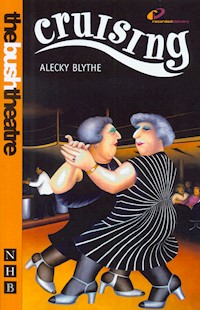
A hilarious, real-life comedy about pensioners going in search of love - from the sublime to the downright saucy. Maureen is a pensioner in search of passion. After 33 blind dates, 12 cruises and one broken heart, she is still determined to find Mr Right. But when best friend Margaret beats her to the altar, Maureen has her doubts - is Margaret just on the rebound and, more importantly, will she lose her pension? Alecky Blythe's verbatim theatre play Cruising was first staged at the Bush Theatre, London, in 2006 in a co-production with Recorded Delivery, using an innovative verbatim-theatre technique. The technique consists of recording interviews with real people, editing them and replicating them on stage in all their uncanny verisimilitude. The result is both disconcertingly comic and profoundly moving, as all the individual peculiarities of the 'characters' are scrupulously reproduced.
Sie lesen das E-Book in den Legimi-Apps auf:
Seitenzahl: 84
Veröffentlichungsjahr: 2016
Das E-Book (TTS) können Sie hören im Abo „Legimi Premium” in Legimi-Apps auf:
Ähnliche

















Alecky Blythe
CRUISING
NICK HERN BOOKSLondonwww.nickhernbooks.co.uk
Contents
Title Page
Original Production
Introduction
Characters
Cruising
About the Author
Copyright and Performing Rights Information
Cruising was first performed at the Bush Theatre, London, on 7 June 2006, with the following cast:
ROY/BERNARD/PETER/JACK
Jason Barnett
ROBERTA/PAT
Alecky Blythe
GEOFF/DUDLEY
Ian Dunn
MAUREEN
Miranda Hart
MARGARET/LIZ
Claire Lichie
Director
Matthew Dunster
Designer
Anna Bliss Scully
Lighting Designer
David Holmes
Movement Director
Georgina Lamb
Introduction
by Alecky Blythe
Verbatim theatre first attracted me when I was looking at alternative ways of creating work for myself as an actress. An inspiring workshop, ‘Drama without Paper’, run by Mark Wing-Davey at the Actors Centre, triggered the necessary creative spark that has been burning healthily ever since. Mark taught a technique that he had acquired and adapted from Anna Deavere Smith with whom he had worked in New York. The verbatim technique requires no transcribing but works directly from the interview via earphones. The exact speech pattern of the interviewee – including coughs, stutters and non sequiturs – is faithfully reproduced. The difference Mark introduced was to perform the interviews still wearing the earphones. This stopped the actors from ever falling into their own speech patterns, and the performances were all the more compelling for it. Anna had only used the earphones in rehearsals.
The Actors Centre, where Recorded Delivery is now a resident company, supported an idea for a verbatim play and helped set up the company, offering rehearsal and performance space to try something out. With Mark as my mentor, I created Come Out Eli. The idea for the play itself was to interview people about their fears, so an armed siege in nearby Hackney Central, where crowds had gathered to watch the ‘spectacle’, seemed the ideal place to collect interviews. As the stand-off between the police and Eli the gunman continued into its third week, the curiosity and, in some cases, outrage of the locals grew, and I simply gathered their personal stories about how they had been affected. I was drawn to the fantastically diverse range of people who for once had a common talking point. The topic of fear had been the starting point for the play which then grew into something quite different. Not only did the siege give the piece a narrative structure but the dramatic setting of the stand-off was ideal for uninhibited speech because the interviewees were more engaged in what was going on (or not) than the pressure of an interview situation.
In subsequent pieces I have tried to find a setting which takes the interviewee’s attention off the microphone as much as possible. Most verbatim theatre is created from interviews that have obviously been set up, leading to a certain self-consciousness in the characters. This approach can be very illuminating, but I am aiming for a more ‘fly on the wall’ documentary style as this can lead to more dramatic situations. Cruising shifts between monologues with Maureen, the protagonist through whom the narrative weaves, and scenes with her friends that illustrate and push the narrative on. Also, by meeting her in public and private, a more rounded character is created. However, when I first interviewed her, I was so intrigued by her that my original idea was to make a one-woman show. After Eli, which had forty-seven characters, All The Right People Come Here and Strawberry Fields, both with too many characters to count, a show focusing on one or a few characters was an exciting new challenge.
Maureen was a woman I interviewed for Strawberry Fields, which was about the effects of modern farming methods on the land and the community in the rural idyll of Herefordshire where she lives. In Strawberry Fields she immediately came across as a very interesting and likeable character: all the actors wanted to play her. She had the potential to command more than just a walk-on part, so I ventured to interview her again to see what else she had to reveal. Two-and-a-half hours later, the tape was still running, and the idea for Cruising had been conceived. What made her story extraordinary – apart from her healthy libido – was an attitude towards men and love which mirrored the views of women fifty years younger. She spoke about her broken heart as if she were a love-struck teenager not a worldly widow of seventy-two with two married children. Her story threw up so many questions. How much do we mature emotionally? Do we not learn from our mistakes? Are one-night stands still as possible and, if so, as painful in one’s seventies as in one’s twenties? A whole new world of pensioners in search of passion had been discovered through Maureen, and she was willing to take me on her journey to explore it.
In the early stages of research, as well as talking to her contacts – i.e. friends in a similar situation and past failed dates – other pensioners were interviewed. However, when Maureen’s friend Margaret announced her engagement to Geoff, that story became the main narrative thrust of the piece as it fuelled Maureen’s own feelings of loneliness and the need to find love. The natural course of events had produced their own dramatic situation. The love story had not happened for Maureen as she had hoped, but for her good friend Margaret. Maureen is left at the end of the play still broken-hearted, consoling herself with her busy life and having resorted to buying a cat for company. This particular moment in time catches her in an unusually melancholy mood, not her typical persona but one which maybe only her cat gets to see. Since then, she has inevitably bounced back and is knocking off e-mails to men from all over the UK with renewed vigour. Although this is undoubtedly how she would like to be remembered, it would not make for such a poignant ending.
I did not set out to make a biographical documentary, but a piece of drama which has been edited and therefore warped in some way for dramatic purposes. There is, of course, a moral responsibility to consider when dealing with and presenting real life, one which I endeavour to uphold. Nonetheless, the end result is a play created from real life that has been processed firstly by the editing of the material and secondly by the performance. No matter how truthful the methods of representation, the characters inevitably take on a life of their own once nurtured by the director and presented by the actors. However, all the while the audience know that these are the words of real people, and this is the magic of the technique.
Special thanks to Maureen, Margaret and Geoff and all those who contributed their stories.
Characters (in order of appearance)
FATHER TOWNSEND, mid-thirties. He has a beardMAUREEN, early seventies. She wears a hearing aid and colourful jewellery with her outfit. Reading glasses hang on a chain around her neckPAT, early forties. Trousers and a beige blouseLIZ, mid-forties. Long denim skirt and sequined pumpsJOHN, eighty. Blazer and a tieROY, late sixties. Checked shirt and corduroy trousersROBERTA, sixty. Sleeveless puffa jacket and a skirtBERNARD, seventy-eight. Black shirt and a bright red jumperDUDLEY, late seventies. White shirt and a black tiePETER, sixty-eight. Dark green fleece and glassesMARGARET, seventy-six. Frilly lilac blouse and a neat little skirtGEOFF, eighty. Blazer with cufflinks and a tie. Metal framed glassesJOY, late sixties. Royal-blue, wide-brimmed hat and matching jacketDEREK, early seventies. Navy suit. Club tie. GlassesPAT, mid-sixties. Lemon-yellow, low-backed dress and feathered hatPHOTOGRAPHER, mid-forties. Black suitVIVIAN, early forties. Floral dressJACK, eighty-two. Grey suit. Pale green shirt and off-white tie with a tie pin. Metal-framed glassesWAITRESS, forties. White shirt and black skirt
Some names and places have been changed.
Forward slashes (/) indicate the moment when one character is interrupted by another. The dialogue which interrupts is also preceded by a forward slash. Where multiple slashes appear within one speech, the character continues talking with the overlapping dialogue given after the end of their speech. When two characters’ adjacent lines begin with a forward slash this indicates they speak simultaneously.
1.
Welcome (2'32")
The Priory Church, Leominster.
A very hot day in June. The organ plays an excerpt from Samson by Handel as MARGARET enters. The congregation whispers and fidgets as they wait for the service to start.
FATHER TOWNSEND. May the grace of our Lord Jesus Christ, the Love of God, and the fellowship of the Holy Spirit be with you.
CONGREGATION. And also with you.
FATHER. Lovely to be able to welcome you all here, on this beautiful day for a – wonderful occasion. Special welcome, of course, to Margaret and Geoff –
A baby in the congregation begins to fret.
It’s uh – a great privilege and pleasure to be conducting this important ceremony – and very special cem . . . ceremony. Special welcome to your families, and to all friends, and to all members of this congregation – the choir, and everyone who’s come to be with you on this special day. Just a couple of notices before I say the first prayer – erm, in fact only one notice:
The church door slams.
The dreaded subject of confetti –
Soft laughter in the congregation.
– of course you can throw it.
General laughter.
Make a mess. That’s great. Okay, let us pray.
God of wonder, and of joy. Send your Holy Spirit and pour into our hearts that most excellent gift of love. That we may worship you now with thankful hearts, and serve you always with willing minds. Through Jesus Christ, our Lord, Amen.
CONGREGATION. Amen.
FATHER. First of all, I am required to ask anyone present who knows a reason why these persons may not lawfully marry – to declare it.
Silence.
2.
World Cruise (2'46")
MAUREEN’s living room, comfortable with floral cushioned chairs.




