


Erhalten Sie Zugang zu diesem und mehr als 300000 Büchern ab EUR 5,99 monatlich.
- Herausgeber: Nick Hern Books
- Kategorie: Poesie und Drama
- Serie: NHB Modern Plays
- Sprache: Englisch
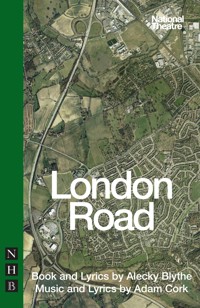
In late 2006 the everyday life of the quiet rural town of Ipswich was shattered by the discovery of the bodies of five women. The residents of London Road had struggled for years with the soliciting and kerb-crawling that they frequently encountered. As Steve Wright, the occupant of No. 79, was arrested, charged and then convicted of the murders, the immediate community grappled with the media frenzy and what it meant to be at the epicentre of this tragedy. London Road is a verbatim-theatre musical based on those events, with book and lyrics by Alecky Blythe, who recorded extensive interviews with the people of Ipswich, and music by Adam Cork, whose score is a response to the melodic and rhythmic speech patterns captured on those recordings. The musical was developed by the National Theatre, London, and first performed there in the Cottesloe auditorium in April 2011. It won the 2011 Critics' Circle Award for Best Musical. London Road is an experimental and challenging work which reveals the ways in which even the darkest experiences can engender a greater sense of our mutual dependence.
Sie lesen das E-Book in den Legimi-Apps auf:
Seitenzahl: 119
Veröffentlichungsjahr: 2014
Das E-Book (TTS) können Sie hören im Abo „Legimi Premium” in Legimi-Apps auf:
Ähnliche




LONDON ROAD
Book and Lyrics by
Alecky Blythe
Music and Lyrics by
Adam Cork
NICK HERN BOOKS
London
www.nickhernbooks.co.uk
Contents
Title Page
Singing for Real by Alecky Blythe
Saying in Tune by Adam Cork
Original Production
Characters
The Residents of London Road
Note on the Text
Act One
Act Two
About the Authors
Copyright and Performing Rights Information
Singing for Real
Development of the project
In the spring of 2007 I was invited to take part in the writers and composers week at the National Theatre Studio. The purpose of the week was to pair up a handful of writers and composers, put the pairings in a room together and see if any interesting discoveries were made by the end of it. The wonderful thing about the Studio is that on the surface it gives artists the opportunity to experiment and ‘get things wrong’. However, underneath this relaxed, cosy veneer, those who are lucky enough to workshop projects there know that in some cases there is the slim but real potential for them to be brought to life on the South Bank. So it was in an atmosphere of latent dreams that Adam and I first met.
I was delighted to be at the workshop, as working with music was a voyage into uncharted territory for me. As my work is made from recorded everyday conversations and replicated by actors as authentically as possible, musical theatre, with its necessary affectation, is not a genre that sits easily with me. I wanted to find out if I could adapt the verbatim technique in a way which incorporated music without losing its honesty.
Development of the technique
I work using a technique originally created by Anna Deavere Smith. Deavere Smith was the first to combine the journalistic technique of interviewing her subjects with the art of reproducing their words accurately in performance. It was passed on to me via Mark Wing-Davey in his workshop ‘Drama Without Paper’.
The technique involves going into a community of some sort and recording conversations with people, which are then edited to become the script of the play. However, the actors do not see the text. The edited recordings are played live to the actors through earphones during the rehearsal process, and onstage in performance. The actors listen to the audio and repeat what they hear. They copy not just the words but exactly the way in which they were first spoken. Every cough, stutter and hesitation is reproduced. Up till now for my previous shows, the actors have not learnt the lines at any point. By listening to the audio during performances the actors are helped to remain accurate to the original recordings, rather than slipping into their own patterns of speech or embellishment.
The considerable musical dimension of London Road has required a rethinking of the presentation of this recorded-delivery verbatim technique. By setting some of the material to music – even though Adam has been scrupulous in notating the tune of the spoken voice so that it remains faithful to how it was first said – the fact that at times characters sing their words instead of speak them as they did in real life, is a departure from the purer verbatim form of my past endeavours. In keeping with the songs being learnt from the score, the spoken text has also been learnt. With both the songs and the spoken text the audio has remained intrinsic to the process, so that the original delivery as well as the words are learnt.
I had arrived at the writers and composers week armed with a range of material with which we could experiment – but it was the interviews that I recorded in the winter of 2006 in Ipswich that best lent themselves to musical intervention. What Adam and I discovered with the music was that it succeeded in binding together shared sentiments that were being echoed throughout the town during those worrying times. More importantly, Adam was able to set these words to music by following the cadence and rhythms of the original speech patterns so accurately that it did not diminish their verisimilitude. I was also excited to have a new tool at my disposal with the songwriting. By creating verses and choruses, I could shape the material for narrative and dramatic effect further than I had ever been able to do before. To my surprise, we had between us the seeds of both the subject and the technique to take to another stage.
Development of the story
My first interviews from Ipswich were collected on 15th December 2006; five bodies had been found but no arrests had been made. The town was at the height of its fear. I had been gripped and appalled by the spiralling tragedies that were unravelling in Ipswich during that dark time. It would of course be a shocking experience for any community, but the fact that it took place in this otherwise peaceful rural town, never before associated with high levels of crime or soliciting, made it all the more upsetting for the people who lived there. It was not what was mainly being reported in the media about the victims or the possible suspects that drew me to Ipswich, but the ripples it created in the wider community in the lives of those on the periphery. Events of this proportion take hold in all sorts of areas outside the lead story, and that is what I wanted to explore.
It was not until six months later, when I returned to Ipswich to gauge the temperature of the town after the arrests but before the trial, that I stumbled upon what was to me the most interesting development so far. A Neighbourhood Watch that had been set up at the time of the murders had organised a ‘London Road in Bloom’ competition and the street could not have looked more different from when it had been besieged by the media the winter before. Hanging baskets lined the roads and front gardens were bursting with floral displays. Such was the impact of the terrible happenings in that area that the community had come together and set up a series of events, from gardening competitions to quiz nights, in order to try to heal itself. Although this had some coverage in the local press, the national media had not reported this final and important chapter of the story. Over the course of the next two years, I regularly revisited the residents of London Road to chart their full recovery.
I would like to say a special thank you to everyone who shared their stories with me, particularly the members of the London Road Neighbourhood Watch, without whose generosity the play would not have been possible.
Alecky Blythe, 2011
Saying in Tune
When I first met Alecky at the National Theatre Studio almost four years ago, as part of an experimental week which brought together composers and playwrights, I had no idea that I’d be working with a ‘verbatim’ practitioner. And when Alecky explained the concept and methods of this documentary form to me, I have to admit my very first thought was ‘How on earth can I turn this into music?’ But when we started listening to her interviews, I began to feel that this could be an inspiring new approach to songwriting, or, more accurately, an exciting development of an existing way of composing songs. Whenever I’ve set conventional texts to music, I’ve always spoken the words to myself, and transcribed the rhythms and the melodic rise and fall of my own voice, to try and arrive at the most truthful and direct expression of the text. And here was an opportunity to refine that to a much purer process, without any authorial or poetic interpretation (not to mention my own bad acting) polluting the connection between the actual subject and his or her representation in music.
And so we began, with a few ideas about what we wanted the piece to be. My initial aim was that the music should be as articulated as possible, otherwise we wouldn’t be doing justice to the reality and the uniqueness of the depicted people. I also wanted to seize the challenge of taking an experimental idea and developing it into something which could be interesting as both music and drama. I didn’t want to reference any overall musical style, but rather, discover responses suggested by the material on a moment-by-moment basis. For that reason I didn’t foresee much cross-pollination of musical motifs from one song to another, although I did want the identity of each individual song to be clear; I felt this was the only way I could create musical meaning from this un-versified, spontaneously spoken text. I also hoped that, in the spirit of the documentary concept, the musical score would be like a time capsule inside which the speech rhythms would be captured and contained, frozen and fossilised in music just as they have a fixed existence on Alecky’s recordings. And I wanted to find a way of singing with the quality of speech, which is altogether different from either an operatic or a conventional musical-theatre vocal style. In this last wish I have been very lucky, as our Musical Director David Shrubsole and the voice expert Mary Hammond have together helped the cast develop and maintain a speech-like way of singing which engages their prodigious techniques from a variety of disciplines.
At the outset I imagined that the process of finding a way to set words to music while staying faithful to the ideals of verbatim documentary theatre would eventually lead us to a whole new set of ideal principles, a properly developed written recipe for how we should conduct this experiment. In the event, we never did arrive at anything that prescriptive. In fact, as you experience the production you’re presented with the evolution of our approach. Some of the songs and fragments written towards the beginning of our process of development – early works that have ‘made the cut’ – are quite different from the more recent pieces. As I transcribed and composed and thought about it all, I found myself getting better and quicker at doing it, and representing the music of the speech rhythms with increasing forensic zeal, to the point where transcriptions from earlier in the process started to feel a little naïve, or less faithful to the documentary ideal than the later songs. But the slightly freer hand I gave myself initially had produced some interesting results, and abandoning the earlier music seemed to diminish the experience somehow.
Having said that, it’s very easy retrospectively to describe what we’ve done in terms of ‘rules’, or at least to say that there are some things that generally seem to happen. The lack of rhyme or consistent meter or line length in spontaneous speech, even after we’ve structured the recordings into ‘verses’ and ‘choruses’, results in labyrinthine tunes which offer hardly any repetitive potential in themselves, as rhythmic or melodic material. So our instinct has been for the most part to contain these anarchic lines within fairly solid musical structures, and these containers are often built out of key elements of the transcribed voice, translated into harmonic progressions, or rhythms in the accompaniment. And on the occasions when this approach has repeatedly led towards the wrong sort of song, I’ve had a good long think about what the song should express musically and composed a ‘container’ unconnected with the musical surface of the words, but inspired by their literal content, or the tone in which they are spoken, or the mood of the situation in which they were uttered, or that of the situation which they describe.
It’s also possible to notice some effects of the verbatim song forms we’ve developed, whilst confessing that many of them were unforeseen! A presentational style seems to suit the material better than a psychological one. As with non-musical documentary theatre, the actors find they are inhabited (or possessed) by the voices of the people they represent, rather than creating roles using the traditional rules of characterisation. I find that hearing the natural speech patterns sung in this way can have the effect of distancing the audience from the ‘character’, and even the ‘story’, but in a positive way that alters the quality of listening. Making spontaneously spoken words formal, through musical accompaniment and repetition, has the potential to explode the thought of a moment into slow motion, and can allow us more deeply to contemplate what’s being expressed. This seems particularly interesting when many different people speak about the same thought or feeling.
In fact, the choral presentation of this story in particular seems to underline the ritual aspect of human communal experience. The experiences captured on this stage are not new to our species, whether it’s the healing process after a tragedy, the gathering of forces within a community to find and punish a dangerous individual, or the telling of all these events to the wider community. This is deeply ancient, shared human experience in all its facets, no matter how much professionalism and the division of labour distance us from each other today. The people of Ipswich, the residents of London Road, and the news media, play their part in this ritual, and so do we, in presenting this piece of choric theatre.
Adam Cork, 2011
London Road was first performed in the Cottesloe auditorium of the National Theatre, London, on 14 April 2011 (previews from 7 April), with the following cast (only main roles are indicated):
CLARE BURT
Jan
ROSALIE CRAIG
Helen
KATE FLEETWOOD
Julie
HAL FOWLER
Tim
NICK HOLDER
Ron
CLAIRE MOORE
June
MICHAEL SHAEFFER
Alfie
NICOLA SLOANE
Rosemary
PAUL THORNLEY
Dodge
HOWARD WARD
Terry
DUNCAN WISBEY
Gordon
MUSICIANS
MARTIN BRIGGS
Percussion
JON GINGELL
Guitar / Bass Guitar
RACHEL ELLIOTT
Woodwind
CHRISTIAN FORSHAW
Woodwind
SIMON HARAM
Woodwind
IAN TOWNSEND
Keyboards
Director
Rufus Norris
Designer
Katrina Lindsay
Lighting Designer
Bruno Poet
Movement Director
Javier De Frutos
Sound Designer
Paul Arditti
Music Director
David Shrubsole
Associate Music Director
Ian Townsend
The production transferred to the Olivier auditorium of the National Theatre on 28 July 2012, with the following changes to the cast and creative team:
JAMES DOHERTY
Terry
LINZI HATELEY
Helen
STEVE SMITH
Guitar / Bass Guitar




