


17,99 €
Mehr erfahren.
- Herausgeber: John Wiley & Sons
- Kategorie: Bildung
- Sprache: Englisch
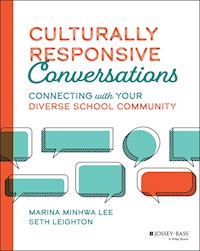
A strategic handbook for educators and administrators serving increasingly multicultural classrooms In Culturally Responsive Conversations, longtime cultural inclusion educators Marina Lee and Seth Leighton deliver an eye-opening discussion of how to develop better relationships and improve learning outcomes in a student body that's growing increasingly culturally diverse. In the book, readers will explore practical strategies to improve the K-12 educational experience for everyone, including cultural groups who have historically been overlooked or marginalized. This book provides a usable toolkit for educators to have more effective conversations with families from multicultural backgrounds and give all students the educational experience that they deserve. The authors tackle historical models for educating immigrants in the United States while identifying the many stakeholders in the education system and how familial involvement shapes and impacts student achievement. Readers will also find: * Interactive self-practice exercises, along with extensive references for additional study * Expansive treatments of effective cultural communication and the barriers that prevent teachers and students from achieving it * Explanations of how teacher-parent communication can be impacted by cross-cultural talk An unmatched resource for educators, administrators, and K-12 school leaders, Culturally Responsive Conversations also belongs on the bookshelves of parents, families, and community members hoping to advance the cause of diverse, equitable, and inclusive schools for all.
Sie lesen das E-Book in den Legimi-Apps auf:
Seitenzahl: 318
Veröffentlichungsjahr: 2023
Ähnliche

















Table of Contents
COVER
TITLE PAGE
COPYRIGHT
DEDICATION
ACKNOWLEDGMENTS
ABOUT THE AUTHORS
PERSONAL NOTES FROM THE AUTHORS
PERSONAL NOTE FROM MARINA LEE: THIS IS MY WHY
PERSONAL NOTE FROM SETH LEIGHTON
PART I: SETTING THE STAGE
1 IMMIGRATION AND EDUCATION IN THE USA
THE GREAT EXPERIMENT
THE RISE OF THE COMMON SCHOOL
INDUSTRIALIZATION AND SCHOOLING
IMMIGRATION AND DEMOGRAPHIC CHANGE
EDUCATIONAL REFORM IN THE TWENTIETH CENTURY: A PERPETUALLY (RE)CREATED NATION
SUMMARY
SELF-PRACTICE EXERCISES FOR EDUCATORS
NOTES
2 IT TAKES MORE THAN A VILLAGE
MULTIPLE CULTURAL MODELS
COMMUNITY AND STAKEHOLDERS IMPLICATIONS
WHO IS IN YOUR VILLAGES?
RISING CULTURAL COMPLEXITY
SUMMARY
INTERACTIVE SELF-PRACTICE EXERCISES
EFFECTIVE CONVERSATIONAL POINTS
NOTE
3 THE INTERPLAY BETWEEN LANGUAGE AND CULTURE
EVOLUTION OF VARIATIONS IN LANGUAGE
CULTURE
MAINTAINING AWARENESS OF STEREOTYPES
STEPS FORWARD
DEFINING SUCCESS
CULTURAL PERSPECTIVE ON GIVING COMPLIMENTS
SUMMARY
SELF-REFLECTIVE EXERCISES FOR EDUCATORS
NOTES
4 STAYING MINDFUL OF NUANCES
MANAGING CONVERSATIONS WITH DIFFERENT ETHNIC, CULTURAL, AND GEOGRAPHIC GROUPS
CULTURAL BACKGROUNDS
LOW-CONTEXT AND HIGH-CONTEXT CULTURES
MAKING PROGRESS: CHOOSING WORDS CAREFULLY
SUMMARY
SELF-PRACTICE EXERCISES FOR EDUCATORS
NOTES
5 EFFECTIVECROSS-CULTURAL COMMUNICATIONS IN SCHOOL CONTEXTS
COMMUNICATION CATEGORIES
THE ACCULTURATION PROCESS
ADVICE FOR EDUCATORS
SUMMARY
SELF-REFLECTIVE EXERCISES FOR EDUCATORS
PART II: THE FAMILY AND THE CLASSROOM
6 PERSPECTIVES ON THE EDUCATOR'S ROLE
FAULTY BEGINNINGS, FAULTY ENDS
CLASSROOM EXPECTATIONS
CULTURAL VIEW OF THE TEACHER
IT'S NOT ALL UP TO THE KIDS
SUMMARY
SELF-REFLECTIVE EXERCISES FOR EDUCATORS
7 CULTURAL VALUES AND DIVERSITY
TOUCHING ON TERMINOLOGY
FAMILY DIVERSITY
CONSIDERING CULTURAL VALUES AND CORE BELIEFS
FORMATION OF CULTURAL VALUES
ROLE OF CULTURAL VALUES
WHAT DOES THE EXISTENCE OF CULTURAL GAPS MEAN FOR EDUCATION?
IDENTIFYING CULTURAL GAPS
SUMMARY
INTERACTIVE SELF-PRACTICE EXERCISES
EFFECTIVE CONVERSATIONAL POINTS
NOTES
8 WORKING WITH MULTICULTURAL FAMILIES
KEY DIMENSIONS OF CROSS-CULTURAL VARIATION RELATED TO PARENTS
COLLECTIVISM AND INDIVIDUALISM
MAKING USE OF WHAT YOU KNOW
CONSIDERING CULTURAL GAPS
COMMON DISCREPANCIES IN CULTURAL PERSPECTIVES
SUMMARY
INTERACTIVE SELF-PRACTICE EXERCISES
EFFECTIVE CONVERSATIONAL POINTS
NOTES
PART III: REMEMBERING THE INDIVIDUAL
9 MAKING SPACE FOR INDIVIDUAL SELF-ACTUALIZATION
IMPORTANCE OF SELF-ACTUALIZATION
APPLICATIONS IN EDUCATION
SUMMARY
INTERACTIVE SELF-PRACTICE EXERCISES
EFFECTIVE CONVERSATIONAL POINTS
NOTES
10 ADDRESSING NEURODIVERSITY WITH CROSS-CULTURAL FAMILIES
WHAT IS NEURODIVERSITY?
SPECIFIC STRATEGIES FOR TEACHING NEURODIVERSE STUDENTS
ADDRESSING NEURODIVERSITY WITH CULTURAL SENSITIVITY
SUMMARY
INTERACTIVE SELF-PRACTICE EXERCISES
EFFECTIVE CONVERSATIONAL POINTS
NOTES
PART IV: SUPPORTING STUDENTS WITH HIGHER EDUCATION PLANS
11 INTRODUCTION TO SUPPORTING STUDENTS WITH HIGHER EDUCATION PLANS
OVERVIEW
12 NAVIGATING HIGH-PRESSURE CONSTRUCTS
SCRIPT
NOTES
13 CULTURAL PERSPECTIVES ON TESTING AND CREATING A COMPREHENSIVE BEST-FIT COLLEGE LIST
CONCEPT OF SACRIFICE
GENERAL VIEW OF ACCOUNTABILITY
SCRIPT
RECOMMENDATION LETTERS
SUMMARY
SELF-PRACTICE EXERCISES FOR EDUCATORS
COLLEGE ADMISSIONS RESOURCES
NOTES
Appendix 1: LEARNING THROUGH EXTRACURRICULAR ACTIVITIES
ENGLISH
SPANISH
CHINESE
Appendix 2: COMMON GREETINGS
RESOURCES CONSULTED
CONCLUSION
INDEX
END USER LICENSE AGREEMENT
List of Illustrations
Chapter 3
Figure 3.1 The Inglehart–Welzel World Cultural Map
Chapter 4
Figure 4.1 Top birthplaces for immigrants in the United States.
Figure 4.2 High-context and low-context cultures.
Chapter 9
Figure 9.1 Maslow's pyramid of needs.
Guide
Cover
Title Page
Copyright
Dedication
Acknowledgments
About the Authors
Personal Notes From the Authors
Table of Contents
Begin Reading
Appendix 1 Learning Through Extracurricular Activities
Appendix 2 Common Greetings
Resources Consulted
Conclusion
Index
End User License Agreement
Pages
i
v
vi
vii
xi
xii
xiii
xv
xvi
xvii
xviii
xix
1
3
4
5
6
7
8
9
10
11
12
13
15
16
17
18
19
20
21
22
23
24
25
26
27
28
29
30
31
32
33
34
35
36
37
38
39
40
41
42
43
44
45
46
47
48
49
50
51
52
53
54
55
56
57
58
59
60
61
62
63
65
66
67
68
69
70
71
73
75
76
77
78
79
80
81
82
83
84
85
86
87
88
89
90
91
92
93
94
95
96
97
98
99
100
101
102
103
104
105
106
107
108
109
111
112
113
114
115
116
117
119
120
121
122
123
124
125
126
127
128
129
130
131
133
134
135
137
138
139
141
142
143
144
145
146
147
148
149
150
151
152
153
155
156
157
158
159
160
161
162
163
164
165
166
167
169
170
171
172
173
175
176
177
178
179
180
181
182
183
184
185
186
187
Praise for Culturally Responsive Conversations
“Marina and Seth's wisdom and stories helped me better understand what I've seen and heard in classrooms around the world, and reflect on how I can be better with kids of every background.”
—Mike Goldstein, Founder, Match Education, Boston
“Scholars have dissected cultural responsiveness, alerting educators of its importance, but educators are still left with the question of ‘how do we actually do this in schools?' The authors extend current knowledge into practical, digestible nuggets of wisdom that concretize and demystify cultural responsiveness for educators.”
—Josephine M. Kim, Senior Lecturer on Education at Harvard University
“In this engaging and highly readable primer on cross-cultural communications for educators Marina Lee and Seth Leighton offer an original synthesis of knowledge based on scholarship and on practice with practical exercises that can help the reader become more self-aware and competent in navigating cross-cultural exchanges. Their own lived experience, as a multicultural family and as global educators, uniquely qualifies them to speak with authority and authenticity about the potential of true communication that bridges cultures. This book will empower educators to realize the potential that lies in culturally diverse classrooms and schools.”
—Fernando M. Reimers, Ford Foundation Professor of the Practice of International Education, Harvard Graduate School of Education
Culturally Responsive Conversations
Connecting with Your Diverse School Community
Marina Minhwa Lee
Seth Leighton
Copyright © 2023 by John Wiley & Sons, Inc. All rights reserved.
Published by John Wiley & Sons, Inc., Hoboken, New Jersey. Published simultaneously in Canada.
No part of this publication may be reproduced, stored in a retrieval system, or transmitted in any form or by any means, electronic, mechanical, photocopying, recording, scanning, or otherwise, except as permitted under Section 107 or 108 of the 1976 United States Copyright Act, without either the prior written permission of the Publisher, or authorization through payment of the appropriate per-copy fee to the Copyright Clearance Center, Inc., 222 Rosewood Drive, Danvers, MA 01923, (978) 750-8400, fax (978) 750-4470, or on the web at www.copyright.com. Requests to the Publisher for permission should be addressed to the Permissions Department, John Wiley & Sons, Inc., 111 River Street, Hoboken, NJ 07030, (201) 748-6011, fax (201) 748-6008, or online at www.wiley.com/go/permission.
Trademarks: Wiley and the Wiley logo are trademarks or registered trademarks of John Wiley & Sons, Inc. and/or its affiliates in the United States and other countries and may not be used without written permission. All other trademarks are the property of their respective owners. John Wiley & Sons, Inc. is not associated with any product or vendor mentioned in this book.
Limit of Liability/Disclaimer of Warranty: While the publisher and author have used their best efforts in preparing this book, they make no representations or warranties with respect to the accuracy or completeness of the contents of this book and specifically disclaim any implied warranties of merchantability or fitness for a particular purpose. No warranty may be created or extended by sales representatives or written sales materials. The advice and strategies contained herein may not be suitable for your situation. You should consult with a professional where appropriate. Further, readers should be aware that websites listed in this work may have changed or disappeared between when this work was written and when it is read. Neither the publisher nor authors shall be liable for any loss of profit or any other commercial damages, including but not limited to special, incidental, consequential, or other damages.
For general information on our other products and services or for technical support, please contact our Customer Care Department within the United States at (800) 762-2974, outside the United States at (317) 572-3993 or fax (317) 572-4002.
Wiley also publishes its books in a variety of electronic formats. Some content that appears in print may not be available in electronic formats. For more information about Wiley products, visit our web site at www.wiley.com.
Library of Congress Cataloging-in-Publication Data:
Names: Lee, Marina M. (Marina Minhwa), author. | Leighton, Seth, author.
Title: Culturally responsive conversations : connecting with your diverse school community / Marina M Lee, Seth Leighton.
Description: Hoboken, New Jersey : Jossey-Bass, [2023] | Includes index.
Identifiers: LCCN 2022059904 (print) | LCCN 2022059905 (ebook) | ISBN 9781119849155 (paperback) | ISBN 9781119849186 (adobe pdf) | ISBN 9781119849179 (epub)
Subjects: LCSH: Multicultural education—United States. | Inclusive education—United States.
Classification: LCC LC1099.3 .L454 2023 (print) | LCC LC1099.3 (ebook) | DDC 370.1170973—dc23/eng/20230113
LC record available at https://lccn.loc.gov/2022059904
LC ebook record available at https://lccn.loc.gov/2022059905
Cover Design: Wiley
Cover Image: © FoxysGraphics/Getty Images
Author Photos: (Lee) Courtesy of Marina Lee, (Leighton) Photo by Justin Knight
For Madeline Eung Raehui
ACKNOWLEDGMENTS
Turning an idea into a book was both challenging and rewarding. We especially want to thank the individuals who helped make this happen. We are incredibly grateful for the contributions of research and experiences from students, colleagues, and friends to this book; whether small or large, the friendly spirit and assistance were always significant and meant much more to us than words can express.
Alexandra Koch-Liu
Anthony J. Lee
Amardeep Bhatia
Amelia Stevens
Annie Dong
Aparna Prasad
April J. Remfrey
Ava Shaw
Bernard West
Caroline Min
Chris Zhengda Lu
Christina Linden
Chujie Qiu
Claudia Gonzalez Salinas
David Hawkins
Derek O'Leary
Diana Rangraves
Donovan Richards
Karen V. Wynn, PhD.
Elaine Yining Yan
Fr. Jaehwa Lee
Grace Haddad
Graeme Peele
Hanjing Wang
Hanson Liu
Harry Gallen
James Holden
Jane Namussis
Jean Louis
Jeffrey Li
John Youngho Lee
Joshua Andrew Guo
Julie Moloney
Junming Xing
Kara Madden
Kelly Lu
Linus Law
Metta Dael
Midori Yasamura
Naeun Ruby Koo
Nathaniel Dvorkin
Peter Berzilos
Rebecca Grappo
Rebecca Leighton
Ryan Jin
Sam Fleischmann
Sanaa Gupta
Sanjna Srinivasan
Sarah Loring de Garcia
Shirley Brito
Sonya Pareek
Sophia Tanh
Tammy Alt
Tejas West
Teo Salgado
We are grateful for the guidance of our mentors over the years, including Jerry Murphy, Fernando Reimers, Monica Higgins, Josephine Kim, John Curtis Perry, Juliana Chen, Sung-Yoon Lee, Steven Koltai, Molefi Mataboge, Jed Willard, Michael Goldstein, and countless other colleagues and friends from UNESCO APEID, the Korean Development Institute, Tokyo Parawood, the University of Gondar, Praphamontree School, Harvard Graduate School of Education, the Fletcher School of Law and Diplomacy, and many, many, many schools around the world with whom we've had the good fortune to work.
We express our gratitude to the amazing community of global educators at Envoys, who have taught us both how to truly collaborate across geographic and cultural borders. Special thanks to Felipe Correa, Isabel Eslava, Luis Garcia, Angela Gomez, Daniela Gomez, Annie Harold, Mason Hults, Daniel Matallana, Annie Peuquet, and Laura Rocha for their constant support, advice, and inspiration.
We thank the team at Cogita Education Initiatives, past and present, who have stood strong and compassionate through the years. They are indisputably a group of creative souls who give it their all to educate responsibly. With their intelligence, grace, and humor, they have given a new definition to teamwork, always inspiring me to do and be better as a person and a member of this power team.
Cindy Xuejiao Lin
Diana Xiunan Jin
Haoyi (Vivian) Li
Jill K. Schaffer
Jessie Zhijie Yang
Nora Yasamura
Tingjun (Tina) Liu
Yingyi (Wenny) Lin
Marina would also like to thank our colleagues and wonderful team members who have supported our important work with families in meaningful ways: Caitlin McGuire, Julie Moloney, Kate Milani, and Tammy Alt.
Thanks to the Jossey-Bass and Wiley team who helped us so much in shepherding us in the creation of our first book. Special thanks to Amy Fandrei, acquisitions editor; Mary Beth Rossworm, editorial assistant; Pete Gaughan, managing editor; Tom Dinse, development editor; Premkumar Narayanan, content refinement specialist; Julie Kerr, copyeditor; and the composition team at Straive for your patience and support.
We thank our nieces and nephews, Alex, Daphne, Emilia, and Magnolia, for their curiosity, bravery, and wit.
Seth would like to thank his parents, Arlene and Jeff, and brother, Max, for modeling how to navigate the world with empathy, understanding, and respect. Marina would like to thank Gomo and Elena and her family of educators, especially her talented siblings, Anthony J. Lee, Sophia Lee Tanh, and Father Jaehwa Lee, and especially her father and dear mother, John and Regina, whose sacrifices and courage have always given strength for the path ahead.
ABOUT THE AUTHORS
Born in Incheon, South Korea, Marina Minhwa Lee moved to the United States at a young age, gaining an early perspective on the role of students in serving as cross-cultural “brokers” for families. A former biological researcher, Marina earned her Master of Education from Harvard Graduate School of Education, where her studies focused on immigration, education, and identities.
Marina went on to found Cogita Education Initiatives, a leading provider of educational advising services that empowers students to connect together for the common good. Cogita is committed to enlightening and educating global leaders by cultivating their potential to be changemakers for their generation. Through Cogita, Marina has worked with hundreds of immigrants and international families on transitions to the U.S. educational culture. She is a professional member of the Independent Educational Consultants Association, the National Association of College Admission Counseling, and The Association of Boarding Schools. She consults regularly with leading independent schools on international student support, cultural competency training, and global education curriculum. She can be reached at [email protected].
Seth Leighton grew up in a small town on the coast of Maine, regularly exploring the outdoors with his friends and family. After attending the local public school in rural Maine, his desire for adventure and exploration has led him around the world, and he has lived, worked, and traveled across North America, South America, Asia, Africa, Europe, and Australia.
Seth co-founded Envoys, a unique organization that partners with innovative teachers and schools to push the boundaries of possibility for global education. Using a blended model of online courses and focused international travel programming, Envoys builds the skill sets associated with global competency. Seth graduated cum laude from Harvard College and has earned advanced degrees from the Harvard Graduate School of Education and the Fletcher School of Law and Diplomacy. Seth can be reached at [email protected].
PERSONAL NOTES FROM THE AUTHORS
PERSONAL NOTE FROM MARINA LEE: THIS IS MY WHY
At five years old, I immigrated to the United States of America from Incheon, South Korea.
It was very clear to me, even at that age, that there were certain gender expectations within my family, no matter where I lived. I distinctly recall my parents scolding me for not pouring the water properly into the glasses or setting the dinner plates down delicately. As per their training and patterned behaviors, each time they were prefaced with, “Girls should …”
I didn't realize until college that many of the gender expectations from my family and my school community contradicted each other. Each seemed to define what successful members of a community looked like:
If I followed one set of expectations, I would be considered a disempowered woman.
If I followed the other, I would be a bold, unrighteous woman brought up without manners, therefore shaming myself and my family.
Even as young as 10 years old, I cut up fruit and made coffee for my father's guests and friends of his or the family who visited our home. I often sat with them for a few minutes and asked about how they were doing, allowed them to ask me questions about school and grades, and then went upstairs to my room to study.
Schoolwork was the only excuse that would be a good enough reason not to stay long with the guests. I excused myself politely, indicating I had a lot of schoolwork to do. I'd get kind nods and enthusiastic “of course, of course” and other words of approval. In retrospect, they were expressions of appreciation for following a culturally conditioned norm everyone could rely on.
Even if a child providing snacks to guests was not expected in some households, it was worthy of praise when she did. Yejul ee joh tah, meaning I was brought up with such strong etiquette, reflecting the good family upbringing and being a good girl for following their norm.
Almost any Korean household would agree that my role at the time wasn't surprising to them and would receive a lot of micro-gender-specific admiration. If one of my brothers were to set up fruit for the guests, the praise would have been different, expressing an out-of-the-ordinary surprise and novelty.
FRIENDS OPENED ME TO ANOTHER PERSPECTIVE
When my friends came over and saw me prepare these snacks, they were confused. Most feminists among us, or what we thought of like feminism, said I was a servant to men. They did not understand why I needed to bring my parents’ guests anything. There was no praise from them. I felt embarrassed by what they thought of me, whereas I thought I was doing the right thing in my family.
Antithetical to this is how girls are brought up in the United States. Here, being bold, independent, and even fierce is a good thing. Not speaking up means you don't have an opinion of your own, which means you don't think critically or have a strong sense of self, not that you were gracious enough to let others speak their minds and listen to them.
It was not surprising then when my primary school teacher asked my parents to meet her, that although I was top of my class in grades and getting an A, she told them I was too quiet. I needed to speak up in class and share more of my opinions. This was what would jeopardize my grade. My father told me I needed to do better in school. Without realizing the impact of her words, my teacher just made my father speak with me about values that seemed to go against those I was brought up with. I was told conflicting messages, and I didn't know how to reconcile them. This started a spiral of identity questioning that inevitably pitted two parts of my identity against each other, and it felt like there could be only one winner.
WITHIN CULTURAL CLARITY: WHAT IS GOOD AND BAD
What I thought was “good” was “bad” and propagated disempowerment of women in U.S. society. I was a part of a regression seen through the lens of my friends’—and many other—“white” adults’ eyes.
As I grew older, I didn't fully understand the complexity of cultural contexts beyond our linear color graph of good, bad, and grey areas. The grey area implied it could be good or bad depending on the context. I have now discovered that culturally influenced behavior, customs, and traditions don't fit into these bipolar, two-dimensional extremes with the grey area in between—that is, there's no possibility of many traditions having the potential to be either good or bad, right or wrong.
I hope this book allows others to see instead that these traditions are, on the whole, linked to another plane of existence that is deeply meaningful to the individual and families. They are tied to the practice and historical connections that have shaped our values and, thus, influenced our identity.
PERSONAL NOTE FROM SETH LEIGHTON
My childhood was characterized by a distinct lack of cultural diversity. Growing up in the 1980s and 1990s in the largely homogenous state of Maine, my interactions with cultures different from my own were limited to the stereotypes portrayed through American entertainment and media at the time.
While my parents, teachers, and greater community, by and large, provided consistent messages for sensitivity and tolerance, like many white Americans, I grew up in a context that supported a sense of my culture being the fundamental “correct” one, and the basis for comparison between all other ways of being. College provided one immediate shake for this perspective, but it was not until I was able to put myself into a wholly new situation that I began to truly appreciate the challenges of living in a cross-cultural milieu.
BROADENING MY WORLD, AND MY WORLDVIEW
My international career began shortly after college when I took a volunteer teaching assignment at a rural high school in the Rayong Province of Thailand. The first few weeks of my time in Rayong were a whirlwind of work at the school, fighting through the normal experiences of any first-time teacher trying desperately to stay ahead with lesson planning and classroom dynamics. I was very lucky to have experienced colleagues to rely on for the basics of student management and to listen to ideas for creative lessons and activities. Very gradually, I built a degree of confidence in my own identity as an educator and took heart in the real progress I saw in my students.
While at the school, I was placed with a host family who owned a large furniture factory. My one-room apartment was perched inside the factory, and my door opened out on 400 people crafting, assembling, and boxing rubberwood furniture for shipment around the world.
While my host family was incredibly generous and amazingly kind, my hometown community seemed far away, and I felt a real disconnect from the people in my immediate surroundings that was hard to manage. Having grown up in a small town in rural Maine, I was accustomed to a sense of neighborliness that was hard to picture occurring in my present circumstances. The physical and cultural distance from those around me seemed impossible to bridge—how would I ever be able to start a conversation?
However, my feeling of connection would come back from the strangest set of circumstances, as one night I got a knock on my door from the brother in my host family. There had been a delay in manufacturing, and an order had to be shipped out immediately. Could I help with the packing?
Feeling a bit awkward, but eager to be of use, I took a spot on the factory floor. I was greeted not with wariness, or even ambivalence, but instead with warm smiles and a happy sense of camaraderie. I was handed a roll of shipping tape and given the task of closing off the box of folding wooden chairs, destined for the shelves of Crate & Barrel.
That experience gave me a true immersion into the Thai concept of sanuk. More than having fun, sanuk is about finding a gentle humor and pleasure in any activity. Jokes, songs, and consistent friendly banter were the norm on the assembly and packing lines, and made the hours fly by.
Soon I was on the factory floor on a regular basis. Welcomed in no small part as a teacher of many of their children, I developed a real sense of belonging with the factory workers. My Thai slowly improved, and the reality of this “far end” of the global supply chain became very real for me, forever altering my perception of how products are made and how benefits of employment and trade are distributed around the world. Most importantly, it was quite humbling to feel such openness from people whose backgrounds were so different from mine.
CONTINUING MY JOURNEY
Since my time in Thailand, my experiences interacting with people with views of the world that are radically different from my own have only grown. When I was 26 years old, I received a fellowship from the U.S. Department of State to teach at a university in the city of Gondar in northern Ethiopia.
This was a metropolis of some 250,000 people, with barely a handful of foreigners living full time, mostly involved with the university and medical school. Gondar itself was a former capital of Ethiopia, with the massive fort still standing as a symbol of the Emperor Fasilides's seventeenth-century kingdom that stretched over most of Northern Africa. By the time I arrived, the city (and the country) had suffered through a combination of drought, corruption and misrule, and foreign occupation that had devastated its economy for years. Things were (and are) incredibly difficult for my students. Incredibly bright, talented, and hardworking, they faced daily challenges of supplies and materials, yet they preserved and served as a daily source of motivation for me.
Roughly two months into my time in Ethiopia, I developed a cough and mild fever. What might have kept me home in bed for a morning in another place felt like a major cause for concern in this isolated community, so I headed into the local clinic to see what might be occurring. In a tiny office with chemical reagents housed in recycled plastic milk containers, a lab coat–clad doctor drew my blood for testing. I went over to his office and waited a short while, and finally the doctor came in with the results.
“Your bloodwork has come in and shows signs of malaria. Do you agree? If so, we would like you to start you on antimalarial medication.”
I was momentarily dumbfounded—the idea that a medical professional would ask for my “agreement” on a diagnosis was totally outside of my way of thinking. After a moment, I realized this unique phrasing was a small sign of a slightly different framework around decision-making, wherein no important judgments could be made without some sense of discussion and consensus. With this in mind, I agreed with the verdict, and returned to my home for a few admittedly harrowing days of recovery.
I have been amazingly fortunate that my professional life has given me the opportunity to work closely with people from around the world. As the founder of an educational travel organization, I collaborate on a daily basis with people from drastically different sociocultural backgrounds from my own. For this book, I wish to impart some of the frameworks and lessons that I've learned along the way, and, most importantly, to ensure that the kindness I have had in my life continues to be “paid forward” by well-intentioned educators everywhere.
PART ISETTING THE STAGE
1IMMIGRATION AND EDUCATION IN THE USA
This chapter provides background on how the goals and means of education have evolved over the history of the United States, moving from the pre-colonial period through the advent of the “common school” and progressive educational movements. We review the ways in which schools have responded to the waves of immigration that created modern America and consider the extent to which the concept of school in the United States both shapes and is shaped by the changing demographics of the student bodies.
This chapter concludes with self-reflective exercises to help educators consider the ways their own experience of school has impacted their views of citizenship, both intentionally and unintentionally. Prompts are given for educators to begin to plan out their learning goals related to developing a sense of “American” identity for students from different cultural backgrounds.
THE GREAT EXPERIMENT
In its most rose-colored and idealistic view, the political institutions of the United States can be regarded as a “great experiment,” organizing individuals from a wide variety of social, economic, geographic, and cultural backgrounds under a common value system prioritizing “life, liberty, and the pursuit of happiness.” The lofty democratic principles of equal rights, individual freedoms, and government by a majority have continued to be tested as waves of immigration have changed the demographics of the country.
The idea of education as the primary means to meet these tests has been present from the nation's earliest days. Across the New England colonies, each town was established as a religious republic, and “the school everywhere in America arose as a child of the Church”1 from the onset of the colonial period. Puritan leaders pushed the Massachusetts General Court to issue the “Old Deluder Satan” Act of 1647, making literacy a legal requirement punishable by fine:
That every Township in this Jurisdiction, after the Lord hath increased them to the number of fifty Housholders, shall then forthwith appoint one within their town to teach all such children as shall resort to him to write and read, whose wages shall be paid either by the Parents or Masters of such children, or by the Inhabitants in general …
And it is further ordered, that where any town shall increase to the number of one hundred Families or Housholders, they shall set up a Grammar-School, the Masters thereof being able to instruct youth so far as they may be fitted for the Universitie.2
While the responsibility for educating children varied across the colonies between the individual family and the larger community, the post-Revolution mindset saw the need for developing the “common school.” Drawing upon Enlightenment ideals, Thomas Jefferson called for the creation of elementary schools across Virginia in his widely noted 1779 Bill for the More General Diffusion of Knowledge, declaring:
At every of these schools shall be taught reading, writing, and common arithmetic, and the books which shall be used therein for instructing the children to read shall be such as will at the same time make them acquainted with Græcian, Roman, English, and American history. At these schools all the free children, male and female, resident within the respective hundred, shall be intitled to receive tuition gratis, for the term of three years, and as much longer, at their private expence, as their parents, guardians or friends, shall think proper.3
In Jefferson's view, these publicly supported and managed schools would provide the citizenry with the basic literacy and numeracy skills seen as necessary for the development of the nation as a whole. Presaging the arguments that would determine first the common school movement of the 1800s and the progressive developments of the 1900s, Jefferson argued that the country as a whole would benefit from public investments in education.
Despite these lofty ideals expressed by Jefferson and other Founding Fathers, the end of the 1700s saw a “patchwork pattern of schools, most of which were conducted under the auspices of private schoolmasters or sectarian religious groups.”4 While upper classes maintained access to higher learning, the ability to gain skills and knowledge necessary for productive work for the masses was largely dependent on apprenticeships or family-based learning, limiting the opportunities for upward mobility. As the century turned, newfound social conditions and a rapidly industrializing nation prompted renewed pressure for a more organized approach to widespread public education.
THE RISE OF THE COMMON SCHOOL
As often in American education, what were widespread societal pressures became personified in one “heroic individual,” in this case the educational reformer Horace Mann, often referred to as the Father of the Common School. An active barrister and politician, Mann was elected to the Massachusetts State Senate as a Boston representative in 1835, serving as the Senate President from 1836 to 1837. During his time in the Senate, Mann focused his energies on infrastructure, funding the construction of railroads and canals. In 1837, Mann departed his law practice and legislative position to take on the duties of secretary to the newly established state board of education in Massachusetts. Once he assumed this role, Mann withdrew from all other professional and business engagements, and became wholly dedicated to educational reform.
In 1838, Mann founded The Common School Journal, targeting the issues surrounding public education in the United States and promulgating the following six principles:
The public should no longer remain ignorant.
Education should be paid for, controlled, and sustained by an interested public.
Education will be best provided in schools that embrace children from a variety of backgrounds.
Education must be nonsectarian.
Education must be taught using the tenets of a free society.
Education should be provided by well-trained, professional teachers.
Mann led the creation of numerous schools throughout Massachusetts, serving families from a wide range of socioeconomic backgrounds in both urban and rural areas. Drawing on his legislative experience, Mann drove the creation of tax-supported elementary public education in several states, along with the professionalization (and, as a continued trend, feminization) of the teaching force.
Mann's vision for institutionalizing teacher training took place mainly through the development of “normal schools” setting standards for pedagogical and curricular norms. In 1839, the first of these state-funded schools was established in Lexington, Massachusetts, maintaining continuous operations and eventually becoming Framingham State University. Normal schools were open to women, providing new opportunities for women to enter the workforce.
Mann's success in bringing about common schools came from his strong and repeated arguments that universal education was an essential precursor for a stable and harmonious polis. This message resonated across the growing class of new property owners, especially only a few generations removed from the American Revolution. Mann's assertion that the sanctity of “life, liberty, and the pursuit of happiness” was dependent on a highly literate and numerate population held both a practical as well as a patriotic appeal. As the historian Ellwood P. Cubberley noted:
No one did more than [Mann] to establish in the minds of the American people the conception that education should be universal, non-sectarian, free, and that its aims should be social efficiency, civic virtue, and character, rather than mere learning or the advancement of sectarian ends.5
Mann's efforts catalyzed universal public education in the Northern United States during the 1800s, with continued attention toward the standardization of structured curriculum and away from the “single schoolmarm” model of the traditional colonial communities. By 1864, all students in the city of Chicago were divided into age-based grades, with each grade following a distinct course of study for each subject.6
INDUSTRIALIZATION AND SCHOOLING
While the common school movement began to influence the educational systems of the Southern states, the structural realities of slave-based economies made the establishment of free public schools untenable until after the Civil War. As the Reconstruction era took hold, the developmental needs of the South and concurrent reorganization of civil society created the space for the common school to become a reality across the newly re-formed nation. Robert E. Lee expressed the needs of the South in a private letter as:
So greatly have those interests [educational] been disturbed in the South, and so much does its future condition depend upon the rising generation, that I consider the proper education of its youth one of the most important objects now to be attained, and one from which the greatest benefits may be expected. Nothing will compensate us for the depression of the standard of our moral and intellectual culture, and each State should take the most energetic measures to revive the schools and colleges, and, if possible, to increase the facilities for instruction and to elevate the standard of learning.7
By the advent of the twentieth century, the Southern states had experienced “the greatest educational awakening in their history,”8 with new educational legislation setting out minimum requirements and subjects of instruction. Within the span of one century, education in every state in the nation had transitioned from mainly religious oversight, mixed in with familial instruction and both formal and informal apprenticeships, to a wholly secular undertaking funded by the public at large, with set curriculum, professional instructors, and requirements for progression.
As the rapidly industrializing nation saw continued societal and economic changes, the nature of debates around the purpose of education in the United States evolved as well. Public awareness of the changes in American society was driven in part by the developments in communication networks that created new connections throughout the growing nation. Between 1870 and 1880, the number of newspapers in America doubled, demonstrating both the growing demand for knowledge of current events and the growing supply of educated journalists and reporters. Readership in other mediums grew apace, with the circulation of weekly magazines exceeding that of newspapers in the 1890s. This widespread appetite for reading was evidenced by the astounding Ladies Home Journal




