


47,99 €
Mehr erfahren.
- Herausgeber: John Wiley & Sons
- Kategorie: Wissenschaft und neue Technologien
- Sprache: Englisch
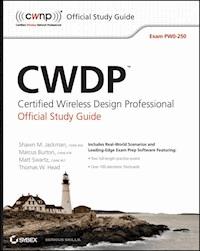
The official study guide for the Certified Wireless Design Professional (CWDP) exam from CWNP! This official guide is what you need to prepare for the vendor-neutral CWDP exam (PW0-250), which tests an IT professional's ability to design, plan, and troubleshoot a wireless network. Administered by CWNP, the industry leader for enterprise Wi-Fi training and certification, the CWDP exam is for those operating in large WLAN deployments. This practical guide not only covers all exam objectives, it also gives you practical information on designing for complex environments such as businesses, hospitals, educational facilities, and in outdoor spaces. * Covers all exam objectives for the Certified Wireless Design Professional (CWDP) exam, exam PW0-250 * Covers planning, developing a WLAN design strategy and RF, conducting advanced site surveying, developing 802.11 security, and troubleshooting * Companion CD includes two practice exams and over 100 electronic flashcards * Sybex is the official publisher for Certified Wireless Network Professional, Inc., the certifying vendor for the CWAP program If you want to prepare for CWNP certification, a Sybex Study Guide is what you need! Note: CD-ROM materials for eBook purchases can be downloaded from href="http://www.cwnp.com/sybex.%20To%20%201Cbooksupport.wiley.com">http://booksupport.wiley.com.
Sie lesen das E-Book in den Legimi-Apps auf:
Seitenzahl: 1470
Veröffentlichungsjahr: 2011
Ähnliche



















Contents
Foreword
Introduction
Assessment Test
Chapter 1: Gathering and Analyzing Requirements
Preparation and Planning
Meeting the Customer
Gathering the Requirements
Using a Customer’s Existing Assets to Save Time and Money
Understanding the Deployment Environment
Constraints
Creating the Customer Requirements Document
Statement of Work
Summary
Exam Essentials
Review Questions
Answers to Review Questions
Chapter 2: Designing for Client Devices and Applications
General Client Design Factors
Common Client Device Form Factors
Summary
Exam Essentials
Review Questions
Answers to Review Questions
Chapter 3: Designing for Applications
Understanding WLAN Applications
Guest Access
Summary
Exam Essentials
Review Questions
Answers to Review Questions
Chapter 4: Industry-Specific Design Considerations
Healthcare
Retail
Education
Other Verticals
Summary
Exam Essentials
Review Questions
Answers to Review Questions
Chapter 5: Vendor and WLAN Architecture Selection
Consumer vs. Enterprise Equipment
Management, Control, and Data Planes
Architecture
Additional Vendor Selection Considerations
Summary
Exam Essentials
Review Questions
Answers to Review Questions
Chapter 6: RF Communication Principles
Understanding Basics of RF
Radio Propagation
Modulation
Noise
Units of Measure
Communications Link
Summary
Exam Essentials
Review Questions
Answers to Review Questions
Chapter 7: RF Hardware and 802.11n
RF Cables and Connectors
Filters
Antennas
802.11n
Summary
Exam Essentials
Review Questions
Answers to Review Questions
Chapter 8: Site Survey Preparation
Primary Events
Administrative Items
Environment
Understanding the Wired Network
Survey Equipment
Point-to-Point Links
Summary
Exam Essentials
Review Questions
Answers to Review Questions
Chapter 9: Site Survey RF Design
RF Survey Overview
Spectrum Analysis
Survey Types
Dealing with Multiple Floors
Utilizing Infrastructure Links
Handling Critical Findings
Designing for Dual Spectrums
Survey Client Considerations
Frequency Band–Specific Considerations
PHY Rate Support
Updating an Existing Design
Interpreting Survey Results
MCA vs. SCA
Summary
Exam Essentials
Review Questions
Answers to Review Questions
Chapter 10: MAC Layer Design
Understanding Quality of Service
Protection Modes
Power Management
Roaming and Mobility
WLAN Configuration
Summary
Exam Essentials
Review Questions
Answers to Review Questions
Chapter 11: Basic WLAN Security Design
A General Overview of WLAN Security
Basic WLAN Security
WPA-Personal and WPA2-Personal
Summary
Exam Essentials
Review Questions
Answers to Review Questions
Chapter 12: Advanced Enterprise WLAN Security Design
WPA-Enterprise and WPA2-Enterprise
AAA
User Databases
Extensible Authentication Protocol
PKI and Certificates
Segmentation and Filtering
Captive Portals
Endpoint Security
Virtual Private Networking
WIDS/WIPS
Fast Secure Roaming
Summary
Exam Essentials
Review Questions
Answers to Review Questions
Chapter 13: Documentation and Finalizing the Design Solution
Design Documentation
High-Level Design
Low-Level Design
Operational and Maintenance Plan
Summary
Exam Essentials
Review Questions
Answers to Review Questions
Chapter 14: Post-Installation Validation
Post-Installation RF Assessment
Interference Mitigation
Design Validation
Frame and Channel Analysis
Roaming Analysis
Load and Performance Testing
Application Testing
Failover and Redundancy Testing
Network Approval
Summary
Exam Essentials
Review Questions
Answers to Review Questions
Chapter 15: Design Troubleshooting
Troubleshooting Steps
Spectrum Analysis
Security Model Analysis and Troubleshooting 802.1X Authentication
Quality of Service Analysis
Network Analysis
Pesky Clients
Common Troubleshooting Mistakes: What Not to Do
Summary
Exam Essentials
Review Questions
Answers to Review Questions
Appendix: About the Companion CD
Glossary
Index
Wiley Publishing, Inc. End-User License Agreement
The Best CWDP Book/CD Package on the Market!
Advertisement
CWDP® Certified Wireless Design Professional
Acquisitions Editor: Jeff Kellum
Development Editor: Denise Santoro Lincoln
Technical Editors: Jennifer Huber; Jerome Henry
Production Editor: Dassi Zeidel
Copy Editor: Liz Welch
Editorial Manager: Pete Gaughan
Production Manager: Tim Tate
Vice President and Executive Group Publisher: Richard Swadley
Vice President and Publisher: Neil Edde
Media Project Manager 1: Laura Moss-Hollister
Media Associate Producer: Doug Kuhn
Media Quality Assurance: Shawn Patrick
Book Designers: Judy Fung and Bill Gibson
Proofreader: Publication Services, Inc.
Indexer: Ted Laux
Project Coordinator, Cover: Katie Crocker
Cover Designer: Ryan Sneed
Copyright © 2011 by Wiley Publishing, Inc., Indianapolis, Indiana
Published simultaneously in Canada
ISBN: 978-0-470-76904-1
ISBN: 978-1-118-04159-8 (ebk.)
ISBN: 978-1-118-04161-1 (ebk.)
ISBN: 978-1-118-04160-4 (ebk.)
No part of this publication may be reproduced, stored in a retrieval system or transmitted in any form or by any means, electronic, mechanical, photocopying, recording, scanning or otherwise, except as permitted under Sections 107 or 108 of the 1976 United States Copyright Act, without either the prior written permission of the Publisher, or authorization through payment of the appropriate per-copy fee to the Copyright Clearance Center, 222 Rosewood Drive, Danvers, MA 01923, (978) 750-8400, fax (978) 646-8600. Requests to the Publisher for permission should be addressed to the Permissions Department, John Wiley & Sons, Inc., 111 River Street, Hoboken, NJ 07030, (201) 748-6011, fax (201) 748-6008, or online at http://www.wiley.com/go/permissions.
Limit of Liability/Disclaimer of Warranty: The publisher and the author make no representations or warranties with respect to the accuracy or completeness of the contents of this work and specifically disclaim all warranties, including without limitation warranties of fitness for a particular purpose. No warranty may be created or extended by sales or promotional materials. The advice and strategies contained herein may not be suitable for every situation. This work is sold with the understanding that the publisher is not engaged in rendering legal, accounting, or other professional services. If professional assistance is required, the services of a competent professional person should be sought. Neither the publisher nor the author shall be liable for damages arising herefrom. The fact that an organization or Web site is referred to in this work as a citation and/or a potential source of further information does not mean that the author or the publisher endorses the information the organization or Web site may provide or recommendations it may make. Further, readers should be aware that Internet Web sites listed in this work may have changed or disappeared between when this work was written and when it is read.
For general information on our other products and services or to obtain technical support, please contact our Customer Care Department within the U.S. at (877) 762-2974, outside the U.S. at (317) 572-3993 or fax (317) 572-4002.
Wiley also publishes its books in a variety of electronic formats. Some content that appears in print may not be available in electronic books.
Library of Congress Cataloging-in-Publication Data
CWDP : certified wireless design professional official study / Shawn M. Jackman . . . [et al.]. —1st ed.
p. cm.
ISBN 978-0-470-76904-1 (pbk.)
1. Wireless LANs—Design and construction—Examinations—Study guides. 2. Telecommunications engineers—Certification. I. Jackman, Shawn M., 1974- II. Title: Certified wireless design professional official study guide.
TK5105.78.C94 2011
621.384076—dc22
2010054032
TRADEMARKS: Wiley, the Wiley logo, and the Sybex logo are trademarks or registered trademarks of John Wiley & Sons, Inc. and/or its affiliates, in the United States and other countries, and may not be used without written permission. CWDP is a trademark of CWNP, Inc. All other trademarks are the property of their respective owners. Wiley Publishing, Inc., is not associated with any product or vendor mentioned in this book.
Dear Reader,
Thank you for choosing CWDP: Certified Wireless Design Professional Official Study Guide. This book is part of a family of premium-quality Sybex books, all of which are written by outstanding authors who combine practical experience with a gift for teaching.
Sybex was founded in 1976. More than 30 years later, we’re still committed to producing consistently exceptional books. With each of our titles, we’re working hard to set a new standard for the industry. From the paper we print on, to the authors we work with, our goal is to bring you the best books available.
I hope you see all that reflected in these pages. I’d be very interested to hear your comments and get your feedback on how we’re doing. Feel free to let me know what you think about this or any other Sybex book by sending me an email at [email protected]. If you think you’ve found a technical error in this book, please visit http://sybex.custhelp.com. Customer feedback is critical to our efforts at Sybex.
Best regards,
Neil Edde
Vice President and Publisher
Sybex, an Imprint of Wiley
We dedicate this book to our families and the continued support that has helped to make this book possible.
Acknowledgments
Shawn Jackman would like to thank his wife, Joy, and his children, Summer, Pierce, and Julia, for the years of unwavering love and support.
Marcus Burton would like to thank his beautiful God, his beautiful wife, and his beautiful kids, Noah and Amalia. Lindsey, I love you today!
Marcus would also like to give an honorable mention to his significantly less beautiful brothers in arms, Devin, Josiah, and the Pudloafs.
Matt Swartz would like to thank his wife, Christie, and children, Lauren and Kyla, for their constant love and support.
Tom Head would like to thank his wife, Meridith, and his children, Laura and Ethan, for their loving support during the writing of this book.
We would all like to thank the following individuals for their support and contributions during the entire process:
We must first thank Sybex Acquisitions Editor Jeff Kellum. Jeff is an extremely patient and understanding editor who occasionally sends a nasty email message, especially when our day jobs take us away from writing for too long. We would also like to thank our development editor, Denise Lincoln. We also need to send special thanks to our editorial manager Pete Gaughan and our production editor Dassi Zeidel, and Liz Welch, our copyeditor. We also want to thank Jennifer Huber and Jerome Henry, our technical editors.
In addition, we thank Kevin Sandlin and Marcus Burton with the CWNP program (www.cwnp.com). You should be proud of the international renowned wireless certification program that you and your team have developed. It has been a pleasure working with all of you over the years.
A special thank you goes to Young Kim for his contribution to Chapter 15. Young’s expertise is deep and wide in both networking and wireless, and his many years of experience with troubleshooting wireless networks is a valuable contribution for all readers.
Shawn would also like to thank the following co-workers and professional colleagues who contributed to this book and his career: Devin Akin, Nico Arcino, Marcus Burton, David Coleman, Ken Fisch, Tom Head, Jon Krabbenschmidt, Charlie Nowak, Zack Ryan, Adam Schembs, George Stefanick, and Matt Swartz.
Tom would also like to thank Elena Bogorad for assistance with proofreading.
Matt would also like to thank his manager at Cisco Systems, Jon Leary, for consistently encouraging him to meet new challenges that have fed his thirst for unsolved problems and driven his technical and personal development.
We would also like to thank the following individuals and companies for their support and contributions to the book:
Aerohive Networks (www.aerohive.com)—Devin Akin, Adam Conway
AeroScout (www.aeroscout.com)—Gabi Daniely
AirMagnet (www.airmagnet.com)—Dilip Advani, Bruce Hubbert
AirTight (www.airtightnetworks.com)—Gopinath KN
Aruba Networks (www.arubanetworks.com)—Andy Logan, Chris Leach
Cisco Systems (www.cisco.com)—Chris Allen, Brian Cox, Jim Florwick, John Helm, Young Kim, Sudheer Matta, Fred Niehaus, Sean Simmons
InfoLogix (www.infologix.com)—Katrina McSweeney
Meraki (www.meraki.com)—John Bicket
Meru Networks (www.merunetworks.com)—Joe Epstein
Phoenix Antennas (www.phoenixantennas.com)—Stephen Tilston, David Tilston
Ruckus Wireless (www.ruckuswireless.com)—GT Hill
SunWize Technologies (www.sunwize.com)—Charlie Bachman, Laurie DuBois
TerraWave (www.terrawave.com)—Carter Burke, Felicia Carreon
VeriWave (www.veriwave.com)—Eran Karoly
Vocera (www.vocera.com)—Chris O’Donnell, Brian Sturges
WildPackets (www.wildpackets.com)—Stephanie Temples
Xirrus (www.xirrus.com)—Violet Smith, Bruce Miller
About the Authors
Shawn Jackman designs and establishes new product offerings and sets Wi-Fi direction for one of the United States’ largest hospital systems, Kaiser Permanente. Shawn coauthored the CWSP Certified Wireless Security Professional Official Study Guide: Exam PW0-204 (Sybex, 2010). He has traveled the United States and internationally, designing wired and wireless networks, from concept to completion, for healthcare, warehouse, hospitality, education, metro/municipal, government, franchise, and retail environments. Shawn is a member of the CWNE Roundtable, a group of individuals who work with the CWNP Program to provide direction for the CWNE exam and certification. He lives in the San Francisco Bay Area with his wife, Joy, and their three children, Summer, Pierce, and Julia. Shawn is CWNE #54, and he can be reached via email at [email protected].
Marcus Burton is the Director of Product Development and primary content developer at CWNP. Marcus has authored or co-authored numerous WLAN exams (CWTS, CWNA, CWSP, CWAP, and CWDP), course guides, whitepapers, and articles. In addition, he has served as technical editor for numerous whitepapers as well as the CWTS: Certified Wireless Technology Specialist Official Study Guide (Sybex, 2009) and the CWSP Certified Wireless Security Professional Official Study Guide (Sybex, 2010). At CWNP, Marcus actively participates with many WLAN vendors in product engineering, testing, and design; he also has in-depth experience with a comprehensive range of WLAN technologies and vendor products. Marcus is CWNE #78.
Matt Swartz is a Technical Leader within Cisco’s Advanced Services Wireless Practice. He delivers scalable designs that enable mobility solutions across many verticals for Cisco’s largest customers. Matt’s most recent focus is on high-density wireless as he drives new technology to expand capacity in these environments. Prior to joining Cisco in 2003, Matt held network engineering positions with a number of service providers and enterprises. He is CCIE #13232 (Routing/Switching & Wireless) and CWNE #57. He also holds a BS degree from Old Dominion University, and is a member of the CWNE Roundtable. Matt can be reached at [email protected].
Thomas Head has been an engineer and manager in the wireless industry for over 20 years. Tom graduated from Rensselaer Polytechnic Institute with a degree in physics. He was an engineer, then manager, of radio design at Lockheed Martin’s spacecraft division. He was also manager of radio programs for Lucent Technologies’ third-generation cellular base station. At Flarion Technologies, Tom was responsible for RF and network testing of Flarion’s innovative Flash-OFDM wireless system. He formed his own company, Aereo Networks, in 2006, which provided wireless test services and software for the US Army, Army Reserves, and major healthcare systems. He can be reached at [email protected].
Foreword
So you want to design an enterprise wireless network? “I can’t connect to the Wi-Fi!” is what you’re going to hear if you don’t get your Wi-Fi right. How do you permanently remove this wonderful end user complaint from your WLAN? It starts with proper design.
I actually considered starting and ending this foreword to the CWDP: Certified Wireless Design Professional Official Study Guide with just the above sentiment. That sums it up, but there is much more to it. Today’s end user expects the wireless network to just work, period. When it doesn’t, customers leave, employees complain, managers scream, and your network is always to blame . . . even when it isn’t.
A few years ago, before Polycom bought them, SpectraLink ran into quite a few of these complaints, only the complaints were “These phones don’t work!” and it really was the network. What did SpectraLink do? They created a services team to design and build their customers’ WLANs properly, so that the SpectraLink phones running on those WLANs would work. It wasn’t the phones. It was the network. The network was not properly designed to support Wi-Fi phones. That was five years ago. Imagine what the network has to support today, thanks to Mr. Steve Jobs!
Whether you’re designing for a coffee shop hotspot or the Super Bowl, your design before the network is implemented will determine hero or goat status. The fun part is, much like security, it gets noticed only when it doesn’t work. If everything works flawlessly, you’ve done your job. When you hear that soulful end user scream—“Mine’s broken!”—then you know you’ve missed the mark.
So how do you design for something you can’t see? RF is a strange animal indeed, often referred to as black magic, or smoke and mirrors, so you must know RF cold. That includes the RF math, behavior, and characteristics, in addition to the building(s) for which you are designing the network. That’s right: you have to know building materials! RF acts differently around cement, metal, drywall, plaster, wood, trees, fences, and, yes, people. That’s part of the reason we require a CWNA before you can be a CWDP. You have to know RF, and you have to know RF really well before you can claim to be a WLAN designer.
And, oh, wouldn’t it be nice if every new WLAN was a sweet new greenfield implementation? Sorry, not going to happen. You will most likely be replacing an old 802.11b or 802.11g WLAN with an 802.11n system. And wouldn’t it be nice if it were just rip and replace? Ha! Life should be so easy! If your manager or your customer suggests rip and replace, you’d do well to suggest that they find someone else to do this job. That should get someone’s attention. Then it’s your job to explain, for example, how differently an 802.11g network and an 802.11n network behave, not only in that particular environment, but in any environment.
With a/b/g, multipath and interference were the bane of your existence. Now, multipath is good for 802.11n Wi-Fi. That means a complete change in the way you design the WLAN for any environment.
Ah, but we don’t design only for the environment, do we? No, no, we don’t. We must design for the specific applications, and the type(s) of and number of devices that will utilize the WLAN, and the specific industry, and the number of end users . . . the list goes on and on. And then there’s VoWiFi and video. How many people have you seen watching (fill in the blank) on YouTube on the wireless LAN? Your WLAN has to support that kind of bandwidth, lest you hear the cry of the end user: “Mine’s broken!”
Reliable enterprise Wi-Fi starts with the design of the wireless network. So where do you start to end up with a great design? You guessed it: your old friend the RF site survey. Missed it, didn’t you? What’s wrong? Haven’t climbed enough towers, scaled enough ceilings, pushed enough carts, dropped enough handhelds, or walked enough miles lately? It’s time to go back to where you started, and improve your game not just a little but a lot. When you did your first 50 RF site surveys, were you thinking about the design of the network, or were you thinking about getting the survey done as quickly and with as little pain as possible?
Now return to the RF site survey with the—no, with your—network design in mind. This time, you’re doing the survey for the purpose of designing a reliable, scalable, secure, mission-critical enterprise wireless LAN. It’s not just Internet access anymore; it is the new access layer technology for the 21st century.
You want to design my wireless network? Start with this book, and see where it takes you.
Kevin Sandlin
Co-Founder and CEO
CWNP, Inc.
Introduction
The content of this book is focused on the real world of wireless design. While this book provides all of the necessary information to pass the CWDP exam, the content is primarily focused on providing tangible value to immediately expand your wireless expertise. The knowledge you will obtain from this book will not only prove valuable if you plan on performing or participating in wireless designs, but will also help you understand what makes WLANs tick, spot design mistakes, troubleshoot pesky clients and applications, understand and quantify RF issues, and more.
Writing a book on wireless design in order to certify career professionals on designing for any equipment vendor isn’t a light undertaking. Vendors differ in their approach. There are even different architectures that greatly vary in the way they work, which is certainly the case between equipment vendors, but major architectural differences can even be found between product lines from a single equipment vendor.
The approach taken with the CWDP is far deeper in one area in particular than any other CWNP curriculum has ever embarked upon before—RF. Radio frequency fundamentals is an extremely tough area to teach and is probably the single least understood area of wireless networking across technical professionals. This book aims to change some of that. After all, a house can’t be built on a bad foundation. A wired network can’t be built using bad cabling. A supersonic jet . . . you get the point. Without the proper foundation for a wireless LAN, the performance will suffer and your network may ultimately fail.
The total focus of this book isn’t just the wireless network infrastructure—we also explore the client devices that the wireless network infrastructure supports. In Wi-Fi, the communication link of a wireless client and an AP must be in parity with each other. For example, if you switch phones, even with the same mobile network carrier, your experience will vary. Where you may have once had good reception, you won’t now, and vice versa. It is no different with Wi-Fi. In fact, it is worse. Mobile network carriers have incredible control over the phones they will support and perform a great deal of engineering before placing them into the hands of customers. Wi-Fi, on the other hand, has many different equipment infrastructure vendors, an even greater disparity of operating modes, and a far greater variety of client devices with comparatively very little rigor and testing between them. Industry standards have a lot of wiggle room, and as a wireless network designer, you need to take this fact into account from the onset. After all, the very reason a wireless network exists is to support client devices.
If you have purchased this book or if you are thinking about purchasing this book, you probably have some interest in taking the CWDP® (Certified Wireless Design Professional) certification exam or in learning more about what the CWDP certification exam is about. We would like to congratulate you on this first step, and we hope that our book can help you on your journey. Wireless networking is one of the hottest technologies available today and demands for mobility are great among a wide variety of industries. As with many fast-growing technologies, the demand for knowledgeable people is often greater than the supply. The CWDP certification is your opportunity to distinguish yourself from others and a way to prove that you have the knowledge and skills to support this growing industry. This Study Guide was written with that goal in mind.
This book will teach you about wireless networking so that you have the knowledge needed not only to pass the CWDP certification test, but also to be able to design, install, and support wireless networks. We have included review questions at the end of each chapter to help you test your knowledge and prepare for the test.
Before we tell you about the certification process and requirements, we must mention that this information may have changed by the time you are taking your test. We recommend that you visit www.cwnp.com as you prepare to study for your test to determine what the current objectives and requirements are.
To adequately study for the CWDP exam, you need to do more than just study the questions and answers in this book! The practice questions we have supplied are designed to test your knowledge of a concept or objective that is likely to be on the CWDP exam, but to really learn this material, you need to read and study the chapters in the book. Please note that the practice questions will be different from the actual certification questions, but if you learn and understand the topics and objectives, you will be better prepared for the test.
Lesen Sie weiter in der vollständigen Ausgabe!
Lesen Sie weiter in der vollständigen Ausgabe!
Lesen Sie weiter in der vollständigen Ausgabe!
Lesen Sie weiter in der vollständigen Ausgabe!
Lesen Sie weiter in der vollständigen Ausgabe!
Lesen Sie weiter in der vollständigen Ausgabe!
Lesen Sie weiter in der vollständigen Ausgabe!
Lesen Sie weiter in der vollständigen Ausgabe!
Lesen Sie weiter in der vollständigen Ausgabe!
Lesen Sie weiter in der vollständigen Ausgabe!
Lesen Sie weiter in der vollständigen Ausgabe!
Lesen Sie weiter in der vollständigen Ausgabe!
Lesen Sie weiter in der vollständigen Ausgabe!
Lesen Sie weiter in der vollständigen Ausgabe!
Lesen Sie weiter in der vollständigen Ausgabe!
Lesen Sie weiter in der vollständigen Ausgabe!
Lesen Sie weiter in der vollständigen Ausgabe!
Lesen Sie weiter in der vollständigen Ausgabe!
Lesen Sie weiter in der vollständigen Ausgabe!
Lesen Sie weiter in der vollständigen Ausgabe!
Lesen Sie weiter in der vollständigen Ausgabe!
Lesen Sie weiter in der vollständigen Ausgabe!
Lesen Sie weiter in der vollständigen Ausgabe!




