



36,99 €
Mehr erfahren.
- Herausgeber: John Wiley & Sons
- Kategorie: Wissenschaft und neue Technologien
- Sprache: Englisch
The must-have guide to the CWTS exam, updated for 2017
CWTS Certified Wireless Technology Specialist Study Guide is your number-one resource for comprehensive exam preparation. Updated to study in 2017 and beyond, this book takes a multi-modal approach to ensure your complete confidence and ability for the big day: full coverage of all CWTS exam objectives reinforces your conceptual knowledge, hands-on exercises help hone your practical skills, and the Sybex online learning environment provides flashcards, a glossary, and review questions to help you test your understanding along the way. An objective map and pre-assessment test allow for more efficient preparation by showing you what you already know and what you need to review—and the companion website's complete practice exams give you a "dry run" so you can pinpoint weak areas while there's still time to improve. If you're serious about earning your CWTS certification, this book is your ideal companion for complete and thorough preparation.
Learn critical concepts and apply essential skills in areas like hardware and software, radio frequency fundamentals, surveying and installation, support, troubleshooting, security, and more. This guide gives you everything you need to approach the exam with confidence.
- Master 100 percent of the CWTS exam objectives
- Use effective planning tools to get the most out of your study time
- Practice your skills with hands-on exercises and real-world scenarios
- Access online study aids that let you review any time, any place
The CWTS certification gets your foot in the door of a growing industry, and is a stepping stone to the industry standard CWNP certification. The exam will test your abilities in all fundamental areas of Wi-Fi technology, so it's important that your study plan be complete and up-to-date. CWTS Certified Wireless Technology Specialist Study Guide is your ideal solution for comprehensive preparation.
Sie lesen das E-Book in den Legimi-Apps auf:
Seitenzahl: 846
Veröffentlichungsjahr: 2017
Ähnliche
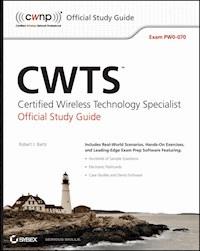


















CWTS®, CWS, and CWT Complete Study Guide
Exams PW0-071, CWS-100, CWT-100
Robert J. Bartz
Development Editor: Kelly Talbot
Technical Editors: Bryan Harkins and Ben Wilson
Production Editor: Dassi Zeidel
Copy Editor: John Sleeva
Editorial Manager: Mary Beth Wakefield
Production Manager: Kathleen Wisor
Executive Editor: Jim Minatel
Book Designers: Judy Fung and Bill Gibson
Proofreader: Kim Wimpsett
Indexer: Ted Laux
Project Coordinator, Cover: Brent Savage
Cover Designer: Wiley
Cover Image: © Jeremy Woodhouse/Getty Images, Inc.
Copyright © 2018 by John Wiley & Sons, Inc., Indianapolis, Indiana
Published simultaneously in Canada
ISBN: 978-1-119-38503-5ISBN: 978-1-119-41940-2 (ebk.)ISBN: 978-1-119-41939-6 (ebk.)
Manufactured in the United States of America
No part of this publication may be reproduced, stored in a retrieval system or transmitted in any form or by any means, electronic, mechanical, photocopying, recording, scanning or otherwise, except as permitted under Sections 107 or 108 of the 1976 United States Copyright Act, without either the prior written permission of the Publisher, or authorization through payment of the appropriate per-copy fee to the Copyright Clearance Center, 222 Rosewood Drive, Danvers, MA 01923, (978) 750-8400, fax (978) 646-8600. Requests to the Publisher for permission should be addressed to the Permissions Department, John Wiley & Sons, Inc., 111 River Street, Hoboken, NJ 07030, (201) 748-6011, fax (201) 748-6008, or online at http://www.wiley.com/go/permissions.
Limit of Liability/Disclaimer of Warranty: The publisher and the author make no representations or warranties with respect to the accuracy or completeness of the contents of this work and specifically disclaim all warranties, including without limitation warranties of fitness for a particular purpose. No warranty may be created or extended by sales or promotional materials. The advice and strategies contained herein may not be suitable for every situation. This work is sold with the understanding that the publisher is not engaged in rendering legal, accounting, or other professional services. If professional assistance is required, the services of a competent professional person should be sought. Neither the publisher nor the author shall be liable for damages arising herefrom. The fact that an organization or Web site is referred to in this work as a citation and/or a potential source of further information does not mean that the author or the publisher endorses the information the organization or Web site may provide or recommendations it may make. Further, readers should be aware that Internet Web sites listed in this work may have changed or disappeared between when this work was written and when it is read.
For general information on our other products and services or to obtain technical support, please contact our Customer Care Department within the U.S. at (877) 762-2974, outside the U.S. at (317) 572-3993 or fax (317) 572-4002.
Wiley publishes in a variety of print and electronic formats and by print-on-demand. Some material included with standard print versions of this book may not be included in e-books or in print-on-demand. If this book refers to media such as a CD or DVD that is not included in the version you purchased, you may download this material at http://booksupport.wiley.com. For more information about Wiley products, visit www.wiley.com.
Library of Congress Control Number: 2017951652
TRADEMARKS: Wiley, the Wiley logo, and the Sybex logo are trademarks or registered trademarks of John Wiley & Sons, Inc. and/or its affiliates, in the United States and other countries, and may not be used without written permission. CWTS is a registered trademark of CWNP, LLC All other trademarks are the property of their respective owners. John Wiley & Sons, Inc. is not associated with any product or vendor mentioned in this book.
About the Author
Robert Bartz is a technical trainer, computer networking consultant, technical author, and speaker. He is a graduate of California State University Long Beach, College of Engineering, with a Bachelor of Science degree in Industrial Technology. Prior to entering the field of computer networking, Robert was employed as an aerospace test engineer working with military fighter aircraft radar systems and communication satellite spacecraft. After leaving the aerospace industry, he attained numerous technical certifications over the years, starting with Novell NetWare and moving on to Microsoft networking, CompTIA, Cisco Systems, and the CWNP program. Robert currently holds the Certified Wireless Network Expert (CWNE) and Certified Wireless Network Trainer (CWNT) credentials. He has more than 27 years of experience with computer networking technology and has been involved with the CWNP program since its inception.
Robert attended the first-ever CWNA class in 2001 and has taught vendor-neutral IEEE 802.11 wireless LAN technology to thousands of people from various industries and markets across the United States and around the world. Robert is the founder of Eight-O-Two Technology Solutions, LLC, a computer networking technical training and consulting services company that provides technical education and consulting services to various businesses and organizations. He spends his spare time learning and working with new technology, having fun outside, and enjoying the beauty of his surroundings at his home in Colorado. He can be contacted by email at [email protected].
Acknowledgments
I would like to thank my wife and two adult children for their support and patience during the writing of this book.
I would also like to thank everyone at Sybex who helped with the creation of this book, including executive editor Jim Minatel, production editor Dassi Zeidel, and copy editor John Sleeva. I owe all these individuals a lot of thanks for their patience while working with me on this book and keeping things on track. Kelly Talbot is the development editor for this book. It was great to work with Kelly once again. Many thanks go to Kelly for his time and work to help make this book an educational and enjoyable read. His editorial skills and attention to detail, in addition to assisting with the flow, organization, and suggestions, were a huge help to me. Also, thanks to Ben Wilson, the proofread technical editor.
The technical editor for this book is Bryan Harkins. It is always a pleasure to work with Bryan. I want to thank Bryan once again for his timely reviews, comments, and great suggestions that helped make this book a valuable reference source. His many years of experience as a technical trainer, engineer, security specialist, and author were a great contribution in creating a book I am sure you will enjoy reading.
I would like to thank the thousands of students who have taken the time to attend the computer networking classes I was given the opportunity to teach over the last couple of decades. Educating, mentoring, and entertaining so many of these individuals gave me the inspiration and motivation to author this book and share my knowledge with people who want to learn more about this wonderful technology.
CWNP has realized the need for vendor-neutral wireless LAN training and certification and has done a great job of building a brand over the years that is known worldwide. The CWNP program continues to grow at a strong pace, adding many new certified individuals every day. I offer a special thank-you to the CWNP team for providing a much-needed product in the industry.
Finally, a thank-you to all the manufacturers, vendors, organizations, and individuals that I have worked with in the industry, providing me the technology and tools needed to help write this book.
Contents
About the Authors
Acknowledgments
Introduction
About CWNP
®
CWNP Learning Resources
How to Become a CWTS
How to Become a CWS
How to Become a CWT
Who Should Get This Book?
How to Use This Book and the Companion Website
CWTS, CWS, and CWT Exam Objectives
CWTS Exam Objectives
CWS Exam Objectives
CWT Exam Objectives
Assessment Test
Answers to Assessment Test
Chapter 1 Computer Networking Fundamentals
Network Types
Network Topologies
The OSI Model
Device Addressing
Summary
Exam Essentials
Review Questions
Chapter 2 Wireless Local Area Networking, Standards, and Certifications
The Wireless Computer Network
Building-to-Building Connectivity Using Wireless LAN Technology
Radio Frequency Regulatory Domain Governing Bodies and Local Regulatory Authorities
The IEEE
Interoperability Certifications
Common Wireless Local Area Network Deployment Scenarios
Summary
Exam Essentials
Review Questions
Chapter 3 Infrastructure and Client Devices Used with Wireless Networking
The Wireless Access Point
Wireless Mesh
Wireless Bridges
Wireless Repeaters/Range Extenders
Wireless LAN Controllers and Cloud-Managed Architectures
Power over Ethernet
Radio Hardware Used with Wireless LAN Technology
USB 1.0, USB 1.1, USB 2.0, and USB 3.0
Peripheral Component Interconnect
Mini-PCI, Mini-PCIe, and Half Mini-PCIe
Wireless Workgroup Bridges
Client Device Drivers
Client Utility Software
Summary
Exam Essentials
Review Questions
Chapter 4 Radio Frequency Fundamentals for Wireless Networking
Understanding Radio Frequency
Wireless LAN Coverage and Capacity
Radio Frequency Range and Speed
Wi-Fi and Non–Wi-Fi Interference
Basic Units of Radio Frequency Measurement
Summary
Exam Essentials
Review Questions
Chapter 5 Antenna Technology for Wireless Networking
Basic Radio Frequency Antenna Concepts
Wireless LAN Antenna Types
Radio Frequency Cables and Connectors
Factors in Antenna Installation
Minimizing the Effects of Multipath Using Antenna Diversity
Combating Effects of Wind and Lightning in Wireless LAN Installations
Installation Safety
Antenna Mounting
Maintaining Clear Communications
Summary
Exam Essentials
Review Questions
Chapter 6 Communication for Wireless Networking
Wireless LAN Operation Methods
Connecting to an IEEE 802.11 Wireless Network
The Distribution System
Data Rates
Throughput
Dynamic Rate Switching
Wireless LAN Transitioning/Roaming
IEEE 802.11 Power Save Operations
IEEE 802.11 Protection Mechanisms
Summary
Exam Essentials
Review Questions
Chapter 7 Modulation Technology for Wireless Networking
Network Access Methods
Spread-Spectrum Technology
IEEE 802.11g Extended Rate Physical
IEEE 802.11n High Throughput
IEEE 802.11a, 802.11g, 802.11n, and 802.11ac OFDM
Summary
Exam Essentials
Review Questions
Chapter 8 Security Fundamentals for Wireless Networking
Introducing IEEE 802.11 Wireless LAN Security
Wireless LAN Threats and Intrusion
IEEE 802.11 Standard Security
Early Wireless LAN Security Methods
MAC Address Filtering
IEEE 802.11 Authentication and Data Encryption
IEEE 802.11 SOHO and Enterprise Security Technologies
Wi-Fi Protected Access and WPA2 Personal Security
WPA and WPA2 Enterprise Security
IEEE 802.1X/EAP
IEEE 802.11 Encryption Methods
Role-Based Access Control
Virtual Private Networking
The Wireless Intrusion Prevention System
The Captive Portal
Wireless Network Management and Monitoring Systems
Industry Regulatory Compliance
Summary
Exam Essentials
Review Questions
Chapter 9 Design for Wireless Networking
Wireless Site Surveys
Gathering Business Requirements
Interviewing Stakeholders
Gathering Site-Specific Documentation
Identifying Infrastructure Connectivity and Power Requirements
Understanding Application Requirements
Understanding Radio Frequency Coverage and Capacity Requirements
Client Connectivity Requirements
Antenna Use Considerations
The Physical Radio Frequency Site Survey Process
Radio Frequency Spectrum Analysis
Received Signal Strength
Performing a Manual Radio Frequency Wireless Site Survey
Performing a Predictive Modeling Site Survey
Performing a Post-Deployment Site Survey
Protocol Analysis
RF Coverage Planning
Infrastructure Hardware Selection and Placement
Testing Different Antennas
Wireless Channel Architectures
Wireless Device Installation Limitations
Site Survey Report
Summary
Exam Essentials
Review Questions
Chapter 10 Mobile Device Management and BYOD Fundamentals
Mobile Device Management Solutions
Common Mobile Device Operating System Platforms
The Mobile Application Store
Pushing Content to Mobile Devices
Mobile Device Management Administrative Permissions
Understanding Mobile Device Management High Availability and Redundancy
Mobile Device Management Device Groups
Location-Based Services
Mobile Device Telecommunications Expense Management
Captive and Self-Service Portals
General Technology Network and Security Policy
Information Technology and Security Policy Implementation and Adherence
Backup, Restore, and Recovery Policies
Operating System Modifications and Customization
Technology Profiles
Understanding Group Profiles
Policy and Profile Pilot Testing
Summary
Exam Essentials
Review Questions
Chapter 11 Troubleshooting for Wireless Networking
Identifying Wireless LAN Problems
Wireless LAN Connectivity—Coverage and Capacity Problems
Application Performance Problems
Optimizing Wireless Networks
Summary
Exam Essentials
Review Questions
Appendix Answers to Review Questions
Chapter 1: Computer Networking Fundamentals
Chapter 2: Wireless Local Area Networking, Standards, and Certifications
Chapter 3: Infrastructure and Client Devices Used with Wireless Networking
Chapter 4: Radio Frequency Fundamentals for Wireless Networking
Chapter 5: Antenna Technology for Wireless Networking
Chapter 6: Communication for Wireless Networking
Chapter 7: Modulation Technology for Wireless Networking
Chapter 8: Security Fundamentals for Wireless Networking
Chapter 9: Design for Wireless Networking
Chapter 10: Mobile Device Management and BYOD Fundamentals
Chapter 11: Troubleshooting for Wireless Networking
Advert
EULA
List of Tables
Chapter 1
TABLE 1.1
Chapter 2
TABLE 2.1
TABLE 2.2
TABLE 2.3
Chapter 3
TABLE 3.1
TABLE 3.2
TABLE 3.3
Chapter 4
TABLE 4.1
TABLE 4.2
TABLE 4.3
TABLE 4.4
TABLE 4.5
TABLE 4.6
Chapter 5
TABLE 5.1
TABLE 5.2
TABLE 5.3
TABLE 5.4
TABLE 5.5
Chapter 6
TABLE 6.1
Chapter 7
TABLE 7.1
TABLE 7.2
Chapter 8
TABLE 8.1
TABLE 8.2
TABLE 8.3
TABLE 8.4
TABLE 8.5
List of Illustrations
Chapter 1
FIGURE 1.1
Example of a local area network (LAN)
FIGURE 1.2
Example of a wide area network (WAN) connecting two LANs
FIGURE 1.3
Example of a metropolitan area network (MAN) connecting a small town
FIGURE 1.4
Example of a campus area network (CAN) connecting a school campus
FIGURE 1.5
Example of a wireless Bluetooth network connecting several personal wireless devices
FIGURE 1.6
Example of the bus topology
FIGURE 1.7
Example of the ring topology
FIGURE 1.8
Example of a common star topology using either wired or wireless devices
FIGURE 1.9
Mesh networks can include either wired or wireless devices.
FIGURE 1.10
Wired peer-to-peer and wireless ad hoc networks
FIGURE 1.11
Point-to-point connections using either wired or wireless connections
FIGURE 1.12
Point-to-multipoint connections using either wired or wireless connections
FIGURE 1.13
Representation of the OSI Model
FIGURE 1.14
Physical layer sublayers, PLCP and PMD
FIGURE 1.15
Data Link layer sublayers, LLC and MAC
FIGURE 1.16
Data Link layer (Layer 2) to Network layer (Layer 3) address translation
FIGURE 1.17
Comparison between TCP and UDP protocols
FIGURE 1.18
Peer communication between three of the seven layers
FIGURE 1.19
Information is added at each layer of the OSI model as data moves between devices.
FIGURE 1.20
The MAC address is analogous to the address of buildings on a street.
FIGURE 1.21
Example of a Layer 2 MAC address showing the OUI and unique physical address
FIGURE 1.22
The
ipconfig
command-line utility displaying a physical/MAC address in Microsoft Windows
FIGURE 1.23
A network with Layer 3 network device logical addressing
FIGURE 1.24
Example of a Class C logical IP address
FIGURE 1.25
The Microsoft Windows
ipconfig
command-line utility showing logical address information
FIGURE 1.26
Network Address Translation (NAT) and Port Address Translation (PAT). The IP addresses shown are examples.
Chapter 2
FIGURE 2.1
A wireless point-to-point connection using directional antennas
FIGURE 2.2
A typical point-to-multipoint connection using omnidirectional and directional antennas
FIGURE 2.3
ITU-R administrative region map
FIGURE 2.4
WLAN controller showing the IEEE 802.11a data rates
FIGURE 2.5
WLAN controller showing the IEEE 802.11g data rates
FIGURE 2.6
WLAN controller showing the IEEE 802.11n MCS and data rates for the 5 GHz band
FIGURE 2.7
Wi-Fi Certified logo for devices that are Wi-Fi certified
FIGURE 2.8
Example of a SOHO WLAN configuration
FIGURE 2.9
Floor plan of a typical office area that may use IEEE 802.11 WLAN technology
FIGURE 2.10
Wireless hotspot allows users to connect to the Internet from remote locations.
FIGURE 2.11
Office with conference area and cubicle offices
FIGURE 2.12
Classrooms for WLAN deployment
FIGURE 2.13
Warehouse facility with high ceilings and storage shelving inside
FIGURE 2.14
Medical offices often use WLAN technology
FIGURE 2.15
Wireless last-mile data delivery
Chapter 3
FIGURE 3.1
Access point connected to an Ethernet network
FIGURE 3.2
Half-duplex communication one direction at a time
FIGURE 3.3
NETGEAR Model R7000 AC1900-Nighthawk Smart Wi-Fi dual-band IEEE 802.11ac Gigabit router
FIGURE 3.4
D-Link DAP-2590 AirPremier N dual-band PoE SOHO-grade access point, front and end views
FIGURE 3.5
D-Link DAP-2590 AirPremier N dual-band PoE SOHO-grade access point configuration screen
FIGURE 3.6
The Aruba Networks 220 series IEEE 802.11ac dual-band access point
FIGURE 3.7
Extreme Networks AP-7131 enterprise-grade access point configuration page in a web browser
FIGURE 3.8
Cisco Aironet 3500e CleanAir IEEE 802.11n access point
FIGURE 3.9
ADTRAN/Bluesocket 2030 IEEE 802.11ac (3x3:3) indoor access point
FIGURE 3.10
Aerohive BR200 wireless branch router
FIGURE 3.11
Mesh access points/routers connected to a common infrastructure and to the Internet
FIGURE 3.12
Wireless bridges connecting two LANs
FIGURE 3.13
A wireless repeater extends the range of a wireless network.
FIGURE 3.14
Wireless client device roaming across Layer 2 and Layer 3 boundaries
FIGURE 3.15
Standard Ethernet pin assignment
FIGURE 3.16
PSE single-port injector and PD access port
FIGURE 3.17
USB 2.0 port on notebook computer panel
FIGURE 3.18
NETGEAR WG311T IEEE 802.11g wireless PCI adapter
FIGURE 3.19
IEEE 802.11 Mini-PCI adapter
FIGURE 3.20
Full Mini-PCIe adapter
FIGURE 3.21
Typical application for an enterprise WWB
FIGURE 3.22
EnGenius Technologies ECB3500 802.11g High Power 600mW wireless access point/bridge/repeater/router
FIGURE 3.23
Microsoft Windows 10 Professional Device Manager utility
FIGURE 3.24
Linksys Dual-Band Wireless-N USB client utility
FIGURE 3.25
Proxim Client Utility for 8494-US 802.11a/b/g/n USB adapter
FIGURE 3.26
Microsoft Windows 10 Professional client utility
Chapter 4
FIGURE 4.1
Radio frequency is used in many different devices to provide wireless communications.
FIGURE 4.2
A basic sine wave, one complete cycle varying voltage at a point in time
FIGURE 4.3
RF transmitter and receiver. In a WLAN, the transmitter and receiver could be an access point and client device, respectively.
FIGURE 4.4
The wavelength is the distance of one complete cycle, measured in centimeters or inches.
FIGURE 4.5
Frequency is the number of complete cycles in one second.
FIGURE 4.6
Two signals at the same frequency with different amplitudes
FIGURE 4.7
Phase is the difference in degrees between two signals.
FIGURE 4.8
Wide coverage with only a single access point is not recommended.
FIGURE 4.9
Users of these access points will experience overlapping channel interference in a multichannel architecture because they are all set to the same channel.
FIGURE 4.10
Co-location of access points with proper channel reuse. Overlapping areas use different channels in a multichannel architecture to prevent interference.
FIGURE 4.11
The oval area represents the Fresnel zone RF coverage area between a transmitter and receiver, two wireless bridges in a point-to-point connection.
FIGURE 4.12
Channel overlap in the 2.4 GHz ISM band
FIGURE 4.13
Five channels of separation and 25 MHz of separation between nonoverlapping channels
FIGURE 4.14
Radio frequency reflection
FIGURE 4.15
Radio frequency refraction
FIGURE 4.16
Radio frequency diffraction
FIGURE 4.17
Radio frequency scattering
FIGURE 4.18
Radio frequency absorption
FIGURE 4.19
Output doubled in power from 100 mW to 200 mW from amplifier with a gain or change in power of +3 dB
FIGURE 4.20
Data sheet from an Aruba Networks IEEE 802.11ac AP 330 wave 2 wireless access point showing the mapping of minimum receiver sensitivity in dBm to data rates in Mbps
FIGURE 4.21
Restaurant analogy example of radio frequency noise
FIGURE 4.22
The MetaGeek Chanalyzer spectrum analyzer utility shows a noise floor for the tested site of about −98 dBm.
FIGURE 4.23
Graph showing the received signal strength vs. noise floor and the SNR using the MetaGeek Chanalyzer spectrum analyzer utility
Chapter 5
FIGURE 5.1
RF lobes’ shape and coverage area are affected by the type and design of an antenna.
FIGURE 5.2
Horizontal (azimuth) and vertical (elevation) beamwidths measured at the half power, or −3 dB point
FIGURE 5.3
A perfect isotropic radiator emits energy equally in all directions.
FIGURE 5.4
An access point supplying 25 mW of RF power to an antenna with a gain of 10 dBi for an output at the antenna of effectively 250 mW of RF power
FIGURE 5.5
Horizontally and vertically polarized antennas
FIGURE 5.6
The omnidirectional radiation pattern has a toroidal shape.
FIGURE 5.7
2.4–2.5 GHz and 5.1–5.8 GHz dual-band rubber duck antenna
FIGURE 5.8
Omnidirectional 2.4–2.5 GHz and 5.1–5.8 GHz dual-band rubber duck antenna physical specifications
FIGURE 5.9
Vertical (elevation) and horizontal (azimuth) charts for omnidirectional antenna
FIGURE 5.10
2.4 GHz 11 dBi dual polarization diversity/MIMO/802.11n flat panel antenna
FIGURE 5.11
Vertical (elevation) and horizontal (azimuth) charts for 2.4 GHz 11 dBi dual polarization diversity/MIMO/802.11n flat patch antenna
FIGURE 5.12
2.4 GHz and 4.9 to 5.8 GHz dual-feed dual-band 90° sector panel antenna
FIGURE 5.13
Vertical (elevation) and horizontal (azimuth) charts for 2.4 GHz and 4.9 to 5.8 GHz dual-feed dual-band 90° sector panel antenna
FIGURE 5.14
2.4 GHz 15 dBi Yagi antenna
FIGURE 5.15
Vertical (elevation) and horizontal (azimuth) charts for 2.4 GHz 14 dBi Yagi antenna
FIGURE 5.16
Front and back views of a 5.8 GHz 29 dBi ISM / U-NII band parabolic dish antenna
FIGURE 5.17
Vertical (elevation) and horizontal (azimuth) charts for a 5.8 GHz 29 dBi ISM/U-NII band solid parabolic dish antenna
FIGURE 5.18
L-com spool of low-loss 400-series coaxial bulk cable
FIGURE 5.19
Short pigtail adapter cable
FIGURE 5.20
Several common RF connectors used with WLANs
FIGURE 5.21
Effects of multipath
FIGURE 5.22
Phoenix Contact 2.4–5.9 GHz surge protection device
FIGURE 5.23
Stationary antenna mast mounting kit with U-bolts
FIGURE 5.24
L-com 2.3 GHz to 6 GHz 3 dBi omnidirectional ceiling mount antenna
FIGURE 5.25
Visualization of the Fresnel zone
Chapter 6
FIGURE 6.1
Example of an independent basic service set (IBSS)
FIGURE 6.2
IBSS, ad hoc, or peer-to-peer network using common configuration parameters
FIGURE 6.3
Entering the SSID and other parameters in the Microsoft Windows 7 wireless configuration client utility
FIGURE 6.4
Setting the RF channel for an IBSS, ad hoc wireless network in a wireless network adapter driver advanced settings page
FIGURE 6.5
Basic service set consisting of a single access point connected to a distribution system and associated devices
FIGURE 6.6
Graphical user interface for an Aruba Networks access point configuring the SSID
FIGURE 6.7
Two basic service sets connected by a common distribution system, making an extended service set
FIGURE 6.8
An example of passive scanning with a WLAN client listening for access points in the BSA
FIGURE 6.9
Packet capture of beacon frames
FIGURE 6.10
Wireless client device sending a probe request frame to access points in radio range
FIGURE 6.11
Packet capture of probe request and probe response frames
FIGURE 6.12
A wireless client authenticating to an access point using open system authentication
FIGURE 6.13
Packet capture of open system authentication
FIGURE 6.14
Shared-key authentication uses a four-way frame exchange.
FIGURE 6.15
Packet capture of a four-frame exchange 802.11 shared-key authentication
FIGURE 6.16
IEEE 802.11 authentication and association
FIGURE 6.17
Packet capture of the IEEE 802.11 association request and association response process
FIGURE 6.18
Packet capture of disassociation and deauthentication frames
FIGURE 6.19
Two access points connected to a common distribution system—in this case, IEEE 802.3, Ethernet
FIGURE 6.20
Two dual-band access points used to create a wireless mesh distribution system
FIGURE 6.21
Windows 10 wireless configuration utility showing a data rate of 867 Mbps for an IEEE 802.11ac WLAN adapter
FIGURE 6.22
Actual throughput of an IEEE 802.11a/g/n 300 Mbps WLAN adapter
FIGURE 6.23
A graphical representation of dynamic rate switching
FIGURE 6.24
The roaming process for a WLAN
FIGURE 6.25
Packet capture of the reassociation process
FIGURE 6.26
The driver settings for a wireless adapter in a laptop computer and power save mode setting
Chapter 7
FIGURE 7.1
Computers connected to Ethernet cable using CSMA/CD
FIGURE 7.2
Wireless LAN devices using CSMA/CA and DCF
FIGURE 7.3
Half-duplex operation has some effect on overall data throughput.
FIGURE 7.4
Narrowband frequency—high power, narrow frequency
FIGURE 7.5
Spread-spectrum technology—low power, wide frequency
FIGURE 7.6
DSSS is limited to a 22 MHz–wide channel in the 2.4 GHz ISM band. Each channel for DSSS is 5 MHz on center.
FIGURE 7.7
The 2.4 GHz ISM band allows 14 channels.
FIGURE 7.8
3 nonoverlapping channels possible in the 2.4 GHz ISM band
FIGURE 7.9
Selecting an operation mode on a dual-band IEEE 802.11a/b/g/n SOHO access point
FIGURE 7.10
OFDM transmit spectral mask for 20 MHz transmission
FIGURE 7.11
MIMO hardware uses separate radio chains for each band and one antenna for each radio.
FIGURE 7.12
More lanes, more cars—wider channels, more data
FIGURE 7.13
OFDM transmit spectral mask for 40 MHz transmission
FIGURE 7.14
Co-location of various IEEE 802.11 devices/technologies
FIGURE 7.15
Two access points on overlapping channels as seen in MetaGeek’s Chanalyzer. The “Data” access point is on channel 1, and the “Guest” access point is on channel 3 in the 2.4 GHz ISM band.
Chapter 8
FIGURE 8.1
WLANs are subject to many potential security threats.
FIGURE 8.2
A WLAN controller allowing you to disable SSID broadcast
FIGURE 8.3
The Windows command-line utility
ipconfig.exe
will display MAC addresses.
FIGURE 8.4
A MAC address filter table on a SOHO access point
FIGURE 8.5
SOHO wireless access point with PIN-based security
FIGURE 8.6
D-Link wireless router with push-button security
FIGURE 8.7
D-Link wireless access point preshared key passphrase settings
FIGURE 8.8
WLAN client authenticating to a RADIUS server using IEEE 802.1X/EAP
FIGURE 8.9
Aerohive HiveManager Online cloud-based IEEE 802.1X/EAP configuration screen
FIGURE 8.10
Remote user authenticating to a remote access server
FIGURE 8.11
Wireless access point configured as a RADIUS client device
FIGURE 8.12
WLAN controller security configuration screen
FIGURE 8.13
Wireless access point security configuration selection
FIGURE 8.14
OSI model representation of a Layer 3 VPN security solution
FIGURE 8.15
Representation of a VPN tunnel
FIGURE 8.16
Microsoft Windows 7 Professional built-in VPN client utility configuration
FIGURE 8.17
WLAN client using a wireless hotspot to connect to a corporate office using VPN technology
FIGURE 8.18
A WIPS dashboard
FIGURE 8.19
WIPS policy configuration
FIGURE 8.20
The WIPS overlay installation uses separate devices.
FIGURE 8.21
WIPS integrated solution sensor radio built into a wireless access point
FIGURE 8.22
Aruba Networks Airwave wireless network management software platform
FIGURE 8.23
Aerohive HiveManager NMS cloud-based WNMS
FIGURE 8.24
The MetaGeek Chanalyzer spectrum analyzer shows an RF DoS attack using a narrow-band jamming device.
Chapter 9
FIGURE 9.1
Various personal devices that may be connected to a wireless network
FIGURE 9.2
A small office wireless network installation using omnidirectional antennas
FIGURE 9.3
Sample checklist showing some information collected for a wireless site survey
FIGURE 9.4
A legacy IEEE 802.11a/b/g dual-band access point mounted on a ceiling 35 feet high with diversity antennas spaced incorrectly for diversity technology
FIGURE 9.5
Importing a floor plan map using the Ekahau Site Survey program
FIGURE 9.6
Floor plan with an existing wireless network deployment
FIGURE 9.7
Small office/warehouse floor plan showing RF coverage using different antenna types
FIGURE 9.8
MetaGeek Chanalyzer shows an RF capture of the 2.4 GHz ISM band.
FIGURE 9.9
MetaGeek DBx spectrum analyzer for IEEE 802.11a/b/g/n/ac networks operating in the 2.4 GHz and 5 GHz frequency ranges
FIGURE 9.10
AirMagnet Spectrum XT USB Spectrum Analyzer screen capture
FIGURE 9.11
MetaGeek Chanalyzer shows a microwave oven operating at maximum power. These typically create a mountain-like shape, as shown in the waterfall view.
FIGURE 9.12
A wireless client utility showing signal, noise, and data rate
FIGURE 9.13
Ekahau HeatMapper, a Wi-Fi coverage mapping site survey software utility, is a free download from Ekahau.
FIGURE 9.14
Approximate access point locations
FIGURE 9.15
The AirMagnet Wi-Fi Analyzer can be used to view existing IEEE 802.11 wireless networks.
FIGURE 9.16
Access point temporarily mounted using an expandable light pole
FIGURE 9.17
Ekahau Site Survey (ESS) showing a passive survey
FIGURE 9.18
AirMagnet Survey showing an active site survey
FIGURE 9.19
OmniPeek by Savvius identifies nearby wireless networks.
FIGURE 9.20
Expandable light pole used for temporary mounting and testing of Yagi and patch antennas
FIGURE 9.21
An example of an MCA deployment
FIGURE 9.22
An example of an SCA deployment
FIGURE 9.23
Ekahau site survey built-in reporting features
Chapter 10
FIGURE 10.1
Geo-fencing example
FIGURE 10.2
Geo-location can identify the physical location of a device.
FIGURE 10.3
Windows Intune mobile device management dashboard
FIGURE 10.4
Windows Intune password policy configuration screen
FIGURE 10.5
Windows Intune management console used to create a license agreement
Chapter 11
FIGURE 11.1
Many components, whether wired or wireless, can be the source of or contribute to WLAN problems.
FIGURE 11.2
A wireless access point (transmitter) and wireless client device (receiver) with computer data traversing the air using RF
FIGURE 11.3
The lower two layers of the OSI model are responsible for the operation of wireless networks. The Physical layer provides a connection between devices.
FIGURE 11.4
Disabled WLAN adapter and Microsoft Windows 10 WLAN AutoConfig service not running
FIGURE 11.5
Microsoft Windows 10 WLAN AutoConfig service not running and resolution using the built-in troubleshooting diagnosis feature
FIGURE 11.6
Devices and components that make up a WLAN showing potential wireless client-side issues
FIGURE 11.7
Layers 3 and 4 of the OSI model are responsible for the addressing and routing of information as well as the session connection between devices.
FIGURE 11.8
DHCP and IP address information from the ISP to the wireless client device
FIGURE 11.9
Microsoft Windows APIPA address displayed using the
ipconfig
command
FIGURE 11.10
Limited or no connectivity as the result of an IP address not being obtained from a DHCP server in the Microsoft Windows operating system
FIGURE 11.11
Windows 7 on a notebook computer with no IP address
FIGURE 11.12
The Microsoft Windows 7 and Windows 10 wireless adapters show errors when an incorrect WPA2 passphrase is entered.
FIGURE 11.13
Wireless client device receiving a fraction of the amount of power output by the access point
FIGURE 11.14
Representation of received signal strength (signal quality) and data rate using the Microsoft Windows wireless client utility
FIGURE 11.15
Microsoft Windows wireless client utility displays signal strength difference between nearby wireless access points.
FIGURE 11.16
Two FTP sessions showing the difference in throughput based on distance from an access point
FIGURE 11.17
Increasing the output power of an access point will provide higher received signal strength for the client, resulting in better overall throughput.
FIGURE 11.18
Device driver information in Microsoft Windows for a USB wireless network adapter
FIGURE 11.19
Aruba Networks wireless access point firmware update screen
FIGURE 11.20
NETSCOUT AirMagnet Spectrum XT showing devices that may cause RF interference
FIGURE 11.21
Load balancing ensures optimal performance for connected wireless client devices.
FIGURE 11.22
Hidden node caused by an obstruction
FIGURE 11.23
Hidden node as a result of distance and weak signal strength between wireless client devices
FIGURE 11.24
Hidden node based on technology types such as HR/DSSS and ERP-OFDM
Guide
Cover
Table of Contents
Introduction
Pages
iii
iv
xvii
xviii
xix
xx
xxi
xxii
xxiii
xxiv
xxv
xxvi
xxvii
xxviii
xxix
xxx
xxxi
xxxii
xxxiii
xxxiv
xxxv
xxxvi
xxxvii
xxxviii
xxxix
xl
xli
xlii
xliii
xliv
xlv
xlvi
xlvii
xlviii
xlix
l
li
lii
1
2
3
4
5
6
7
8
9
10
11
12
13
14
15
16
17
18
19
20
21
22
23
24
25
26
27
28
29
30
31
32
33
35
36
37
38
39
40
41
42
43
44
45
46
47
48
49
50
51
52
53
54
55
56
57
58
59
60
61
62
63
64
65
66
67
68
69
70
71
72
73
74
75
76
77
78
79
80
81
82
83
84
85
86
87
88
89
90
91
92
93
94
95
96
97
98
99
100
101
102
103
104
105
106
107
108
109
110
111
112
113
114
115
116
117
118
119
120
121
122
123
124
125
126
127
128
129
131
132
133
134
135
136
137
138
139
140
141
142
143
144
145
146
147
148
149
150
151
152
153
154
155
156
157
158
159
160
161
162
163
164
165
166
167
168
169
170
171
172
173
174
175
176
177
178
179
180
181
182
183
184
185
186
187
188
189
190
191
192
193
194
195
196
197
198
199
200
201
202
203
204
205
206
207
208
209
210
211
212
213
214
215
216
217
218
219
220
221
222
223
224
225
226
227
228
229
230
231
232
233
234
235
236
237
238
239
240
241
242
243
244
245
246
247
248
249
250
251
252
253
254
255
256
257
258
259
260
261
262
263
264
265
266
267
268
269
270
271
272
273
274
275
276
277
278
279
280
281
282
283
284
285
286
287
288
289
290
291
292
293
294
295
296
297
298
299
300
301
302
303
304
305
306
307
308
309
310
311
312
313
314
315
316
317
318
319
320
321
322
323
324
325
326
327
328
329
330
331
332
333
334
335
336
337
338
339
340
341
342
343
344
345
346
347
348
349
350
351
352
353
354
355
356
357
358
359
360
361
362
363
364
365
366
367
368
369
370
371
372
373
374
375
376
377
378
379
380
381
382
383
384
385
386
387
388
389
390
391
392
393
394
395
396
397
398
399
400
401
402
403
404
405
406
407
408
409
410
411
412
413
414
415
416
417
418
419
420
421
422
423
425
426
427
428
429
430
431
432
433
434
435
436
437
438
439
440
441
442
443
444
445
446
447
448
449
450
451
452
453
454
455
456
457
458
459
461
462
463
464
465
466
467
468
469
470
471
472
473
474
475
476
477
478
479
480
481
482
483
484
485
486
487
488
489
490
491
492
493
494
495
496
497
498
499
500
501
502
503
505
506
507
508
509
510
511
512
513
514
515
516
517
518
519
520
521
522
523
524
525
526
527
548
Introduction
This book is intended to provide an introduction to the exciting and emerging world of IEEE 802.11 wireless LAN (WLAN) technology. This technology continues to expand at a phenomenal pace, with constant improvements in speed, performance, reliability, and security. This book will teach you the fundamentals of IEEE 802.11 standards-based wireless technology, giving you an overview of the terminology, hardware and software components, radio frequency (RF) communication principles, and support and maintenance associated with WLAN technology, commonly referred to as Wi-Fi™.
In addition to providing an overview of the technology, this book will help you prepare for the Certified Wireless Technology Specialist (CWTS) certification exam, the Certified Wireless Specialist (CWS) certification exam, and the Certified Wireless Technician (CWT) certification exam, which are all available from the Certified Wireless Network Professional (CWNP) program.
CWTS is an entry-level enterprise WLAN certification and is recommended as preparation for the Certified Wireless Network Administrator (CWNA) certification. This certification is geared specifically toward WLAN support staff, sales and marketing personnel, or anyone who wants to become more familiar with the enterprise WLAN industry.
CWS is targeted for those who need to be able to explain basic features and capabilities of WLAN solutions, including access points, controllers, WLAN management solutions, and 802.11 networks. It also helps you assist in selecting the best equipment for a deployment or communicate well with those who are responsible for such decisions. The CWS is not responsible for the configuration and management of the WLAN but must have the ability to gather information to determine requirements and match technologies to those requirements for a deployment.
CWT is geared toward the individual who can install access points based on a design document, configure access points for initial operations, and ensure connectivity. The CWT can troubleshoot basic problems and assist users in-person or through remote communications in problem resolution. The ability to configure a WLAN client for connectivity is paramount and includes an understanding of the configuration process for service set identifiers (SSIDs), security settings, and other client adapter settings. The CWT is not responsible for WLAN design, analysis, or security design; however, the CWT should be able to gather information from a design specification document to properly configure an access point and troubleshoot individual connection issues. The CWT may not be aware of the actual WLAN architectural design, the RF design, or the full feature set in use to implement the WLAN.
In addition to helping you prepare for all three certification exams, this book will give you the fundamental knowledge, tools, and terminology to more effectively sell and support enterprise IEEE 802.11 WLAN technologies. The main goal of this book is for you to learn “what it is,” not “how it works.” The “how” part comes later, in other Study Guides and instructor-led courses. After reading this book and completing all the available practice exam tools included, you will have the knowledge needed to take the CWTS, CWS, or CWT certification exams.
For more information about these and other vendor-neutral WLAN certifications from the CWNP program, visit www.cwnp.com.
About CWNP®
CWNP, the abbreviation for Certified Wireless Network Professional, is the industry standard for vendor-neutral, enterprise WLAN certifications. The CWNP program develops courseware and certification exams for IEEE 802.11 WLAN technologies in the computer networking industry.
CWNP offers several levels of enterprise WLAN certifications, from novice to expert. The goal of CWNP is to provide educational resources and certifications that are recognized worldwide to information technology (IT) and sales professionals in the field of IEEE 802.11 wireless networking technology. By acquiring this knowledge, these professionals will be able to enter any business and sell, design, install, manage, and support a WLAN infrastructure, regardless of which manufacturer’s solution is used.
In addition to CWTS, CWT, and CWS, five other wireless certifications are currently offered from CWNP:
CWNA: Certified Wireless Network Administrator The CWNA (Certified Wireless Network Administrator) certification is the foundation-level enterprise WLAN certification for the CWNP program. The CWNA certification will validate one’s skills to successfully administer enterprise-class WLANs. Passing the CWNA exam will also earn the base certification toward the more advanced CWNP certifications. The CWNA exam measures one’s ability to understand all of the features and functions of IEEE 802.11 WLAN technology. Passing the CWNA-107 certification exam will satisfy the requirement to become CWNA certified.
CWSP: Certified Wireless Security Professional The CWSP (Certified Wireless Security Professional) certification is one of the advanced-level WLAN certifications offered by the CWNP program. Acquiring this certification will prove one’s ability to successfully apply the most up-to-date IEEE 802.11 WLAN security solutions to an organization’s IEEE 802.11 wireless network. This certification will ensure that the successful candidate understands the security weaknesses inherent in IEEE 802.11 WLANs, the solutions available to address those weaknesses, and the steps necessary to implement a secure and manageable WLAN in an enterprise environment. Successfully passing two exams is required to become CWSP certified:
Exam CWNA-107 – Certified Wireless Network Administrator
Exam CWSP-205 – Certified Wireless Security Professional
CWDP: Certified Wireless Design Professional The CWDP (Certified Wireless Design Professional) certification is a professional-level career certification for those in wireless computer networking who have already obtained the CWNA certification and have a thorough understanding of RF technologies and applications of 802.11 networks. This certification prepares WLAN professionals to properly design an IEEE 802.11 WLAN for various environments and for optimal performance. Successfully passing two exams is required to become CWDP certified:
Exam CWNA-107 – Certified Wireless Network Administrator
Exam CWDP-302 – Certified Wireless Design Professional
CWAP: Certified Wireless Analysis Professional The CWAP (Certified Wireless Analysis Professional) certification is a professional-level career certification for those in wireless computer networking who have already obtained the CWNA certification and have a thorough understanding of RF technologies and applications of 802.11 wireless networks. This certification provides an in-depth look at 802.11 operations and prepares WLAN professionals to be able to perform, interpret, and understand wireless packet and spectrum analysis. You must successfully pass two exams to become CWAP certified:
Exam CWNA-107 – Certified Wireless Network Administrator
Exam CWAP-402 – Certified Wireless Analysis Professional
CWNE: Certified Wireless Network Expert The CWNE (Certified Wireless Network Expert) credential is the highest certification offered by the CWNP program. By successfully completing the CWNE requirements, you will have demonstrated that you have the most advanced skills available in today’s IEEE 802.11 WLAN market. The CWNE certification ensures that you have mastered all relevant skills to administer, install, configure, troubleshoot, and design wireless network systems. Protocol analysis, intrusion detection and prevention, performance and QoS analysis, spectrum analysis and management, and advanced design are some of the areas of expertise you will need to know. Successfully passing four exams is required to become CWNE certified:
Exam CWNA-107 – Certified Wireless Network Administrator
Exam CWSP-205 – Certified Wireless Security Professional
Exam CWDP-302 – Certified Wireless Design Professional
Exam CWAP-402 – Certified Wireless Analysis Professional
The following criteria must also be met:
Three years of documented enterprise Wi-Fi implementation experience
Three professional endorsements
Two other current, valid professional networking certifications
Documentation of three enterprise Wi-Fi projects in which you participated or led in the form of 500-word essays
Re-certification every three years by completing continuing education (CE) credits. During the three-year CWNE cycle, a CWNE professional must report a minimum of 60 CE hours.
For additional information on the details required for CWNE certification, including information regarding what is valid for continuing education credit hours, visit www.cwnp.com.
CWNT: Certified Wireless Network Trainer Certified Wireless Network Trainers (CWNT) are qualified instructors certified by the CWNP program to deliver CWNP training courses to IT professionals. CWNTs are technical and instructional experts in wireless technologies, products, and solutions. CWNP Authorized Learning Centers (ALC) are required to use CWNTs when delivering training using official CWNP courseware.
Keep in mind that the certification exam numbers listed in this book are as of this writing. When CWNP updates an exam, the exam reference number will change. For the most current information regarding all certifications and exams, visit www.cwnp.com.
CWNP Learning Resources
A variety of resources are available to help you learn vendor-neutral WLAN technology. Listed are some of these resources:
Self-study materials
Study guides from Sybex
Online practice exams from
www.cwnp.com
Instructor-led classroom training
Online live training
Computer-based training (CBT)
CWNP website
CWNP forums
CWNP blog
CWNP learning center, offering 1,000+ white papers
How to Become a CWTS
To become a CWTS, you must complete the following two steps:
Agree that you have read and will abide by the terms and conditions of the CWNP confidentiality agreement.
Pass the CWTS PW0-071 certification exam.
A copy of the CWNP confidentiality agreement can be found online at the CWNP website.
When you take the CWTS certification exam, you will be required to accept the confidentiality agreement before you can continue to complete the exam. After you have agreed, you will be able to continue with the exam. When you pass the exam with a score of 70 percent or higher, you will have met the requirements to become CWTS certified.
The information for the CWTS exam is as follows:
Exam name: Certified Wireless Technology Specialist
Exam number: PW0-071
Cost: $150.00 (USD)
Duration: 90 minutes
Questions: 60
Question types: Multiple choice/multiple answer
Passing score: 70 percent
Available languages: English
Renewal: None—lifetime certification. Recommended prior to CWNA.
Availability: Register at Pearson VUE (
www.vue.com/cwnp
)
When you schedule the exam, you will receive instructions regarding appointment and cancellation procedures, ID requirements, and information about the testing center location. In addition, you will receive a registration and payment confirmation email. Exams can be scheduled weeks in advance or, in some cases, even as late as the same day.
After you have successfully passed the CWTS exam, the CWNP program will award you the lifetime certification. If the email contact information you provided the testing center is correct, you will receive an email from CWNP recognizing your accomplishment and providing you with a CWNP certification number. After you earn any CWNP certification, you can request a certification kit from CWNP. You will need to log in to the CWNP tracking system, verify your contact information, and request your certification kit.
How to Become a CWS
To become a CWS, you must complete the following:
Pass the CWS-100 certification exam.
The information for the CWS exam is as follows:
Exam name: Certified Wireless Specialist
Exam number: CWS-100
Cost: $75.00 (USD)
Duration: 90 minutes
Number of questions: 60
Type of questions: Multiple choice/single correct
Passing score: 70 percent
Available languages: English
Renewal: 3 years
Availability: Online
To register for the CWS certification exam, visit the CWNP website at www.cwnp.com.
How to Become a CWT
To become a CWT, you must complete the following:
Pass the CWT-100 certification exam.
The information for the CWT exam is as follows:
Exam name: Certified Wireless Technician
Exam number: CWT-100
Cost: $75.00 (USD)
Duration: 90 minutes
Number of questions: 60
Type of questions: Multiple choice/single correct
Passing score: 70 percent
Available languages: English
Renewal: 3 years
Availability: Online
To register for the CWT certification exam, visit the CWNP website at www.cwnp.com.
Who Should Get This Book?
Reading this book will provide you with an overview of IEEE 802.11 WLAN technology. This book is written with the CWTS, CWS, and CWT exam objectives in mind and “what it is,” not “how it works.” The exam objectives were designed based on the skill set the intended audience should need in order to perform their job functions or roles in an organization. One thing to keep in mind is that this book will introduce and teach you a technology, a combination of computer LAN and RF technology.
If you follow the exam objectives, perform the hands-on exercises, and utilize all the available exam questions and practice exams at the book’s companion website (www.wiley.com/go/sybextestprep) and at www.cwnp.com, you should be prepared to pass the certification exams. This book will also serve as a stepping-stone to more advanced books that teach the technology in more depth, as well as a reference guide for the technology.
How to Use This Book and the Companion Website
Several testing features are in this book, and an exam engine that contains flashcards and additional practice exams is available on the book’s companion website (www.wiley.com/go/sybextestprep). These are designed to test your knowledge of the information you have learned from reading the book and performing the exercises. Although there is no guarantee you will pass the certification exam if you use this book and the additional online material, you will have all the tools necessary that effectively prepare you to do so.
Before You Begin At the beginning of the book (right after this introduction) is an assessment test you can use to check your readiness for the certification exams. Take this test before you start reading the book; it will help you determine the areas you may need to brush up on. The answers to the assessment test appear on a separate page after the last question of the test. Each answer includes an explanation, shows a chapter reference, and describes why the other options are incorrect.
Chapter Review Questions To test your knowledge as you progress through this book, there are review questions at the end of each chapter. As you finish each chapter, answer the review questions and then check your answers. The correct answers appear in an appendix at the back of the book. You can go back and revisit the section that deals with each question you answered wrong to ensure that you understand the material and answer correctly the next time you are tested on that topic.
Electronic Flashcards You will find flashcard questions on the book’s companion website (www.wiley.com/go/sybextestprep). These are short questions and answers, just like other flashcards you may be familiar with and have used in the past. You can answer them on your PC or download them onto a tablet, smartphone, or other client device for quick and convenient reviewing.
Test Engine The book’s companion website (www.wiley.com/go/sybextestprep) also contains the Sybex Test Engine. With this custom test engine, you can identify weak areas up front and then develop a solid studying strategy that includes each of the robust testing features described previously. The readme file will walk you through the quick, easy installation process.
In addition to the assessment test and the chapter review questions, you will find two bonus exams. Use the test engine to take these practice exams just as if you were taking an actual exam (without any reference material). When you have finished the first exam, move on to the next one to solidify your test-taking skills. Getting a high percentage of the answers correct is an indication you are ready to take the actual certification exams.
Labs and Exercises Several chapters in this book have lab exercises that use evaluation software that is downloadable from the manufacturer’s website. These exercises will provide you with a broader learning experience by providing hands-on experience and step-by-step problem solving.
The Certification Exams Are Based on the Exam Objectives
It is important to note that in order to pass the certification exam, you should study from the currently posted exam objectives. Use this book as a learning aid to understand the exam objectives. For the most up-to-date certification exam objectives, visit the CWNP website at www.cwnp.com.
CWNP Exam Terminology
The CWNP program uses specific terminology when phrasing the questions on any of the CWNP exams. The terminology used most often mirrors the language that is used in the IEEE 802.11 standard. While technically correct, the terminology used in the exam questions often is not the same as the marketing terminology that is used by the Wi-Fi Alliance or the manufacturers of WLAN equipment.
As of this writing, the most current IEEE version of the 802.11 standard is the IEEE 802.11-2016 document, which includes all the amendments that have been ratified since the IEEE 802.11-2012 standard. Standards bodies such as the IEEE often create several amendments to a standard before “rolling up” the ratified amendments (finalized or approved versions) into a new standard.
For example, you might already be familiar with the term 802.11g, which is a ratified amendment that has now been integrated into the IEEE 802.11-2016 standard. The technology that was originally defined by the 802.11g amendment is called Extended Rate Physical (ERP). Although the name 802.11g effectively remains the more commonly used marketing terminology, exam questions may use the technical term ERP instead of 802.11g. A document with exam terms is available from the CWNP website. At the time of this writing, the URL to access this document is www.cwnp.com/uploads/misc/cwnp_exam_terms.pdf.
CWTS, CWS, and CWT Exam Objectives
The CWTS, CWS, and CWT certifications, covering the current objectives, will certify that successful candidates know the fundamentals of RF behavior, can describe the features and functions of wireless components, and have the skills needed to understand and/or install and configure wireless network hardware components. A typical CWTS candidate should have a basic understanding of data networking concepts.
The skills and knowledge measured by this examination are derived from a survey of wireless networking experts and professionals. The results of this survey were used in weighing the subject areas and ensuring that the weighting is representative of the relative importance of the content.
CWTS, CWS, and CWT Complete Study Guide has been written to cover every exam objective at a level appropriate to its exam weighting. The following sections provide a breakdown of this book’s exam coverage, showing you the weight of each section.
CWTS Exam Objectives
Subject Area
Percent of Exam
Wi-Fi Technology, Standards, and Certifications
25%
Hardware and Software
20%
Radio Frequency (RF) Fundamentals
20%
Site Surveying and Installation
10%
Applications, Support, and Troubleshooting
15%
Security and Monitoring
10%
Total
100%
Wireless Technologies, Standards, and Certifications - 25%
1.1 Define the roles of the following organizations in providing direction and accountability within the wireless networking industry
IEEE
Wi-Fi Alliance
Local regulatory authorities
1.2 Define basic characteristics of and concepts relating to Wi-Fi technology
Range, coverage, and capacity
Frequencies/channels used
Channel reuse and co-location
Infrastructure and ad hoc modes
BSSID, SSID, BSS, ESS, BSA, IBSS
Network discovery via active and passive scanning
802.11 authentication and association
Data rates and throughput
The distribution system and roaming
Protection Mechanisms
Power saving operation
Dynamic rate switching
1.3 Summarize the basic attributes of the following WLAN standards, amendments, and product certifications
802.11a
802.11b
802.11g
802.11n
Wi-Fi Multimedia (WMM) certification
WMM Power Save (WMM-PS) certification
Wi-Fi Protected Access (WPA/WPA2) certification
Enterprise
Personal
1.4 Explain the role of Wi-Fi as a network access technology
WPAN, WLAN, WMAN, WWAN
The OSI reference model
Hardware and Software - 20%
2.1 Identify the purpose, features, and functions of the following wireless network components. Choose the appropriate implementation or configuration steps in a given scenario.
Access Points
Controller-based
Autonomous
Cooperative
Mesh
Wireless LAN Routers
Wireless Bridges
Wireless Repeaters
WLAN Controller
Distributed and centralized data forwarding
Power over Ethernet (PoE) Devices
802.3af and 802.3at
Midspan
Endpoint
2.2 Identify the purpose, features, and functions of the following client device types. Choose the appropriate installation or configuration steps in a given scenario.
PC Cards (ExpressCard, CardBus, and PCMCIA)
USB2
PCI, Mini-PCI, and Mini-PCIe, and Half Mini PCIe cards
Workgroup Bridges
Client utility software and drivers
2.3 Identify the purpose, features, and proper implementation of the following types of antennas
Omni-directional/dipole
Semi-directional
Highly-directional
2.4 Describe the proper locations and methods for installing RF antennas
Internal and external (to the AP) antennas
Pole/mast mount
Ceiling mount
Wall mount
Radio Frequency (RF) Fundamentals - 20%
3.1 Define the basic concepts and units of RF measurements, identify when they are used, and perform basic unit conversion.
Watt (W) and milliwatt (mW)
Decibel (dB)
dBm
dBi
RSSI
SNR
3.2 Identify and explain RF signal characteristics
Frequency
Wavelength
Amplitude
Phase
3.3 Identify factors which affect the range and rate of RF transmissions
Line-of-sight requirements
Interference (Wi-Fi and non-Wi-Fi)
Environmental factors, including building materials
Free Space Path Loss
3.4 Define and differentiate between the following physical layer wireless technologies
802.11b HR/DSSS
802.11g ERP
802.11a OFDM
802.11n HT
3.5 Define concepts which make up the functionality of RF spread spectrum communication
802.11 channels
Co-location of 802.11a/b/g/n systems
Adjacent-channel and co-channel interference
WLAN/WPAN co-existence
CSMA/CA operation
Half duplex communications
3.6 Understand and apply basic RF antenna concepts
Passive Gain
Beamwidth
Simple diversity
Polarization
3.7 Identify the use of the following WLAN accessories and explain how to select and install them for optimal performance and regulatory domain compliance
RF cables
RF connectors
Lightning Arrestors and grounding rods
Site Surveying and Installation - 10%
4.1 Understand and describe the requirements to gather information prior to the site survey and do reporting after the site survey
Gathering business requirements
Interviewing stakeholders
Gathering site-specific documentation including existing network characteristics
Identifying infrastructure connectivity and power requirements
Understanding RF coverage requirements
Understanding application requirements
4.2 Define and differentiate between the following WLAN system architectures and understand site survey concepts related to each architecture. Identify and explain best practices for access point placement and density.
Multiple Channel Architecture (MCA)
Single Channel Architecture (SCA)
4.3 Describe the primary purpose and methodology of manual and predictive site surveys




