


9,59 €
Mehr erfahren.
- Herausgeber: Luath Press
- Kategorie: Gesellschafts- und Liebesromane
- Sprache: Englisch
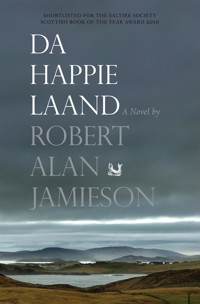
Shortlisted for the Creative Scotland and Scottish Mortgage Investment Trust Fiction Award 2011An experimental novel on a grand scale, beautifully carried through. A Perth minister takes in a traumatised stranger who calls himself 'the son and heir to being lost'. When the stranger disappears, the events leading up to and following on from this are revealed. Shifting perspectives from a contemporary mystery to a history of Shetland and emigration, it extends the idea of Scottish empire and diaspora imaginatively, while addressing notions of being and belonging in 21st century Scotland. BACK COVER Hit wis kynda da promised land in mony wyes, da Happie Laand across da sea...In the summer of the year of the Millennium, a barefoot stranger comes to the door of the manse for help. But three days later he disappears without trace, leaving a bundle of papers behind.Da Happie Laand weaves the old minister's attempt to make sense of the mysteries left behind by his 'lost sheep' with an older story relating the fate of a Zetlandic community across the centuries - the tales of those people who emigrated to New Zetland in the South Pacific to build a new life in the promised land, and those who stayed behind. REVIEWS A work of complexity, a novel to be savoured and one that will only get better with age. NEW SHETLANDER Jamieson achieves something quite extraordinary - [he] combines a compelling modern mystery with 500 years of history in a typically experimental style that leaves many of his contemporaries lagging THE LIST Robert Alan Jamieson's strange masterpiece Da Happie Laand haunts dreams and waking hours, as it takes my adopted home of Shetland, twisting it and the archipelago's history into the most disturbing, amazing slyly funny shapes. THE SUNDAY HERALD
Das E-Book können Sie in Legimi-Apps oder einer beliebigen App lesen, die das folgende Format unterstützen:
Seitenzahl: 669
Veröffentlichungsjahr: 2014
Ähnliche



















ROBERT ALAN JAMIESON was born in Lerwick on Up Helly Aa, 1958 and grew up in the crofting community of Sandness. He attended the University of Edinburgh as a mature student and subsequently held the William Soutar Fellowship in Perth. He was a co-editor of Edinburgh Review,1993–98, and writer in residence at the universities of Glasgow and Strathclyde, 1998–2001. Since then he has tutored creative writing at the University of Edinburgh. He is the author of three novels, three collections of poetry and two plays, and has edited a number of anthologies. Through his occasional work with the organisation Literature Across Frontiers, his poetry in Shetlandic Scots has been translated into more than a dozen languages, and he has translated over twenty contemporary European poets into Shetlandic Scots.
Robert Alan Jamieson is one of this country’s finest, most distinctive writers, andDa Happie Laandis his best work yet. Vast in scope but understated in tone, big in ambition and beautifully rendered from beginning to end, if there’s any justice this potent tale of a very unreal world and another very real one should find a wide audience of readers who will come away feeling inspired and uplifted.RODGE GLASS
Epic and ironic, tragic and humorous, encyclopedic and confessional, realistic and fantastic,Da Happie Laandrelates a stunning journey across an invisible archipelago, combining Ulysses’ zest for geographical exploration with Penelope’s superior ability to weave a story-cloth – a beautiful Shetlandic lace of memories and voices that will haunt long after you turn the last page.CARLA SASSI
Finally, Shetland has the novel she deserves – big in scope, rich in ideas, uncompromising in execution. Jamieson explores metafiction, ethnology, history, linguistics, existentialism and sheer irrepressible humanity with imaginative zest, encyclopaedic knowledge and a wry, subtle humour. This intimate, multifaceted epic puts you in mind of such literary greats as Allende, Nabokov and Marquez and will swiftly be recognised as a great addition to the wise and quietly dignified bookshelf of Northern European Literature.KEVIN MACNEIL
Coupled to a quiet and unobtrusive experimentalism, [Jamieson] has produced a work of power and originality.SCOTTISH REVIEW OF BOOKS
DA HAPPIE LAAND
Robert Alan Jamieson
LuathPress Limited
EDINBURGH
www.luath.co.uk
Contents
EDITOR’S PREFACE
Introduction
CHAPTER ONE
CHAPTER TWO
CHAPTER THREE
CHAPTER FOUR
CHAPTER FIVE
CHAPTER SIX
CHAPTER SEVEN
CHAPTER EIGHT
CHAPTER NINE
First published 2010
This edition 2011
eBook 2014
ISBN: 978-1906817-86-2
ISBN (eBook): 978-1-909912-84-7
The publisher acknowledges the support of Creative Scotland towards the publication of this volume.
The author’s right to be identified as author of this book under the Copyright, Designs and Patents Act 1988 has been asserted.
© Robert Alan Jamieson 2010, 2011
This book is dedicated to three late mentors, great encouragers all –
John J and Laurence Graham of Shetland and Hugh Nolan of Australia
Thanks to
my father: JRP Jamieson, for telling me what no research could uncover
those who provided shelter of one kind or another during the writing:
my family; the William Soutar Fellowship, Perth; Lister Housing Cooperative, Edinburgh; the Scottish Arts Council; the universities of Glasgow, Strathclyde and my alma mater, Edinburgh
those who have listened to much talk about this book:
Mary Blance, Richard Browne, Alex Cluness, George Gunn, Wilma Jamieson, Murdo Macdonald, Lorna J Waite
those who saw early drafts, and said what was needed:
Jenny Brown, David Goldie, Duncan McLean, Jennie Renton, Robin Robertson
those who read the first full draft, and said it was nearly done:
Rajorshi Chakraborti, Rodge Glass, Wilma Jamieson, Kevin MacNeil, Randall Stevenson
those who read the final draft, and said it was ready:
Belica-Antonia Kubareli, Jordan Ogg, Carla Sassi
those who have made publishing easy:
Tom Bee, Leila Cruickshank, Gavin MacDougall, Jennie Renton
EDITOR’S PREFACE
What follows, arranged in these pages, are the various contents of an outsize brown manila envelope delivered to me by one of the elders of the Church of Scotland in Craigie, Perth, Scotland, in2003, soon after the death of the former incumbent minister of that parish, who was for a number of years my next-door neighbour there. This man, the late Reverend Archibald Nicol, was a cultured and sophisticated individual despite his essential and unshakeable belief in the ineffable and inexplicable, with whom I had a number of interesting conversations during my time as William Soutar Fellow in ‘The Fair City’.
My interest in the contents of the envelope was spurred by the realisation, when I had read Reverend Nicol’s accompanying letter, that I too had met the barefooted bearded stranger who, as I quickly came to understand, had briefly entered the old minister’s life with such a dramatic effect. This stranger had, in fact, knocked on my door first and asked me for directions to the manse, which I duly gave him, so I was in direct causal relationship to what this envelope contained.
I have arranged these papers to mimic the order in which I found them, to present the fabula contained within more or less as I encountered it. I cannot tell whether this order was the true and full intention of Reverend Nicol, or to what extent it is the product of chance. However, I have included much that to Reverend Nicol’s mind was merely a footnote, or background to the story, including his own correspondence; and, in editing his typescript of James Gabrielsen’s history, I have allowed certain passages to stand which the Reverend Nicol had himself excised as digressive, by rulering lines through them. This I do in the belief that he too has become a player in this drama – to which, in view of the content, I have given the titleDa Happie Laand.
I have included an amount of ephemera where that material is mentioned in the letters – essays on the colony of New Zetland, its history and language, interviews and other notes which were sent to the Reverend Nicol. For the general reader, these may be quickly passed over, yet I believe they have their role in the story as a whole, and so have included them where they occurred in the related correspondence, as Nicol had attached them. As to the sources for the Reverend’s version of Gabrielsen’s history, this script appears to be a palimpsest of different writings. It is possible to detect an original nineteenth-century style which I presume to be Gabrielsen’s in much of the reportage, even in those passages where Nicol does not acknowledge him, while other sections seem to suggest a more twentieth-century mindset, in style and vocabulary – we presume Nicol’s own interventions. It is clear one or both of the authors made free use of the records of both the Truck Commission and the Crofters Commission, in addition to the journals of Sir Walter Scott and the young Robert Louis Stevenson. I also found reference in the marginalia toThe Zetland Bookby AT Kuliness, published in1954, and therefore a source of Nicol’s and not Gabrielsen’s.
RA Jamieson
Note: The observant reader will detect considerable variation in some of the names, apparent elisions in the text, as well as inconsistencies in some of the dates and details. These are issues that cannot be resolved. The recorded past is essentially unstable. All versions suffer from partiality, presumption and occasional error. There is no ‘gospel truth’ here, no authority to refer to, for true and final judgement. I present the mysteries as I have found them.
Perth
10th January 2002
Dear Mr Jamieson
You will, I trust, remember we were neighbours in Wilson Street, Perth, while you were community writer-in-residence there a few years ago, and that you and I spoke at some length about literary matters. I have now a request to make of you, if you are willing and able, which I hope will not be too onerous a task.
I am entrusting to your care the enclosed scripts which have preoccupied me in the last few months. I wonder whether there is, in your opinion, anything of merit that might be salvaged? I feel that among the fragments I have collected there is a story of genuine interest, a mystery relating to the death of Rod Cunninghame, or Scot, and the disappearance of his son David; yet the writing of that has confounded me, just as the truth has. You will, I trust, understand as you read.
Perhaps you, as an editor, may be better placed to do the work of collation and I am happy to pay the labourer his worth. I enclose copies of the correspondence between myself, Philippa Gabrielsen of New Zetland and Peter A Scot of Miami, as this may help in explaining the background.
Please excuse brevity – I was recently seriously ill and writing is almost too great a task now. I am no longer in Wilson Street either myself these days, but in a retirement home across the river.
Best wishes to you and your family
Yours faithfully
Archibald Nicol (Rev.)
21 June 2000 – Train
If I closemy eyes, a red light flashes – it’s the light that tells me a message has been received. What it doesn’t tell is whether the message is complete or coherent, if the caller has left their name, their number, whether the automaton will chantthe other person has cleared, the other person has cleared– or if a voice will speak.
That light is flashing on the inside of my eyelids now. PressRewind,StopandPlay. Four rings, a pause and then a very English voice.
‘My name is Hart. Doctor Peter Hart. I’m calling about your father. My number is …’
The tape fuzzes before it runs out. I replay it over and over again. The mumbled number becomes clearer. As do the lost words, when I call him back:
I’m afraid your father has
disappeared
Carbon Copy retained of a letter from the
Rev. Archibald Nicol of Perth, Scotland, sent presumably to
Philippa Gabrielsen of Tokumua (New Zetland)
and Peter A Scot of Miami
February 20th 2001
Dear
I am writing to you as I found your name and address in an envelope containing papers pertaining to the late Mr Rod Cunninghame, along with an unfinished manuscript of ‘A History of the Parish of Norbie and Thulay in Zetland’, written by one James Gabrielsen, a schoolmaster in that parish, presumably in the late nineteenth century, and various documents relating to the Gabrielsen and Scot families of that parish.
These papers came into my possession by chance some months ago and they have presented me with a moral dilemma which I am now attempting to resolve. I apologise in advance for what is liable to be a very longwinded explanation, but I trust you will bear with me as this is a matter of the utmost importance to me.
I was visited recently by a young man I believe is David Cunninghame,the remaining son of said Rod and his wife Ella, though he did not volunteer his identity and I was thus unaware of who he was until after he left. But I first must also tell you who I am, and what my relationship is to the Cunninghame family.
I am a Church of Scotland minister, recently retired through ill health, and the family was once amongst my congregation. Indeed, Ella was organist in our church for many years, but she, her son Martin and now her husband are with the Lord now – David is the sole remaining child. It was this David who came to see me, I realise in retrospect. He stood there on the threshold of the manse, barefooted, a pair of brown brogues in his hands. I thought he was some wandering tramp who had come to the manse looking for Christian kindness, and so I took him in. He was clearly distressed, and so I tried to counsel him. He told me, in fragments, of a recent bereavement, though he didn’t specify who had died. He was so distracted I couldn’t extract from him the details. When I asked for his name, he merely said he was a pilgrim, ‘the son and heir of being lost’, and when I asked where he was going, he laughed and cried out, ‘Jerusalem!’
David stayed three nights with us in the manse. He slept for most of that time, as if fevered, muttering all the while. On the fourth morning, I opened my eyes to see him in our bedroom, peering down at me, where I lay, half-awake, with a most disturbing expression on his face. He made neither excuse nor apology, but simply smiled, then left the room silently as if he had every right to be there.
What mischief – if any – he had in mind, I cannot say, but the experience confirmed a growing unease I had felt at his presence, since his bare and blistered feet first crossed the threshold, and he sat down to share our plain dinner of boiled fish and potatoes that Friday evening. He had looked at me that first night as if he knew something which I didn’t – as if he knew me. It was most disconcerting. But now, realising who this bearded wanderer was, I can see that the tension between us arose from my failure to recognise him – an infant I had baptised, yes, but a child I had known well enough too, as a choirboy. Now he is a grown man, a stranger to me – and I feel I have failed in some final test of my duty of care.
When I finally arose and went downstairs that day, ready to confront whatever troubled mind awaited me, I found he had gone, as if risen from the dead, leaving behind the unmade bed, and on it a old brown leather briefcase, containing the various papers I have described.
So you see, I hope, why I write to you now, as you are one of only three contacts I have with the mystery which David left – from among all these papers which he carried with him when he came, and left behind him when he went. I would like to trace this man and help him if I can, and if God wills it.
I would appreciate, at your earliest convenience, any information you may be able to give me on the Cunninghame family, particularly the whereabouts of the said David.
I am
Yours sincerely
Rev. Archibald Nicol (retired)
PS– If you are indeed the person who supplied the copies of Gabrielsen’s history, you should already have these, but I will enclose a set in case you have it no longer. I do not know if this is a full copy. It seems to end very abruptly, and chapter nine is merely a few notes?
21 June 2000 – Train
I lay my head back on the railway seat and try to shut it out. I try to close my eyes and drift away, but there’s Gran with her white perm and gold-rimmed glasses, at home in Blair. I’d phoned her, trying to be tactful, to ask if she’d seen him. But she sensed there was something wrong, and I had to tell her. She kept on at me to go. And so I agreed. I agreed to go to the island where he’d last been living. I had a few days holiday due. She said I was to be sure to let her ken.
I open my eyes slowly, on the North Sea. The intercity express is skirting cliffs above a rocky coastline near Johnshaven, where my father’s Ford Cortina blew a cylinder head gasket on a family trip to Aberdeen. Martin and me watched the inshore fishermen while the village mechanic howked under the bonnet and my mother disappeared to visit the village church. That was her hobby, visiting churches.
The window flecks with drizzle. In the seats behind me, four men are drinking cans of super-lager, joking and sharing stories from the rigs. This is oil country now. The fishing boats have gone. The grey horizon hides platforms, pipelines, supply vessels, helicopters, hard hats, mud, drilling bits, accommodation blocks, four square meals a day. All hidden from the traveller till the next Piper Alpha lights up the sky.
I close my eyes. PressRewind,Stop
andPlay
Letter from Philippa Gabrielsen
to Rev. Archibald Nicol,
August12th 2000
Bon Hoga
Sellafir
Tokumua
NZ
Dear Archibald
Of course I don’t mind you writing to me, in fact I’m rather glad you did! I have been expecting a message from Rod Cunninghame for a few months and was wondering if something had befallen him. But it wasn’t me who sent Gabrielsen’s history, I’m afraid, although the writer is an ancestor of my husband’s. It really is most interesting to both of us. Rod had mentioned that he had located the original and was to send a copy to me.
I’ll explain myself a bit for your benefit. I first got in touch with Rod through a common contact in Zetland, a man by the name of Peter Frazer who is a local wise man and expert on genealogy. It turned out that both Rod and I were researching the same two families but from opposite ends. So we have had a lot of correspondence over the last year or so and Rod was planning to visit Tokumua, or New Zetland as the locals here still insist on calling it.
I myself am not a local here but came as a schoolteacher about twelve years ago, from Wellington. I had never been here before and ‘PiriNZ’, as they sometimes call New Zetland in Tokumua, was just a few dots in the midst of a great ocean on the map to me, notable only because it had a similar name to New Zealand, but I knew little more than that. I had no idea about the Zetlandic colony or the weird cultural mix that there is and to begin with found it very strange and hard to adjust to, in so many ways quite different from Wellington. But I am now quite active in trying to preserve that very history as vice-president of the Heritage Society. We have a new project to create ‘A House of Memories’ in the oldest house here, once the home of Captain Jack Kulliness, the original Zetlandic settler.
I personally have become particularly interested in the history of our little school here, and its founder, my husband’s great-grandfather, a Zetlandic minister called Thorvald Gabrielsen, who came out here as the leader of the first big shipload of settlers in1877. He was a son of your historian, James the schoolmaster at Norbie in ‘old’ Zetland, where the majority of those settlers came from. He was really both minister and schoolteacher to them, you see, and led the expedition with all the zeal of a pilgrim father. In fact, they called him ‘The Minister’, and that is how he is known today. The statue to him in Serrafir bears that name.
His father, your James Gabrielsen, besides devoting his life to the education of his fellow men, was a great scholar and correspondent, and acted as the agent for emigration to New Zealand for a number of years. He was also an acquaintance of the very first Zetlander to arrive in Tokumua, this Jack Kuliness I mentioned, a sea captain who had visited the archipelago a few times as a young sailor aboard whaling ships, and then was commander of a whaling station there during the1830s. Though the station folded when the sealing and whaling moved on, ‘Kapiyaki’, as he was called, stayed on, trading as he had always done and making the occasional voyage to New Zealand and Australia. Over time he built himself a fine wooden house which he named Sellafirt after his native village in Zetland, but no sooner was the house finished than off he went in his ship.
For a year the house lay as it was, guarded by a few men he had recruited from among the local Murikavi people, and so long went by they thought he might have been killed by pirates, but then one day he sailed back into the harbour in Sellafirt with not only a new ship but a new wife – a Maori woman from the Bay. This couple were the key to the Zetland colony. Around their fine wooden house a shanty-town began to grow, which took the name Serrafir, and in time, when the colonists came out in1877, it began to grow to be a proper town. Where I now live!
Anyhow, I didn’t mean to go on like that. You see how ‘teacherly’ I am, without even trying! But I will send you more material, if you like. One thing I know you will be interested in is something I am going to do this summer.
There is a woman who is now in her hundredth year, by the name of Mimie Jeromsen. Mimie is the oldest person in the Zetlandic community and what will be really interesting to you is that she once worked as a maid for the Scot-Cunninghame family. I have arranged to go to see her in three weeks’ time.
Best wishes
Philippa
PS– hope you like the enclosed postcard – new design!
21 June 2000 – Ferry/Town
And so I’d phoned him back.
‘Your father hasn’t been seen for four days. I thought he might have decided to travel south, perhaps, to visit you?’
‘I haven’t seen my father for years. But who are you exactly, Dr Hart?’
‘I own the chalet …’
‘Chalet?’
‘ … where he lives.’
‘His landlord?’
‘More of a friend.’
I stop the memory tape. My father has disappeared. And what kind of friend is this landlord? I run my fingertips over railway seat fibres. They bristle harmlessly.
I let the tape run back to the time when I knew him best. The time when he was there, and he lifted me up to his huge shoulders and set me there to see the world from a place higher than he himself could reach. Then he was Daddy. But the shoulders are narrow now, and my fingers won’t stay still. I pressFast Forward, let the spindles turn, to the time when he stood bent and balding at my brother’s graveside, the moment when the orbit of my family exploded, when its central star imploded and turned us all to a scattering. Yes, things reassure – a note at Christmas, a card.
The message is received. But when somebody I haven’t seen for years disappears, have they not disappeared already? Or was I always conscious of something tangible, even in absence, being there?
No, I deny the existence of a being such as ‘Daddy’, whose child I am. A father, maybe, possessed by me – my father.
I think about that letter and pull it from my bag. Why had I never replied? It was so obviously a plea for forgiveness. But I couldn’t find it in me.
The ferry takes all night. The sea is quite calm, they tell me, but I can’t sleep. The cabin is far too hot and I feel I can’t breathe. I left in such a hurry, brought nothing to read, and the only book to hand is a Gideon’s.
At last, I hear people moving in the corridor, the sounds of morning, and I rise. A steward brings me a bowl of lumpy porridge in the ferry café, with milk that sways around as the waves collide with the ship. It’s liquid within liquid. I am made of liquid, my body merely water, swilling around. I try to eat, hungry and nauseous at the same time, lift a spoon, then stop.
A lighthouse appears, then land like paradise promised but so long in coming that it’s hardly believed when glimpsed in the distance. I shove the porridge bowl away. That’s all I can stomach.
The sound of a foghorn draws me out through a doorway to the deck. There’s the white lighthouse clinging to a sharp cliff and a bare conical hill behind, the smell of hot engine oil blown by the gusting breeze. The engines slow. The ferry glides into harbour through a morning mist, past a town-bound midsummer morning.
Seagulls flash by, squabbling over scraps dumped in the harbour water. The ferry comes alongside. The little town offers the ship a rope, thrown up from the quay by a stocky island docker. A door in the side of the ship opens and I rejoice at reaching the promised island, take my rucksack and descend. Immediately the sickness eases a little.
Streetlamps yellow the morning mist. I walk towards one, hoping for illumination on this strange place, this quest.
Out of the fog a taxi appears and the driver takes me into the town, where the folk are waking. I wander along the crooked main street, no wider than a bus, imagining my father here, walking through this place he chose to go to, as far north as he could get in Britain.
What was he looking for
here
A History of Zetland with particular attention to the Parish of Norbie, Valay and Thulay, as transcribed from the unfinished 1899 original of James Gabrielsen (schoolteacher), and supplemented by
Rev. Archibald Nicol, MA, DD, of Perth
CHAPTER ONE
‘THE BEAUTIFUL ESTATE OF NORBIE’
My intent is to lay before the reader a brief history of the parish, as my research has revealed it. I make no pretence of expertise in this field. My study tends me towards a better grasp of Abraham’s Moriah, of Sinai, the summits of Gerizim and Ebal, or glorious Carmel, than it does the boreal peaks of my native land. Indeed it is only since my retirement from the ministry that I have ventured into the northern territories of this realm. I am neither expert as historian, nor in the area of our scrutiny. The distant isles of Zetland I was unacquainted with until my 73rd year, and venturing imaginatively there I came upon a land such as I had never glimpsed even in moments of reverie. Nonetheless I will attempt, with the aid of various authorities and quotations, to establish this particular parish in the mind of the reader.
To begin I might turn to the advertisement description from The Scotsman of July 31st, 1894, the year in which this history will end, when the estate was sold by the ancient family who had fallen on hard times:
ZETLAND
For Sale by Private Bargain
THE BEAUTIFUL ESTATE OF NORBIE, in the parishes of Vass and Saness, on the West Coast of the Mainland of ZETLAND, comprising lands on the well known Harbour of Valaysund to which high-class Passenger Stamers (sic) run weekly, in 24 hours from Aberdeen, and 14 hours from the railway at Thurso. The Estate is within 22 miles of Larvik by good road, and it is intersected by good county roads.
NORBIE HALL, which contains Dining-Room, Drawing Room, Six Good Bed-rooms, Large Kitchen, and Servant’s Accommodation, Patent W.C. and bath, Store-room, Stabling, and Out-houses, and Good Walled Gardens attached, is situated under the shelter of Westness Hill, on a beautiful bay, with splendid views of the large islands of Papay and Thulay, and the islands of Magnus Bay. It occupies one of the finest positions in Zetland, the Rock Scenery being superb.
The Estate is estimated to contain about 15,000 acres. The Home Farm is in the Proprietor’s hands, and the remainder of the Estate is let to crofters and farmers, who pay their rents with regularity.
The sport upon the Estate is good – 250 couple of Snipe, 45 brace of Wild Duck, and numerous Wild Fowl, Rabbits, and Seals have been shot in a short season. The Sea Trout as well as the Loch and Burn Trout Fishing in numerous Burns and Lochs is the best in Zetland.
This most picturesque of sketches we may assume tends slightly to the rose-coloured, as it was no doubt intended to sway the purchaser by its charm. We find a different kind of portrait in the press of 1869, in a letter (to which we shall later return) by our primary source for the history that follows – James Gabrielsen, the local schoolmaster, begging funds with which to build a new schoolhouse:
Norbie, situated on the north-west of the mainland of Zetland, is about three miles long by about one and a half miles of average breadth, is bounded on the south by a ridge of hills, the chief of which is Westness Hill, rising 1,000 feet above the level of the sea; and its shores are washed on the west, north, and east by the waves of the Atlantic, of the Sound of Papay, and of Magnus Bay; and is separated from the neighbouring parish by a large tract of wild waste moorland. It is the prettiest parish in the Zetland Islands; and contains a population of upwards of 600. The inhabitants are fishermen, crofters, and common sailors and there are very few well-to-do families among them. The gales of October 1867 utterly destroyed their crops, and this year’s fishing turned out a complete failure, so that they are at present seriously embarrassed.
These glimpses of the past are as yet distant futures to our narrative, however, for the building of the parish school and the sale of Norbie estate are far progressed from the beginning of our tale. The land-owning family who fell from power at the end of the nineteenth century and the peasantry around them had a much older relationship and their common history is an example of an identifiable period in Zetlandic society.
We might properly begin our story in 1469, the point at which Zetland is pawned by the Danish government to the Scotch, for it is the coming of the Scots to Zetland which is the key theme of this story, and our family is by coincidence named ‘Scot’. But to do so would be to ignore the earlier history and, before any of this, I would gladly paint for you a picture of the early Christian missionaries, voyaging northwards bearing the glorification of Our Lord and his servant St Ninian of Whithorn like torches before them in the dark, barbarian islands. I wish you might see them now as I do, as they pilot their tiny coracle craft around the steep and haven-less west side of Zetland – a speck of bobbing flotsam passing between the fabulous cliff-isle of Thulay rising a thousand feet sheer out of the Atlantic ocean on the horizon, its three-step northern face stark against a setting sun, and the dramatic Red Sandstone cliffs of Deepdale scarred with waterfalls at Westness to landward.
I would have you apprehend, as they did, when rounding the ultimate western headland and passing through the fierce tidal passage between the Zetland mainland and the island of Papay, the welcoming green, flat meadows of Norbie, lying in the mouth of a sheltered vale, with two large freshwater lochs and numerous streams running into them from the mountain above. You, like them, would wish to draw your boat ashore on the perfect curve of the sandy beach, and consider this a good place in which to found a church. So ‘St Ninians’ was established there, in a time before record, perhaps as long ago as the Fall of Rome – and though nothing now remains of this building, the field where it stood is still recalled locally. According to one of the elders of the parish, no grass would ever grow where the pulpit once stood – the sacred spot resisted secular use. In recent times a local crofter, under duress from the authorities who had heard of his prize, presented the Zetland Museum with the original font, a hollowed-out granite block which he had been using as a water trough for his home flock of sheep.
What these courageous Christian pioneers found in Zetland, we can but guess. Earlier peoples had inhabited the isles, had built their round ‘brochs’ or ‘burgs’ for defence from weather and foe, but whether they remained when the missionaries arrived or whether they had left, chased south by worsening climate or killed by some famine, I cannot tell. Whatever the case, Zetland was firmly Christianised, we know, by the time the heathen Norsemen began to arrive from western Scandinavia around 800, before the Scots and Picts became one people under Kenneth McAlpin in 843, with his coronation in the heart of the country at Dunkeld.
Little the inhabitants of this remotest parish would have known of that, or any of the other significant events shaping Scotch history for the next four hundred years, for it and the rest of Zetland was then amongst the Norwegian empire centered on the city of Bergen – first as part of a vast Norse ‘Jarldom’ (earldom) of the Orcades, stretching over the whole western seaboard from Ireland to the north of Europe; then, after the Norwegian king confiscated it from the Orcades’ jarls, under direct rule from Bergen.
I will not dwell on this Norse era. The Orcadian writer Mr GM Brown has written at length on this period and has presented an excellent, if creative, life of the great Orcadian Christian figure of St Magnus Erlendsson, the jarl who was killed in 1117 by his cousin.
Suffice to say that, from 1195 when the Orcades and Zetland were separated, the former became increasingly Scotch, passing into the hands of the Earl of Angus in 1231, while the latter remained staunchly Norse, so that when King Haakon massed his fleet of two hundred warships in preparation for the long voyage southwards to engage the Scots in battle in 1263, he gathered his fleet in an eastern harbour of Zetland not as a beach-head in a foreign land, but as the outer reach of his own secure country.
By then, another strange people had begun to frequent the Zetlandic shores during the long summer days – the ‘Dutchies’, traders of the Hanseatic League – drawn by the riches of fish around the distant archipelago.
With such links to Scandinavia and the continental coast, it is safe to assume that the great victory of our national hero William Wallace would have been of less immediate interest to the natives of our parish of 1296 than, for instance, the news from Bergen of progress in the building of the Apostles’ Church, funded largely from Zetlandic and Faeroese rents. At this time, Zetland was closer in culture and politics to its mountainous northern neighbour than the gentle green slopes of the Orcades, or the land of the Scots.
Yet Scotland impacted on Zetland ever-increasingly from this point onwards, with Viking-like raids on the islands by marauders from the south in 1312 demonstrating the danger. Having arrived at the subtle acquisition of the Orcades jarldom, and having won independence from England under Bruce at Bannockburn in 1314, no doubt the distant shores of Hjaltaland (as it was in Norse times) held an appeal for the political Scot of the period, particularly if the northern seaboard could then be fortified against further incursions by belligerent Norwegians.
As it was, the balance of human power in all these places was to be challenged by a tiny organism rushing northwards from the Mediterranean, the so-called Black Death.
In Scotland, John of Fordun records that in the year 1350 there was in the kingdom of Scotland, ‘so great a pestilence and plague among men … as, from the beginning of the world even unto modern times, had never been heard of by man, nor is found in books, for the enlightenment of those who come after. For, to such a pitch did that plague wreak its cruel spite, that nearly a third of mankind were thereby made to pay the debt of nature.’
In Norway too, the effect was devastating. The disease was brought on a ship from London. The crew discovered the infection, and quickly succumbed – two days was the usual extent of the dying process. Finally the vessel ran aground somewhere off Bergen. The local people went out to the ship’s aid, only to discover the awful cargo. A number of the well-to-do families tried to escape by going to the mountains, with the aim of founding a new settlement, but the killer followed them and all died but one. A girl was found, many years later, running wild like a dog and shunning human company, as if still terrified by the spectre of plague.
Beyond this tragic, miserable time, in the vacuum we may assume prevailed, a powerful figure rises in the northern islands, a man whose life verges upon myth – Henry Sinclair of Rosslyn. As with St Magnus, much has been written of Sinclair, and heated arguments about his deeds persist. There are some who say he was the conqueror of Zetland and Faroe, a voyager to Iceland, who built up a great navy and travelled the old Norse route to America in the company of two Genovan navigators and cartographers. To them, he was one of the outstanding men of his century.
Others are less convinced. But that Henry Sinclair was invested by King Haakon of Norway as the Jarl of the Orcades and Lord of Zetland on the 2nd of August 1379 is a matter of record. In so doing, Haakon reunited the two archipelagos, though in practice Sinclair had to win his lands. He finally took Zetland following the suspicious killing of his rival Malisse Spera at Tingwall in 1391, after a protracted struggle for supremacy. The following year King Robert III of Scotland acknowledged Sinclair’s power and his control of access to the waters of the North Atlantic. The Norwegian empire was in serious decline at this time, so an opportunity existed for Sinclair. When, in 1397, Norway and Denmark were united under Christian II of Denmark, the power that was once Bergen formally diminished – it had waned for decades prior to that. The Black Death left so few alive that positions in the church could not be filled – and this lack of vigour led to the appointment of the first Scot as Bishop of the Orcades, William Tulloch, in 1418.
The rise of a powerful king in Edinburgh far to the south, James I, with an intense determination to weld his country together by whatever means required, and the desire to encourage trade with Holland and Scandinavia, must have made the seabound Sinclairs, with their powerful estates and northern connections, seem attractive allies.
To allow the reader to gauge the potency of the potentate, William Sinclair, known as ‘Prodigus’, who began the building of Rosslyn Chapel in 1446, was ‘Prince of Orknay, (Duke of Holdembourg), Earle of Catness (and Stratherne), Lord Zetland, Lord Saintclair, Lord Nithsdale, Sherieff of Dumfriese, Lord Admiral of the Scots Seas, Lord Chief Justice of Scotland, Lord Warden and Justiciar of the three Marches betwixt Berrick and Whithorne, Baron of Rosline, Baron of Pentland and Pentland Moore in free forestrie, Baron of Couslande, Baron of Cardain Saintclair, Baron of Herbertshire, Baron of Hectford, Baron of Grahamshaw, Baron of Kirktone, Baron of Cavers, Baron of Newborugh in Buchan, Baron of Roxburgh, Dysart, Polmese, Kenrusi, etc., Knight of the Cockle after the ordre of France, and Knight of the Garter after the order of England, Knight of the Golden Fleece, Great Chancellour, Chamberlain and Livetenant of Scotland, etc.’
‘Titles to weary a Spaniard’, as one commentator phrased it. Sinclair was also one of the claimants to the vacant Norwegian throne in 1449, and although unsuccessful in that endeavour he was made Lord Chancellor of Scotland in 1454 and was rewarded with the new Scotch Earldom of Caithness by James II in 1455.
Our quiet remote parish has habituated many generations during the previous pages. Little of all that I have described, perhaps not even the plague, will have made its way out here on the very edge of Europe.
However, momentous events at the highest level of society are about to bring Norbie into recorded history, with the Danish king’s promise of the isles of Zetland and the Orcades as surety on a sum of dowry due to the Scotch king, James III, on the occasion of his marriage to the Danish princess. Zetland’s price was 8,000 florins. When the sum was unforthcoming, the Scots quite gleefully annexed the islands, along with the Orcades, to the throne.
William Sinclair, son of ‘Prodigus’, had to surrender his title, and within eleven years, was declared ‘incomposmentis et fatuus’ and ‘a waster of his lands and goods for sixteen years previously’. Thus, by 1482, the Scotch crown had taken the dangerous and debated lands of the north to itself, and the power of the Sinclairs was waning. Though Lord Henry Sinclair was granted a thirteen-year lease of the Orcades and Zetland, the custody of Kirkwall Castle and the offices of Foud and Bailie, in 1489, the land and the right to grant it now belonged to the Scotch crown.
The era of the Scots was beginning in Zetland – and in our parish, as a precursor to what will follow, we find Jopinn Sigarsen and Hans Sigurdsson at the Bergen lawcourt in 1489, defending their lands at ‘Norbie, Hjaltaland’ against a counterclaim by a Scot – named Sinclair. Though the Norsemen were successful in this case, in time the law would cease to be Norse, the courts would no longer be administered from Norway, and ‘Hjaltaland’ will become, slowly, ‘Zetland’ – and Scotch.
21 June 2000 – Norbie
I get the bus to Dr Hart’s estate at Norbie. The road heads north past the ferry terminal, then turns up a treeless hill. The coach creeps slowly out of the little town, then freewheels down the other side of a long peat hill to a bridge, then climbs up and over another treeless peat hill into the next valley, and down to a huddle of houses. When the driver stops at a junction and tells me it’s my stop, ahead there’s a derelict Victorian villa and down by its fence, a man with his sheepdog, watching a flock of sheep with their lambs.
He says, ‘Aye, aye,’ as I approach, then, ‘Fine day.’ He’s grizzled, brown teeth sticking out beneath his curled lip, a pipe between them, eyes hooded and doleful.
I ask the way to Dr Hart’s.
He looks at me curiously. ‘Oh, just you follow the road. Keep right on till the end of the road and you’ll see the sign. Carry on to the top of the hill, then you’ll see a junction by an old phone box. Go right at that, an carry on doon towards the beach. You’ll see the laird’s hoose fae the top o the hill. Norbie Haa. It’s the big wan by the shore. What we call the big hoose here. It’s a mile or two yet, though.’
So I set out along the road, ignoring the NORBIE PRIVATE ESTATE signs. I haven’t gone far when a vehicle approaches from behind, slows down, and when I turn to look it’s the same old man, driving a green van, with his dog, tongue out, panting on the passenger seat. He stops and slowly screws down the window.
‘I was wonderin, maybe you’ll be wantin a lift?’ he says. ‘I can drop you. A’m the shepherd.’
I tell him I’ll just walk, thanks. As if he’s disappointed, he lifts his head and girns, then drives off. I walk on. Keep right on to the end of the road, he said, so I do just that, whistling that very tune. One of Gran’s.
The sun is breaking through now, the mists are clearing and in the distance I recognise the landowner’s house, positioned so that it overlooks his estate, this Norbie Hall.
Five storeys tall, dwarfing the scattering of low-roofed tenant crofthouses, facing the sea, walled gardens around them, even a few gnarled trees. It’s a beautiful situation, this Norbie, but it’s a house of feudal masters, and the residence of the man who called and caused the red light to flash – and he is expecting me. I wander up the gravel driveway to the house, to the front porch, ring the bell and hear barking. An old balding man appears inside, surrounded by four dogs, two Alsatians and two Corgis. They whirl about his feet, barking, as he opens the door, cursing their howl.
‘Hello,’ he says. ‘David. Would have recognised you. You’re like your father.’
It’s the voice from the recorded message, but now it isn’t threatening, it’s warm, and he takes my hand.
‘You’re Dr Hart?’
‘Hart, yes. Your father’s friend,’ he says, smiling. He shakes my hand. He’s very jolly this and jolly that, despite everything, as he leads me into the hallway of the Hall, followed by the dog pack. The house has a feel of old Empire, the very smell of colonialism I know from big houses in Perth, the same assortment of carvings and trophies, models and maps of exotic provinces. Here, the focus is on Selangor and Malaya.
‘I have to tell you, I don’t think that there’s a great deal you can do. But of course you’re welcome to stay in the Haa as long as you’re here.’
We go upstairs, into a lounge on the first floor. The room is far smaller than I’d imagined. The deep window cavities tell why – walls of solid stone, feet thick, surround us.
He offers me a seat, then sits himself, as the dogs file in around their master’s armchair, to lie down as if rehearsed. Through the dirty panes of glass, I see the views to the beautiful arc of silvery beach and the knobbly finger of dark land, pointing out to sea. And on the horizon, a strange island with a three-step outline materialises from the clearing mists.
‘Can I offer you something to eat?’ he asks. ‘There’s steak pie the cook made, would only take a few minutes to heat. My own beef.’
‘No, no thanks, I’ve eaten. I’ve been eating all day. Anyway, I’m a vegetarian.’
‘Ah! I’ll tell her that. Would have come to pick you up from the bus if you’d called, you know.’
Then, suddenly gruff, Dr Hart apologises for not having acted sooner. He is worried about my father. They often talked. They played chess together.
‘He was rather good. Tell you the truth, one can get a little lonely here, which is why I so value your father’s company. Having an intelligent well-read man around, one appreciates that.’
Then Dr Hart offers me a dram. I hesitate, but he’s already on his feet, moving towards the ornate sideboard, where the decanter stands. He brings it and two glasses, fills them and leaves the decanter standing there on the table between us.
And I picture my father, sitting here in the drawing room of this obviously lonely laird, drinking his whisky, warmed by the fellowship of the bottle. Soon another whisky is poured in my glass, even though I don’t want it, and I’ve told Dr Hart so. I take a sip or two as he rambles on about Malaya, rubber, his life, and how he came to be here. I just nod now and then, my eyes nearly shutting. I can’t keep awake any longer. I’m too tired to listen. So I leave the whisky and make an early exit.
He leads me up through the lower floors till we come to a narrow spiral stair. I think of David Balfour at the House of Shaws, one of the stories my father read me, and how that image stuck in mind, the steps twisting higher through the stairwell till it reaches the one where the night sky waits – that step out into flight.
But there’s a landing, a tiny door and a room, the smell of damp, a bed covered with a yellow candlewick. A table, a bedside lamp, and a window onto the light, the midsummer sky still a crystal blue above, now studded with stars.
‘I had Mrs Mitchell put you in here,’ he says. ‘Servant’s quarters, really, but the big rooms take so long to warm. If I’d had more warning you were coming …’
‘Really, this is fine,’ I say. ‘Thanks.’
After his slow steps have gone quiet, I lie on the little bed and drift into a dream that my father is an ANZAC, and that I am the Red Cross.
There’s a knock on the door.
‘Are you there?’
It’s him, the old laird. Across a chasm of rest, he calls me out of sleep again.
‘Yes?’
I hear him shuffling on the stairhead. ‘Dinner will be ready in half an hour,’ he says.
Water needles my neck. I adjust the temperature and stand there, soaking it in, soaking in that goodness, that fresh steaming hotness, emptying my mind. After yesterday’s madness, I’m trying my best to mend myself again, to draw the splintered pieces together into one whole. And the water helps. It seems to wash away what’s inside as well as out. The heat eases the pain and when I step back out, into the chilly dampness of the bathroom and shut the taps off, I feel better. More like myself again. I go back to my room and put on a clean shift, as Gran calls it. A shift into something new, untarnished. I dry my hair with a towel, absorbed in the present again.
The table’s set for three, proper cutlery and wine-glasses and all that. There’s the laird and a guest. The guest’s got his back to me at first, but when he turns round I see a churchman. And he stands up smiling, black curly hair on top of his head, dark eyes sparkling.
‘I’d like you to meet Reverend Shand Pirie,’ the laird says as the minister holds out his hand to me.
‘Oh, please, Peter. Let’s forget the formality. Call me Shand.’
And I shake Shand’s hand. The skin feels soft but the grip is firm. Has this been set up, for my benefit, this meal, this visit?
‘I’m very sorry about your father.’
‘But we mustn’t jump to conclusions.’
No.
A woman comes in with a big tureen. Dr Hart thanks her, introduces her as Mrs Mitchell, sits down, beckoning us to do likewise. She sets it in the middle of the table and lifts the lid off, then starts spooning into my plate. The strong aroma of onion rises on the steam in the damp air of the old house.
‘French onion soup. My own onions,’ the laird says. ‘Absolutely no meat extract, isn’t that so, Mrs Mitchell?’ he adds, to the minister. ‘Rod spawned a vegetarian,’ he adds. ‘Although you eat fish, don’t you?’
And then the minister starts.
‘Our Heavenly Father, we thank thee for this, our daily bread, and pray that those who are cold and hungry tonight will find a place to sleep and food to eat, by Thy Grace. Amen.’
This is the first time I’ve heard anybody say grace over a meal in many years and it releases the memory tape. Spinning out come a hundred family meals, my grandmother presiding. The clink of spoons on china, the blue willow patterns round the lip of the plates, the formal place settings, the smell of the soup, all loaded with remembering. Wash your hands before dinner, now sit up straight, don’t play with your cutlery. Don’t fiddle with your fork. The bairn inside is cowed down, polite, waiting for the sign.
You may begin.
But Reverend Pirie takes a first spoonful of soup and places the spoon on the middle of the empty plate, then stares at me.
‘Are you a churchgoer?’
‘No, not for years.’
‘So you share your father’s scepticism?’
‘Scepticism?’
‘Oh, he and I have had many an argument. Always friendly, mind you.’
I ask, was my father interested in religion?
Dr Hart and the Reverend exchange glances. ‘Your father is, I think, a kind of instinctive Christian. That is to say, he lives according to the Christian doctrine, although he was never quite able to accept the idea that Christ was God Incarnate. Now, he isn’t alone in that, by no means. Some of the foremost scholars of our age have had difficulty with just that idea. You may have heard of Don Cupitt? No? A television series a few years ago? No? Well, as I see it, it is the teachings of Christ that are the fundamental things. Don’t you agree, Peter?’
Dr Hart nods. The minister carries on. I’m watching his shining eyes, so cool, so at ease in themselves and the way they see the world. Through certainty. Through a definite belief.
‘Whether or not one chooses to believe that Jesus really was the Son of God, whatever that may mean, whether or not we can accept the Biblical version of events, there’s no dubiety over the teachings themselves. Your father agreed on that.’
‘On what exactly?’
‘The Christian call for compassion. The ideals of faith, hope and charity. Kindness to one’s fellow man. The aspiration towards goodness. Turning the other cheek. Seeking out the mote in one’s own eye, rather than judging others.’
He lists these like they were self-evidently true. I finish my soup and put my spoon down. He’s leaning forward towards me as if he expects me to say something.
‘You’re familiar with these ideas?’
‘Oh, I remember the teachings. But there’s one thing that always bothers me. The whole Imperialist approach. Subjugation and the suppression of so-called heresy. That’s why I can’t take God or the church seriously.’
The minister is still smiling, as if he’s heard all this a thousand times and he’s got an answer at the ready. But all he says is: ‘I sense at this moment in time, you’re in need of faith, you’re seeking something.’ He laughs, as if he expected a comment, anticipated it and had the response ready. ‘Not just your father, but Our Father. And the way to Him is through his Son. All it takes is for you to open up your heart to Jesus, to ask Him to come into your life and immediately the pain you feel will ease. I know, believe me.’
As he speaks he takes my hand in his, the touch of a concerned friend, or a lover, sensing the pulse of emotion inside. And for a moment, he has me, caught in a reflex, a pattern of physical call and response that I know so well, from my mother, her friends, the church in Perth. His eyes have the look of genuine compassion.
Mrs Mitchell comes back carrying a silver platter with a salmon on board, and starts to portion it out. The Reverend Pirie leans away, his serious hanging face with him for a moment, before he looks up, transformed to happiness again.
I take my plate in turn, and the three of us begin to eat.
‘I was reading earlier today,’ the minister goes on, talking with his mouth full, ‘a man called Joseph Campbell. Do you know his Hero with a Thousand Faces?’
I shake my head, although I do.
‘No? Oh, he’s a wonderful scholar. Really, you should read him. He spent his whole life studying the world’s myths. There was a television series based on his work a while ago.’ He’s chewing and eating as he talks, excited by the sound of his own voice, while Dr Hart looks on admiringly, supping his wine with more enthusiasm than he has for eating the big fish.
‘It’s just that when you mentioned the settlers in America earlier, Peter, it reminded me of where he quotes this New England preacher of the late eighteenth century. I can’t recall the exact words, but the image is one of the bow of God’s wrath, with the arrow ready on the string, and he says that justice is bending the arrow is towards you. And that it’s only at his pleasure that the arrow isn’t fired. Now it’s a poetic metaphor, obviously, but one senses that impending doom that hangs over us all. Whether it’s our own lives, or our children’s, or our parents’, at any time, without the slightest warning, that arrow can shoot out and destroy all your certainties. That is what happens. People drift along quite happily as long as the arrow doesn’t shoot out, then suddenly they find themselves in need of help. That’s my vocation, to help in that hour of need, to help them find the path to God. To let them see that despite everything, God’s promise is kept, that we can trust in Him, in His will, that every sorrow can and shall be overcome in time.’
He chews away at the forkfuls of salmon and salad, watching me. So I just eat. I eat, I nod politely, sit up straight and clean my plate. Dr Hart keeps filling his glass. And by the time the salmon’s eaten, the minister’s flagging, his words are drying up, the storm is passing. He’s giving into the silence, quietude has swallowed him, though still he’s talking,
and I
drift
‘Split the stick and there’s Jesus,’ he says and turns to me, his dark eyes dancing, as if I must surely share his amazement. But I’ve no idea what he’s on about.
‘It’s a Gnostic aphorism. God at the heart of everything, even the dumb, inanimate wood. It’s like the teachings of the Koran, wherever you turn there is the presence of Allah.’
‘Ah …’ says Dr Hart, and fills his glass.
The Reverend Pirie hesitates, remembering. ‘Peter, you recall we were discussing this Bible Code book the other day. Another question which arises concerns whether or not the code is written in stone, so to speak. You’ve heard of this, David, I expect? It has been spot-on in predicting future events which took place after its first writing but which, to us, happened in the past. The thing is, what of our perceived future? Eh?’
He quickly takes a few bites of his meal, chewing furiously, desperate to return to his subject, as if food is just an obstacle. ‘Now, Roger Penrose suggests in his book that it is only our consciousness which requires us to perceive a flow of time and that to a physicist space and time are interchangeable. Time is no more required to flow than is space. And if time truly doesn’t flow, then it is reasonable to assume that a being of sufficient intelligence, possessing the technology capable of producing something as complex as the Bible Code, would be able to view the whole fabric of time in one complete picture.’
With the timing of a master orator, Pirie bides his moment, then continues: ‘My dear friends, the reality of what we creatures down here on earth experience may only represent a tiny part of the whole and be no more significant than any other part of the picture. No more, in fact, than a single thread within an intricate complexity making up this weave of time.’
The Reverend takes a breath. The echoes of his sonorous tone die out. I am listening.
‘Is the code predicting just one possible and unchangeable future, or is it presenting us with probabilities based upon what is happening in our perceived now?’ Dr Hart asks.
What’s he making of this, the laird? Or Mrs Mitchell, in the kitchen? Is she eavesdropping, or oblivious?
Pirie takes another bite, considers. then continues: ‘We don’t know. The Bible Code contains the interlinked phrases “It was made by computer” and “The writing of God engraved on tablets.” This suggests that computer technology was required to unlock the code, which was in fact the case, though it seems bizarre.’
Again, he eats a few furious mouthfuls. ‘Sir Isaac Newton was obsessed with the notion that there was a code in the Bible and spent much time trying to prove it. No doubt if he’d had access to a modern computer, he could have found it.’
The minister stops and gazes round. The laird suddenly lifts his head from the careful deboning of his salmon. ‘So, tell me, if the code is a way of warning us of possible future catastrophic events on our planet, how do we go about putting it to good use? How can we know what to look for, Shand?’




