


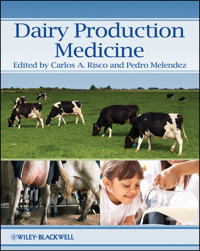
Dairy Production Medicine E-Book
91,99 €
Mehr erfahren.
- Herausgeber: John Wiley & Sons
- Kategorie: Fachliteratur
- Sprache: Englisch
This comprehensive book integrates new technology and concepts that have been developed in recent years to manage dairy farms in a profitable manner. The approach to the production of livestock and quality milk is multidisciplinary, involving nutrition, reproduction, clinical medicine, genetics, pathology, epidemiology, human resource management and economics. The book is structured by the production cycle of the dairy cow covering critical points in cow management. Written and edited by highly respected experts, this book provides a thoroughly modern and up-to-date resource for all those involved in the dairy industry.
Sie lesen das E-Book in den Legimi-Apps auf:
Seitenzahl: 1118
Veröffentlichungsjahr: 2011
Ähnliche




















Table of Contents
Cover
Title page
Copyright page
Dedication
Preface
Acknowledgments
Contributors
1 Management Considerations from Parturition to the End of the Voluntary Waiting Period to Optimize Health and Reproductive Performance
Introduction
Management of the Transition Period
Calving Management
Moving Fresh Cows Through Pens Before and After Calving
Postpartum Health Monitoring
Strategies to Maximize PR at the End of the VWP
Early Diagnosis of Nonpregnant Cows
2 Nutritional Management of the Prepartum Dairy Cow
Introduction
The Transition Period
Nutritional Physiology
DMI
Grouping Strategies
Energy Status and Nutrition
Protein Nutrition
Calcium Nutrition
Fiber, Particle Size, and Chewing Activity
Feed Bunk Management and Cow Behavior
Vitamin and Mineral Nutrition
Additives
3 Calving Management: A Team Approach
Introduction
Calving Facilities
Signs of Calving
Calving Problems
Calving Assistance
Examination
Guidelines to Determine if There Is Room
Preparation of the Cow for Pulling the Calf
Rotation of the Calf
Care of the Calf Immediately After Delivery
Artificial Respiration
Care of the Dam After Delivery
Colostrum
4 Monitoring Health and Looking for Sick Cows
Introduction
Monitoring Postpartum Health
Rectal Temperature
Attitude
Milk Production and Walking Activity
Uterine Discharge
Ketones in Milk or Urine
5 Nutritional Management of Lactating Dairy Cows
Introduction
Feeding Systems and Grouping Strategies for Lactating Cows
DMI
Meeting the Caloric Needs of Lactation
Fiber Carbohydrates
Nonfibrous Carbohydrates
Supplementation with Fats
Protein Nutrition
Minerals
Vitamins
General Guidelines for Ration Formulation
Feed Additives
Feeding Frequency, Feed Bunk Management, and Feed Availability
6 Reproductive Management in Dairy Cows
Introduction
Evaluating Reproductive Performance
Developing a Reproductive Program
Summary
7 Reproductive Management of Lactating Dairy Cows for First Postpartum Insemination
Introduction
Indicators of Reproductive Efficiency
VWP and First Postpartum Insemination
Management of Anovular Cows
Implementing Reproductive Programs for First AI
Insemination After Presynchronization
Summary
8 Applications of Ultrasonography in Dairy Cattle Reproductive Management
Introduction
Ultrasound Physics and Terminology
Early Pregnancy/Open Diagnosis
Later Pregnancy Evaluation and Fetal Gender Determination
Gestational Aging
Twinning
Embryonic and Fetal Viability
Uterus
Cervix, Vagina, and Oviducts
Ovary
Staging the Estrous Cycle Based on Ultrasound Examination
Ultrasound with Synchronization Protocols
Embryo Transfer
Summary
Acknowledgments
9 Resynchronization of Estrus, Ovulation, and Timed Insemination in Lactating Dairy Cows
Introduction
Intravaginal Progesterone Devices and Artificial Insemination at Detected Estrus (AIDE)
Resynchronization of Cows Detected Nonpregnant by Rectal Palpation
Resynchronization of Cows Detected Nonpregnant by Ultrasonography
Summary
10 Diseases that Affect the Reproductive Performance of Dairy Cattle
Introduction
Hypocalcemia-Related Diseases
Diseases Related to Negative Energy Balance
Body Condition Scores (BCSs)
Herd Diagnostics for Ketosis Risk
Uterine Infections
Definition and Clinical Features of Uterine Infections
Mastitis
Embryonic Loss
Lameness and Reproductive Performance
11 Infectious Reproductive Diseases
Introduction
Infectious Diseases for Which Reproductive Studies Have Been Performed
Reproductive Diseases Lacking Vaccine Efficacy Studies
12 Economics of Reproductive Performance
Introduction
Brief Overview of Current Reproductive Performance and Breeding Programs
Comparisons of Reproductive Programs
Economic Value of Improved Reproductive Performance
Economic Value of a Change in Pregnancy Rate
Cost per Day Not Pregnant
Value of a New Pregnancy
Cost of Abortion
Optimal Days to First Insemination
Insemination Value
13 Managing Reproduction During Heat Stress in Dairy Cows
Impact of Heat Stress on Dairy Cow Fertility: A Widespread and Growing Problem
Physiology of Heat Stress
Disruptions in Reproductive Function Caused by Heat Stress
Heat Stress Risk Assessment
Cooling Strategies to Minimize the Magnitude of Heat Stress
Management of Cows to Reduce Effects of Heat Stress on Estrus Detection
Management of Cows to Reduce Effects of Heat Stress on Fertility
14 Immunology and Vaccination of Dairy Cattle
Introduction
Challenge
Timing of Disease
Immunology of Dairy Cattle
The Neonatal Immune System
Colostrum
Colostrum Absorption
Vaccination to Improve Colostral Quality
Maternal Antibody Interference Revisited
Impact of Stress
Choosing Vaccines
Modified Live Versus Inactivated Vaccines
Designing a Vaccination Program
Summary
15 Management of Dairy Calves from Birth to Weaning
Introduction
Perinatal Care
Nutritional Management
Housing
Health Care
Records
16 Nutritional Management of Dairy Heifers
Introduction
Grouping Strategies
Weight, Height, and Body Condition Score
Herd Health Program for Raising Heifers
Practical Considerations
17 Management Strategies to Optimize Reproductive Efficiency in Dairy Heifers
Introduction
Estrous Synchronization Programs
Prostaglandin F2α (PGF2α)
Progestogen Release Intravaginal Device
Ovulation Synchronization Protocols
Supplementation of Exogenous Progesterone During the Synchronization Period
The Ovsynch Protocol
The Ovsynch Protocol in Dairy Heifers
The Co-Synch Protocol
The 5-Day Co-Synch + CIDR Protocol
The 5-Day Co-Synch + CIDR Protocol in Dairy Heifers with One PGF2α Injection
Use of Sexed Semen in the 5-Day Co-Synch + CIDR Protocol in Dairy Heifers
18 Managing Mastitis and Producing Quality Milk
Introduction
Milk Quality Terminology and Background
Developing a Milk Quality Plan
Conclusion
19 Lameness in Dairy Cattle
Introduction
Displacement of P3 by Alternate Mechanisms
Ulcers of the Toe, Sole, and Heel (Pododermatitis circumscripta, Rusterholtz Ulcer/Sole Ulcer, Toe Ulcer, and Heel Ulcer)
Effects of Body Condition on Claw Disorders
White Line Disease
Sole Abscess Associated with Traumatic Lesions of the Sole (Subsolar Abscess, Pododermatitis septica, Pododermatitis septica traumatica)
Toe Lesions in Cattle
Thin Soles and TSTU
Underlying Causes of Thin Soles
Clinical Observations
Corkscrew Claw (Otherwise Known as Screw Claw)
Wall Cracks in Cattle
Trauma-Related Lesions of the Toe
Iatrogenic-Overtrimming and Improper Trimming Technique
Topical Therapy of Claw Lesions
Infectious Disorders of the foot skin
The Capture of Lameness Data for Analysis and Interpretation of Foot Health
Use of Information on Lameness
20 Management Strategies for Optimizing Forage Quality for Dairy Production
Introduction
Pasture Forage
Green Chop
Hay Production
Silage Production
Summary
21 Applied Statistical Analyses for Dairy Production
Introduction
Nature of the Data
Summarizing Data and the most Common Distributions
Probabilities and Significance
Comparing Groups
Association Among Variables
Epidemiological Concepts
Statistical Analysis in Practical Settings
22 Dairy Records Analysis and Evaluation of Performance
Introduction
Why Monitor?
Evaluating Reproductive Performance
Transition Cow Performance Monitoring
Milk Production Monitoring
Mastitis Monitoring
Heifer and Youngstock Monitoring
Summary
23 Managing People in Today’s Production Dairy Environment
Times Have Changed
Defining Management, Wrestling with Change
The “Six-P” (P6) Approach to Management
P1—Personnel
Four Keys to Personnel
P2—Purpose
P3—Planning
P4—Protocol
P5—Practice
P6—Performance
The Consulting Veterinarian
Many Hats, Multiple Roles
Teaching Is Essential
It’s Not All Fun
Closing the Gate
24 Practical Genetics
Introduction
Management or Fitness Traits
Correcting Mistakes Made in the Past
25 Euthanasia Techniques for Dairy Cattle
Introduction
Euthanasia Defined
Physiological Mechanisms of Death by Euthanasia
Recognition of Pain and Suffering in Animals
Indications for Euthanasia
Nonambulatory Cattle
Prognosis for Down Cows
Determination of the Most Appropriate Euthanasia Method
Firearms and Selection of the Appropriate Bullet, Shotshell, or Slug
Captive Bolt
Anatomical Landmarks in Cattle
Secondary Kill Steps
Exsanguination
Pithing
Intravenous Injection of KCl
Euthanasia for Calves
Euthanasia of Dairy Calves Using Controlled Blunt Force Trauma
Confirmation of Death in Euthanized Animals
Additional Considerations for Conducting Euthanasia Procedures
Personnel Training
26 Managing Herd Health in Organic Herds
Introduction
Importance of Protocols
Individual Cow Treatments in Organic Herd Health
Conclusions
Index
This edition first published 2011 © 2011 by John Wiley & Sons, Inc.
Wiley-Blackwell is an imprint of John Wiley & Sons, formed by the merger of Wiley’s global Scientific, Technical and Medical business with Blackwell Publishing.
Registered office: John Wiley & Sons Ltd, The Atrium, Southern Gate, Chichester, West Sussex, PO19 8SQ, UK
Editorial offices: 2121 State Avenue, Ames, Iowa 50014-8300, USA
The Atrium, Southern Gate, Chichester, West Sussex, PO19 8SQ, UK
9600 Garsington Road, Oxford, OX4 2DQ, UK
For details of our global editorial offices, for customer services and for information about how to apply for permission to reuse the copyright material in this book please see our website at www.wiley.com/wiley-blackwell.
Authorization to photocopy items for internal or personal use, or the internal or personal use of specific clients, is granted by Blackwell Publishing, provided that the base fee is paid directly to the Copyright Clearance Center, 222 Rosewood Drive, Danvers, MA 01923. For those organizations that have been granted a photocopy license by CCC, a separate system of payments has been arranged. The fee codes for users of the Transactional Reporting Service are ISBN-13: 978-0-8138-1539-8/2011.
Designations used by companies to distinguish their products are often claimed as trademarks. All brand names and product names used in this book are trade names, service marks, trademarks or registered trademarks of their respective owners. The publisher is not associated with any product or vendor mentioned in this book. This publication is designed to provide accurate and authoritative information in regard to the subject matter covered. It is sold on the understanding that the publisher is not engaged in rendering professional services. If professional advice or other expert assistance is required, the services of a competent professional should be sought.
Library of Congress Cataloging-in-Publication Data
Dairy production medicine / edited by Carlos A. Risco, Pedro Melendez.
p. cm.
Includes bibliographical references and index.
ISBN 978-0-8138-1539-8 (hardcover : alk. paper)
1. Dairy farming. 2. Dairying. 3. Dairy cattle–Diseases. I. Risco, Carlos A. II. Melendez, Pedro.
SF239.D18 2011
636.2'142–dc22
2011010019
A catalogue record for this book is available from the British Library.
This book is published in the following electronic formats: ePDF 9780470960523; Wiley Online Library 9780470960554; ePub 9780470960530; Mobi 9780470960547
Disclaimer
The publisher and the author make no representations or warranties with respect to the accuracy or completeness of the contents of this work and specifically disclaim all warranties, including without limitation warranties of fitness for a particular purpose. No warranty may be created or extended by sales or promotional materials. The advice and strategies contained herein may not be suitable for every situation. This work is sold with the understanding that the publisher is not engaged in rendering legal, accounting, or other professional services. If professional assistance is required, the services of a competent professional person should be sought. Neither the publisher nor the author shall be liable for damages arising herefrom. The fact that an organization or Website is referred to in this work as a citation and/or a potential source of further information does not mean that the author or the publisher endorses the information the organization or Website may provide or recommendations it may make. Further, readers should be aware that Internet Websites listed in this work may have changed or disappeared between when this work was written and when it is read.
This book is dedicated to my family Omi, Carlos, Cristina, and Jacqueline, for their support and encouragement to practice my profession with unwavering dedication at the expense of shared time together.
Carlos A. Risco
I would like to dedicate this book to my wife Maria Ester, my children Diego, Ignacio, and Elisa, my father, and brother Oscar, and specially my mother Eliana, who recently passed away, for their unconditional support, and understanding of my devotion to this wonderful profession.
Pedro Melendez Retamal
Preface
Dairy farming is an important component of agriculture worldwide because of the value of milk to human nutrition. However, the production of milk at the farm level is under constant economical, societal, and environmental challenges which places constraints for dairy farmers to meet the demands of an increasing world population for a wholesome and economical supply of milk. Consequently, dairy farmers must continuously modify and adapt management of their milk production system to meet these challenges by relying on specialists to provide them with management guidelines.
Dairy production medicine integrates specialties of veterinary medicine and animal science into a dairy production system designed to produce milk in a profitable manner. The approach to the design, implementation, and management of this system is multidisciplinary and includes clinical medicine, economics, epidemiology, food safety, genetics, human resource management, nutrition, preventive medicine, and reproduction. These specialties must work in concert to harmonize management of the individual dairy farm in order to obtain a profit without neglecting animal welfare and food safety.
Our premise for this book is the recognition that a book that integrates the above-mentioned specialties within the context of production medicine is lacking for dairy cattle. This book covers production medicine in relation to the production cycle of the dairy cow and replacement heifer. Within this context, components of the production cycle include the nonlactating, post partum, and breeding periods. For each component, appropriate management for a successful outcome is addressed.
During the last 30 years, the role of veterinarians working with dairy cattle has changed from an emphasis on clinical medicine to consulting, evaluation of herd performance, and employee training. Therefore, our goal for this book is to provide students, veterinarians, and dairy specialists with a reference for dairy production medicine that can be used to provide dairy herd management services. In doing so, we recognize that a dairy herd is composed of individual animals that must be housed in a comfortable environment, fed to meet their nutrient requirements according to their stage of production, and provided with prompt treatment of disease. If at the individual animal level these requirements are met, the overall animal well-being of the herd improves commensurate with societal expectations for the care of food-producing animals.
Because of the breadth of expertise that is required to write a book on dairy cattle production medicine, we solicited the contribution of talented individuals. We are grateful to them and acknowledge their valuable contribution.
Carlos A. Risco
Gainesville, Florida
Pedro Melendez Retamal
Santiago, Chile
Acknowledgments
I was very fortunate to receive an education at the University of Florida from talented teachers whose enthusiasm and passion for medicine paved the way for my long-term commitment to learn. Drs. Ken Braun and Maarten Drost were exceptional role models and have made a special contribution to my professional development. I was fortunate to enter clinical practice at the Chino Valley Veterinary Group, in Ontario, California; these talented clinicians were generous with their time allowing me to transition well from student to practitioner. I am grateful to Drs. Louis Archbald and William Thatcher for their mentorship in the research arena. I would like to acknowledge my dairy clients for allowing me to work with them in their noble cause. Lastly, I want to thank my students and residents for the privilege to teach them which has given me great joy.
Carlos A. Risco
I would like to acknowledge my colleagues and friends in academia for their wise assistance, and to my students for the satisfaction they have given me. Finally, I want to express my sincere gratitude to my past and current clients who have trusted in my knowledge, attitude, and professionalism.
Pedro Melendez Retamal
Contributors
Adegbola T. Adesogan, Ph.D.
Professor
University of Florida
Department of Animal Sciences
Bldg 459, Shealy Drive
P.O. Box 110910
Gainesville, FL 32611
Louis F. Archbald, D.V.M., M.S., Ph.D, Dipl. ACT
Professor Emeritus
University of Florida
College of Veterinary Medicine
P.O. Box 100136
Gainesville, FL 32610
Julian A. Bartolome, D.V.M., Ph.D., Dipl. ACT
Professor
Facultad de Ciencias Veterinarias
Universidad Nacional de La Pampa
La Pampa, Argentina
Donald Bennink, J.D.
Owner
North Florida Holsteins
2740 W County Road 232
Bell, FL 32619-1350
Mauricio Benzaquen, D.V.M., M.S.
Universidad del Salvador
Carrera de Veterinaria
Pilar-Buenos Aires, Argentina
Jill D. Colloton, D.V.M.
Private Practitioner
Bovine Services, LLC
F4672 State Highway 97
Edgar, WI 54426
www.bovineultrasound.net
Victor Cortese, D.V.M., Ph.D., Dipl. ABVP (dairy)
Director Cattle Immunology
Pfizer Animal Health
746 Veechdale Road
Simpsonville, KY 40067
Albert de Vries, Ph.D.
Professor
University of Florida
Department of Animal Sciences
Bldg 499, Shealy Drive
P.O. Box 110910
Gainesville, FL 32611
Maarten Drost, D.V.M., Dipl. ACT
Professor Emeritus
University of Florida
College of Veterinary Medicine
P.O. Box 100136
Gainesville, FL 32610
Peter J. Hansen, Ph.D.
Professor
University of Florida
Department of Animal Science
Bldg 499 Shealy Drive
P.O. Box 110910
Gainesville, FL 32611
Sheila M. McGuirk, D.V.M., Ph.D.
Professor
University of Wisconsin
School of Veterinary Medicine
2015 Linden Drive
Madison, WI 53706
Pedro Melendez Retamal, D.V.M., M.S., Ph.D.
Professor
University of Santo Tomas
School of Veterinary Medicine Viña del Mar
Chile
Courtesy Appointment
University of Florida
College of Veterinary Medicine
Gainesville, FL 32610
Michael Overton, D.V.M., M.P.V.M.
Associate Professor
University of Georgia
College of Veterinary Medicine
Department of Population Health
425 River Road—Rhodes Center
Athens, GA 30602-2771
Pablo J. Pinedo, D.V.M., Ph.D.
Resident
University of Florida
College of Veterinary Medicine
P.O. Box 100136
Gainesville, FL 32610
Maria Belen Rabaglino, D.V.M., M.S.
Doctoral Student
University of Florida
College of Medicine
Gainesville, FL., 32610
Jim P. Reynolds, D.V.M., M.P.V.M.
Professor
Food Animal Production
College of Veterinary Medicine
Western University
309 E. Second Street
Ponoma, CA 91766
Carlos A. Risco, D.V.M., Dipl. ACT
Professor
University of Florida
College of Veterinary Medicine
P.O. Box 100136
Gainesville, FL
Pamela L. Ruegg, D.V.M., M.P.V.M.
Professor and Extension Milk Quality Specialist
University of Wisconsin
School of Veterinary Medicine
2015 Linden Drive
Madison, WI 53706
José Eduardo P. Santos, D.V.M., Ph.D
Associate Professor
University of Florida
Department of Animal Science
Bldg 499 Shealy Drive
P.O. Box 110910
Gainesville, FL
Jan K. Shearer, D.V.M., M.S.
Professor and Extension Veterinarian
Iowa State University
College of Veterinary Medicine
Ames, IA 50021
David P. Sumrall, B.S., M.S.
President
Dairy Production Systems, LLC
High Springs, FL
www.DPSDairy.com
William W. Thatcher, Ph.D., Dipl. ACT (Honorary)
Research Professor Emeritus
University of Florida
Department of Animal Science
Bldg 499 Shealy Drive
P.O. Box 110910
Gainesville, FL 32610
Sarel R. van Amstel, B.VSc., Dip. Med. Vet., M. Med. Vet (Med)
Professor
Department of Large Animal Clinical Sciences
College of Veterinary Medicine
The University of Tennessee
2407 River Drive
Knoxville, TN 37996
Juan S. Velez, D.V.M., M.S., Dipl. ACT
Aurora Organic Dairy
Director of Technical Services
7388 State Hwy 66
Platteville, CO 80651-9008
1
Management Considerations from Parturition to the End of the Voluntary Waiting Period to Optimize Health and Reproductive Performance
Carlos A. Risco
Abstract
From an animal health and well-being and performance perspective, the postpartum period is composed of an early window where health greatly impacts production and reproductive efficiency. Thus, appropriate management during this period is critical to ensure a normal state of cow health at the herd level to optimize production and reproductive performance. This chapter discusses management considerations from parturition to the end of the voluntary waiting period to optimize health and reproductive performance.
Introduction
Reproductive efficiency is vital for the economic viability of a dairy farm because it increases the likelihood of cows remaining in the herd, increases the number of cows that spend their productive life in profitable milk production, increases the number of calves born per year, and reduces involuntary culling (de Vries, 2006). However, reproductive efficiency has decreased in lactating dairy cows worldwide as evidenced by a reduction in conception rates (Macmillan et al., 1996; Royal et al., 2000; Lucy, 2001; de Vries, 2006). Although causes for this decline are multifactorial, attenuation of estrus expression in high-producing cows (Wiltbank et al., 2006), embryonic mortality (Santos et al., 2001), energy metabolism during early postpartum, and its interactions with immune function play a major role (Hammon et al., 2006). Further, the trend for larger herds coupled with labor shortage has resulted in new challenges in compliance with health and reproductive programs. Thus, opportunities abound for veterinarians to work with dairy producers to implement a sound reproductive management program to mitigate the effect of these factors on reproductive efficiency.
Pregnancy rate (PR) determines the calving to conception interval (CCI) at the end of the voluntary waiting period (VWP). As PR increases, the CCI is reduced, thereby increasing the amount of milk produced per day of herd lifetime and reducing the number of cows culled for reproductive failure, which collectively increases herd income (Risco et al., 1998; de Vries, 2006). Thus, it is clear that the challenge for both producers and veterinarians is to employ a reproductive program that attains and maintains a herd PR commensurate with a profitable production of milk.
Lesen Sie weiter in der vollständigen Ausgabe!
Lesen Sie weiter in der vollständigen Ausgabe!
Lesen Sie weiter in der vollständigen Ausgabe!
Lesen Sie weiter in der vollständigen Ausgabe!
Lesen Sie weiter in der vollständigen Ausgabe!
Lesen Sie weiter in der vollständigen Ausgabe!
Lesen Sie weiter in der vollständigen Ausgabe!
Lesen Sie weiter in der vollständigen Ausgabe!
Lesen Sie weiter in der vollständigen Ausgabe!
Lesen Sie weiter in der vollständigen Ausgabe!
Lesen Sie weiter in der vollständigen Ausgabe!
Lesen Sie weiter in der vollständigen Ausgabe!
Lesen Sie weiter in der vollständigen Ausgabe!
Lesen Sie weiter in der vollständigen Ausgabe!
Lesen Sie weiter in der vollständigen Ausgabe!
Lesen Sie weiter in der vollständigen Ausgabe!
Lesen Sie weiter in der vollständigen Ausgabe!
Lesen Sie weiter in der vollständigen Ausgabe!
Lesen Sie weiter in der vollständigen Ausgabe!
Lesen Sie weiter in der vollständigen Ausgabe!
Lesen Sie weiter in der vollständigen Ausgabe!
Lesen Sie weiter in der vollständigen Ausgabe!
Lesen Sie weiter in der vollständigen Ausgabe!
Lesen Sie weiter in der vollständigen Ausgabe!
Lesen Sie weiter in der vollständigen Ausgabe!
Lesen Sie weiter in der vollständigen Ausgabe!




