


0,49 €
Niedrigster Preis in 30 Tagen: 3,49 €
Niedrigster Preis in 30 Tagen: 3,49 €
Mehr erfahren.
- Herausgeber: Booksell-Verlag
- Kategorie: Poesie und Drama
- Sprache: Englisch
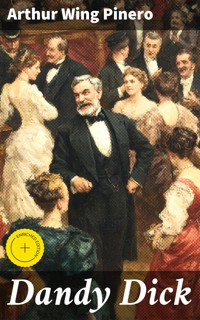
"Dandy Dick," a comedic play by Arthur Wing Pinero, deftly explores themes of social status, the rigidity of class distinctions, and the function of artifice in Victorian society. Through sharp dialogue and lively character interactions, the play revolves around the eccentricities of its titular character, the well-dressed and melodramatic Dandy Dick, whose obsession with maintaining a veneer of sophistication often leads to comically absurd situations. Pinero's adept use of humor, paired with a vibrant narrative style, underscores the contrasts between genuine emotion and societal expectations, placing the play firmly in the context of late Victorian theatre, where social satire flourished alongside the exploration of moral dilemmas. Arthur Wing Pinero (1855-1934), an influential figure in British theatre, transitioned from a career in law to the world of playwriting, ultimately becoming a prominent playwright of his time. His works often reflect his keen observations of contemporary society, influenced by his background in law and his experiences within the theatrical milieu. Pinero's ability to intertwine humor with critical social commentary was honed through years spent observing the intricacies of human behavior, which is wonderfully encapsulated in "Dandy Dick." "Dandy Dick" is highly recommended for readers and theatre enthusiasts seeking both entertainment and a rich commentary on societal norms. Pinero's exploitative wit not only makes for a delightful read but also invites reflection on the constructs of identity and class. This play exemplifies the nuances and complexities of human relationships, making it a timeless piece that resonates with audiences even today. In this enriched edition, we have carefully created added value for your reading experience: - A succinct Introduction situates the work's timeless appeal and themes. - The Synopsis outlines the central plot, highlighting key developments without spoiling critical twists. - A detailed Historical Context immerses you in the era's events and influences that shaped the writing. - A thorough Analysis dissects symbols, motifs, and character arcs to unearth underlying meanings. - Reflection questions prompt you to engage personally with the work's messages, connecting them to modern life. - Hand‐picked Memorable Quotes shine a spotlight on moments of literary brilliance. - Interactive footnotes clarify unusual references, historical allusions, and archaic phrases for an effortless, more informed read.
Das E-Book können Sie in Legimi-Apps oder einer beliebigen App lesen, die das folgende Format unterstützen:
Veröffentlichungsjahr: 2019
Ähnliche













Dandy Dick
Table of Contents
Introduction
In Dandy Dick, Arthur Wing Pinero turns the clash between rigid conscience and irresistible chance into a buoyant storm of complication, charting how a model of clerical rectitude finds his carefully ordered world rattled by the risky glitter of the racecourse, the pressures of respectability, and the quickening missteps that follow when duty, desire, and reputation begin to tug in opposite directions, framing moral certainty not as a fixed anchor but as a delicate equilibrium tested by money, community expectations, and the comic momentum of events spiraling faster than any single intention can control.
Written and first staged in the late 1880s, Dandy Dick belongs to Pinero's celebrated sequence of Victorian farces, works that helped establish him as one of the leading dramatists of his generation. Set in an English clerical household within reach of a bustling race meeting, the play draws on familiar farcical architecture—respectable rooms, anxious relatives, sudden visitors—to orchestrate public decorum and private impulse in comic counterpoint. Its period milieu matters: the expanding leisure culture of the era meets the moral scrutiny of church and community, giving the piece its lively friction and social bite.
The premise is elegantly simple and rich in comic potential. A conscientious churchman, outspoken against betting and sport, finds circumstances nudging him toward a wager on the horse that lends the play its title, hoping to remedy a practical problem without compromising his soul. From that poised, precarious decision springs a series of misunderstandings and near-misses, all propelled by brisk dialogue, precise timing, and the cheerful audacity of farce. The experience is sprightly, warm, and good-humored, inviting the audience to enjoy complication without malice and to admire how tightly built mechanisms can unleash cascading laughter.
Running beneath the bustle are themes that still resonate. The play probes the elasticity of principle under pressure, the social theater of respectability, and the seductions of chance as a shortcut to solvency or success. It studies how institutions project moral stability while the individuals inside them accommodate everyday contingencies. Without sermonizing, it raises questions about whether action defines character or whether intention can redeem a compromising choice, and it observes how communities police behavior even as they relish stories of those who err. Chance, conscience, and reputation become the three legs of its comic stool.
Pinero's craftsmanship shows in the balance of types and tones. Authority faces wit; caution locks horns with exuberance; household order meets the improvisations of guests, messengers, and hangers-on. Scenes turn on small props and plausible mistakes rather than sheer absurdity, keeping the world recognizably human even as events accelerate. The language is crisp and pointed, suited to performers who can shade irony without cruelty and pace without haste. Physical business complements verbal sparkle, yet the humor never depends solely on doors and disguises; it springs from characters whose virtues, weaknesses, and blind spots collide at speed.
For contemporary readers and audiences, the play's questions feel fresh: How far should principle yield to pragmatism? When do public roles trap private selves? What happens when a community's rules collide with the harmless pleasures it also sustains? Beyond its period charm, Dandy Dick offers an anatomy of social pressure—financial, familial, and reputational—that remains legible in modern life. Its view of risk, from small wagers to larger gambles of identity, asks us to consider what we are willing to stake to keep faith with others and with ourselves, and how easily good intentions tangle.
Approached on the page or in performance, Dandy Dick rewards attention to its clockwork and to the gentle humanity that steadies its whirl. Readers will find a lucid blueprint for laughter; theatergoers will sense how rhythm, pauses, and glances create comic inevitability. Situated between the bustling farces that made Pinero's name and the later social dramas that deepened his reputation, it offers a clear view of his versatility. Above all, it remains an engaging invitation to watch certainty wobble and recover, leaving behind not cynicism but a pleased recognition of fallible people muddling through.
Synopsis
Set in a cathedral town abutting a fashionable racecourse, Dandy Dick follows a scrupulously principled clergyman whose daily routine privileges duty, decorum, and visible rectitude. The household revolves around his careful guidance, with two spirited daughters testing boundaries in harmless ways and servants navigating the strict order he expects. A practical crisis intrudes when urgent funds are required for a church project that has outgrown its subscribed donations. The impending race meeting, with its bustle and temptations, presses close upon the deanery walls, offering a worldly counterpoint to clerical reserve and establishing the play’s central tension between rigid ideal and nearby allure.
As preparations for the races fill the town, the clergyman’s lively sister arrives, carrying the breezy confidence of the sporting world and a disarming affection for her brother’s welfare. She talks freely of trainers, odds, and stable gossip, introducing the name on everyone’s lips: Dandy Dick, a sleek contender expected to distinguish itself on the course. The sister’s playful needling meets the clergyman’s firm repudiations, yet a letter demanding immediate payment for the church work heightens the stakes. The juxtaposition of moral principle and pressing necessity quietly nudges him toward a more flexible view, framing a choice he would rather not face.
Unable to reconcile principle with ledger demands, the clergyman considers a discreet, limited wager as a temporary expedient, determined to avert scandal by preserving absolute secrecy. The plan involves intermediaries—an obliging coachman, a taciturn stablehand, a bookmaker known by reputation rather than sight—so that no trace leads back to the deanery. Farcical precautions multiply: whispered instructions, coded notes, and pockets bulging with carefully wrapped coin. What begins as a tidy, private solution acquires its own momentum, drawing him into unfamiliar haunts and leaving him dependent on people whose worldliness contrasts sharply with his official image and personal ideals.
The excursion into racing circles produces early complications. In the crowded inn parlors and at the edge of the paddock, he misreads etiquette and betrays inexperience, while curious observers take note of his presence. A small bottle—described by some as a harmless restorative and by others as a suspect stimulant—circulates among hands already under surveillance for illicit tactics. Rumors of horse-nobbling set the authorities on alert. Through intersecting errands and misdelivered messages, the clergyman finds the dubious vial in his keeping at precisely the moment when such possession looks least defensible, and the gap between private intention and public appearance widens rapidly.
At home, subplots tighten the knot. The daughters’ prospects attract scrutiny from a stern local magistrate and more affable admirers, each representing different social pathways and expectations. Courting visits overlap with discussions of propriety, while minor deceptions—concealed notes, borrowed wraps, unchaperoned strolls that were meant to be innocent—feed suspicion. Money meant for the wager crosses paths with funds earmarked for household accounts, and a careless exchange of envelopes magnifies risk. The family’s standing, the young women’s futures, and the clergyman’s reputation interlace, so that a single misstep now threatens not only a project’s financing but a cluster of domestic hopes.
On the tense evening before the race, the clergyman ventures out to confirm that his small stake is placed and to safeguard the interests he has reluctantly embraced. Patrols, primed by talk of interference with the horses, watch the stables closely. Caught in the wrong place at the wrong hour, burdened with the ambiguous bottle and unable to account for himself without unmasking the secret plan, he is seized by the authorities. The arrest, conducted with bureaucratic propriety and comic literalness, sets off a scramble at home: alibis must be invented, evidence spirited away, and well-meaning allies prevented from compounding the confusion.
Morning brings a formal confrontation before local authority, where the clergyman’s public standing collides with the procedural logic of the law. The hearing becomes an arena for farce: witnesses arrive out of order, testimony skirts the essential points, and objects crucial to the case migrate between pockets. The magistrate, mindful of community standards, seeks clarity; the household, mindful of scandal, seeks discretion. The accused wavers between frank admission and guarded silence, while the outcome of the imminent race threatens to recast every inference. With each partial disclosure, the narrative balances resolution against the risk of deepening the tangle.
Race time approaches, and events accelerate. Offstage, hooves drum and spectators roar; onstage, characters track snippets of news, misinterpret signals, and privately calculate consequences. The question of Dandy Dick’s performance bears directly on debts and reputations, yet the more urgent concern is restoring trust. A sequence of recognitions and corrections allows misplaced items to find their owners and misunderstood motives to be set in proportion. Without dwelling on the precise result, the play steers the crisis toward restoration rather than exposure, keeping the focus on how a web of small compromises and concealments can either rupture or be carefully unpicked.
In the aftermath, the household regains its equilibrium, and public appearances are reconciled with private intentions. The clergyman’s dilemma—how to uphold principle amid practical necessity—emerges as the play’s central thread, treated with brisk humor rather than moral indictment. Dandy Dick functions chiefly as a catalyst, drawing respectable figures into contact with a world they denounce yet imperfectly understand. The farce closes with relationships steadied, resources accounted for, and lessons quietly absorbed about the uses and limits of rigidity. The overall message emphasizes leniency, common sense, and the comic recognition that respectability often rests on negotiated arrangements.
Historical Context
Arthur Wing Pinero’s Dandy Dick (first performed in 1887) is set in a fictional cathedral town in southern England during the high Victorian era. The milieu is recognizably that of Sussex and the south-coast counties, where established racecourses such as Goodwood, Brighton, and Lewes drew mixed crowds of aristocrats, professionals, and working people. The narrative unfolds amid ecclesiastical precincts, rectories, and nearby inns, juxtaposing Anglican decorum with the noisy commerce of horse racing. Late nineteenth-century Britain was marked by expanding railways, rising mass leisure, and a powerful ethos of middle-class respectability. The book exploits these contrasts: a dean’s household becomes entangled with the racetrack economy and with the legal and moral regimes policing it.
Victorian horse racing formed one of Britain’s largest leisure industries, regulated by the Jockey Club (established mid-eighteenth century) and consolidated through celebrated meetings at Epsom, Ascot, Goodwood, and other tracks. After the Betting Houses Act of 1853 outlawed off-course betting shops, wagering remained legal on-course, sustaining a vibrant ecosystem of owners, trainers, stablemen, and bookmakers. The sport’s visibility increased with rail excursions and specialized press. Dandy Dick’s central predicament—the dean’s wager on a racehorse to fund church repairs—mirrors the period’s collision between respectable morality and the irresistible social magnetism of racing. The plot’s brushes with doping suspicions and bookmakers echo anxieties about corruption that accompanied racing’s explosive growth.
The Church of England’s nineteenth-century reorganization created chronic financial and administrative strains that inform the book’s premise. The Ecclesiastical Commissioners, established in 1836, redistributed revenues and oversaw cathedral estates, while the Church Rates Abolition Act of 1868 removed compulsory local rates that had supported parish buildings. Costly Victorian restorations, often led by architects such as George Gilbert Scott, placed further pressure on diocesan and cathedral finances. Tithes were commuted under the 1836 Act, but resistance culminated in the Welsh Tithe War (1886–1891), dramatizing wider discontent over ecclesiastical funding. In this climate, the fictional dean’s whimsical turn to a wager to repair fabric is a satirical exaggeration of real fundraising improvisations—bazaars, subscriptions, and appeals—that clergy increasingly relied upon.
The professionalization of policing furnishes the book with both plot machinery and social texture. The Metropolitan Police (1829) and the County and Borough Police Act (1856) established uniformed forces across England and Wales, with summary courts and magistrates handling minor offenses linked to gambling, licensing, and public order. The Licensing Act of 1872 tightened control over inns and drunkenness; policing of betting remained uneven after 1853, encouraging vigilant constables around race meetings. Dandy Dick’s comic entanglement with an officious inspector and misidentified “medicines” recalls real Victorian concerns about frauds, stimulants, and animal welfare in sport, and suggests the era’s expanding bureaucratic reach into private life, where clerical dignity offered no certain protection from arrest or suspicion.
Women’s changing civil status in the 1870s and 1880s provides another historical hinge. The Married Women’s Property Acts (1870, 1882) allowed wives to own earnings and property, strengthening the legal independence of widows and unmarried women. Socially, elite and middle-class women increasingly appeared at major meetings like Ascot and Goodwood, sometimes as owners or influential bettors, even as they navigated codes of propriety. Dandy Dick’s forceful racing enthusiast, the dean’s sister, accords with this environment of heightened female autonomy and public presence. Her confidence in stables and wagers both unsettles and catalyzes the drama, pointing to the period’s tensions between entrenched clerical patriarchy and a widening sphere of female initiative in leisure and finance.
The world of the book is inseparable from the Victorian leisure revolution enabled by railways, the press, and legal-regulatory frameworks. The London, Brighton and South Coast Railway (formed 1846) linked London with Sussex resort towns and nearby racecourses; excursion trains from the 1850s swelled attendance at Brighton and Goodwood, and Lewes’s long-established track became a regional draw. Telegraphy and cheaper newspapers, after the repeal of stamp duties in 1855, fostered a specialized sporting press—Bell’s Life in London, The Sportsman (founded 1865), and The Sporting Times (1865)—that printed odds, tips, and scandal, feeding a national betting conversation. The state’s response mixed tolerance and moral caution: the Betting Houses Act (1853) pushed wagering onto courses, while the Licensing Act (1872) sought sobriety in public houses, pivotal social spaces in racetrack towns and cathedral cities alike. These pubs, inns, and assembly rooms—carefully regulated yet essential to local economies—frame the play’s misunderstandings and clandestine exchanges. On the cultural front, the Theatres Act of 1843 preserved the Lord Chamberlain’s licensing power, shaping how playwrights satirized clergy, police, and public vice. Pinero, an actor turned dramatist in London’s thriving West End, premiered Dandy Dick in 1887 amid a commercial theatre boom centered on precisely such topical farces. Censorship discouraged overt political polemic, yet the stage’s appetite for clerical predicaments and racecourse scrapes offered audiences a safe mirror for anxieties about respectability. The ease of travel, the omnipresent sporting press, and the codified but porous legal boundaries around betting and drink together created a social field where a dignified dean might plausibly slip into a bookmaker’s orbit—and where a misplaced bolus or suspicious draught could translate into comic crisis with unmistakably modern resonances.
Shifts in governance and class relations supply a wider backdrop to the book’s cross-class encounters. The Second Reform Act (1867) and the Third (1884) broadened the electorate, while the Local Government Act (1888) instituted elected county councils, diminishing the informal sway of clerical and landed elites over local administration. Yet cathedral clergy remained moral authorities, even as the racecourse mixed aristocrats, professionals, servants, grooms, and bookmakers in close quarters. Dandy Dick mines this permeability: rectory, police station, and stable yard intersect, producing misrecognitions that expose the fragility of status. The work thus reflects an era when formal respectability met a democratizing public sphere, often with unsettling, humorous consequences.
As social and political critique, the book targets the contradictions of late-Victorian respectability. It exposes how ecclesiastical finance could push churchmen toward ethically ambiguous means, how zealous policing risked humiliating the innocent, and how anti-gambling rhetoric coexisted with a thriving, quasi-legal betting economy. By giving a capable woman a central role in racing decisions, it quietly challenges clerical patriarchy and acknowledges the legal changes enabling female agency. The farce’s collisions between deanery and racecourse, vestry and inn, puncture pretensions of class infallibility. Without preaching, the work indicts moral double standards and bureaucratic heavy-handedness, inviting audiences to scrutinize the social order that produced them.




