


0,49 €
Niedrigster Preis in 30 Tagen: 1,99 €
Niedrigster Preis in 30 Tagen: 1,99 €
Mehr erfahren.
- Herausgeber: Booksell-Verlag
- Kategorie: Poesie und Drama
- Sprache: Englisch
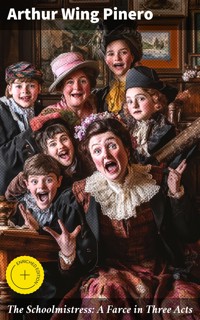
In "The Schoolmistress: A Farce in Three Acts," Arthur Wing Pinero crafts a delightful comedic exploration of the intricacies of romantic entanglements and the societal expectations surrounding education and gender. Set against the backdrop of late Victorian England, the play employs sharp wit and playful dialogue, illustrating the complexities of love and ambition through its dynamic characters. Pinero's mastery of farce is evident in the rapid pacing and contrived scenarios that lead to humorous misunderstandings, revealing both the absurdity and poignancy of human desire. Pinero, a prominent figure in the realm of English theatre during the late 19th and early 20th centuries, was deeply influenced by the cultural nuances of his time, particularly the evolving roles of women in society. Having started as an actor, he transitioned into playwriting, reflecting the social mores and facilitating conversations around gender and class in his works. His background in theatre and law, coupled with his keen observations of human nature, informed his narrative style, making "The Schoolmistress" a timeless reflection on social norms. This farce is highly recommended for readers and theatre enthusiasts alike, as it encapsulates the humor and challenges of its era while maintaining relevance today. Pinero's sharp commentary wrapped in laughter offers valuable insights into the eternal complexities of human relationships, inviting audiences to both reflect and revel in the folly of love. In this enriched edition, we have carefully created added value for your reading experience: - A succinct Introduction situates the work's timeless appeal and themes. - The Synopsis outlines the central plot, highlighting key developments without spoiling critical twists. - A detailed Historical Context immerses you in the era's events and influences that shaped the writing. - A thorough Analysis dissects symbols, motifs, and character arcs to unearth underlying meanings. - Reflection questions prompt you to engage personally with the work's messages, connecting them to modern life. - Hand‐picked Memorable Quotes shine a spotlight on moments of literary brilliance. - Interactive footnotes clarify unusual references, historical allusions, and archaic phrases for an effortless, more informed read.
Das E-Book können Sie in Legimi-Apps oder einer beliebigen App lesen, die das folgende Format unterstützen:
Veröffentlichungsjahr: 2021
Ähnliche


















The Schoolmistress: A Farce in Three Acts
Table of Contents
Introduction
When the guardians of decorum lose control, the comic truth about respectability tumbles into the open. Arthur Wing Pinero’s The Schoolmistress: A Farce in Three Acts channels the high-velocity pleasures of late Victorian stage comedy into a compact portrait of order under siege. The premise is simple and tantalizing: an institution built on rules and appearances becomes the arena for mishaps, misread signals, and inconvenient visitors. What follows is farce in its classic sense—precision-timed entrances and exits, escalating misunderstandings, and a steady unmasking of pretenses—crafted by a playwright who understood both theatrical mechanics and the social codes they gently lampoon.
Pinero, a major English dramatist active in the late nineteenth and early twentieth centuries, made his name with a run of farces in the 1880s before turning to more serious social dramas in the 1890s. The Schoolmistress belongs to that earlier phase, showcasing his deft sense of comic architecture and his interest in the etiquette of everyday life. First produced in the later 1880s, the play displays the period’s fascination with propriety, domestic ritual, and the fragile line between public virtue and private impulse. Its three-act structure supports a carefully staged crescendo, inviting audiences to relish complication without losing the thread.
Set in and around a girls’ school, the play centers on a head of the establishment whose commitment to discipline is tested by an evening that refuses to stay contained. Small acts meant to preserve appearances—harmless subterfuge, polite omissions, well-intended politeness—compound into a labyrinth of mistaken conclusions. Visitors arrive at inopportune moments, messages go astray, and rooms fill faster than they empty, all while the veneer of institutional calm must be maintained. The result is a pressure cooker of social choreography in which authority, reputation, and personal desire are held in delicate balance, encouraging laughter while foregrounding stakes that feel recognizably human.
The experience Pinero offers is brisk, buoyant, and meticulously engineered. Dialogue snaps with energy, but the comedy relies equally on movement, timing, and spatial wit—the strategic opening and closing of doors, a mislaid item, an ill-timed entrance. Characters speak in tones of perfect propriety even as circumstances drag them toward absurdity, a contrast that gives the humor its bite. The voice is urbane rather than caustic, playful rather than cruel, and the mood remains sparkling as complications mount. Audiences will find the rhythm of classic farce here: rapid acceleration, near-collisions, and just enough breathing space to appreciate the ingenuity of the next turn.
Beneath the playfulness lies a set of themes that continues to resonate. The Schoolmistress explores how social roles—teacher, guardian, spouse, subordinate—become costumes people struggle to keep straight when real feelings intrude. It probes the demands of respectability and the performative labor required to uphold it, especially in spaces dedicated to moral instruction. Authority figures discover their limits; institutions reveal their dependence on individual improvisation. The comedy thus invites reflection on gendered expectations, the management of appearances, and the awkward elasticity of rules. Pinero’s insight is that farce, by exaggerating ordinary slippages, clarifies the pressures that decorum exerts in everyday life.
As a work of its period, the play offers a window onto Victorian theatrical craft and cultural preoccupations. Pinero stands at a crossroads: his farces refined commercial comedy for broad audiences, while his later plays would interrogate social convention more directly. The Schoolmistress captures the transitional energy of that moment, using laughter to test the boundaries of what polite society can acknowledge. The meticulous plotting reflects a professional stage ecosystem that prized ensemble work and structural clarity. Without depending on topical satire, the play engages with a wider conversation about education, class signaling, and the uneasy marriage of duty and pleasure.
For contemporary readers and theatergoers, the appeal lies in both the sheer fun of the mechanics and the surprising timeliness of its concerns. The setting may be historical, but the spectacle of image management under pressure feels familiar, whether in classrooms, workplaces, or public life. The play raises questions about who gets to define order, how institutions conceal their messiness, and why small evasions so often spiral. Its elegance makes it accessible; its subtext invites reconsideration. Approached as literature or as a blueprint for performance, The Schoolmistress demonstrates how a well-made farce can still illuminate the delicate dance between principle and pretense.
Synopsis
The Schoolmistress: A Farce in Three Acts presents a bustling girls' boarding school at the height of the season, run by a vigilant headmistress whose livelihood depends on order, reputation, and the goodwill of wealthy patrons. The opening establishes the daily machinery of classes, music lessons, and governesses, and introduces a handful of spirited senior pupils whose curiosity repeatedly tests the rules. A handful of adults around the school—an earnest assistant mistress, a romantic music master, and two practical servants—complete the ensemble. The tone signals lighthearted crisis rather than grave danger, while hinting that a single evening of loosened discipline could overturn the careful arrangements of a lifetime.
Pressure mounts when the headmistress learns that a prominent figure intends to visit, and that financial matters tied to the school’s lease require her immediate attention elsewhere. She plans a brief absence, leaving strict instructions and appointing a reliable deputy to keep the establishment exemplary. At the same time, unrelated threads begin to knot: a note passes between a gentleman and someone within the school, a trivial kindness is mistaken for a signal, and a suggestion for an innocent evening entertainment gathers momentum. The coincidences are ordinary in isolation, but together they create an opening through which impropriety, or the mere appearance of it, might slip.
Word of the headmistress’s brief departure leaks beyond the staff room, magnified by the household’s busy network of errands, deliveries, and servants’ friends. A pair of well-meaning gentlemen, one with a personal interest in a teacher and another serving as a chaperoning companion, find pretexts to approach the premises. Meanwhile, a senior pupil imagines romance at the periphery of the school’s protected world, prompting small acts of disobedience. Doors are left unbolted, a costume box is unpacked for a proposed recital, and promises of caution are exchanged. Nothing appears flagrantly wrong, yet boundary lines soften just enough to invite confusion and chance encounters.
The first act gathers these threads into a poised situation. With the headmistress convincingly away on pressing business, an evening program intended as a harmless diversion is improvised. Guests who should not be there are smuggled in under respectable descriptions, and the faculty’s sober routines bend into informal hospitality. Each person justifies a small exception for the sake of kindness or convenience, unaware that the sum of exceptions creates a precarious picture. The weather and the hour conspire to detain visitors longer than planned. By the curtain, the house contains more people than the rules allow, and the possibility of discovery shadows every doorway.
Act Two unfolds as an escalating set of concealments and mistaken identities. A light supper acquires the appearance of a party, and a rehearsal is mistaken for a dance. Men who should not be seen in a school at night borrow cloaks, aprons, and instruments to pass as tradesmen or musicians. Harmless flattery blossoms into comic jealousy. Then an unanticipated arrival upsets the balance: an official presence connected to the school appears at the gate, and the headmistress returns earlier than anyone expected. Rooms are rearranged in haste, doors slam, lights flicker, and characters shuttle between corridors, changing stories as quickly as costumes.
The center of the farce is a prolonged sequence of near exposures. A visitor hides in a cupboard that proves to be a thoroughfare, a borrowed coat carries a telltale label, and a musical phrase betrays someone who claims never to have met a certain guest. The headmistress, piecing together fragments, senses disorder without glimpsing its full extent. Accusations, apologies, and half-truths crisscross the stage as everyone strives to protect reputations. The school’s very purpose—safeguarding innocence—heightens the stakes and the comedy. The act closes on a tableau in which appearances seem most compromising, though the audience knows the misdemeanors are social, not moral.
Act Three begins with consequences. The night’s tumults give way to stern interviews, the collection of evidence, and a brisk audit of keys, letters, and visiting cards. Those involved attempt to regularize what occurred by presenting it as an administrative misunderstanding, while would-be suitors press their honorable intentions. The possibility of scandal threatens the school’s finances and the future of several livelihoods. Yet alliances form across lines of authority: a loyal servant shields an impulsive pupil, and a clear-eyed assistant mistress speaks frankly to the head of house. The focus shifts from frantic motion to negotiation, explanation, and the sorting of responsibilities.
As explanations settle, revelations alter the balance of power. The headmistress reveals private circumstances that cast her earlier severity in a new light, and her necessity to preserve appearances becomes understandable. An influential visitor, once angry, proves open to persuasion when the whole truth is outlined with tact. Practical solutions are found that reconcile decorum with sympathy: matches are sanctioned rather than thwarted, titles are clarified, and debts of gratitude are acknowledged. Without detailing the final arrangement, the arc moves toward reinstated order, preservation of the school’s standing, and futures secured for the central figures in ways compatible with propriety and feeling.
The farce ultimately presents a comic study of Victorian respectability under pressure, insisting that rules exist to guide conduct but cannot extinguish human spontaneity. By tracing one night’s lapse from rigid supervision to careful restoration, it affirms both the resilience of institutions and the adaptability of individuals. The girls’ school remains what it was meant to be, yet its leaders understand their charges and colleagues more fully. The tone stays light, the pace quick, and the endings humane. The work’s central message is balance: honor public duty, recognize private hearts, and admit that even guardians of order may need forgiveness and wit.
Historical Context
Set in the mid-1880s in a prosperous London suburb, The Schoolmistress unfolds within the enclosed, rule-bound world of a private girls’ college and the drawing rooms that sustain it. The milieu is recognizably late Victorian: a city swollen by railway-enabled suburban growth, governed by punctilious codes of respectability, and alive with anxieties about female education and propriety. The play’s time and place presume a clientele of middle- and upper-middle-class families seeking polish and protection for their daughters, while commerce, servants, and social surveillance press close at hand. This environment—orderly on the surface, precarious beneath—supplies the farce with its tensions: strict timetables, visiting hours, fees, and reputations that can be undone in a single evening’s indiscretion.
The most immediate historical backdrop is the transformation of girls’ schooling after the Schools Inquiry Commission (Taunton Report) of 1868–1869 and the Elementary Education Act of 1870, followed by compulsory attendance under the 1880 Act. These measures, along with the formation of the Girls’ Public Day School Company (1872), expanded secondary provision for girls and professionalized headship. Pioneers such as Frances Mary Buss (North London Collegiate School, founded 1850) and Dorothea Beale (Cheltenham Ladies’ College, reformed from 1858) advocated rigorous curricula and moral discipline. Cambridge’s Girton (1869) and Newnham (1871) symbolized higher aspirations, even as full degrees remained contested. The Schoolmistress mirrors this landscape by placing a woman at the helm of a fee-paying institution, dramatizing curriculum, conduct, and guardianship as daily negotiations between educational ideals and parental expectations.
The legal and economic frameworks governing women’s autonomy shifted decisively with the Married Women’s Property Acts (1870, 1882), enabling married women to own earnings and property, and the Guardianship of Infants Act (1886), which strengthened mothers’ rights. These reforms underwrote the rise of women proprietors and professionals, including headmistresses who ran schools as commercial ventures with contracts, ledgers, and liabilities. The Association of Head Mistresses (founded 1874) further consolidated standards and collegial authority. Pinero’s farce leverages this context: the titular schoolmistress must balance educational duty against cash flow, creditors, and social prestige. The comic crises—fees overdue, patrons to appease, and decorum to maintain—reflect the hard realities of female entrepreneurship in a market still policed by male respectability and legal technicalities.
Victorian social purity campaigns profoundly shaped public discussion of young women’s safety. The Criminal Law Amendment Act of 1885 raised the age of consent to sixteen and empowered authorities against trafficking, following W. T. Stead’s 1885 “Maiden Tribute of Modern Babylon” exposé; the National Vigilance Association formed the same year. Meanwhile, Josephine Butler’s activism secured repeal of the Contagious Diseases Acts in 1886, repudiating state control over women’s bodies. This climate intensified vigilance around chaperonage, visiting rules, and the segregation of sexes—central preoccupations in girls’ schools. The play’s plot devices—unexpected male intrusions, nocturnal misadventures, and frantic efforts to preserve propriety—echo these societal fears, satirizing how moral panics and bureaucratic safeguards can entangle well-meaning educators.
Class structure and domestic service, the largest female occupation, formed the fabric of school households. By the 1891 census, well over a million women in Britain worked as domestic servants, staffing kitchens, laundries, and dormitories that maintained middle-class respectability. Schools depended on this labor hierarchy, where maids and matrons enforced routine while governing their own informal networks and discretion. Farce traditionally exploits such vertical interactions, and The Schoolmistress is no exception: servants mislay messages, misread commands, and inadvertently expose secrets. The comedy underscores how the genteel veneer of education rests on the invisible, often precarious, work of women whose class positions give them both limited power and pivotal influence over daily order.
Rapid urbanization and suburbanization shaped the play’s setting and rhythms. London’s population exceeded 3.8 million by 1881, expanding along the Metropolitan (1863) and District (1868–1871) railways and the completed Circle Line (1884). Respectable villas doubled as small enterprises, from schools to lodging houses, in neighborhoods where one scandal could empty a prospectus. The proximity of parents, trustees, and tradesmen—connected by trains, cabs, telegraph, and the penny post—meant reputations could be swiftly made or ruined. The Schoolmistress leverages this compressed geography: arrivals, departures, and misdirected communications escalate farcically, reflecting a metropolis where speed magnifies error and where suburban gentility depends on constant performance before ever-watchful neighbors.
The conditions of Victorian theater also informed the play’s contours. Under the Theatres Act of 1843, the Lord Chamberlain licensed plays, steering playwrights toward socially acceptable satire rather than explicit political controversy. Arthur Wing Pinero, an actor-turned-playwright, refined high-velocity farce for West End audiences, and The Schoolmistress was first produced in London in 1886, when commercial theaters favored topical comedies of manners. The Court Theatre’s repertory demonstrated how censorship, box-office discipline, and ensemble playing encouraged plots about propriety, status, and minor law-breaking. The play’s ingenious concealments and rapid reversals are theatrical responses to regulatory boundaries: it lampoons the rituals of respectability while remaining within the period’s permissible comic decorum.
In this context, The Schoolmistress functions as a social critique of late-Victorian domestic governance, exposing how ideals of female virtue, educational uplift, and middle-class polish are entangled with money, surveillance, and legal constraint. By compressing crises of fees, chaperonage, and reputation into one racing night, the play indicts the brittleness of respectability culture and the unequal burdens placed on working women who must be both entrepreneurs and moral exemplars. Its satirical treatment of guardianship, male interference, and bureaucratic “safeguards” reveals class anxieties and gendered double standards, suggesting that the very structures claiming to protect girls’ futures can imperil the livelihoods and autonomy of the women tasked with educating them.




