


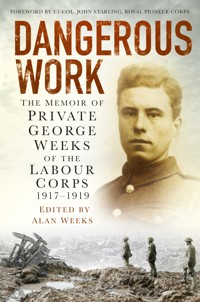
Dangerous Work E-Book
Erhalten Sie Zugang zu diesem und mehr als 300000 Büchern ab EUR 5,99 monatlich.
- Herausgeber: The History Press
- Kategorie: Geisteswissenschaft
- Sprache: Englisch
British military labour during the First World War developed from an ad hoc arrangement in 1914 into a corps some 400,000 strong, supported by as many as a million dominion and foreign workers by 1918. Records of this contribution to victory are extremely rare. George Weeks wrote down his experience on squares of wallpaper – always a practical man. And what a record it is. The Somme, Passchendaele and the Messines Ridge all feature in George's calm description of his extraordinary experiences. He camped in 'the vast graveyard of Cambrai', he cut down an entire forest for duckboards, and he mended the aircraft of Captain Ball VC with dope and linen! With the corps working on the front lines and often under fire, this truly was dangerous work.
Sie lesen das E-Book in den Legimi-Apps auf:
Seitenzahl: 207
Veröffentlichungsjahr: 2014
Das E-Book (TTS) können Sie hören im Abo „Legimi Premium” in Legimi-Apps auf:
Ähnliche




















CONTENTS
Title
Preface
Introduction by Lt–Col. John Starling
1 March 1917
2 April 1917 – Somme
3 May 1917
4 June–August 1917 – Somme
5 September 1917 – Somme Area
6 October 1917 – Ypres Salient
7 November 1917 – Ypres Salient
8 December 1917 – Ypres (St–Jean/Kitchener Wood)
9 January–February 1918
10 March 1918 – Barly
11 April 1918
12 May 1918
13 June 1918
14 July 1918
15 August 1918
16 September–October 1918
17 November–December 1918
18 January 1919
19 February 1919
20 March 1919
21 April 1919
22 May 1919
23 June–August 1919
24 September–November 1919
Appendix
Copyright
PREFACE
This is my father’s account of his war experiences on the Western Front between 1917 and 1919, edited by me. This was handwritten after the war on seventy-eight sheets of cut-up wallpaper. They were in a box file left to me by my father. Notes and comments are included in the main text but are shown in a different font – this is to assist in the reading of the document, otherwise the reader would be continually looking up references elsewhere. I have added two simple maps so that the reader may follow George’s movements in northern France and Flanders.
Alan Weeks
INTRODUCTION
In fifteen years of research into the role and activities of the Labour Corps this is the only soldier’s diary I have ever seen. What makes it even more remarkable is the fact that for a corps that was to involve over 500,000 British officers and men there are only three known records and these were all by officers and written after the event when events could be judged in retrospect.
The diary makes interesting reading. It is the thoughts of a private soldier that have not been rewritten after the war. It does not involve great military actions but day-to-day survival in terrible conditions. It is quite obvious that world or national events have little or no concern to Private Weeks and his comrades who are involved in the daily grind of maintaining roads and railways.
The Labour Corps was one of a number of units that was formed during the war and disappeared soon after the war finished. Their activities are generally unsung and there were few formal records of their achievements; the units did not maintain war diaries. When Britain entered the European war in August 1914 all planning was based on a short war fought where local labour was easily available and tonnages of equipment were limited (siege warfare was not envisaged). France was different: most of the available manpower in France was conscripted to serve in the French Army and so the British Expeditionary Force (BEF) had to maintain its own supply lines.
When the BEF deployed it was mainly an infantry-heavy force with limited artillery and was not equipped for the drawn-out siege warfare experienced from November 1914 onwards. In 1914 the army was using about 10,000 tons of ammunition a month but by June 1917 this had risen to 230,000 tons a month. Add to this food, fuel (including fodder), trench stores (sandbags, props, pickets etc.), medical supplies and all the other equipment, and you can see what a massive effort was required to unload from ships in France, load trains, transfer to light railways and roads, and finally move stores to the front on mules and by men. It should be remembered these were the days before material-handling equipment and all stores were moved by hand. At the same time railways and roads were laid, upgraded and maintained by a significant uniformed workforce.
The first labour units were deployed to France in early 1915 to work in the docks and maintain the railways. As the army grew, so did the demand for labour. In 1916, with the introduction of conscription, more men were being enlisted of lower medical category and over the accepted age limit of 35 for the infantry. These men, many suffering minor physical ailments like short-sightedness and from poor nutrition, were placed into infantry labour units and moved to France.
In April 1917 all the various forms of labour – infantry, Army Service Corps, Royal Engineers, prisoners of war etc. – were placed under a single command and the Labour Corps was formed. Many units did not take to being referred to as Labour Corps and you will note that George continually refers to the Queen’s Regiment because his company, 132 Company Labour Corps, was previously 24 (Infantry) Labour Company the Queen’s Regiment. Being a ‘labourer’ and not a ‘soldier’ had a certain stigma and as a result even the army ensured that medals and any graves were marked with the serviceman’s original regiment (if he had one).
With the massive increase in labour units due to conscription there were still shortages. By November 1918 there were over 395,000 members of the Labour Corps. Eventually the British looked to their empire for support and Indians, Africans and West Indians came to France. By the end of the war there were 98,000 Chinese employed by the Labour Corps.
Following the war, the Corps was involved in battlefield salvage, which was to recover valuable material from the battlefield. It was not the British Army’s problem to return the battlefield to farmland. Whilst carrying out this work the Corps also underook the task of concentrating the various battlefield graves into what are now the Commonwealth War Grave Commission cemeteries in France. This task proved so demanding that men who had left the service were asked to re-enlist to undertake burial duties.
George’s diary makes interesting reading. He was a volunteer from a reserved occupation and being medically downgraded to C2 meant he did not have to join. His experiences reflect those of the many thousands of men who were in the Labour Corps; he has little knowledge of events outside his own section of twenty-eight men, and interestingly, even though he knows he joined 24 (Labour) Company, Queen’s Regiment, when that forms into the Labour Corps he seems unsure of the company number. He reflects the attitude of many of the men transferred to the Labour Corps in that he continually refers to his ‘old’ regiment and cap-badge rather than the new organisation.
Throughout his service he visits all the main combat areas, starting with clearing up the old Somme battlefield, moving to Ypres to maintain roads during the battle of Passchendaele and, although not in the line during the March offensives, being actively employed in producing the GHQ Reserve Line. After the allied advance in August 1918 he followed the advancing army into German-occupied Belgium and finally into the occupied zone of Cologne.
His experiences show that although the Corps was not in the front line its members spent many long periods within the range of enemy artillery without relief. The front-line infantry tended to rotate between front line, support and reserve/rest/training (outside of enemy artillery range). George himself spends a long period at Kitchener Wood, Ypres, building an artillery-locating facility which is abandoned. Other records I have seen show men maintaining light railways, within the range of enemy guns for up to six months without a break. It must be remembered that all these men were of low medical category.
Although initially unarmed, the Labour Corps was not non-combatant. The non-combatant corps consisted of conscientious objectors, whereas the Labour Corps tended to be personnel who had been medically downgraded due to wounds or age. Had the original companies been armed, a lot of work would have been lost as the men undertook weapons training etc. Following the March 1918 offensive, a decision was made to arm the whole Labour Corps, to enable its men to defend themselves and certain areas of the line, but this took time.
George’s Unit, 132 Company, although a labour company of five officers and 425 men, does not fully reflect all 300 British labour companies at the front. Since it was employed in relatively quiet zones it suffered remarkably few casualties, and there are only two recorded Meritorious Service Medals and no gallantry awards. Some units were unlucky and ended up bearing the brunt of the German advances in 1918.
I wish that this script had been available when I was researching the work of the Labour Corps as it fully represents the role played by many thousands of men, both British and foreign (Indians, Africans, Chinese etc.), within the corps in France.
Lt-Col. John Starling, (co-author with Ivor Lee ofNo Labour, No Battle: Military Labour During the First World War)
THE MEMOIR OF
PRIVATE GEORGE WEEKS
1
MARCH 1917
At the beginning of March 1917, I was approaching my nineteenth birthday, which was the tenth of April. Little did I know that I was to celebrate this event on the Somme.
I was employed as a docker in the South West India docks, mostly discharging sugar from Cuba. This was extremely heavy labour: being tall, I was back-lifter in a piling squad consisting of five men. Although I was a near six-footer my weight was 9 stones, 2 lbs.
This waterway still exists some 200m south of Canary Wharf. The main (earlier) West India Dock waterways are also still there, about 200m north of Canary Wharf. The docks closed to commercial traffic in 1980.
I gradually realised I was being dehydrated through excess hard work and lack of nourishment. So the time had arrived when I decided to alter these circumstances.
On the first Monday of March a fresh consignment of sugar got through the submarine blockade. [Unrestricted U-boat warfare resumed in 1917 with the German aim of forcing Britain to sue for peace. Outnumbered by 190 divisions to 150 on the Western Front, German hopes of victory there had dwindled. In this month 25 per cent of Britain-bound shipping was lost. The American president had severed all diplomatic relations with Germany (Congress declared war on 6 April). Germany hoped for a profitable peace settlement before the American Army was ready to fight in Europe.] The squad was busily engaged piling the heavy bags. After lunch, which was not a lot, I enraged the largest lout of the other four – at least twice my weight. He was under the mistaken impression that he could misname me with impunity. I answered this character so effectively that he attacked me, with the result that I received a cut and blackened eye.
I had noticed his bloated waistline swollen with the lunchtime imbibement of liquor, so after receiving a few blows he sank to the floor of the warehouse gasping like a great porpoise. I had landed the right blow in the right place.
Knowing full well that this incident would not end there (I was the outsider of the five) I decided to end my work there and burn my boats. I therefore proceeded to the Labour Office with the plea that medical attention was needed. My time and wages were made up and as I received my employment cards as well I had washed my hands of the docks for the time being.
Arriving home in Cubitt Town I bathed the eye, made tea and changed to outdoor attire, wearing one of my so-called two best suits, deciding to spend a couple of hours at the cinema.
Cubitt Town is the south-east part of the Isle of Dogs, East London, facing Greenwich across the Thames. William Cubitt, Lord Mayor of London 1860 to 1862, was responsible for the development of housing and amenities in this area in the 1840s and 1850s for workers in the local docks, shipbuilding yards and factories.
I took the bus to Poplar. At the Pavilion was showing ‘The Battle of the Somme’.
The ‘Pav’, as we still called our favourite picture palace thirty years later, was situated at the junction of East India Dock and Cotton Street.The Battle of the Somme(1916) was one of the most successful British war films ever made. It is estimated that more than 20 million tickets were sold in this country in the first two months of its release. It was distributed worldwide in order to prove this country’s commitment to the war. It is the source of many of the conflict’s most iconic images. The film gave an unprecedented insight into the realities of trench warfare, controversially including the depiction of dead and wounded soldiers. It showed scenes of the build-up to the infantry offensive and the massive preliminary bombardment. Coverage of the first day of the battle – the bloodiest single day in the British Army’s history – demonstrated the smallness of the territorial gains and the huge losses suffered to gain them. As a pioneering battlefield documentary, the very concept ofThe Battle of the Sommeoutraged commentators and set off a fierce debate about showing actual combat. The use of a staged sequence to represent the opening of the assault posed doubts about the documentary format.
It was horrifying to me, and at the back of my mind was the thought that I was classified C2, which meant passed for Home Service under the Lord Derby Scheme. [The ‘Lord Derby Scheme’ (officially the ‘Group Scheme’ – ‘Group’ referring to men’s dates of birth and call-up dates) was abandoned at the end of 1915 because not enough potential recruits were coming through this voluntary (though morally persuasive) system. Real conscription arrived with the Military Service Act of January 1916. George must have been amongst the last men attested to under the Lord Derby Scheme because the last registrations for it were made in March 1916, when George was still 17 (he was born 10 April 1898).] I wouldn’t be subjected to those terrible conditions.
C2 Medical Category meant ‘C – temporarily unfit for service in categories A (fit for general service) or B (not fit for general service, but fit for service at home), but likely to become fit within six months, and for employment in depots; and ‘2’ – able to walk to and from work a distance not exceeding 5 miles, see and hear sufficiently for ordinary purposes. The C2 medical classification was due to his chronic migraines. Moreover, the government had pledged not to send teenagers to the front line (by 1918 half the infantry was 19 or under!). Any pledge made by the Lord Derby Scheme not to send some men abroad was just as likely to fall foul of the pressing needs of the British Expeditionary Force. Of the men medically examined in 1917 and 1918 only 36 per cent were found fit enough for full military service; 40 per cent were physically unable to serve, even as non-combatants. Men of George’s age were being called up by October 1916 but dockers were regarded as doing work of national importance.
On my way home the thought struck me that the way out for me was to join the Army. So next morning I travelled to the local recruiting office. After a great deal of discussion trying to persuade me to go to a munitions factory in the Midlands I was finally enrolled in a Works Battalion [it was a labour company of five officers and 425 men and not a labour/works battalion of thirty-six officers and 1,000 men] called the 24th Queen’s Royal West Surreys, at that time stationed at the Rangers Drill Hall in Harrow Road, Paddington.
These men were also below the A1 medical grade required for full service but could be employed within the range of enemy artillery (again, George and his mates were certainly within range near Ypres in late 1917 and early 1918, and very definitely in extreme danger from enemy aircraft).
Arriving and reporting to this depot the next morning I realised that this was an entirely new unit formed with men from all over London with Categories B1 down to my low one. It took several days to start licking this outfit into shape. The drilling was no novelty to me. I had spent several years as a member of the Boy’s Brigade and knew the basic drill prevailing at that period.
The catering arrangements were excellent. In sections we were taken to various coffee and dining rooms and supplied with substantial meals. I liked this. Around the third day we were taken by the lorry load to Park Royal Depot for kitting out. I was amazed at the efficient way this chore was accomplished. Some fellows were barely five feet tall, others six feet three inches plus. All were seen to at lightning speed.
About the fourth day since our enlistment the Unit came face to face with a fresh arrival – our Sergeant Major arrived from Hampshire, from the famous Green Howards. I have heard since that this Regiment is noted for quick step marching. [This is not the case for the Green Howards (Yorkshire Regiment) but would have been true for the Rifle Brigade (Green Jackets), and as the Rifle Brigade was a London-based unit it is more likely that this is where he was from.] No doubt he had been informed of the hard task awaiting him and was soon employed in turning us inside out. His favourite utterance was ‘I’ll liven you up, you people’, and, funnily enough, he succeeded.
On the fifteenth of March, the Unit was inspected by the Commander of the whole London area – Major General Sir Francis Lloyd. He paused behind me and screwing his cane between my shoulder blades commanded me to ‘Get that busby seen to’, meaning that my hair needed barbering, of course.
Major-General Lloyd commanded the Brigade of Guards and was also General Officer Commanding London District. He was responsible for the defence of London, especially against Zeppelins. He had delegated powers over trains, hospitals, etc.
The Sergeant Major stated I was for the high jump and my name and number were taken down for some punishment to be doled out to me.
The next day, the sixteenth, a depressing rumour travelled around that the Battalion [company] was about to embark for France. There was not a lot of substance in this grapevine until mid-afternoon when dozens of Military Police arrived and all exits were sealed. The penny dropped. The next morning we were entrained for Folkestone and went aboard a famous Thames cruise vessel which was propelled by paddle wheels.
When the Unit arrived in early morning at Folkestone a ladle of vegetable soup was issued to each man. On the boat young lads were passing among us offering pork pies at two pence each. I purchased three of these. Afterwards I had good cause to reflect that stew and pork pie was not a suitable diet for a rather bumpy trip across the Channel.
The vessel arrived at Boulogne 17 Mar 1917. The crossing had been extremely rough and most of us were in a bad way. We still had to march through the town and up the hill to St Martin’s Camp. Here we were shouted and screamed at by a bevy of Base Wallah NCOs, which did not improve our condition and demeanour very much.
Hardly had we settled in the bell tents allotted us when we were paraded again. The request was politely bawled out – ‘All men able to play a musical instrument step two paces forward’.
Around twenty fellows did so. They were marched away, the rest of us dismissed. About a half hour later these unfortunates arrived back from their ‘musical lesson’ – emptying latrine buckets.
Happily, our stay in this hateful place was just the night. We were marched to a railhead the next morning, where we entrained, arriving at Aschew Woods in the early hours of the next morning. We had been allowed to remove our boots. Whilst we occupied these box trucks unfortunately the boots got mixed, with dire results. I was one of the unlucky ones with a size nine and one about size seven.
The next camp was some two miles from the railhead, and I, amongst a dozen others, had to march to this place wearing only one boot.
During the day, however, with a number of men missing from parade, the Section leaders received orders to adjust this matter, and the men wearing larger boots than their size foot were booked for fatigues at a later date.
After a day or so’s rest in this delightful spot infested with rats the size of cats we moved to the delightful village called Mailly Maillet [to work on a railway crossing and in storage dumps]. My Section was extremely lucky: we were billeted in an hotel called the Hôtel-de-Ville. There was only one snag, only the cellar was left intact and that was the quarter allocated to us.
Our rations at this stage were reasonably adequate, much more than I was getting at home. A couple of days after our arrival the Unit was marched three miles or thereabouts across open country. The whole terrain was in a shocking mess. Shell craters, smashed houses and trees, graves, wire metal, all the carnage of modern warfare. It was the Somme battlefield, the one I was viewing at the cinema such a short time previously.
There is no doubt that George had arrived in a devastated area, but, in fact, this was the far northern sector of the battle zone, and it was in enemy hands throughout the Battle of the Somme. The area certainly suffered from British bombardment but the final environmental disaster was actually wreaked by the Germans themselves in ‘Operation Alberich’. ‘Operation Alberich’ followed the decision of General von Ludendorff, the German Commander in the west, to substantially withdraw from the front line established between Vimy (British sector) and Chemin des Dames, near Soissons (French sector) to a newly constructed fortified defensive front called the ‘Siegfried Stellung’ (Hindenburg Line to the Tommies). These works had commenced in the autumn of 1916. The Hindenburg Line was composed of a series of gun emplacements arranged chequer-wise and backed by deep and strongly constructed dugouts scattered over a depth of up to 4 miles. The line stretched for about 70 miles. Ludendorff’s thinking was that he would not be able to win a decisive battle on the Western Front in the current situation, therefore unbreakable defence was the answer, at least until Russia collapsed. It was possible that Britain would agree to a peace settlement in view of the submarine blockade of its coasts. Going back to the Stellung straightened out a potentially dangerous salient. Also the front would shrink by 25 miles and be held by thirteen or fourteen fewer divisions. So when George arrived the enemy front was now about 15 miles further to the east. At its broadest point, around St-Quentin, the Germans had withdrawn about 20 miles. German High Command ordered the destruction of everything in the withdrawal sector in order to make any Allied advance logistically difficult. Crossroads were mined and vast craters would force all wheeled traffic on to the sodden fields. Trees were felled across roads. It was a scene of unfettered destruction – orchards and crops went, and all livestock was driven away. Villages were knocked down, just leaving the red roofs on the ground along with the smashed furniture. Clever booby traps were littered about in everyday objects such as shovels and helmets. Wells were poisoned. This was all accomplished before George came on the scene – hence the wilderness he described, and hence the need for new communications across it. The Labour Corps was employed building road and light railways across the ‘devastated area’ in order to supply the new front line the other side of what had been no-man’s land.
There were various other Units at this spot on our arrival, probably two or three thousand men. Among the chatter going on I detected the Canadian drawl. As far as one could see stretched lines of white tape. On one side was a large dump of tools – pickaxes, spades, crowbars etc.
The order was given to the men to march by the dump of spades and each take one. Then we were told the project was a railway to be constructed towards Achiet-le-Grand.
This was a light (Decauville) narrow-gauge railway line along which trucks could be pushed by hand if required. It could be built far more quickly than a conventional line and reduced the need for local powered locomotion. The Decauville manufacturing company was founded by Paul Decauville, a French pioneer in industrial railways. His major innovation was the use of ready-made sections of track fastened to steel sleepers. It was easily transported. British, French and German engineers built thousands of miles of this track.
Our orders – no human or animal remains to be left between the tapes.
Some days the amount of bodies to be re-buried was so numerous that hardly any construction work was accomplished. It wasn’t long before the line Regiments engaged on this work in between their spells in the trenches discovered that our Unit was an unarmed, non-combative one, and formed the impression, wrongly, that we were conscientious objectors. [Some concientious objectors, in the Non Combatant Corps (NCC) were also employed in France but mainly in quarries and in the forests – they were not employed directly on military work such as moving munitions etc. due to their religious/political beliefs.] One day this led to some trouble with a famous northern Regiment, one whose cap badge was an exploding bomb [probably the Northumberland Fusiliers].




