


26,99 €
Mehr erfahren.
- Herausgeber: John Wiley & Sons
- Kategorie: Wissenschaft und neue Technologien
- Sprache: Englisch
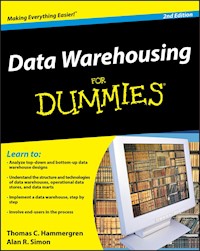
Data warehousing is one of the hottest business topics, and there’s more to understanding data warehousing technologies than you might think. Find out the basics of data warehousing and how it facilitates data mining and business intelligence with Data Warehousing For Dummies, 2nd Edition.
Data is probably your company’s most important asset, so your data warehouse should serve your needs. The fully updated Second Edition of Data Warehousing For Dummies helps you understand, develop, implement, and use data warehouses, and offers a sneak peek into their future. You’ll learn to:
- Analyze top-down and bottom-up data warehouse designs
- Understand the structure and technologies of data warehouses, operational data stores, and data marts
- Choose your project team and apply best development practices to your data warehousing projects
- Implement a data warehouse, step by step, and involve end-users in the process
- Review and upgrade existing data storage to make it serve your needs
- Comprehend OLAP, column-wise databases, hardware assisted databases, and middleware
- Use data mining intelligently and find what you need
- Make informed choices about consultants and data warehousing products
Data Warehousing For Dummies, 2nd Edition also shows you how to involve users in the testing process and gain valuable feedback, what it takes to successfully manage a data warehouse project, and how to tell if your project is on track. You’ll find it’s the most useful source of data on the topic!
Sie lesen das E-Book in den Legimi-Apps auf:
Seitenzahl: 512
Veröffentlichungsjahr: 2009
Ähnliche




















Data Warehousing For Dummies® , 2nd Edition
Table of Contents
Introduction
Why I Wrote This Book
How to Use This Book
Part I: The Data Warehouse: Home for Your Data Assets
Part II: Data Warehousing Technology
Part III: Business Intelligence and Data Warehousing
Part IV: Data Warehousing Projects: How to Do Them Right
Part V: Data Warehousing: The Big Picture
Part VI: Data Warehousing in the Not-Too-Distant Future
Part VII: The Part of Tens
Icons Used in This Book
About the Product References in This Book
Part I: The Data Warehouse: Home for Your Data Assets
Chapter 1: What’s in a Data Warehouse?
The Data Warehouse: A Place for Your Data Assets
Classifying data: What is a data asset?
Manufacturing data assets
Data Warehousing: A Working Definition
Today’s data warehousing defined
A broader, forward looking definition
A Brief History of Data Warehousing
Before our time — the foundation
The 1970s — the preparation
The 1980s — the birth
The 1990s — the adolescent
The 2000s — the adult
Is a Bigger Data Warehouse a Better Data Warehouse?
Realizing That a Data Warehouse
(Usually) Has a Historical Perspective
Chapter 2: What Should You Expect from Your Data Warehouse?
Using the Data Warehouse to Make Better Business Decisions
Finding Data at Your Fingertips
Facilitating Communications with Data Warehousing
IT-to-business organization communications
Communications across business organizations
Facilitating Business Change with Data Warehousing
Chapter 3: Have It Your Way: The Structure of a Data Warehouse
Ensuring That Your Implementations Are Unique
Classifying the Data Warehouse
The data warehouse lite
The data warehouse deluxe
The data warehouse supreme
To Centralize or Distribute, That Is the Question
Chapter 4: Data Marts: Your Retail Data Outlet
Architectural Approaches to Data Marts
Data marts sourced by a data warehouse
Top-down, quick-strike data marts
Bottom-up, integration-oriented data marts
What to Put in a Data Mart
Geography-bounded data
Organization-bounded data
Function-bounded data
Market-bounded data
Answers to specific business questions
Anything!
Data mart or data warehouse?
Implementing a Data Mart — Quickly
Part II: Data Warehousing Technology
Chapter 5: Relational Databases and Data Warehousing
The Old Way of Thinking
A technology-based discussion: The roots of relational database technology
The OLAP-only fallacy
The New Way of Thinking
Fine-tuning databases for data warehousing
Optimizing data access
Avoiding scanning unnecessary data
Handling large data volume
Designing Your Relational Database for Data Warehouse Usage
Looking at why traditional relational design techniques don’t work well
Exploring new ways to design a relational-based data warehouse
Relational Products and Data Warehousing
IBM Data Management family
Microsoft SQL Server
Oracle
Chapter 6: Specialty Databases and Data Warehousing
Multidimensional Databases
The idea behind multidimensional databases
Are multidimensional databases still worth looking at?
Horizontal versus Vertical Data Storage Management
Data Warehouse Appliances
Data Warehousing Specialty Database Products
Cognos (An IBM company)
Microsoft
Oracle
Sybase IQ
Vertica
Chapter 7: Stuck in the Middle with You: Data Warehousing Middleware
What Is Middleware?
Middleware for Data Warehousing
The services
Should you use tools or custom code?
What Each Middleware Service Does for You
Data selection and extractions
Data quality assurance, part I
Data movement, part I
Data mapping and transformation
Data quality assurance, part II
Data movement, part II
Data loading
Specialty Middleware Services
Replication services for data warehousing
Enterprise Information Integration services
Vendors with Middleware Products for Data Warehousing
Composite Software
IBM
Informatica
Ipedo
Microsoft
Oracle
Sybase (Avaki)
Part III: Business Intelligence and Data Warehousing
Chapter 8: An Intelligent Look at Business Intelligence
The Main Categories of Business Intelligence
Querying and reporting
Business analysis (OLAP)
Data mining
Dashboards and scorecards
Other Types of Business Intelligence
Statistical processing
Geographical information systems
Mash-ups
Business intelligence applications
Business Intelligence Architecture and Data Warehousing
Chapter 9: Simple Database Querying and Reporting
What Functionality Does a Querying and Reporting Tool Provide?
The role of SQL
Technical query tools
User query tools
Reporting tools
The idea of managed queries and reports
Is This All You Need?
Designing a Relational Database for Querying and Reporting Support
Vendors with Querying and Reporting Products for Data Warehousing
Business Objects (SAP)
Cognos (IBM)
Information Builders
Microsoft
Oracle
Chapter 10: Business Analysis (OLAP)
What Is Business Analysis?
The OLAP Acronym Parade
Business analysis (Visualization)
OLAP middleware
OLAP databases
First, an Editorial
Business Analysis (OLAP) Features: An Overview
Drill-down
Drill-up
Drill-across
Drill-through
Pivoting
Trending
Nesting
Visualizing
Data Warehousing Business Analysis Vendors
IBM
MicroStrategy
Oracle
Pentaho
SAP
SAS
Chapter 11: Data Mining: Hi-Ho, Hi-Ho, It’s Off to Mine We Go
Data Mining in Specific Business Missions
Data Mining and Artificial Intelligence
Data Mining and Statistics
Some Vendors with Data Mining Products
Microsoft
SAS
SPSS
Chapter 12: Dashboards and Scorecards
Dashboard and Scorecard Principles
Dashboards
Scorecards
The Relationship between Dashboards, Scorecards, and the Other Parts of Business Intelligence
EIS and Key Indicators
The Briefing Book
The Portal Command Center
Who Produces EIS Products
Part IV: Data Warehousing Projects: How to Do Them Right
Chapter 13: Data Warehousing and Other IT Projects: The Same but Different
Why a Data Warehousing Project Is (Almost) Like Any Other Development Project
How to Apply Your Company’s Best Development Practices to Your Project
How to Handle the Uniqueness of Data Warehousing
Why Your Data Warehousing Project Must Have Top-Level Buy-In
How Do I Conduct a Large, Enterprise-Scale Data Warehousing Initiative?
Top-down
Bottom-up
Mixed-mode
Chapter 14: Building a Winning Data Warehousing Project Team
Don’t Make This Mistake!
The Roles You Have to Fill on Your Project
Project manager
Technical leader
Chief architect
Business requirements analyst
Data modeler and conceptual/logical database designer
Database administrator and physical database designer
Front-end tools specialist and developer
Middleware specialist
Quality assurance (QA) specialist
Source data analyst
User community interaction manager
Technical executive sponsor
User community executive sponsor
And Now, the People
Organizational Operating Model
Chapter 15: You Need What? When? — Capturing Requirements
Choosing between Being Business or Technically Driven
Technically-Driven Data Warehousing
Subject area
Enterprise data modeling
Business-Driven Business Intelligence
Starting with business questions
Accessing the value of the information
Defining key business objects
Building a business model
Prototyping and iterating with the users
Signing off on scope
Chapter 16: Analyzing Data Sources
Begin with Source Data Structures, but Don’t Stop There
Identify What Data You Need to Analyze
Line Up the Help You’ll Need
Techniques for Analyzing Data Sources and Their Content
Analyze What’s Not There: Data Gap Analysis
Determine Mapping and Transformation Logic
Chapter 17: Delivering the Goods
Exploring Architecture Principles
What’s an architecture?
What’s an adaptable architecture?
Understanding Data Warehousing Architectural Keys
People and their roles
Consistent delivery process
Standard delivery platform
Assessing Your Data Warehouse Architecture
What are you building?
How are you building it?
Is the delivery automated?
Architecting through Abstraction
Chapter 18: User Testing, Feedback, and Acceptance
Getting Users Involved Early in Data Warehousing
Using Real Business Situations
Ensuring That Users Provide Necessary Feedback
After the Scope: Involving Users during Design and Development
Understanding What Determines User Acceptance
Part V: Data Warehousing: The Big Picture
Chapter 19: The Information Value Chain: Connecting Internal and External Data
Identifying Data You Need from Other People
Recognizing Why External Data Is Important
Viewing External Data from a User’s Perspective
Determining What External Data You Really Need
Ensuring the Quality of Incoming External Data
Filtering and Reorganizing Data after It Arrives
Restocking Your External Data
Acquiring External Data
Finding external information
Gathering general information
Cruising the Internet
Maintaining Control over External Data
Staying on top of changes
Knowing what to do with historical external data
Determining when new external data sources are available
Switching from one external data provider to another
Chapter 20: Data Warehousing Driving Quality and Integration
The Infrastructure Challenge
Data Warehouse Data Stores
Source data feeds
Operational data store (ODS)
Master data management (MDM)
Service-oriented architecture (SOA)
Dealing with Conflict: Special Challenges to Your Data Warehousing Environment
Chapter 21: The View from the Executive Boardroom
What Does Top Management Need to Know?
Tell them this
Keep selling the data warehousing project
Data Warehousing and the Business-Trends Bandwagon
Data Warehousing in a Cross-Company Setting
Connecting the Enterprise
Chapter 22: Existing Sort-of Data Warehouses: Upgrade or Replace?
The Data Haves and Have-Nots
The first step: Cataloguing the extract files, who uses them, and why
And then, the review
Decisions, Decisions
Choice 1: Get rid of it
Choice 2: Replace it
Choice 3: Retain it
Caution: Migration Isn’t Development — It’s Much More Difficult
Beware: Don’t Take Away Valued Functionality
Chapter 23: Surviving in the Computer Industry (and Handling Vendors)
How to Be a Smart Shopper at Data Warehousing Conferences and Trade Shows
Do your homework first
Ask a lot of questions
Be skeptical
Don’t get rushed into a purchase
Dealing with Data Warehousing Product Vendors
Check out the product and the company before you begin discussions
Take the lead during the meeting
Be skeptical — again
Be a cautious buyer
A Look Ahead: Data Warehousing, Mainstream Technologies, and Vendors
Chapter 24: Working with Data Warehousing Consultants
Do You Really Need Consultants to Help Build a Data Warehouse?
Watch Out, Though!
A Final Word about Data Warehousing Consultants
Part VI: Data Warehousing in the Not-Too-Distant Future
Chapter 25: Expanding Your Data Warehouse with Unstructured Data
Traditional Data Warehousing Means Analyzing Traditional Data Types
It’s a Multimedia World, After All. . . .
How Does Business Intelligence Work with Unstructured Data?
An Alternative Path: From Unstructured Information to Structured Data
Chapter 26: Agreeing to Disagree about Semantics
Defining Semantics
Emergence of the Semantic Web?
Preparing for Semantic Data Warehousing
Starting Out on Your Semantic Journey
Business intelligence semantic layer management
Business rules management
Chapter 27: Collaborative Business Intelligence
Future Business Intelligence Support Model
Knowledge retention
Knowledge discovery
Knowledge proliferation
Leveraging Examples from Highly Successful Collaboration Solutions
Rate a report
Report relationships
Find a report
Find the meaning
Shared interests — shared information
Visualization
The Vision of Collaborative Business Intelligence
Part VII: The Part of Tens
Chapter 28: Ten Questions to Consider When You’re Selecting User Tools
Do I Want a Smorgasbord or a Sit-Down Restaurant?
Can a User Stop a Runaway Query or Report?
How Does Performance Differ with Varying Amounts of Data?
Can Users Access Different Databases?
Can Data Definitions Be Easily Changed?
How Does the Tool Deploy?
How Does Performance Change If You Have a Large Number of Users?
What Online Help and Assistance Is Available, and How Good Is It?
Does the Tool Support Interfaces to Other Products?
What Happens When You Pull the Plug?
Chapter 29: Ten Secrets to Managing Your Project Successfully
Tell It Like It Is
Put the Right People in the Right Roles
Be a Tough but Fair Negotiator
Deal Carefully with Product Vendors
Watch the Project Plan
Don’t Micromanage
Use a Project Wiki
Don’t Overlook the Effect of Organizational Culture
Don’t Forget about Deployment and Operations
Take a Breather Occasionally
Chapter 30: Ten Sources of Up-to-Date Information about Data Warehousing
The Data Warehousing Institute
The Data Warehousing Information Center
The OLAP Report
Intelligent Enterprise
b-eye Business Intelligence Network
Wikipedia
DMReview.com
BusinessIntelligence.com
Industry Analysts’ Web Sites
Product Vendors’ Web Sites
Chapter 31: Ten Mandatory Skills for a Data Warehousing Consultant
Broad Vision
Deep Technical Expertise in One or Two Areas
Communications Skills
The Ability to Analyze Data Sources
The Ability to Distinguish between Requirements and Wishes
Conflict-Resolution Skills
An Early-Warning System
General Systems and Application Development Knowledge
The Know-How to Find Up-to-Date Information
A Hype-Free Vocabulary
Chapter 32: Ten Signs of a Data Warehousing Project in Trouble
The Project’s Scope Phase Ends with No General Consensus
The Mission Statement Gets Questioned after the Scope Phase Ends
Tools Are Selected without Adequate Research
People Get Pulled from Your Team for “Just a Few Days”
You’re Overruled When You Attempt to Handle Scope Creep
Your Executive Sponsor Leaves the Company
You Overhear, “This Will Never Work, but I’m Not Saying Anything”
You Find a Major “Uh-Oh” in One of the Products You’re Using
The IT Organization Responsible for Supporting the Project Pulls Its Support
Resignations Begin
Chapter 33: Ten Signs of a Successful Data Warehousing Project
The Executive Sponsor Says, “This Thing Works — It Really Works!”
You Receive a Flood of Suggested Enhancements and Additional Capabilities
User Group Meetings Are Almost Full
The User Base Keeps Growing and Growing and Growing
The Executive Sponsor Cheerfully Volunteers Your Company as a Reference Site
The Company CEO Asks, “How Can I Get One of Those Things?”
The Response to Your Next Funding Request Is, “Whatever You Need — It’s Yours.”
You Get Promoted — and So Do Some of Your Team Members
You Achieve Celebrity Status in the Company
You Get Your Picture on the Cover of the Rolling Stone
Chapter 34: Ten Subject Areas to Cover with Product Vendors
Product’s Chief Architect
Development Team
Customer Feedback
Employee Retention
Marketplace
Product Uniqueness
Clients
The Future
Internet and Internet Integration Approach
Integrity
Data Warehousing For Dummies®, 2nd Edition
by Thomas C. Hammergren and Alan R. Simon
Data Warehousing For Dummies®, 2nd Edition
Published byWiley Publishing, Inc.111 River St.Hoboken, NJ 07030-5774www.wiley.com
Copyright © 2009 by Wiley Publishing, Inc., Indianapolis, Indiana
Published simultaneously in Canada
No part of this publication may be reproduced, stored in a retrieval system or transmitted in any form or by any means, electronic, mechanical, photocopying, recording, scanning or otherwise, except as permitted under Sections 107 or 108 of the 1976 United States Copyright Act, without either the prior written permission of the Publisher, or authorization through payment of the appropriate per-copy fee to the Copyright Clearance Center, 222 Rosewood Drive, Danvers, MA 01923, (978) 750-8400, fax (978) 646-8600. Requests to the Publisher for permission should be addressed to the Permissions Department, John Wiley & Sons, Inc., 111 River Street, Hoboken, NJ 07030, (201) 748-6011, fax (201) 748-6008, or online at http://www.wiley.com/go/permissions.
Trademarks: Wiley, the Wiley Publishing logo, For Dummies, the Dummies Man logo, A Reference for the Rest of Us!, The Dummies Way, Dummies Daily, The Fun and Easy Way, Dummies.com, Making Everything Easier, and related trade dress are trademarks or registered trademarks of John Wiley & Sons, Inc. and/or its affiliates in the United States and other countries, and may not be used without written permission. All other trademarks are the property of their respective owners. Wiley Publishing, Inc., is not associated with any product or vendor mentioned in this book.
LIMIT OF LIABILITY/DISCLAIMER OF WARRANTY: THE PUBLISHER AND THE AUTHOR MAKE NO REPRESENTATIONS OR WARRANTIES WITH RESPECT TO THE ACCURACY OR COMPLETENESS OF THE CONTENTS OF THIS WORK AND SPECIFICALLY DISCLAIM ALL WARRANTIES, INCLUDING WITHOUT LIMITATION WARRANTIES OF FITNESS FOR A PARTICULAR PURPOSE. NO WARRANTY MAY BE CREATED OR EXTENDED BY SALES OR PROMOTIONAL MATERIALS. THE ADVICE AND STRATEGIES CONTAINED HEREIN MAY NOT BE SUITABLE FOR EVERY SITUATION. THIS WORK IS SOLD WITH THE UNDERSTANDING THAT THE PUBLISHER IS NOT ENGAGED IN RENDERING LEGAL, ACCOUNTING, OR OTHER PROFESSIONAL SERVICES. IF PROFESSIONAL ASSISTANCE IS REQUIRED, THE SERVICES OF A COMPETENT PROFESSIONAL PERSON SHOULD BE SOUGHT. NEITHER THE PUBLISHER NOR THE AUTHOR SHALL BE LIABLE FOR DAMAGES ARISING HEREFROM. THE FACT THAT AN ORGANIZATION OR WEBSITE IS REFERRED TO IN THIS WORK AS A CITATION AND/OR A POTENTIAL SOURCE OF FURTHER INFORMATION DOES NOT MEAN THAT THE AUTHOR OR THE PUBLISHER ENDORSES THE INFORMATION THE ORGANIZATION OR WEBSITE MAY PROVIDE OR RECOMMENDATIONS IT MAY MAKE. FURTHER, READERS SHOULD BE AWARE THAT INTERNET WEBSITES LISTED IN THIS WORK MAY HAVE CHANGED OR DISAPPEARED BETWEEN WHEN THIS WORK WAS WRITTEN AND WHEN IT IS READ.
For general information on our other products and services, please contact our Customer Care Department within the U.S. at 877-762-2974, outside the U.S. at 317-572-3993, or fax 317-572-4002.
For technical support, please visit www.wiley.com/techsupport.
Wiley also publishes its books in a variety of electronic formats. Some content that appears in print may not be available in electronic books.
Library of Congress Control Number: 2009920908
ISBN: 978-0-470-40747-9
Manufactured in the United States of America
10 9 8 7 6 5 4 3 2 1
About the Author
Tom Hammergren is known worldwide as an innovator, writer, educator, speaker, and consultant in the field of information management. Tom’s information management and software career spans more than 20 years and includes key roles in successful business intelligence and information management solution companies such as Cognos, Cincom, and Sybase. Tom is the founder of Balanced Insight, Inc., a leading vendor of business intelligence lifecycle management software and services that also works on innovation in semantically driven business intelligence.
While working for Sybase, Hammergren helped design and develop WarehouseStudio, a comprehensive set of tools for delivering enterprise data warehousing solutions. At Cincom, Tom helped deliver the SupraServer product line to market, one of the first fully distributed data management solutions for highly survivable network implementations. During an earlier position at Cognos, he was one of the founding members of the PowerPlay and Impromptu product teams.
Tom has published numerous articles in industry journals and is the author of two widely read books, Data Warehousing: Building the Corporate Knowledge Base and Official Sybase Data Warehousing on the Internet: Accessing the Corporate Knowledge Base (both from International Thomson Computer Press).
Dedication
This book is dedicated to my mother and father. Thank you both for the foundation and direction growing up — and, most importantly, for always supporting me in my life endeavors, no matter how crazy they have been or are. You are the best — all my love!
Author’s Acknowledgments
Writing a book is much harder than it sounds and involves extended support from a multitude of people. Though my name is on the cover, many people were ultimately involved in the production of this work. As I began to think of all the people to whom I would like to express my sincere gratitude for their support and general assistance in the creation of this book, the list grew enormous.
There are those that are most responsible for making this book a reality: Kyle Looper, Acquisitions Editor; Nicole Sholly, Project Editor; and Carole Jelen McClendon of Waterside Productions, my trusted agent for more than 10 years.
The most important thank-you is to my wife, Kim, and loving children, Brent and Kristen. They created an environment in which I could successfully complete this book — an accomplishment that I share with them and one that forced all of us to sacrifice a lot.
Publisher’s Acknowledgments
We’re proud of this book; please send us your comments through our online registration form located at www.dummies.com/register/.
Some of the people who helped bring this book to market include the following:
Acquisitions, Editorial, and Media Development
Project Editor: Nicole Sholly
Acquisitions Editor: Kyle Looper
Copy Editor: Laura K. Miller
Technical Editor: Russ Mullen
Editorial Managers: Kevin Kirschner, Jodi Jensen
Editorial Assistant: Amanda Foxworth
Sr. Editorial Assistant: Cherie Case
Cartoons: Rich Tennant (www.the5thwave.com)
Composition Services
Project Coordinator: Patrick Redmond
Layout and Graphics: Samantha K. Allen, Reuben W. Davis, Nikki Gately, Joyce Haughey, Melissa K. Jester, Sarah Philippart
Proofreaders: Dwight Ramsey, Nancy L. Reinhardt
Indexer: Sharon Shock
Publishing and Editorial for Technology Dummies
Richard Swadley, Vice President and Executive Group Publisher
Andy Cummings, Vice President and Publisher
Mary Bednarek, Executive Acquisitions Director
Mary C. Corder, Editorial Director
Publishing for Consumer Dummies
Diane Graves Steele, Vice President and Publisher
Composition Services
Gerry Fahey, Vice President of Production Services
Debbie Stailey, Director of Composition Services
Introduction
The data warehousing revolution has been underway for over ten years within information technology (IT) departments around the world. If you’re an IT professional, or you’re fashionably referred to as a knowledge worker (someone who regularly uses computer technology in the course of your day-to-day business operations), data warehousing is for you! If you haven’t heard of this phenomenon, you might be aware of the tools that access the data warehouse — business intelligence tools. Data Warehousing For Dummies, 2nd Edition, guides you through the overwhelming amount of hype about this subject to help you get the most from data warehousing.
Lesen Sie weiter in der vollständigen Ausgabe!
Lesen Sie weiter in der vollständigen Ausgabe!
Lesen Sie weiter in der vollständigen Ausgabe!
Lesen Sie weiter in der vollständigen Ausgabe!
Lesen Sie weiter in der vollständigen Ausgabe!
Lesen Sie weiter in der vollständigen Ausgabe!
Lesen Sie weiter in der vollständigen Ausgabe!
Lesen Sie weiter in der vollständigen Ausgabe!
Lesen Sie weiter in der vollständigen Ausgabe!
Lesen Sie weiter in der vollständigen Ausgabe!
Lesen Sie weiter in der vollständigen Ausgabe!
Lesen Sie weiter in der vollständigen Ausgabe!
Lesen Sie weiter in der vollständigen Ausgabe!
Lesen Sie weiter in der vollständigen Ausgabe!
Lesen Sie weiter in der vollständigen Ausgabe!
Lesen Sie weiter in der vollständigen Ausgabe!
Lesen Sie weiter in der vollständigen Ausgabe!
Lesen Sie weiter in der vollständigen Ausgabe!
Lesen Sie weiter in der vollständigen Ausgabe!
Lesen Sie weiter in der vollständigen Ausgabe!
Lesen Sie weiter in der vollständigen Ausgabe!
Lesen Sie weiter in der vollständigen Ausgabe!
Lesen Sie weiter in der vollständigen Ausgabe!
Lesen Sie weiter in der vollständigen Ausgabe!
Lesen Sie weiter in der vollständigen Ausgabe!
Lesen Sie weiter in der vollständigen Ausgabe!
Lesen Sie weiter in der vollständigen Ausgabe!
Lesen Sie weiter in der vollständigen Ausgabe!
Lesen Sie weiter in der vollständigen Ausgabe!
Lesen Sie weiter in der vollständigen Ausgabe!
Lesen Sie weiter in der vollständigen Ausgabe!
Lesen Sie weiter in der vollständigen Ausgabe!
Lesen Sie weiter in der vollständigen Ausgabe!
Lesen Sie weiter in der vollständigen Ausgabe!
Lesen Sie weiter in der vollständigen Ausgabe!
Lesen Sie weiter in der vollständigen Ausgabe!
Lesen Sie weiter in der vollständigen Ausgabe!
Lesen Sie weiter in der vollständigen Ausgabe!
Lesen Sie weiter in der vollständigen Ausgabe!
Lesen Sie weiter in der vollständigen Ausgabe!
Lesen Sie weiter in der vollständigen Ausgabe!




