


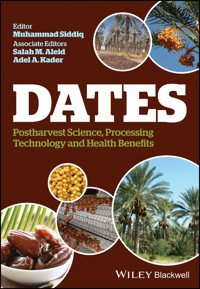
Dates E-Book
152,99 €
Mehr erfahren.
- Herausgeber: John Wiley & Sons
- Kategorie: Fachliteratur
- Sprache: Englisch
Dates are an important fruit, especially in many African, Middle-Eastern and Asian countries. In recent years this fruit has gained significant importance in terms of global commerce. During the period 1990–2009, global production of dates saw an increase of 219% and this trend is expected to continue as per FAO projections. Some of the major challenges confronting date fruit production and commerce are issues related to postharvest handling technologies, use of appropriate processing and packaging technologies, food safety aspects and quality assurance.
Dates: Postharvest Science, Processing Technology and Health Benefits provides contemporary information that brings together current knowledge and practices in the value chain of dates, from production through to consumption. The important book published by Wiley Blackwell features coverage from leading experts on innovative processing technologies, packaging, quality management and pest control for dates. It is the only book to address the science and technology of the postharvest production of dates, a commercially important and growing sector of the food industry.
Sie lesen das E-Book in den Legimi-Apps auf:
Seitenzahl: 601
Veröffentlichungsjahr: 2013
Ähnliche




















Contents
Cover
Title Page
Copyright
Preface
Obituary: Professor Adel A. Kader
List of Contributors
Chapter 1: Overview of Date Fruit Production, Postharvest handling, Processing, and Nutrition
Introduction
World production and trade
Marketing and consumption trends
Date palm growth and fruit production
Postharvest handling and storage
Postharvest quality evaluation
Date processing and by-products
Food safety considerations
Nutritional and health considerations
Summary
References
Chapter 2: Date Palm: Production
Introduction
Ecogeographical boundaries and limitations
Agro-ecology: implications for date production
Production systems: oases and plantations
Management practices
Integrated pest management
Propagation and breeding
Cultivars: diversity and production potential
Biotic and abiotic stresses
Research needs and future prospects
Conclusions
References
Chapter 3: Biology and Postharvest Physiology of Date Fruit
Introduction
Botanical description
Fruit growth and development
Maturity and harvesting indices
Postharvest physiology of dates
Fruit quality disorders
Conclusions
References
Chapter 4: Insect Pests of Stored Dates and Their Management
Introduction
Storage of dates
Damage of stored dates due to insect infestation
Major insect pests attacking stored dates
Insect development in date storage facilities
Sampling detection of insects in stored dates
Insect management during dates storage
Conclusion
References
Chapter 5: Harvesting and Postharvest Technology of Dates
Introduction
Fruit development
Harvesting
Artificial ripening
Drying (dehydration)
Hydration
Preparation for market: postharvest operations
Physical and physiological disorders
Pathological disorders
Disease control strategies
Insect pests and their control
Processing
Food safety considerations
Conclusions
References
Chapter 6: Packaging Technologies for Dates and Date Products
Introduction
Package functionality
Current packaging systems for dates
Innovative packaging technologies for fresh and processed dates
Summary and future research needs
References
Chapter 7: Physical and Structural Characteristics of Dates
Introduction
Geometric characteristics
Water activity and sorption isotherm
Food stability map based on water activity
State diagram
Instrumental texture profile analysis (TPA)
Acknowledgement
References
Chapter 8: Date Fruit Processing and Processed Products
Introduction
Role of chemical composition in date processing
Date harvesting and postharvest processing
Processed date products
Quality management in date processing
Conclusion and perspectives
References
Chapter 9: Innovative Processing Technologies for Processing Dates
Introduction
Innovative processing technologies for dates
Conclusion and perspective
References
Chapter 10: Value-added Utilization of Dates By-products
Introduction
Generation of date waste/by-products
Date by-products utilization – poultry and livestock feeding
Biofuel production
Single-cell protein from dates/date waste
Antimicrobial action of date pit extracts
Date pits as a functional food for humans
Other uses of date waste
Summary
References
Chapter 11: Date Fruit Composition and Nutrition
Introduction
Production, losses, and value-addition
Date fruit composition
Phytochemicals and aroma profile
Medicinal uses of dates
Date-based functional foods
Date pits
Conclusion
References
Chapter 12: Bioactive Compounds, Nutritional and Functional Properties of Date Fruit
Introduction
Nutritional qualities of dates
Phytochemicals in dates
Functional qualities of dates
Summary
References
Index
This edition first published 2014 © 2014 by John Wiley & Sons, Ltd
Registered office:John Wiley & Sons, Ltd, The Atrium, Southern Gate, Chichester, West Sussex, PO19 8SQ, UK
Editorial offices:9600 Garsington Road, Oxford, OX4 2DQ, UK The Atrium, Southern Gate, Chichester, West Sussex, PO19 8SQ, UK 111 River Street, Hoboken, NJ 07030-5774, USA
For details of our global editorial offices, for customer services and for information about how to apply for permission to reuse the copyright material in this book please see our website at www.wiley.com/wiley-blackwell.
The right of the author to be identified as the author of this work has been asserted in accordance with the UK Copyright, Designs and Patents Act 1988.
All rights reserved. No part of this publication may be reproduced, stored in a retrieval system, or transmitted, in any form or by any means, electronic, mechanical, photocopying, recording or otherwise, except as permitted by the UK Copyright, Designs and Patents Act 1988, without the prior permission of the publisher.
Designations used by companies to distinguish their products are often claimed as trademarks. All brand names and product names used in this book are trade names, service marks, trademarks or registered trademarks of their respective owners. The publisher is not associated with any product or vendor mentioned in this book.
Limit of Liability/Disclaimer of Warranty: While the publisher and author(s) have used their best efforts in preparing this book, they make no representations or warranties with respect to the accuracy or completeness of the contents of this book and specifically disclaim any implied warranties of merchantability or fitness for a particular purpose. It is sold on the understanding that the publisher is not engaged in rendering professional services and neither the publisher nor the author shall be liable for damages arising herefrom. If professional advice or other expert assistance is required, the services of a competent professional should be sought.
Library of Congress Cataloging-in-Publication Data
Dates : postharvest science, processing technology, and health benefits / editor, Muhammad Siddiq ; associate editors, Salah M. Aleid, Adel A. Kader. pages cm Includes bibliographical references and index. ISBN 978-1-118-29237-2 (cloth) 1. Dates (Fruit) 2. Date palm. I. Siddiq, Muhammad, 1957- II. Aleid, Salah M. III. Kader, Adel A. SB364.D35 2013 641.3′462–dc23 2013023362
A catalogue record for this book is available from the British Library.
Wiley also publishes its books in a variety of electronic formats. Some content that appears in print may not be available in electronic books.
Cover image: Top front right image: ©iStockphoto/brytta; Bottom left image: ©Shutterstock/Dream79; Bottom second image (small one): ©Shutterstock/ntdanai; Bottom right image: ©Shutterstock/Valery Shanin; All other images supplied by the authors. Cover design by Andy Meaden
Preface
Dates are an important fruit, especially in many African, Middle-Eastern, and Asian countries. Besides its local and regional commercial value, the date palm plays an important role in the diet and social life of communities across the oases of the Middle East and North Africa. The tree and the fruit have been revered because of the numerous horticultural, nutritional, medicinal, economic, architectural, environmental characteristics, and their multiple uses. In recent years, this fruit has gained significant importance in global commerce as well. During the last two decades, the world production of dates has more than doubled; this trend is expected to continue as per FAO projections. However, date fruit has not been afforded its due importance to a scale similar to some other subtropical fruits.
There are some major challenges confronting date fruit production and commerce, such as issues related to postharvest handling technologies, use of appropriate processing and packaging technologies, food safety aspects, and quality assurance. The focus of this book is to cover recent developments in the area of dates production and processing technologies and provide information on a broader spectrum of related topics with comprehensive coverage.
This work provides a contemporary source of information that brings together current knowledge and practices in the value chain of date fruit production, processing, and nutrition. An experienced team of 18 contributors from North America, Asia, and Africa has written 12 chapters. These contributors come from a field of diverse disciplines, including crop sciences, food science and technology, food biochemistry, food engineering, and food packaging. This book provides an in-depth coverage on a wide variety of pertinent topics which include: date fruit production and trade, field production and management practices; fruit biology and postharvest physiology, harvesting, and postharvest handling; postharvest entomology and pathology; packaging technologies; processing and processed products; innovative processing technologies; physical and structural characteristics of fruit; processing and utilization of dates by-products; nutrition and health benefits; and bioactive and phytochemical compounds in dates. The value-chain approach to the topic coverage is the unique feature of this book.
The editors acknowledge many individuals for their support from conception through final production of this book. Foremost is our sincere thanks and gratitude to all authors for their contributions and for bearing with us during the review and finalization process of their chapters. We are grateful to our family members for their understanding and support enabling us to complete this work. We dedicate this work to the worthy contributions of the numerous researchers and students throughout the world for their decades-long devoted efforts to improve the production, postharvest technology and utilization of dates and date products.
Muhammad SiddiqSalah M. AleidAdel A. Kader
Obituary: Professor Adel A. Kader
Professor Adel Kader was among the most widely known and recognized scientists worldwide in the field of postharvest biology and technology. He was the embodiment of a successful scientist, mentor, and citizen of the world. Few people have had a greater impact on a field of scientific study as had Professor Kader on the discipline of postharvest biology and technology. He used his unique stature and abilities to promote an appreciation for the importance of proper postharvest handling of fruits and vegetables among the agricultural community and society at large that has had immeasurable benefits for the health and well-being of people everywhere who consume these foods. Professor Kader had an amazing capacity to assimilate and organize information. He was universally recognized as among the most knowledgeable scientists in his field. However, he was as also widely known for freely sharing his knowledge and experience with both the scientific community and the public.
Professor Kader was born in Cairo, Egypt. He received his BSc in Horticulture from the Faculty of Agriculture at Ain Shams University in Cairo in 1959 at the age of 18. It is interesting to know that he started as a medical student, but at 14 years of age he was afraid of the scenes of human organs and blood and that is why he decided to transfer to the faculty of agriculture. After obtaining his BSc from Ain Shams he moved to the University of California, at Davis where he received his MSc in Vegetable Crops in 1962 and his PhD in Plant Physiology in 1966, at the age of 25. After earning his doctorate, Professor Kader returned to Egypt where he worked in the Faculty of Agriculture at Ain Shams University from 1966 to 1971. While there, he was engaged in teaching and research on postharvest horticulture, and co-authored a classic postharvest textbook in Arabic. He then served as a lecturer and consultant at the Kuwait Institute for Scientific Research from 1971 to 1972, before returning to UC Davis in 1972, first as an Assistant Researcher, and later as an Assistant, Associate, and full Professor until his retirement in 2007, when he held the title of Emeritus Professor. During his tenure at UC Davis he served as Chairman of the Department of Pomology and received numerous awards. Professor Kader served for 18 years on the selected group of the Scientific Advisory Council of the World Foods Logistics Organization, where he was extremely active in supporting the industry all over the world on a voluntary basis.
Professor Kader's commitment to continuing education outside of the classroom and student mentoring is exemplified by his participation in the famous annual two-week Postharvest Technology Short Course, which he was instrumental in co-organizing in 1979 and which has been attended by over 2500 people over the last 34 years from almost every country of the world. Never one to rest on his laurels, Professor Kader launched the Postharvest Technology Research and Information Center Internet site (http://postharvest.ucdavis.edu) in 1998, which has become the premier source of postharvest information worldwide.
After retirement Professor Kader maintained a very active interest in postharvest programs worldwide and frequently participated in seminars at UC Davis and many international meetings, chaired the California Citrus Quality Council, and continued to do some consulting to raise funds for the UC Davis Postharvest Endowment.
Professor Kader passed away on 10 December 2012 while returning from attending an international postharvest meeting in South Africa.
Elhadi M. Yahia
List of Contributors
1
Overview of Date Fruit Production, Postharvest handling, Processing, and Nutrition
Muhammad Siddiq1 and Ibrahim Greiby2
1Department of Food Science & Human Nutrition, Michigan State University, East Lansing, MI, USA, (Currently: Food Science Consultant, Windsor, Ontario, Canada)
2Department of Food Science & Human Nutrition, Michigan State University, East Lansing, MI, USA
Introduction
World production and trade
Marketing and consumption trends
Date palm growth and fruit production
Cultivars
Maturity stages
Harvesting and fruit quality/grades
Harvesting
Fruit quality and grades
Postharvest handling and storage
Postharvest quality evaluation
Date processing and by-products
Food safety considerations
Nutritional and health considerations
Nutritional profile
Bioactive compounds and health significance
Summary
References
Introduction
Date palm (Phoenix dactylifera L.) belongs to the family Arecaceae (syn. Palmaceae) that includes 200 genera; genus Phoenix contains 12 of the 1500 species that belong to the date palm family. Phoenix palms are dioecious and are characterized by pinnate leaves and by duplicate leaflets with acute and sharp tips (Sanderson 2001, Uhl and Dransfield 1987). Besides date palm, the other two most highly valued Phoenix palms are Canary Island Palm (P. canariensis Chabeaud), an ornamental palm and the sugar palm (P. sylvestris Roxb), which is common in the Indian subcontinent for its sugar syrup (Zaid and de Wet 2002). Date palms grow in hot, arid regions of the world and are marketed worldwide as a high-value sweet fruit crop. It is considered as an important subsistence crop in most of the world's desert areas (Al-Shahib and Marshall 2003). The date palm has traveled remarkably well as civilization moved out of the Middle East and reached places such as Spain and the United States, with the Coachella Valley (California) later becoming the primary commercial region of date production in the US (Sauer 1993). Beyond the arid climates, date palm can also be grown in many other countries for food or as an ornamental plant including the continents of Americas, southern Europe, Asia, Africa, and Australia. The majority of date palm-growing areas are located in developing or underdeveloped countries where date fruit is considered the primary food crop, thus playing a major role in the nutritional status of these communities (Pruessner 1920, Sanderson 2001).
The earliest evidence of date palm cultivation goes back to 4000 BCE in Ur, lower Mesopotamia (now Iraq), where the date palm trunks were used for the construction of the temples; while in the Nile Valley, date palm cultivation goes back to 3000 BCE (Erskine et al. 2011).The date palm tree was praised and cherished, as is evident from the drawings and sculptures of ancient civilizations of the Sumerians, Assyrians, Babylonians, and Egyptians, and later by the Greeks and the Romans (Pruessner 1920). Throughout time, dates have been held in very high esteem in all three major regions of the world. In Islam, the date palm is mentioned multiple times in the Holy Quran and 300 times in the sayings or Hadith of the Prophet Muhammad. Likewise, the date palm is praised in Christianity and Judaism and has been linked to numerous religious ceremonies such as Passover and Palm Sunday (Jalbani 2002, Musselman 2007). The date fruit is relished for its sweet, succulent, and exotic flavor. Besides fresh consumption, this fruit is processed into a wide variety of value-added products: such as dry dates, date paste, date syrup, date juice concentrate, date jam, date butter, date bars, date chutney, date relish, and date pickles. Date oil and date coffee are some of the by-products produced from date seeds (Huntrods 2011, Vijayanand and Kulkarni 2012).
This chapter provides an overview of date production, trade, and consumption, fruit biology and postharvest physiology, packaging and storage, processing and processed products, food safety and quality, and nutritional and medicinal significance.
Lesen Sie weiter in der vollständigen Ausgabe!
Lesen Sie weiter in der vollständigen Ausgabe!
Lesen Sie weiter in der vollständigen Ausgabe!
Lesen Sie weiter in der vollständigen Ausgabe!
Lesen Sie weiter in der vollständigen Ausgabe!
Lesen Sie weiter in der vollständigen Ausgabe!
Lesen Sie weiter in der vollständigen Ausgabe!
Lesen Sie weiter in der vollständigen Ausgabe!
Lesen Sie weiter in der vollständigen Ausgabe!
Lesen Sie weiter in der vollständigen Ausgabe!
Lesen Sie weiter in der vollständigen Ausgabe!
Lesen Sie weiter in der vollständigen Ausgabe!




