


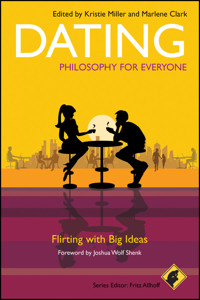
Dating - Philosophy for Everyone E-Book
14,99 €
Mehr erfahren.
- Herausgeber: John Wiley & Sons
- Kategorie: Geisteswissenschaft
- Serie: Philosophy for Everyone
- Sprache: Englisch
DATING PHILOSOPHY FOR EVERYONE Speed dating, online dating, group blind dating, dating consultants... A booming dating industry is catering to an ever-increasing number of single adults in the twenty-first century, with the market for a mate now pulling in more than a billion dollars a year in the United States. So, how do we successfully attempt to navigate the dating minefield? Progressing from the first flirtatious moment of eye contact to the selection of a "mate," Dating - Philosophy for Everyone includes a number of playful yet relevant essays for anyone who has dated, is dating, or intends to date again. It offers fascinating philosophical explorations of topics such as: * The taboos of dating and how to play the dating game * Should science teach men how to attract women? * The problem of having too much choice The vicissitudes of dating and mating are explored from a number of perspectives, all of which will help demystify coupling in the twenty-first century for those young daters just entering the fray, and those veterans returning to the game.
Sie lesen das E-Book in den Legimi-Apps auf:
Seitenzahl: 473
Veröffentlichungsjahr: 2011
Ähnliche




















CONTENTS
FOREWORD
ACKNOWLEDGMENTS
FLIRTING WITH BIG IDEAS
PART I GETTING STARTED
CHAPTER 1 THE PHILOSOPHY OF FLIRTING
CHAPTER 2 GOOD GIRLS DON’T, BUT BOYS DON’T EITHER
Flirting and Courtship
Conservative Ideology
Power Dynamics and Relationships
Exploring the Views of Conservative Men
Timing and Reciprocity
Themes of Contradiction
Conclusion
CHAPTER 3 LOVE FOR SALE
Why Do We Date? A Brief History of Dating
Calculated Relationship Initiation and Maintenance
All “Perfect” Dating Relationships Stumble, but Not in the Same Way
Dating as a Particular Genre of Friendship
Against Unconditional Love
Conclusion
CHAPTER 4 THE DATING ELEVATOR
What Dating Is
The Elevator Image
Strategies
Elevator Ethics
Concluding Remarks
PART II NO-NO’S
CHAPTER 5 “CRAZY IN LOVE”
The “Symptoms” of Love
What is Love?
The Biology of Romantic Love
Rejection in Love
Conclusion
CHAPTER 6 I’M DATING MY SISTER, AND OTHER TABOOS
Mere Social Conventions
Pseudo-Pathologies
Pathologies and Decisions
Pathology and Utility
CHAPTER 7 JUST PUSHY ENOUGH
The Difference Between Appropriate and Inappropriate Boundary Violations
Why Does Prospective Action Work?
Rules on Prospective Boundary Violation
Conclusions
CHAPTER 8 BUY MY LOVE
PART III ROLLING RIGHT ALONG
CHAPTER 9 AGAINST MATCHMAKING
Happy Dating
The End of Matchmaking
Dating Lessons from the Animal Kingdom
For Friends or Family Members
CHAPTER 10 HITTING THE BARS WITH ARISTOTLE
Of Jerks and “Nice” Guys
Gurus of The Game
Aristotle: My Wingman
After The Game
CHAPTER 11 I’VE NEVER BEEN ON A DATE (YET SOMEHOW I GOT MARRIED!)
Mind Games
Is It or Isn’t It?
It Takes Two
The Talk
The Friend Zone
Do You Like Me? Check Box, Yes or No
CHAPTER 12 MORALITY, SPONTANEITY, AND THE ART OF GETTING (TRULY) LUCKY ON THE FIRST DATE
The Kantian Gate
Dating as Flow and Cultivated Spontaneity
PART IV ANOTHER WORLD
CHAPTER 13 DATING AND PLAY IN VIRTUAL WORLDS
“Is this man cheating on his wife?”
“Just a game”
Play and Dating
A Ludic Understanding of Dating
The Wizards of Dating and Their Hangers-on
The Moral Significance of a Ludic Conception of Dating
CHAPTER 14 HOW TO BE YOURSELF IN AN ONLINE WORLD
“Meeting” on the Internet
From Virtual to Real World Meeting
Dating, Objectification, and Self-Definition
Dating and Authenticity
PART V FROM DATE TO MATE
CHAPTER 15 EVOLUTIONARY PSYCHOLOGY AND SEDUCTION STRATEGIES
Sexual Selection, Women’s Preferences, and Mating Intelligence
The Seduction Community: Human Excellence and Empowering Social Art in a Post-Scarcity Era
Is It Wrong to Try to Raise Your Mating Intelligence?
Is Raising Your Mate Value a Good Thing?
A Deflationist Solution to the Problem
Conclusion: What About Women?
CHAPTER 16 MATING, DATING, AND MATHEMATICS
A Lover’s Question
The Game of Love
Where Did Our Love Go?
Love is Strange
CHAPTER 17 WHY LESS MAY BE MORE
NOTES ON CONTRIBUTORS
VOLUME EDITORS
KRISTIE MILLER is a research fellow in philosophy at the University of Sydney, Australia. She is the author of Issues in Theoretical Diversity: Persistence, Composition and Time (2006) as well as numerous journal articles on related topics.
MARLENE CLARK is an Associate Professor of English at the City College Center for Worker Education, City University of New York. Her composition textbook, Juxtapositions: Ideas for College Writers (2005), is in its third edition.
SERIES EDITOR
FRITZ ALLHOFF is an Assistant Professor in the Philosophy Department at Western Michigan University, as well as a Senior Research Fellow at the Australian National University’s Centre for Applied Philosophy and Public Ethics. In addition to editing the Philosophy for Everyone series, Allhoff is the volume editor or co-editor for several titles, including Wine & Philosophy (Wiley-Blackwell, 2007), Whiskey & Philosophy (with Marcus P. Adams, Wiley, 2009), and Food & Philosophy (with Dave Monroe, Wiley-Blackwell, 2007).
PHILOSOPHY FOR EVERYONE
Series editor: Fritz Allhoff
Not so much a subject matter, philosophy is a way of thinking. Thinking not just about the Big Questions, but about little ones too. This series invites everyone to ponder things they care about, big or small, significant, serious … or just curious.
Running & Philosophy: A Marathon for the MindEdited by Michael W. Austin
Wine & Philosophy: A Symposium on Thinking and DrinkingEdited by Fritz Allhoff
Food & Philosophy: Eat, Think and Be MerryEdited by Fritz Allhoff and Dave Monroe
Beer & Philosophy: The Unexamined Beer Isn’t Worth DrinkingEdited by Steven D. Hales
Whiskey & Philosophy: A Small Batch of Spirited IdeasEdited by Fritz Allhoff and Marcus P.Adams
College Sex – Philosophy for Everyone: Philosophers With BenefitsEdited by Michael Bruce and Robert M. Stewart
Cycling – Philosophy for Everyone: A Philosophical Tour de ForceEdited by Jesús Ilundáin-Agurruza and Michael W. Austin
Climbing – Philosophy for Everyone: Because It’s ThereEdited by Stephen E. Schmid
Hunting – Philosophy for Everyone: In Search of the Wild LifeEdited by Nathan Kowalsky
Christmas – Philosophy for Everyone: Better Than a Lump of CoalEdited by Scott C. Lowe
Cannabis – Philosophy for Everyone: What Were We Just Talking About?Edited by Dale Jacquette
Porn – Philosophy for Everyone: How to Think With KinkEdited by Dave Monroe
Serial Killers – Philosophy for Everyone: Being and KillingEdited by S Waller
Dating – Philosophy for Everyone: Flirting With Big Ideas Edited by Kristie Miller and Marlene Clark
Gardening – Philosophy for Everyone: Cultivating WisdomEdited by Dan O’Brien
Motherhood – Philosophy for Everyone: The Birth of WisdomEdited by Sheila Lintott
Fatherhood – Philosophy for Everyone: The Dao of DaddyEdited by Lon S. Nease and Michael W. Austin
Forthcoming books in the series:
Fashion – Philosophy for EveryoneEdited by Jessica Wolfendale and Jeanette Kennett
Coffee – Philosophy for EveryoneEdited by Scott Parker and Michael W. Austin
Blues – Philosophy for EveryoneEdited by Abrol Fairweather and Jesse Steinberg
This edition first published 2010© 2010 Blackwell Publishing Ltd except for editorial material and organization© 2010 Kristie Miller and Marlene Clark
Blackwell Publishing was acquired by John Wiley & Sons in February 2007. Blackwell’s publishing program has been merged with Wiley’s global Scientific, Technical, and Medical business to form Wiley-Blackwell.
Registered OfficeJohn Wiley & Sons Ltd, The Atrium, Southern Gate, Chichester, West Sussex, PO19 8SQ, United Kingdom
Editorial Offices350 Main Street, Malden, MA 02148-5020, USA9600 Garsington Road, Oxford, OX4 2DQ, UKThe Atrium, Southern Gate, Chichester, West Sussex, PO19 8SQ, UK
For details of our global editorial offices, for customer services, and for information about how to apply for permission to reuse the copyright material in this book please see our website at www.wiley.com/wiley-blackwell.
The right of Kristie Miller and Marlene Clark to be identified as the authors of the editorial material in this work has been asserted in accordance with the UK Copyright, Designs and Patents Act 1988.
All rights reserved. No part of this publication may be reproduced, stored in a retrieval system, or transmitted, in any form or by any means, electronic, mechanical, photocopying, recording or otherwise, except as permitted by the UK Copyright, Designs and Patents Act 1988, without the prior permission of the publisher.
Wiley also publishes its books in a variety of electronic formats. Some content that appears in print may not be available in electronic books.
Designations used by companies to distinguish their products are often claimed as trademarks. All brand names and product names used in this book are trade names, service marks, trademarks or registered trademarks of their respective owners. The publisher is not associated with any product or vendor mentioned in this book. This publication is designed to provide accurate and authoritative information in regard to the subject matter covered. It is sold on the understanding that the publisher is not engaged in rendering professional services. If professional advice or other expert assistance is required, the services of a competent professional should be sought.
Library of Congress Cataloging-in-Publication Data
Dating – philosophy for everyone: flirting with big ideas / edited by Kristie Miller and Marlene Clark.
p. cm. — (Philosophy for everyone)
title: Dating – philosophy for everyone
Includes bibliographical references.
ISBN 978-1-4443-3022-9 (pbk.: alk. paper) 1. Dating (Social customs) 2. Mate selection. I. Miller, Kristie Lyn. II. Clark, Marlene. III. Title: Dating – Philosophy for Everyone.
HQ801.D336 2010
646.7'709051—dc22
2010004708
A catalogue record for this book is available from the British Library.
JOSHUA WOLF SHENK
FOREWORD
Some years ago, I got my stomach in a twist about an Israeli-born actress (I’ll call her Rachael). We were set up on a blind date in New York, and, when I saw her, I couldn’t believe my luck. She had dark, curly hair, long legs, and a summer shirt that gave her hips plenty of room to breathe. Her smile warmed me like a heat lamp. I came upon her sitting on the stoop of the restaurant where we’d planned to meet. As she uncurled herself to greet me, I wondered if she would stretch beyond three dimensions. I barely had voice enough to suggest we go inside, and I hoped my legs wouldn’t buckle on the way.
The restaurant was an intimate, narrow room. With the delicate smells and the soft light, the edges of the outside world dissolved. I felt myself fumbling at first in conversation, but she seemed to find my awkwardness charming. She laughed at my jokes, and her eyes went wide at my ruminations on how to find meaning in a life full of so much suffering.
I loved what she had to say, too. As we found our rhythm, I felt comfortable, assured even. The more I settled back into my chair, the more she leaned over the table towards me. But then, the more I felt her presence, the more I longed for her – and the more I found myself teetering on the edge. When she asked for a bite of my food, her lips closed around my fork, and she let her teeth slide faintly along its metal edge. It was one of the most erotic moments of my life – and one of the most precarious.
On one level, dating consists of a series of practical problems: How can we meet good people? How can we keep them interested? But as the ritual that underlies our desire to connect with other people, dating also opens a window into the most basic existential dilemma of social creatures. The desire to connect is the desire to jointly create a mutual reality that transcends our separate selves – and even, in ecstatic moments, obliterate them. But our only prayer at making these connections comes in holding onto our discrete identities.
My only chance of realizing my desire for Rachael depended on deftly containing it.
And that only got harder. After dinner, she came back to my place and immediately made herself at home. She put an album on my stereo – Morcheeba’s “Big Calm,” which would make a rock melt. At some point in the night – I think it was right before she put a spoonful of ice cream on her breast for me to lick off – she told me she wouldn’t be my girlfriend. After we settled into bed for the night, she told me she wouldn’t have sex with me. In the morning, we went to the Russian baths, a cavernous, primordial cellar of steam heat in New York’s East Village. In the wet air, her eyes looked as deep as some fairy-tale well.
I waited as long as I could before I called her again.
In between, I talked about her incessantly. I didn’t just want to figure out the perfect next moves. I wanted to know: What did it all mean?
If you’re holding this book in your hand, you want to figure out what it all means, too. This volume will bring new light to some of your most familiar conversations – and also provoke new and surprising ones. How do we approach intimacy in a virtual space? What do brain science and psychology teach us about the real mental dynamics behind the “madness” of love? How do the ancient teachings connect to modern bar scenes?
On one level, it may seem odd to bring the weight of philosophical inquiry to the casual topic of dating. Actually, there’s no place where philosophy matters more. Camus said the most important philosophical question was suicide. Perhaps, but once you’ve decided to live, the question quickly becomes how to best relate to other people.
Oddly, these questions have long been neglected. For most of the last hundred years, we’ve considered “self” as the basic unit. René Descartes set the stage in 1641 when he declared that each self “inhabits its own subjective realm” with a mental life that “has an integrity prior to and independent of its interaction with other people.” Though Descartes had his challengers this became a core assumption of the Enlightenment, as did Thomas Hobbes’ notion that the natural state of man was “solitary” (as well as “poor, nasty, brutish, and short”). Following this line, the individual emerged as the fundamental focus for students of psychology, political theory, even linguistics. We talk of self-expression, self-realization.
But can we consider the self in isolation?
Increasingly, science is answering this question with a resounding No. The new field of social neuroscience shows how social connection bolsters psychological and physiological health, and how loneliness makes us wither – leading to everything from depression to obesity and heart disease.
Groundbreaking research into the way we form relationships as small children also shows how our reactions to other people operate beneath a level of ordinary detection. To see how infants respond to their mothers, it turns out, we need to film them and play it back frame by frame. We don’t take in a social stimulus and then form a response. The two twist and leap together like figure skaters intimately entwined in their routine. From these roots of connections in our infancy comes our greatest adult desire. As much as we want contentment, “happiness,” and so on, what really drives us is the pursuit of “ecstasy.” The word comes from the Greek ekstasis, which means “standing outside oneself.”
At first, when Rachael told me she wouldn’t be my girlfriend, I thought she was bluffing. Maybe she was. Maybe she meant that she could only give herself to someone who didn’t need her. Maybe she needed someone strong enough for her to bounce up against. Or maybe she just wanted, on some deep level, to replicate her relationship with her father, an explosive man who doted on her but never let her forget her faults.
It’s not that she didn’t like me. She did. Actually, in many ways, she saw the best in me, my smarts, my intuition, my impatience with bullshit. I took her seriously, and, like many beautiful people, she seemed always to fear she couldn’t be seen as more than an object. But she decided that staying in this serious position meant withholding her affection. And that made me insane. On the first date, the potential to merge seemed limitless, and, fueled by that fantasy, I could stay rocked back on my heels. But the more it became clear that she wouldn’t give herself to me, the more I rolled onto the balls of my feet, forever losing my balance.
One night, I got a message from her, and as I planned to call her back, I asked a friend if he would give me some kind of mantra to keep my head clear.
He told me to think: “I was complete before I met you. I’ll be complete long after you’re gone.” I thought this was brilliant. It was precisely the frame I needed to stay strong. But, of course, it wasn’t true. If I really felt complete without her, I wouldn’t have wanted to talk to her. This is a paradox I’ve never been able to work out, nor do I expect I will.
Let’s turn it over to the philosophers.
ACKNOWLEDGMENTS
The editors of this volume have never met or, for that matter, even spoken to one another on the telephone. To complicate matters even more, the entire time this book was in progress, one was (for the most part) in Sydney, Australia, while the other was (again, for the most part) in Brooklyn, New York. And so we must first thank each other for the great patience and flexibility extended to one another as we “worked together” on this book so distant from one another in space and time. The situation made for many late nights and early mornings, and a few groggy laughs, but we trust the quality of the book remained unharmed.
For that quality, we owe a great deal to our contributors, also far flung across the United States, Australia, and indeed the world. We communicated with all of them exclusively through email, and we greatly appreciate their prompt responses to our seemingly endless editorial nitpicking. The contributors represent a range of disciplines, though each shares a philosophical bent with the “true” philosophers of the group. Their essays, while often very different in subject matter and approach, share a seriously light-hearted attitude toward a topic over which people agonize and about which, in response to a need to quell the agony, numerous “experts” offer advice. That daters of all stripes can learn something from the often humorously profound insights of our contributors is without doubt true in this case.
We would also like to thank our publisher, Wiley-Blackwell, and especially our editorial contact there, Tiffany Mok. Most importantly, perhaps, we thank the Philosophy for Everyone series editor, Fritz Allhoff. How he keeps up with the email from all his editors is beyond us. Even more amazing, he answers almost immediately, even at ungodly hours and on holidays. His unstinting attention to detail has made us better editors and we thank him for his patience and generosity.
Last but not least, we thank our readers. We hope you enjoy reading this book as much as we enjoyed pulling it together. If you date, we hope there’s some wisdom here to help you date with greater awareness. If you don’t date, maybe this book will change your mind – but if it doesn’t, we do have one contributor who clams he got married without ever going on a single date!
Kristie Miller, SydneyMarlene Clark, Brooklyn, New York
KRISTIE MILLER AND MARLENE CLARK
FLIRTING WITH BIG IDEAS
An Introduction to Dating – Philosophy for Everyone
The friendship between man and woman seems to be inherent in us by nature. For man is by nature more inclined to live in couples than to live as a social and political being, inasmuch as the household is earlier and more indispensable than the state, and to the extent that procreation is a bond more universal to all living things. In the case of other animals, the association goes no further than this. But human beings live together not merely for procreation, but also to secure the needs of life. There is division of labor from the very beginning and different functions for man and woman. Thus they satisfy one another’s needs by contributing each his own to the common store. For that reason, this kind of friendship brings both usefulness and pleasantness with it, and if the partners are good, it may even be based on virtue and excellence. For each partner has his own peculiar excellence and they can find joy in that fact.
Aristotle, Nichomachean Ethics, 1162a17–27
While dating in its current cultural guise is very different from anything Aristotle ever encountered, our chosen epigraph shows that philosophers have pondered the nature of the human drive to seek out intimate romantic relationships for as long as they have thought about anything. As Aristotle notes, the human drive to live in couples is stronger than even the very strong need to live as a social and political being. And not just for procreation. Aristotle, like most of today’s theorists, believed that human fulfillment rests largely in the ability to form close and loving relationships with others. This book is a collection of essays that looks afresh at the complicated issues surrounding creating, fostering, engaging in, and evaluating our romantic relationships. Authors come from divergent backgrounds, including those of philosophy, psychology, political science, theology, cognitive science, mathematics, and computer science, to ask and answer both age-old questions and pressing new ones about the world of romance and dating.
Lesen Sie weiter in der vollständigen Ausgabe!
Lesen Sie weiter in der vollständigen Ausgabe!
Lesen Sie weiter in der vollständigen Ausgabe!
Lesen Sie weiter in der vollständigen Ausgabe!
Lesen Sie weiter in der vollständigen Ausgabe!
Lesen Sie weiter in der vollständigen Ausgabe!
Lesen Sie weiter in der vollständigen Ausgabe!
Lesen Sie weiter in der vollständigen Ausgabe!
Lesen Sie weiter in der vollständigen Ausgabe!
Lesen Sie weiter in der vollständigen Ausgabe!
Lesen Sie weiter in der vollständigen Ausgabe!
Lesen Sie weiter in der vollständigen Ausgabe!
Lesen Sie weiter in der vollständigen Ausgabe!
Lesen Sie weiter in der vollständigen Ausgabe!
Lesen Sie weiter in der vollständigen Ausgabe!
Lesen Sie weiter in der vollständigen Ausgabe!
Lesen Sie weiter in der vollständigen Ausgabe!
Lesen Sie weiter in der vollständigen Ausgabe!
Lesen Sie weiter in der vollständigen Ausgabe!
Lesen Sie weiter in der vollständigen Ausgabe!
Lesen Sie weiter in der vollständigen Ausgabe!
Lesen Sie weiter in der vollständigen Ausgabe!
Lesen Sie weiter in der vollständigen Ausgabe!




