


20,99 €
Mehr erfahren.
- Herausgeber: John Wiley & Sons
- Kategorie: Wissenschaft und neue Technologien
- Serie: Antipode Book Series
- Sprache: Englisch
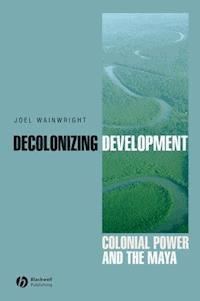
Winner of the 2010 James M. Blaut Award in recognition of innovative scholarship in cultural and political ecology (Honors of the CAPE specialty group (Cultural and Political Ecology)) Decolonizing Development investigates the ways colonialism shaped the modern world by analyzing the relationship between colonialism and development as forms of power. * Based on novel interpretations of postcolonial and Marxist theory and applied to original research data * Amply supplemented with maps and illustrations * An intriguing and invaluable resource for scholars of postcolonialism, development, geography, and the Maya
Sie lesen das E-Book in den Legimi-Apps auf:
Seitenzahl: 619
Veröffentlichungsjahr: 2011
Ähnliche



















Contents
List of Figures
Acknowledgments
List of Abbreviations
Introduction Capitalism qua Development
Contesting Development
Nature/Development
The Post-Development Challenge
Development as Aporia
Capitalism qua Development
Postcolonialism
Territorialization
Spacing
Plan of the Book
Notes
Part I Colonizing the Maya
1 Unsettling the Colonial Geographies of Southern Belize
The Colonization of Southern Belize
Hegemony, Settlement, and Territorialization
“The Indian will Require Patient and Sympathetic Treatment”
Conclusion
Notes
2 The Matter of the Maya Farm System
Archaeology, Mayanism, and Agriculture
Discourses of Agriculture Before the Maya Farm System
“Somewhere in the Depths of the Forest”
The Discourse on the Maya Farm System
Conclusion
The milpa and the Menchu Controversy
Notes
3 An Archaeology of Mayanism
Mayanism, de Vera Paz
The Tezulutlán Experiment
Spacing Hegemony
Lascasian Anthropology: Forerunner of Mayanism
Maya Archaeology in the Archaeology of Mayanism
Discovering American Civilization: Stephens and Catherwood
Thomas Gann’s Explorations and Adventures
The Maya in Asturias’s Hombres de maíz78
The Maya in the British Museum
Conclusion
Notes
Part II Aporias of Development
4 From Colonial to Development Knowledge: Charles Wright and the Battles over the Columbia River Forest
From Colonial to Development Knowledge: Land in British Honduras
Developing the Maya Farm System
Land as Development Doctrine
“Giving Civilization to these Indians”: The Maya Indian Liaison Officer, 1953–1959
Slash-and-Burn People
Reading the Liaison Officer Position
The Conflict over the Columbia River Forest Reserve
Charles Wright and the Social Nature of the Columbia River Forest
Conclusion
Notes
5 Settling: Fieldwork in the Ruins of Development
Settling In
Settling the Maya: The Toledo Research and Development Project
“To Achieve a Settled Population”
“An Honest Report of their Failures”
The Promise of Development Ethnography
Rice and Debt: The Toledo Small Farmer Development Project
Indebtedness and the Reservation Lands
Developing Resistance
Conclusion
Notes
6 Finishing the Critique of Cultural Ecology: Reading the Maya Atlas
Making the Maya Atlas
Reading the Maya Atlas
Space and Gender in the Maya Atlas
Counter-Mapping as Territorialization
Counter-Mapping as Cultural Ecology
Conclusion
Notes
Conclusion
Notes
Bibliography
Archival Sources
Works Cited
Index
Antipode Book Series
General Editor: Noel Castree, Professor of Geography, University of Manchester, UK Like its parent journal, the Antipode Book Series reflects distinctive new developments in radical geography. It publishes books in a variety of formats – from reference books to works of broad explication to titles that develop and extend the scholarly research base – but the commitment is always the same: to contribute to the praxis of a new and more just society.
Published
Decolonizing Development: Colonial Power and the Maya
Joel Wainwright
Privatization: Property and the Remaking of Nature-Society Relations
Edited by Becky Mansfield
Cities of Whiteness
Wendy S. Shaw
Neoliberalization: States, Networks, Peoples
Edited by Kim England and Kevin Ward
The Dirty Work of Neoliberalism: Cleaners in the Global Economy
Edited by Luis L. M. Aguiar and Andrew Herod
David Harvey: A Critical Reader
Edited by Noel Castree and Derek Gregory
Working the Spaces of Neoliberalism: Activism, Professionalization and Incorporation
Edited by Nina Laurie and Liz Bondi
Threads of Labour: Garment Industry Supply Chains from the Workers' Perspective
Edited by Angela Hale and Jane Wills
Life’s Work: Geographies of Social Reproduction
Edited by Katharyne Mitchell, Sallie A. Marston and Cindi Katz
Redundant Masculinities? Employment Change and White Working Class Youth
Linda McDowell
Spaces of Neoliberalism
Edited by Neil Brenner and Nik Theodore
Space, Place and the New Labour Internationalism
Edited by Peter Waterman and Jane Wills
Forthcoming
Grounding Globalization: Labour in the Age of Insecurity
Edward Webster, Rob Lambert and Andries Bezuidenhout
© 2008 by Joel Wainwright
BLACKWELL PUBLISHING
350 Main Street, Maiden, MA 02148–5020, USA
9600 Garsington Road, Oxford OX4 2DQ, UK
550 Swanston Street, Carlton, Victoria 3053, Australia
The right of Joel Wainwright to be identified as the author of this work has been asserted in accordance with the UK Copyright, Designs, and Patents Act 1988.
All rights reserved. No part of this publication may be reproduced, stored in a retrieval system, or transmitted, in any form or by any means, electronic, mechanical, photocopying, recording or otherwise, except as permitted by the UK Copyright, Designs, and Patents Act 1988, without the prior permission of the publisher.
Designations used by companies to distinguish their products are often claimed as trademarks. All brand names and product names used in this book are trade names, service marks, trademarks, or registered trademarks of their respective owners. The publisher is not associated with any product or vendor mentioned in this book.
This publication is designed to provide accurate and authoritative information in regard to the subject matter covered. It is sold on the understanding that the publisher is not engaged in rendering professional services. If professional advice or other expert assistance is required, the services of a competent professional should be sought.
First published 2008 by Blackwell Publishing Ltd
1 2008
Library of Congress Cataloging-in-Publication Data
Wainwright, Joel.
Decolonizing development: colonial power and the Maya/Joel Wainwright.
p. cm. – (Antipode book series)
Includes bibliographical references and index.
ISBN 978-1-4051-5705-6 (hardcover: alk. paper) – ISBN 978-1-4051-5706-3 (pbk.: alk. paper) 1. Mayas–Belize–Toledo District–Economic conditions. 2. Mayas–Belize–Toledo District–Economic conditions. 3. Mayas–Agriculture–Belize–Toledo District. 4. Mayas–Belize–Toledo District–Social conditions. 5. Toledo District (Belize)–Colonial influence. 6. Toledo District (Belize)–Economic conditions. 7. Toledo District (Belize)–Social conditions. I. Title.
F1445.W35 2008
305.897'427072824–dc22
2007026743
The publisher’s policy is to use permanent paper from mills that operate a sustainable forestry policy, and which has been manufactured from pulp processed using acid-free and elementary chlorine-free practices. Furthermore, the publisher ensures that the text paper and cover board used have met acceptable environmental accreditation standards.
For further information on
Blackwell Publishing, visit our website at
www.blackwellpublishing.com
For Julian Cho –
nim li winq, in wami:
Bantiox aawe
List of Figures
0.1George Price teaching a class of Maya students, ca. 19641.1Sketch map showing logging concessions, 18611.2Sketch map showing logging concessions, 1861 (transformed)1.3Map of Crown and private lands, 18681.4Photo of an Alcalde’s court, ca. 19481.5Map of Plan of Indian Reservations, 18881.6Map of Plan of Indian Reservation at San Antonio, ca. 19103.1Parra’s portrait of Las Casas, 18753.2Catherwood’s painting of the Casa del Gobernador atUxmal, 18443.3The British Museum Expedition Team, 19283.4Producing the ‘Maya,’ 19253.5The Maya in the British Museum4.1The Kekchi Traveler, frontispiece to Land in British Honduras, 19594.2‘Physiographic map of the Maya area’ from Morley, 19464.3Julian Cho (at left) leading march through Punta Gorda, 19955.1Belize Marketing Board rice purchases, 1935–19815.2Toledo District milpa rice production, 1975–20055.3The decline of mechanized rice in the Toledo District, 1993–19995.4The division of Indian Reservation lands, 1993–20036.1Map from the Maya Atlas, 19976.2Map of the Maya Cultural Land Use Area from the Maya Atlas, 19976.3Antinomies of Maya culture in the Maya Atlas6.4Map from the Maya Atlas, 1997Acknowledgments
The research for this book was made possible by the financial support of a Fulbright fellowship, a grant from the MacArthur Interdisciplinary Program on Global Change, and fellowships from the University of Minnesota. A Killam postdoctoral research fellowship provided time to write at the University of British Columbia; the book was completed at the Ohio State University. I would like to thank the people of Minnesota, British Columbia, and Ohio for building these great public universities where I have had the good fortune to study, teach, and write.
In a substantive way the research for this book started in 1995, and I owe a tremendous, unpayable debt to the many friends and allies who have sustained and inspired me in the subsequent twelve years. To the following I offer a sincere, and simple, thank you: Daniella Aburto, Pedro Ack and his family, Basilio Ah, Mazher Al-Zoby, Kiran Asher, Nurcan Atalan-Helicke, Luis Avila, Trevor Barnes, Bruce Braun, Jon Brier, Matalia Bul, Oscar Burke, Domingo Cal, Padraig Carmody, Noel Castree, Maggie, Ian, and Ingrid Cho Absher, Ines and Pio Coc, Mateo, Maria, Pas, Marta, Mon, and Cristina Coc, Andres Coh, Mat Coleman, Bud Duvall, Jerry Enriquez, Peter Esselman, Vinay Gidwani, Jim Glassman, Glenn Gould, Leila Harris, Qadri Ismail, Allen Issacman, Carmelito Ixim, Will Jones, Brian King, Premesh Lalu, Gomier Long- ville, Josh Lund, Geoff Mann, Anant Maringati, Jacob Marlin, Mayday Books, Bill and Diane Mercer, Peg and Hans Meyer, Matt Miller, Jane Moeckli, Bernard Nietschmann, Rafa Ortiz, Tom Pepper, Paul Robbins, Morgan Robertson, Eugenio Salam, Abdi Samatar, Anna Secor, Eric Sheppard, Adam Sitze, John Skelton, Michelle Spencer-Yates, Karen Steigman, Amanda Swarr, Pulcheria and Bartolo Teul, Mary Thomas, Latha Varadarajan, Dave and Camille Wainwright, Lou and Shay Wainwright, Rick Wilk, Theresa Wong, and Charles Wright.
My most heartfelt thanks are reserved for Kristin Mercer.
List of Abbreviations
AI Atlantic Industries, Ltd. BDDC British Development Division in the Caribbean BEC Belize Estate and Produce Company CARD Community-initiated Agriculture and Resource Development project CDB Caribbean Development Bank CO Colonial Office CRFR Columbia River Forest Reserve DC District Commissioner DFC Development Finance Corporation FD Forest Department FPMP Forest Planning and Management Project GOB Government of Belize IACHR Inter-American Commission on Human Rights IBRD International Bank for Reconstruction and Development IFAD International Fund for Agricultural Development IFI Intermediary Financial Institution ILRC Indian Law Resource Center IMF International Monetary Fund JCS Julian Cho Society MAFC Ministry of Agriculture, Fisheries, and Cooperatives MFS Maya farm system MLA Maya Leaders Alliance MP Minute Paper NGO Non-Governmental Organization ODA British Overseas Development Administration OED Oxford English Dictionary PUP People’s United Party RLC Reservation Lands Committee, or the Committee TAA Toledo Alcaldes Association TCGA Toledo Cacao Growers Association TMCC Toledo Maya Cultural Council TRDP Toledo Research and Development Project TSFDP Toledo Small Farmers’ Development Project UDP United Democratic Party UN United Nations WTO World Trade OrganizationIntroduction
Capitalism qua Development
Traditional geography steals space just as the imperial economy steals wealth, official history steals memory, and formal culture steals the word.
Eduardo Galeano (2000: 315)
In its brief history, global capitalism has created a world of such intense inequalities that one can only conclude, to borrow Galeano’s words, that the world is governed by an imperial economy designed to steal wealth from the poor. Consider: in 2001 the gross net income (GNI) for the entire world was 31.4 trillion US dollars.1 If this vast sum was distributed equally among the world’s 6.1 billion people, it would amount to $5,120 per person. But the vast majority of people in the world received considerably less. In Latin America and the Caribbean, for instance, the GNI per capita was $3,280; in South Asia, $460; in Sub-Saharan Africa, only $450. Such regional averages are deceptive, however, because each of these regions is in turn divided by inequalities that parallel the global pattern, and the subaltern majorities do not own (let alone earn) even these modest sums. Thus, in a world with a per capita GNI of more than $5,000, there are 2.8 billion people – almost half of the world – who live on less than $700 a year. Of these, 1.2 billion people earn less than $1 a day. This is much worse than it was a generation ago. The average GNI of the richest 20 countries today is 37 times that of the poorest 20, a degree of inequality that has roughly doubled in the past 40 years.2
The irony is that this historic expansion of inequality occurred during a period known as the “age of development,” a time when “development decades” came and went and scores of states built their hegemony, along with multilateral institutions and NGOs for that matter, upon one mandate: accelerating development. A truly global consensus emerged concerning political-economic management – a form of hegemony in Gramsci’s sense3 – that the world’s poor should enjoy the fruits of development. The fact that global capitalism has increased inequality without substantially reducing poverty raises stark questions: what is it that makes some areas of the world rich and others poor? How is it that capitalism reproduces inequality in the name of development? Indeed, how is it that the deepening of capitalist social relations comes to be taken as development?
Contesting Development
This book clears space to answer these questions by investigating colonialism and development through the lens of a postcolonial Marxism and by considering the colonization and development of the region known today as southern Belize. This area, also called the Toledo District, is the poorest in the country and among the poorest regions in Central America. The 2002 GNI for Belize was $2,960.4 The greatest poverty is concentrated in the rural Maya communities in the Toledo District, where 41 percent of the households earned less than $720 per year.5 For the World Bank as much as the local farmers who experience the existential effects of this poverty, the solution to this situation is economic development via neoliberal policy and loans of financial capital.6
The 1990s were a tumultuous decade in the Toledo District of southern Belize as export-oriented neoliberalism became Belize’s de facto development strategy. State spending had been governed by a strict austerity and the state privatized public assets at a rate that left it with little left to sell.7 This complemented a vigorous search for new exports, which have led to an expansion of resource extraction, particularly in fisheries, timber, and agriculture. When the Ministry of Natural Resources sold a number of new logging concessions in Toledo in the mid-1990s, the neoliberal development model collided with an indigenous movement that was gaining ground throughout southern Belize.8 This social movement – called simply “the Maya movement” in Belize – was led by the late Julian Cho, a schoolteacher who was elected to the chairmanship of the movements’ central organization, the Toledo Maya Cultural Council (TMCC), in 1995. Julian and the TMCC struggled to organize Mopan and Q‘eqchi’ Maya-speaking people, whose livelihoods are based on corn and rice production in the forests of Toledo, to win secure rights to the lands that were threatened by the logging concessions. This Maya movement used the logging concessions as a way to articulate claims about land rights and the marginality of the Mayas in Belizean development on national and international scales.
Lesen Sie weiter in der vollständigen Ausgabe!
Lesen Sie weiter in der vollständigen Ausgabe!
Lesen Sie weiter in der vollständigen Ausgabe!
Lesen Sie weiter in der vollständigen Ausgabe!
Lesen Sie weiter in der vollständigen Ausgabe!
Lesen Sie weiter in der vollständigen Ausgabe!
Lesen Sie weiter in der vollständigen Ausgabe!
Lesen Sie weiter in der vollständigen Ausgabe!
Lesen Sie weiter in der vollständigen Ausgabe!
Lesen Sie weiter in der vollständigen Ausgabe!
Lesen Sie weiter in der vollständigen Ausgabe!
Lesen Sie weiter in der vollständigen Ausgabe!
Lesen Sie weiter in der vollständigen Ausgabe!




