


67,99 €
Mehr erfahren.
- Herausgeber: John Wiley & Sons
- Kategorie: Wissenschaft und neue Technologien
- Sprache: Englisch
The UK government has committed to reducing the nation’s carbon emissions by 80% by 2050. Buildings currently use almost half of the UK’s generated energy and they are now the focus of an unprecedented drive to cut energy use in our homes, offices, schools, libraries – in fact in almost every building, public or private.
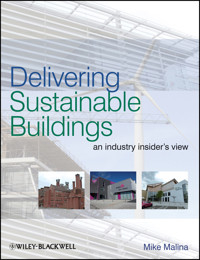
Delivering Sustainable Buildings: an industry insider’s view offers peer-to-peer insights and advice from a leading practitioner in this field and brings together in one book an overview of the main issues to consider when creating energy-efficient and sustainable buildings. A resource to dip into for practical advice, which is both highly readable and also backed up by in-depth technical knowledge, giving the important points to note and common pitfalls to avoid. Based on observations of an author with hands-on experience of dealing with the various elements of the building services engineering industry, the book gives a unique insight into the particular challenges faced by designers, project managers, contractors and installers working to deliver lower carbon and sustainable building projects and operation.
There is a lot of guidance on sustainable buildings available from reputable sources including BRE, CIBSE, B&ES, ECA and BSRIA. This book is different in that it speaks directly to contractors and practitioners, with practical messages dealing with real on-site challenges, offering practical advice based on experience. Many contractors are now faced with a business choice of offering services related to issues of the energy hierarchy, minimising energy use, providing good building automation and controls and then looking further at microgeneration/renewables. Here they must decide what technologies might be suitable for their businesses, as well as considering what level of training is required before they or their employees can start to work with these technologies.
Delivering Sustainable Buildings: an industry insider’s view will help specialist contractors and facilities managers understand sustainable buildings at the strategic level (legislation, finance, training) and then to offer practical advice on various aspects of sustainable buildings (water use, energy-efficient building services, commissioning and keeping the building maintained to optimum performance) to their clients.
Sie lesen das E-Book in den Legimi-Apps auf:
Seitenzahl: 454
Veröffentlichungsjahr: 2012
Ähnliche



















Contents
Foreword
Preface
About the book
About the author
Dedication
Glossary of abbreviations
Introduction
Early modelling and design (BIM)
Technologies and applications
1 Sustainability in the wider context
1 Making the right choices – the sustainability dilemma
Objectivity is the key
Rigorous standards and enforcement
Where will our energy come from in the future?
The leaky bucket!
2 Planning ahead – the role of planning authorities
A major influence?
Planning gain
The disconnect between building control and planning
The Merton rule
Training for planners and building control officers
Planning for the future
3 Legislative overview and meeting your legal obligations
Global targets and local actions
The European influence
Applying the EPBD in the UK
Continuous change – Part L 2010–2013–2016 and a new EPBD
Taking the energy performance of buildings to the next level
Legislation levels, change and enforcement – opinion
Joined-up government?
Looking forward
Enforcement
Some final thoughts
4 Paying for it – the finance question
Short-termism – damages sustainability
Funding for sustainable building projects
The cheapest kilowatt-hour is the one you never use!
What is the Green Deal?
2 Delivering sustainable buildings
5 Delivering an energy-efficient and sustainable building
The wider design process – BREEAM
Learning from the manufacturing and car industry
Designing for sustainable communities
Where is the electricity coming from?
Dynamic demand control
Looking ahead
6 Managing energy and reducing its use
Energy is too cheap
Energy use and carbon taxes
Energy management must be integrated
The energy management process
Data is everything
Training, communication and education
The development of energy ratings
7 Water – a forgotten issue
Water and energy inexorably linked
Management of water in building services
Grey water and rainwater harvesting
Water and pipework infrastructure
8 Putting it together – the contractor’s role
Giving contractors room to work
The soft landings process
Towards proactive contracting
A sustainable future for contractors
Waste
Water
Adding value and opportunity
9 Main plant and building services – HVAC systems
Fixed thinking – assigned to the past
System design and application
Choice of heating systems
Ventilation
Air conditioning and comfort cooling
Bringing it all together
10 Getting and keeping control – building energy management systems
BMS becomes BEMS and can save a lot more energy
Evaluating an existing BEMS
Degree day analysis
Defining good control strategies
Example control strategies
Upgrading the BEMS – the business case
Specifying a new BEMS
Continuous optimisation
The BEMS needs user involvement
11 Commissioning and handover for energy efficiency
What is commissioning?
The commissioning process
Regulations and standards for commissioning
12 Keeping it all going – the importance of maintenance to sustainability
Maintenance is fundamental
Is it worth the risk?
Thermal imaging – seeing in a different light
Application of thermal imaging to sustainable buildings
Linking sustainability and maintenance
3 The human element
13 The skills challenge
Resurgence of skills
Case study – East of England skills challenge
Manufacturers and trade associations – role in training and skills
The green deal – implication on skills
14 Changing behaviours
Behaviour, attitudes and perceptions
Convenience and resistance to change
Getting it right from the start
Getting the workforce on board
15 Putting my own house in order
I had a dream
Jack of all trades
Greenfield or brownfield
Architect and planner-talk to the planners
Specification, materials and construction
Skills and knowing your limitations
Mechanical and electrical
Sustainability dilemma
The future: improvement and continuous commissioning
16 Sharing our technology and expertise with the developed and developing world
The big picture
Sharing our expertise
What did the Romans do for us?
Business and exports
Conclusion – some big challenges ahead
Recommended reading
Advertisements
Index
This edition first published 2013© 2013 Mike Malina
Blackwell Publishing was acquired by John Wiley & Sons in February 2007. Blackwell’s publishing program has been merged with Wiley’s global Scientific, Technical and Medical business to form Wiley-Blackwell.
Registered OfficeJohn Wiley & Sons, Ltd, The Atrium, Southern Gate, Chichester, West Sussex, PO19 8SQ, UK
Editorial Offices9600 Garsington Road, Oxford, OX4 2DQ, UKThe Atrium, Southern Gate, Chichester, West Sussex, PO19 8SQ, UK2121 State Avenue, Ames, Iowa 50014-8300, USA
For details of our global editorial offices, for customer services and for information about how to apply for permission to reuse the copyright material in this book please see our website at www.wiley.com/wiley-blackwell.
The right of the author to be identified as the author of this work has been asserted in accordance with the UK Copyright, Designs and Patents Act 1988.
All rights reserved. No part of this publication may be reproduced, stored in a retrieval system, or transmitted, in any form or by any means, electronic, mechanical, photocopying, recording or otherwise, except as permitted by the UK Copyright, Designs and Patents Act 1988, without the prior permission of the publisher.
Designations used by companies to distinguish their products are often claimed as trademarks. All brand names and product names used in this book are trade names, service marks, trademarks or registered trademarks of their respective owners. The publisher is not associated with any product or vendor mentioned in this book.
Limit of Liability/Disclaimer of Warranty: While the publisher and author(s) have used their best efforts in preparing this book, they make no representations or warranties with respect to the accuracy or completeness of the contents of this book and specifically disclaim any implied warranties of merchantability or fitness for a particular purpose. It is sold on the understanding that the publisher is not engaged in rendering professional services and neither the publisher nor the author shall be liable for damages arising herefrom. If professional advice or other expert assistance is required, the services of a competent professional should be sought.
Library of Congress Cataloging-in-Publication Data
Malina, Mike.Delivering sustainable buildings / Mike Malina. p. cm. Includes bibliographical references and index.
ISBN 978-1-4051-9417-4 (pbk. : alk. paper) 1. Sustainable building–Design and construction. I. Title. TH880.M35 2013 690.028′6–dc23
2012027832
A catalogue record for this book is available from the British Library.
Wiley also publishes its books in a variety of electronic formats. Some content that appears in print may not be available in electronic books.
Cover images courtesy of Mike MalinaCover design by Sandra Heath
Foreword
It was by way of appreciating, in the 1980s, the dreadful consequences of manmade climate change that we soon came to realise that the real problems lay way beyond weather, and that solutions would require fundamental changes to the way we live on this planet. The title ‘sustainability’ was then coined, around the new millennium, as it seemed to encapsulate the basis for the changes needed. As building engineers, we quickly saw that the major responsibility for the problem lay with our product, with buildings producing over half of the ‘climate changing’ carbon emissions, using large quantities of raw materials and throwing away disproportionate amounts to waste. Put simply, we had to do more, much more, with less, far, far less.
The consequences of failure are beyond imagining, threatening the very existence of a future for mankind. We saw the new millennium as a time of ‘the calm before the storm’, a period having the ‘luxury’ of both the time and the money to plan, organise and invest cost-effectively in solutions and a new order of society. A decade on, and a clear sight of the looming storm is upon us, as greedy global financial activity has brought us to the verge of bankruptcy and we can only lament how little we’ve taken advantage of ‘the calm’, when we had the means to make progress, and how it’s now so much harder to do so, with higher costs and our economies in tatters.
Yet already it’s becoming clear that lessons have, even now, not been learned and solutions to economic woes are once again being sought through growth (a concept idolised too often in commercial circles), which solution is but an illusion when based, as it is, on more consumption. This is the very opposite of sustainability, where the solution comes via ‘creation’ through the capture of incoming energy and efficiency in its use, and its distribution for the good of everyone.
So it is that we now see money being printed, in billions, to enable more consumption and more wastage, while sustainability is being side-lined, with its ‘creative potential’ for real growth being sacrificed. Well, we homed-in, a decade ago, on what we had to do and now it’s crucial that we let nothing deter us from pursuing those objectives with the added help from more recent discoveries whose potential could help us catch up on lost time.
Scroll forward a decade and it should be inconceivable that a building would be engineered in any way that:
requires fossil fuel, or nuclear power, to keep it comfortable to be in (instead recovered heat should warm ventilating air and domestic hot water, insulation and airtightness eliminate fabric heat losses and minimise, with the aid of shading, unwanted gains)
does not have adequate day-lighting and efficient, effective lighting facilities
is not equipped with ‘super smart metering’ that automatically adjusts electrical demand to match the most efficient available supply
does not employ its facade and its surrounds to capture and convert the potential of solar energy – this ranges from the simplest warming from winter sunshine, through solar thermal panels for heating water and air, and on to PV for the electricity to power indoor appliances. Many, by then, should be producing considerably more energy than they have direct need of, enabling export and power for transportation. This will also come from employing plants or algae on, or in, the facades and surrounds (100 trillion watts are captured in flower nectar each year)
is not constructed from at least 50% recycled materials and fabricated in off-site factories as low wastage, pre-tested, modules ready for ‘plug-and-play’ assembly at site.
Having first met Mike at the CIBSE/ASHRAE conference in Edinburgh in 2003, I’ve witnessed and admired his enthusiasm and determination over the pursuit of sustainability for the engineering of buildings in particular. Now, with sustainability appreciated as an imperative for the future of mankind, the need for a host of ‘Mikes’ and the global dissemination of their message and knowhow, becomes paramount. His book gives us much to dwell on and also offers a great deal of useful advice on how to respond to the challenge.
Terry Wyatt,Past President CIBSE
Preface
Most worthwhile books are the product of a long period of reflection, often spanning many years. I can trace the journey that led to this work, which seeks to make a small contribution to bridging the gap between the wider issues of sustainability and the key role of sustainable building services engineering, back to my childhood. For many, the environmental and energy performance of the built environment and many of the services crucial to this process; such as pumps, fans and ductwork systems; is less well understood, and the immediate connections are not made to wider environmental and sustainability considerations. What often gets priority is finance and cost factors, which are important and are the primary drivers for many. For me, this attempt to bring together approaches to building services engineering with sustainability – without doubt, the most pressing challenge to face present and future generations – is the culmination of an eclectic range of interests which has shaped my career and life to date.
Given the importance of the subject matter, it seems strange to me that so little has so far been written with a holistic view of both the wider environmental links and sustainable building services engineering. Much has been written about ‘green issues’ and there is a veritable library of handbooks and texts on building services, but to the best of my knowledge this is the first full-length work devoted solely to bringing these important subjects together. There are many environmentalists, ecologists and ‘new sustainability experts’ as well as, of course, many building services engineers, but there are very few who cross the divide and work with both disciplines. Therefore, this process has been largely about bridging a chasm to make new connections, and the journey that brought me to do this started long ago.
It began with an early interest in earth sciences. Anything in, or under and above, the earth was a source of fascination to me. As a child, I would seize any opportunity to dig holes, explore new sites of interest or discover more about the world around me. This interest was always eclectic. I was as intrigued by soil composition – and the invertebrates that inhabited it – as I was by the constellations above us. Microscopic organisms were as absorbing as oak trees, and pebbles as intriguing as the stars. Geology and cosmology held equal sway.
Lesen Sie weiter in der vollständigen Ausgabe!
Lesen Sie weiter in der vollständigen Ausgabe!
Lesen Sie weiter in der vollständigen Ausgabe!
Lesen Sie weiter in der vollständigen Ausgabe!
Lesen Sie weiter in der vollständigen Ausgabe!
Lesen Sie weiter in der vollständigen Ausgabe!
Lesen Sie weiter in der vollständigen Ausgabe!
Lesen Sie weiter in der vollständigen Ausgabe!
Lesen Sie weiter in der vollständigen Ausgabe!
Lesen Sie weiter in der vollständigen Ausgabe!
Lesen Sie weiter in der vollständigen Ausgabe!
Lesen Sie weiter in der vollständigen Ausgabe!
Lesen Sie weiter in der vollständigen Ausgabe!
Lesen Sie weiter in der vollständigen Ausgabe!
Lesen Sie weiter in der vollständigen Ausgabe!
Lesen Sie weiter in der vollständigen Ausgabe!
Lesen Sie weiter in der vollständigen Ausgabe!
Lesen Sie weiter in der vollständigen Ausgabe!
Lesen Sie weiter in der vollständigen Ausgabe!
Lesen Sie weiter in der vollständigen Ausgabe!
Lesen Sie weiter in der vollständigen Ausgabe!
Lesen Sie weiter in der vollständigen Ausgabe!
Lesen Sie weiter in der vollständigen Ausgabe!
Lesen Sie weiter in der vollständigen Ausgabe!
Lesen Sie weiter in der vollständigen Ausgabe!
Lesen Sie weiter in der vollständigen Ausgabe!
Lesen Sie weiter in der vollständigen Ausgabe!
Lesen Sie weiter in der vollständigen Ausgabe!




